Every air fryer owner eventually faces the accessory wall — the racks, liners, pans and gadgets that promise to turn a good machine into a great one. Some of them genuinely do. The air fryer accessories market is now large enough to measure (about 240 million US dollars in 2026, per Future Market Insights figures in our research), and it splits cleanly into two camps: accessories that work with the machine’s one moving part — its hot, fast airflow — and accessories that quietly fight it. A rack that lifts food into the airstream makes dinner better. A solid liner that seals the basket floor can turn crisp fries pale. This guide ranks the six accessory types actually worth buying in Canada and the USA, states plainly what each one costs you in crispness or convenience, and starts from the picks in our main best air fryers in Canada and the USA guide — if you are still choosing the machine itself, start there and come back for the extras.
A seasonal note: accessories are the classic stocking-stuffer price bracket, and our Black Friday kitchen deals watchlist tracks which kitchen categories see real discounts this season — liners and racks are exactly the kind of small purchase worth timing.
Disclosure: CookSmartPicks is reader-supported. When you buy through links on this page, we may earn an Amazon commission at no extra cost to you. Prices and availability change often — check the current price on Amazon before you decide.
How we chose these accessories
CookSmartPicks is a research-based guide. We do not run a test lab, and we never claim hands-on testing we have not done. For this list we compared the accessory categories against manufacturer guidance for the machines in our air fryer guide, the accessory-market data in our 2026-11-14 keyword research (liners alone were a 287 million US dollars market in 2025, with North America holding 38% share), and the accumulated owner consensus in long-term reviews: which accessories get used weekly and which migrate to the back of a drawer. Two filters decided the ranking. First, airflow honesty — every pick states what it does to the air circulation the machine depends on. Second, fit discipline — accessories are sold by basket size, and the choosing section below explains how to measure yours before spending anything, because the most common accessory failure is not quality, it is a 8-inch liner in a 7-inch basket.
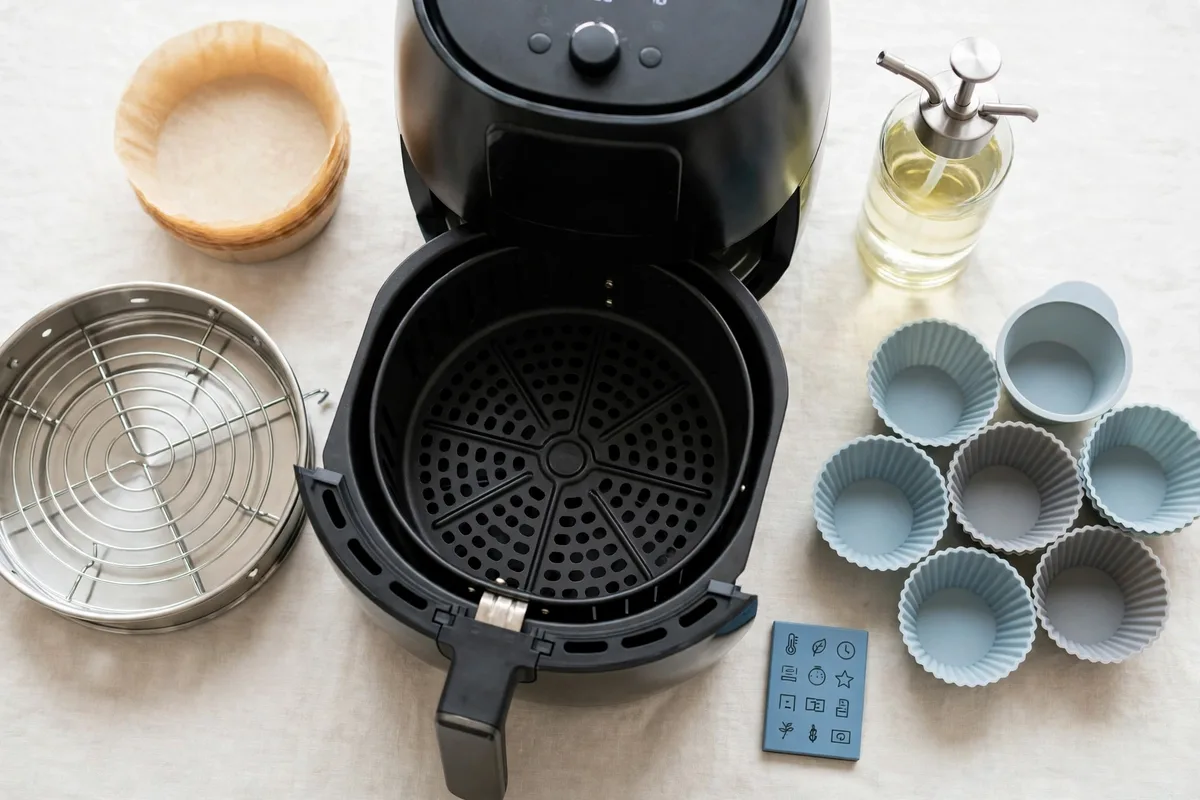
The lineup at a glance
| Accessory | Best for | Why it stands out |
|---|---|---|
| Disposable parchment liners | Easy clean-up | Perforated rounds that catch drips while letting air through — the basket stays clean |
| Reusable silicone liner pot | The reusable option | One washable pot replaces the liner habit for saucy foods, at a small crispness cost |
| Stainless rack & skewer set | Layering and kebabs | Raises food into the airflow and doubles cooking surface — the capacity upgrade |
| Magnetic cooking-times cheat sheet | The cheap upgrade | Times and temperatures for the foods you actually cook, on the fridge, forever |
| Glass oil sprayer | A light, even coating | A pump sprayer lays down the thin oil film that browning needs — without aerosol propellants |
| Silicone muffin cups & baking set | Baking in the basket | Eggs, muffins and reheats in portion-sized cups the basket was secretly built for |
1. Disposable Parchment Paper Liners — Best for easy clean-up
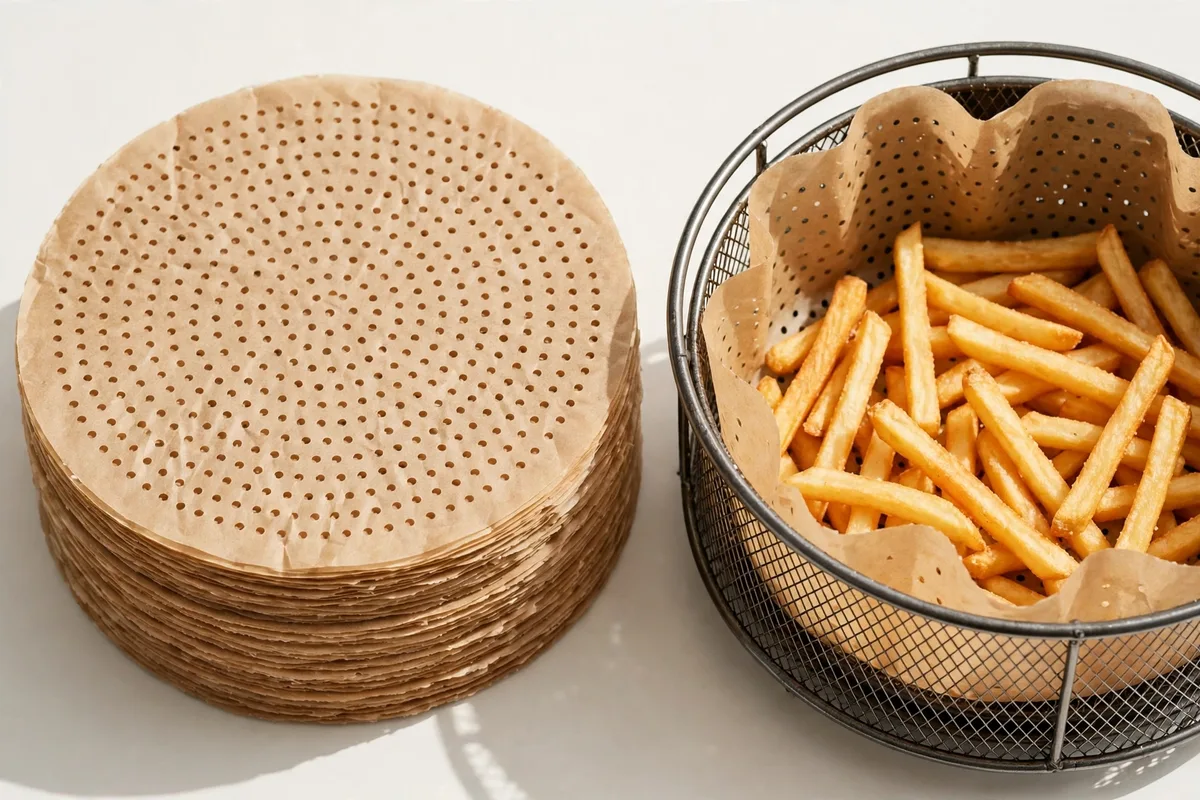
The liner is the accessory that sells the category: a perforated parchment round that sits in the basket, catches the drips and rendered fat, and lifts out afterwards so the basket needs a rinse instead of a scrub. The perforations are the whole design — they let hot air keep moving under the food, which is why proper air fryer liners outperform the solid baking parchment some owners cut to size. Buy them sized to your basket (they are sold by diameter, commonly 8 and 9 inch rounds and squares for dual-basket machines), pre-formed with a shallow wall so juices stay in the liner instead of under it. For sticky, marinated or cheese-covered food — the cooks that genuinely punish a basket — they turn a ten-minute cleanup into ten seconds.
Two honest cautions, and the first is a safety rule, not a preference: never preheat the fryer with an unweighted liner inside. A loose parchment round in an empty basket can lift in the fan’s airflow and touch the heating element — every reputable liner maker prints this warning, and it is the one line in this guide to treat as non-negotiable. Always load food first or with the liner. The second caution is crispness arithmetic: a liner catches fat that would otherwise drain away, so fries sit slightly closer to their own drippings. The difference is small and the cleanup saving is large, but purists cooking plain fries in a bare basket are not wrong either — which is why this is pick one for most people, not a commandment for everyone.
Yay · Pros
- The single biggest cleanup saving in the category — sticky cooks become a rinse
- Perforated designs keep air moving, unlike cut-to-size solid parchment
- Sold by basket size for single and dual-basket machines, in both countries
Hmm · Cons
- Must never be preheated unweighted — it can lift into the heating element
- Food sits closer to its drippings; bare-basket fries crisp marginally better
- A consumable habit — the cost and waste recur, which is the silicone pot’s opening
Best for: sticky-food households and anyone whose fryer use dropped because of the washing-up. Skip if: you cook mostly plain fries and vegetables and your basket already rinses clean in seconds.
2. Reusable Silicone Liner Pot — Best reusable option
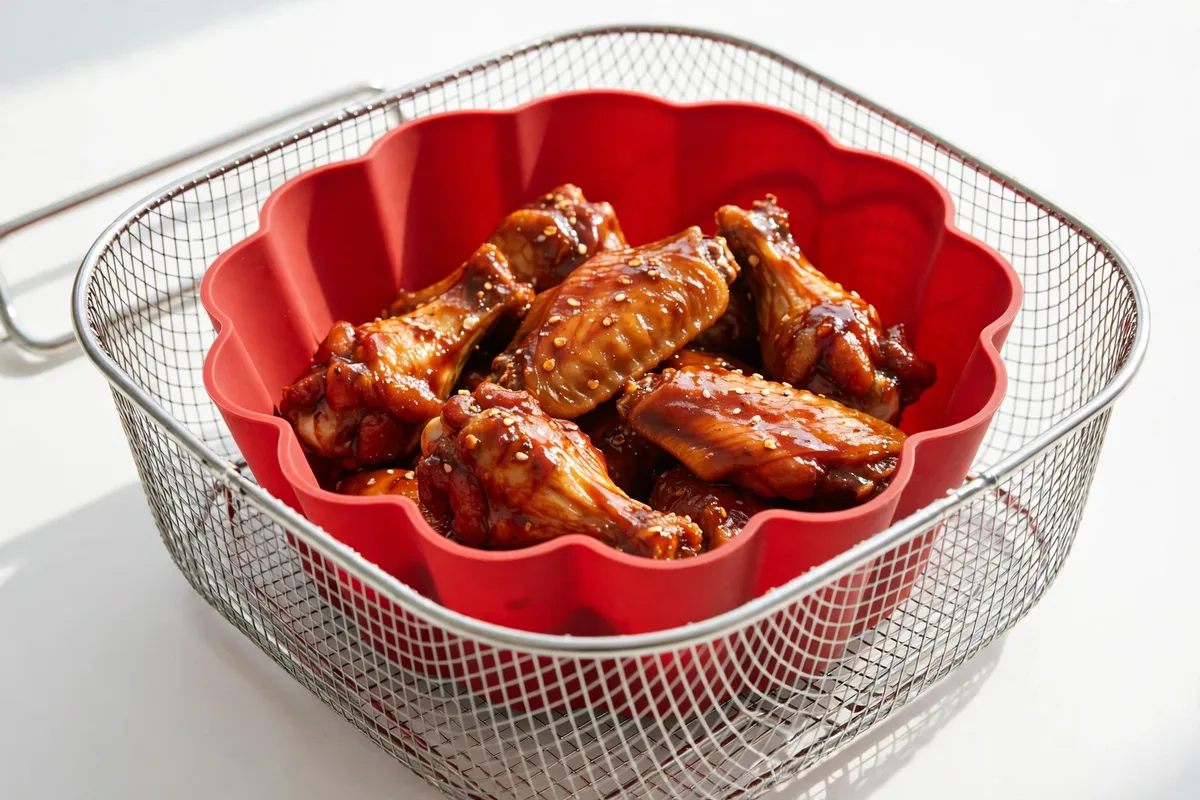
The silicone pot is the liner’s reusable answer: a flexible, dishwasher-safe basket-within-the-basket, usually with ribbed or raised feet, that contains sauces, marinades and melty cheese the way parchment cannot. Where a parchment round merely lines the floor, the pot’s walls hold liquid — it is the right tool for reheating saucy leftovers, cooking marinated wings without the marinade welding itself to the basket, or keeping a small portion together in a large machine. Silicone tolerates air fryer temperatures comfortably, releases food with a flex, and one pot replaces the liner habit for owners who dislike a recurring consumable. Measure your basket before ordering: pots are sold by top diameter and the fit should be snug, not forced.
The trade-off is the one this guide keeps returning to: walls block air. A silicone pot encloses food on five sides, so the underside steams more than it crisps, and foods whose whole point is all-over crunch — fries, wings cooked for skin — come out a step softer than in the bare basket. Experienced owners use the pot selectively: saucy and reheaty jobs in the pot, crisping jobs bare or on the rack below. Used that way it is not a compromise, it is a second cooking vessel your machine did not ship with. Buy one with raised ribs or feet rather than a flat floor — the small air gap underneath is worth having.
Yay · Pros
- Reusable and dishwasher-safe — ends the consumable liner habit
- Walls contain sauces and marinades that defeat flat parchment
- Doubles as a reheating vessel for leftovers in big baskets
Hmm · Cons
- Enclosed sides soften crisping — not the tool for fries or wing skin
- Fit is unforgiving: measure the basket and match the stated diameter
- Cheap unbranded silicone varies in quality — buy food-grade from a named maker
Best for: saucy-food cooks, leftover reheaters, and anyone avoiding a recurring liner purchase. Skip if: your cooking is mostly crisping — the rack and bare basket serve you better.
3. Stainless Steel Rack & Skewer Set — Best for layering and kebabs
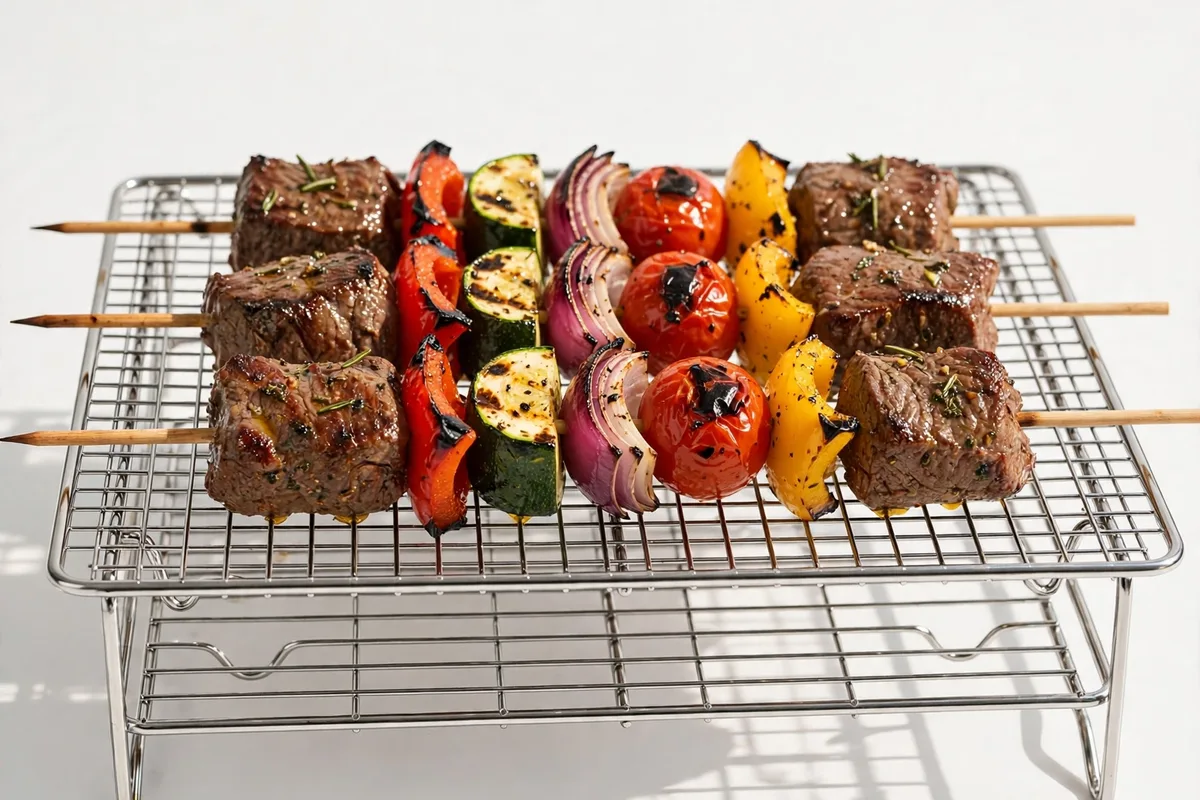
If one accessory deserves the word upgrade, it is the rack. A stainless steel rack stands food up inside the basket — a second storey in the airflow — which does two things at once: it roughly doubles the cooking surface for flat foods like jerky strips, bacon and dehydrated fruit, and it lifts items like chops and chicken pieces off the basket floor so hot air reaches the underside without a mid-cook flip doing all the work. The skewer sets sold alongside racks turn the fryer into a small kebab grill: threaded skewers rest across the rack, drip into the basket, and cook evenly in the moving air. For dual-basket owners, a rack per basket is the closest thing to a capacity doubling that does not involve buying a bigger machine — and our dual-basket air fryers guide shows which machines have the headroom to use one well.
The cautions are geometric. Headroom is the limit: a rack plus food must clear the heating element with margin, so measure basket depth before buying, especially in compact machines (owners of the small machines in our small air fryers guide should check twice). Stacked food also cooks unevenly by layer — the top layer, closer to the element, finishes first — so plan a mid-cook swap for thick items rather than treating the rack as set-and-forget. And stainless quality matters: thin racks warp and their welds rust in dishwashers; a rack that feels substantial in the hand is the one that survives the year.
Yay · Pros
- The only accessory that adds real capacity — a second layer in the airflow
- Lifts food off the floor for more even cooking with fewer flips
- Skewers turn the fryer into a kebab and jerky machine
Hmm · Cons
- Needs headroom — compact baskets may not clear the element safely
- Layers cook at different rates; thick items still need a mid-cook swap
- Thin racks warp and rust — buy substantial stainless, not the thinnest set
Best for: jerky makers, kebab fans, and dual-basket households cooking for a crowd. Skip if: compact-machine owners without the headroom, or anyone who never fills the basket they have.
4. Magnetic Air Fryer Cooking Times Cheat Sheet — Best cheap upgrade
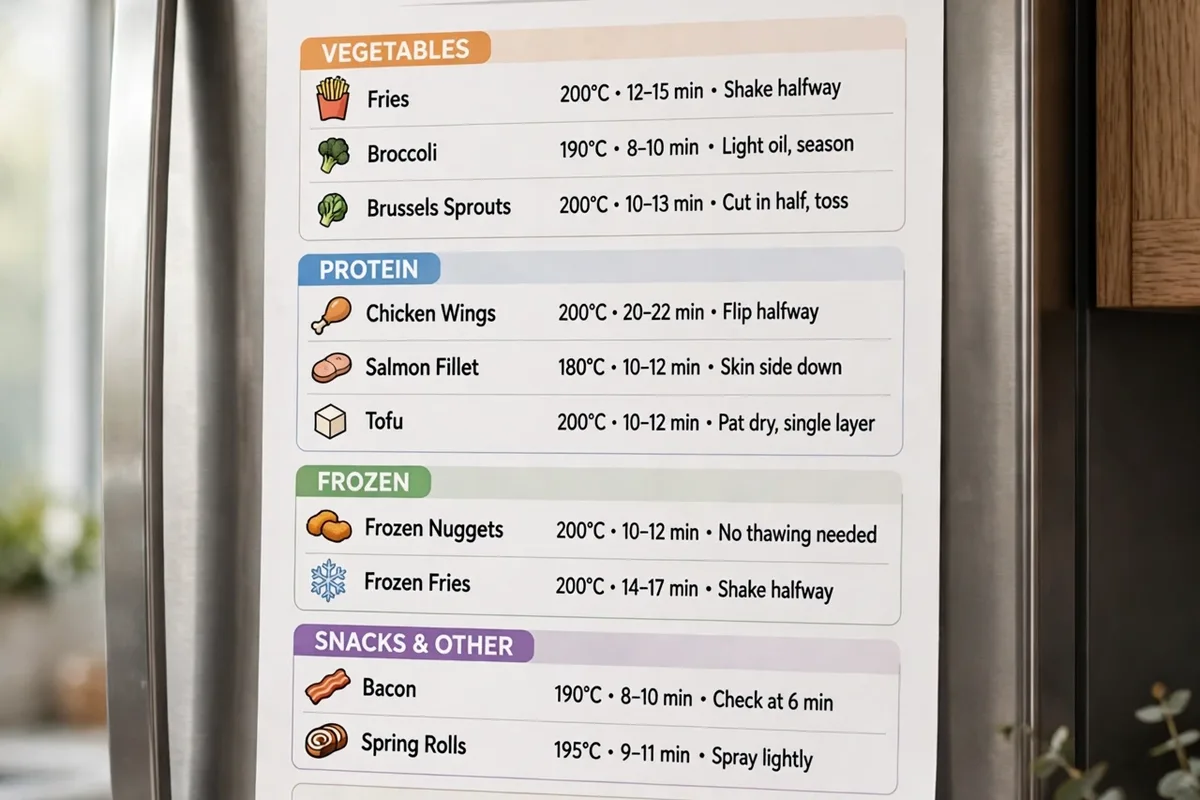
The cheat sheet is the least glamorous accessory on this page and, week for week, possibly the most used: a fridge magnet printed with cooking times and temperatures for the foods people actually air fry — fries, wings, salmon, vegetables, reheats — in both Fahrenheit and Celsius on the better versions, which matters in Canadian kitchens where recipes arrive in both. It removes the two frictions that quietly reduce fryer use: the phone-with-floury-hands search for "how long for salmon again", and the Celsius conversion arithmetic. The good ones are large-print, waterproof-surfaced, and organised by food rather than by marketing. It is also the safest gift on this list: it fits every machine ever made.
Set expectations correctly and it will not disappoint. A magnet is a starting point, not gospel — thickness, starting temperature and your machine’s temperament all move the real number, and the sheet cannot know your salmon fillet is an inch thicker than standard. Treat its times as the first check, not the finish line, and pair it with the one tool no accessory replaces, a probe thermometer for meats. Within those limits it earns its fridge space in the first week.
Yay · Pros
- Removes the daily time-and-temperature search — the friction that reduces fryer use
- Better versions print Fahrenheit and Celsius side by side
- Fits every machine; the universal, zero-risk gift on this list
Hmm · Cons
- Times are starting points — thickness and machine temperament still rule
- No substitute for a probe thermometer on meats
- Print quality varies; choose large-print, waterproof versions
Best for: every owner, honestly — and anyone buying a small, safe gift for one. Skip if: nobody, at this price bracket; skip only if your machine’s presets already cover your whole repertoire.
5. Glass Oil Sprayer — Best for a light, even coating
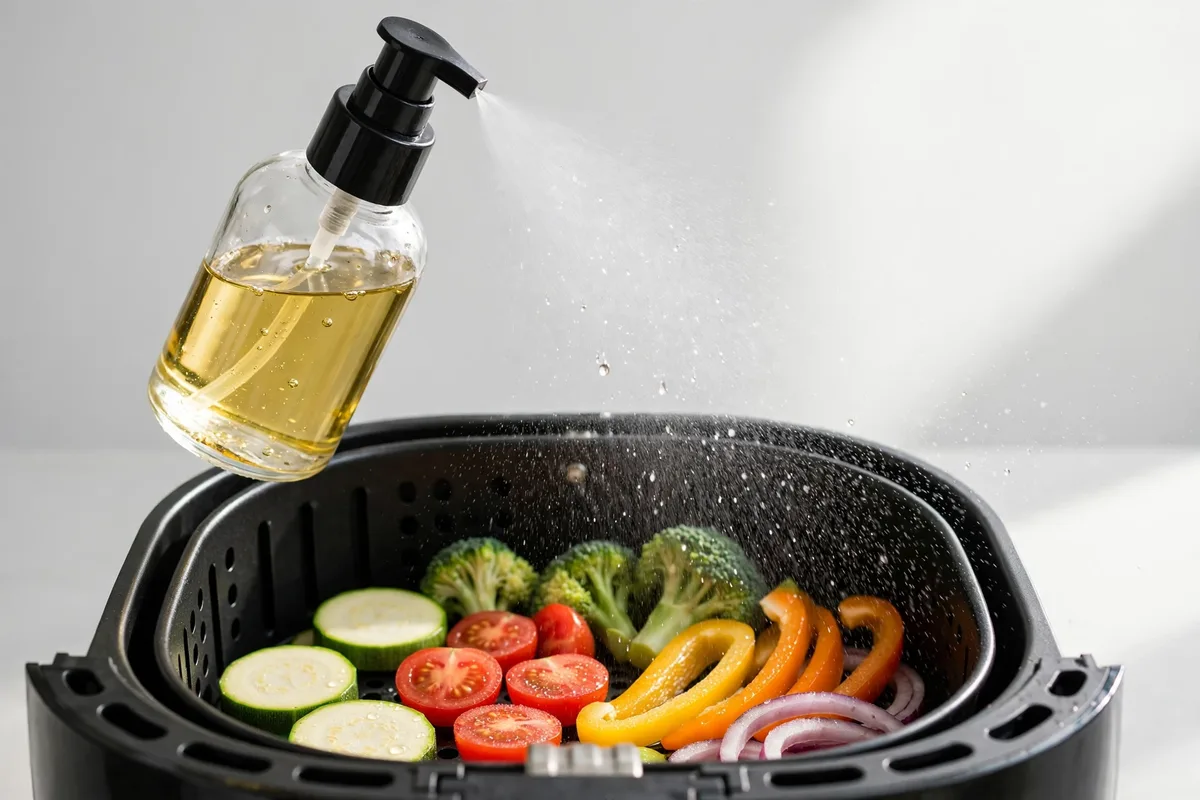
Air frying’s central paradox is that the machine cooks with air but browns with oil — a whisper of it, evenly spread. A pump-action oil sprayer is how you lay that whisper down: a fine mist over fries, vegetables or breaded coatings that promotes browning and helps seasonings stick, at a fraction of the oil of tossing in a bowl. Glass-bodied sprayers are the pick over plastic — they handle oils without staining or holding flavours, clean properly, and the pump mechanisms on the better models produce a fan of mist rather than a squirt-gun stream. Fill with a neutral high-heat oil, spray from a hand’s height, and the coating lands where it should.
The sprayer also solves a coating problem owners rarely hear about: aerosol cooking sprays — the canned kind — carry propellants and additives that manufacturers of nonstick baskets widely advise against, because residue builds into a stubborn film on the coating over time. A refillable pump sprayer holds pure oil and nothing else, which is why it appears in so much long-term owner advice. Its own maintenance is simple but real: run warm water through the nozzle occasionally, because oil left sitting in a fine pump eventually thickens. Do that, and one sprayer outlasts a shelf of aerosol cans.
Yay · Pros
- The thin, even oil film that browning actually needs — without drowning food
- Pure oil only: avoids the aerosol propellants that build film on nonstick baskets
- Glass body cleans properly and does not hold flavours
Hmm · Cons
- Nozzle needs an occasional warm-water flush — oil thickens in fine pumps
- Cheap pumps squirt instead of misting; the spray pattern is the product
- One more small thing to store beside the machine
Best for: anyone whose fries brown unevenly, and every nonstick-basket owner still using canned spray. Skip if: you cook almost nothing that needs oil — some vegetable-only households genuinely do not.
6. Silicone Muffin Cups & Baking Pan Set — Best for baking in the basket
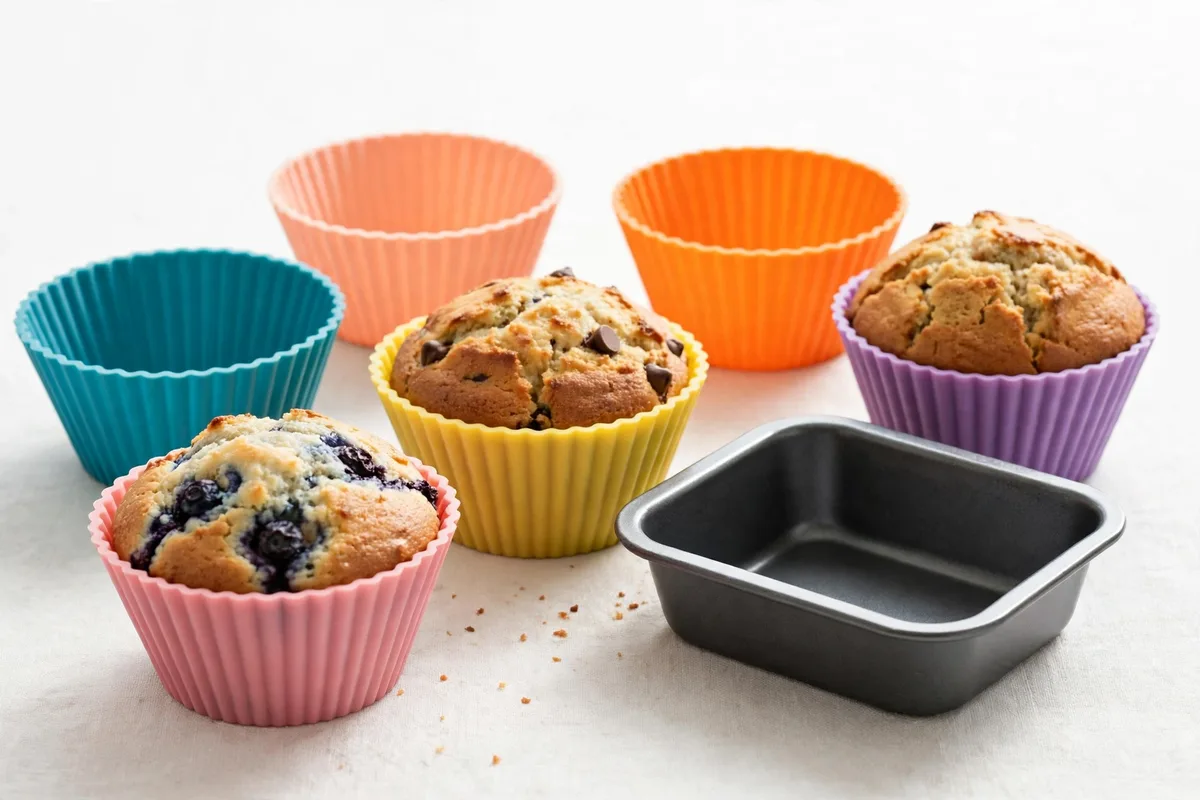
The last pick opens the fryer’s second career: baking. Individual silicone muffin cups portion egg bites, muffins, mini frittatas and frozen desserts directly in the basket — no batter tin to balance, no single large pan to fit — and they release with a flex and wash in the dishwasher. Paired in most sets with a small nonstick baking or pizza pan sized for common baskets, they cover the reheating jobs too: a slice of leftover pizza or a portion of lasagna reheats in the pan without drying the way a microwave leaves it or heating a whole oven for one serving. For small households — the singles and couples our air fryer guide’s compact picks serve — this set is often the difference between a fryer used for dinner and a fryer used for everything.
The limits are batch size and rise. Cups cook in small batches — six cups is a typical basket load — so this is portion baking, not family-scale cake production, and batters rise less evenly than in a still oven because the fan moves the surface; fill cups a little less than oven habit suggests. Silicone quality matters here as with the liner pot: food-grade cups from a named maker, rated comfortably above your machine’s maximum temperature. Within those honest bounds, it is the accessory set owners report reaching for long after the novelty gadgets are forgotten.
Yay · Pros
- Unlocks baking and eggs in the fryer — portion-sized, dishwasher-easy
- The paired pan reheats single servings without heating a whole oven
- Small households get the most: dinner-for-one and dinner-for-two territory
Hmm · Cons
- Small batches only — not family-scale baking
- Batters rise less evenly under a fan; fill cups conservatively
- Buy food-grade silicone rated above your machine’s top temperature
Best for: small households, egg-bite makers, and anyone reheating single servings often. Skip if: you bake at family scale in a real oven and rarely reheat single portions.
Measure first: the two-minute fit check
More accessory purchases fail on fit than on quality, so do this before ordering anything above. Diameter: measure the inside of your basket at its widest cooking surface — the floor, not the rim — and buy liners, pots and pans at or just under that number. Depth and headroom: measure from the basket floor to the lowest point of the heating element with the basket closed; a rack plus the food on it must clear that line with room for air to move. Shape: square baskets (most dual-basket and oven-style machines) take square liners; round basket machines waste corners with them. Model check: the machine’s manual or maker’s page lists its own accessory sizes — our main air fryer guide links each pick’s maker, and two minutes there beats a return label. Sizes are sold in inches across both countries, so no conversion traps — just measure the floor, not the rim.
Air fryer accessory questions, answered
Do liners stop food from getting crispy?
Slightly, and it depends on the liner. Perforated parchment costs the least crispness because air still moves through the holes; a solid silicone pot costs the most because it encloses the food. The practical rule from long-term owner experience: crisping jobs (fries, wings, anything breaded) go bare or on a rack, saucy and reheating jobs go in liners and pots. Used that way, liners do not ruin crisp food — they simply never touch it.
Can parchment liners catch fire in an air fryer?
They can if they touch the heating element, which is why the rule is absolute: never preheat with an unweighted liner inside, and never let a liner extend up the basket walls into the element’s reach. Weighted down with food and sized to the basket floor, parchment is well within its temperature rating in normal air fryer use. The accidents in owner reports share the same setup — an empty preheat and a loose sheet. Do not run that setup.
Why do people say not to use canned cooking spray on air fryer baskets?
Because of what else is in the can. Aerosol sprays carry propellants and emulsifiers that bake into a sticky film on nonstick coatings over repeated use — basket makers widely advise against them for exactly this reason. A refillable pump sprayer (pick 5 above) applies pure oil with no additives, which is why it is the standard long-term recommendation.
What is the one accessory to buy first?
For most households, the parchment liners — they remove the cleanup friction that quietly kills fryer habits, and they cost the least to try. If your pain point is capacity rather than cleanup, start with the rack instead. The cheat sheet is the universal second purchase: it costs little, fits everything, and gets looked at daily.
The short version
Start with the parchment liners for clean-up and the rack and skewer set for capacity — those two change daily cooking the most. Add the silicone pot if your cooking leans saucy, the oil sprayer if your fries brown unevenly or you are still using canned spray, the cheat sheet magnet because it costs little and works forever, and the muffin cup set when you are ready to bake in the basket. And hold the line this guide opened with: accessories that lift food into the airflow help; accessories that seal it away from the airflow are for sauces and reheats only. Measure your basket floor before you buy any of it, and every pick here will fit the machine you already own.
Last updated: November 15, 2026. We refresh this guide each season and whenever a pick is replaced by a better one.