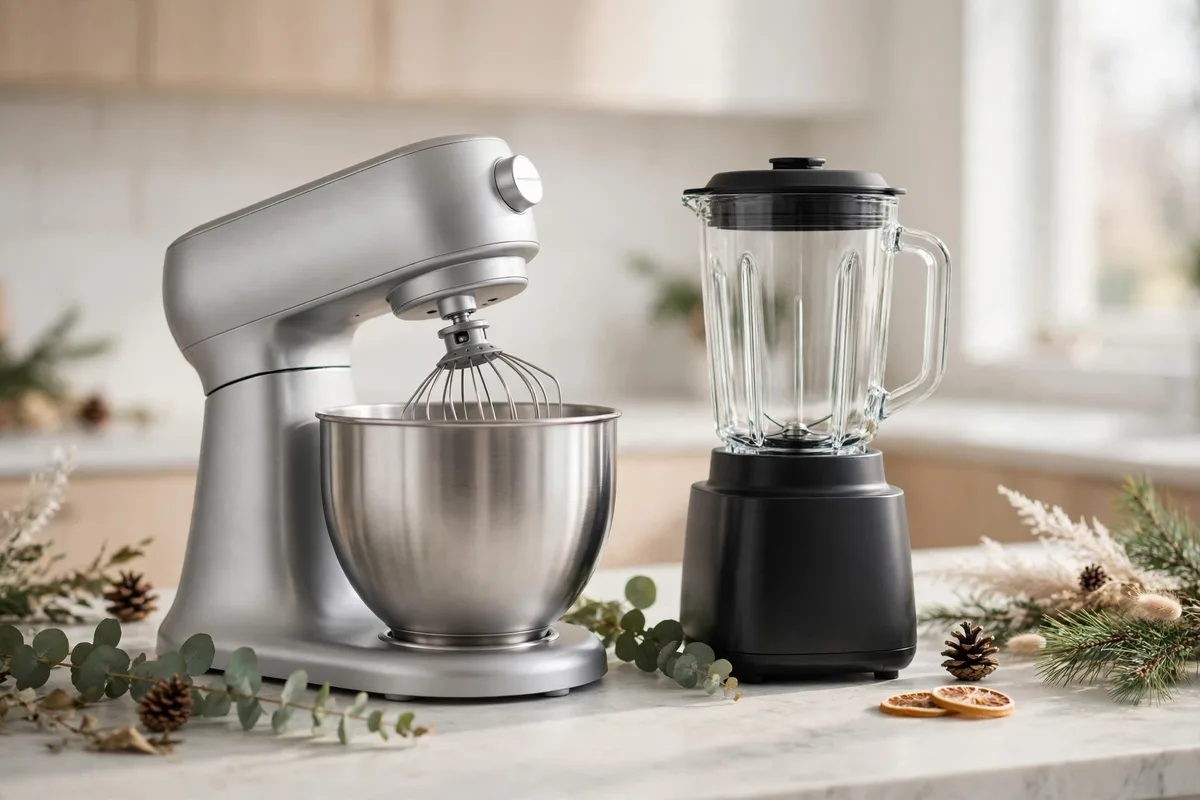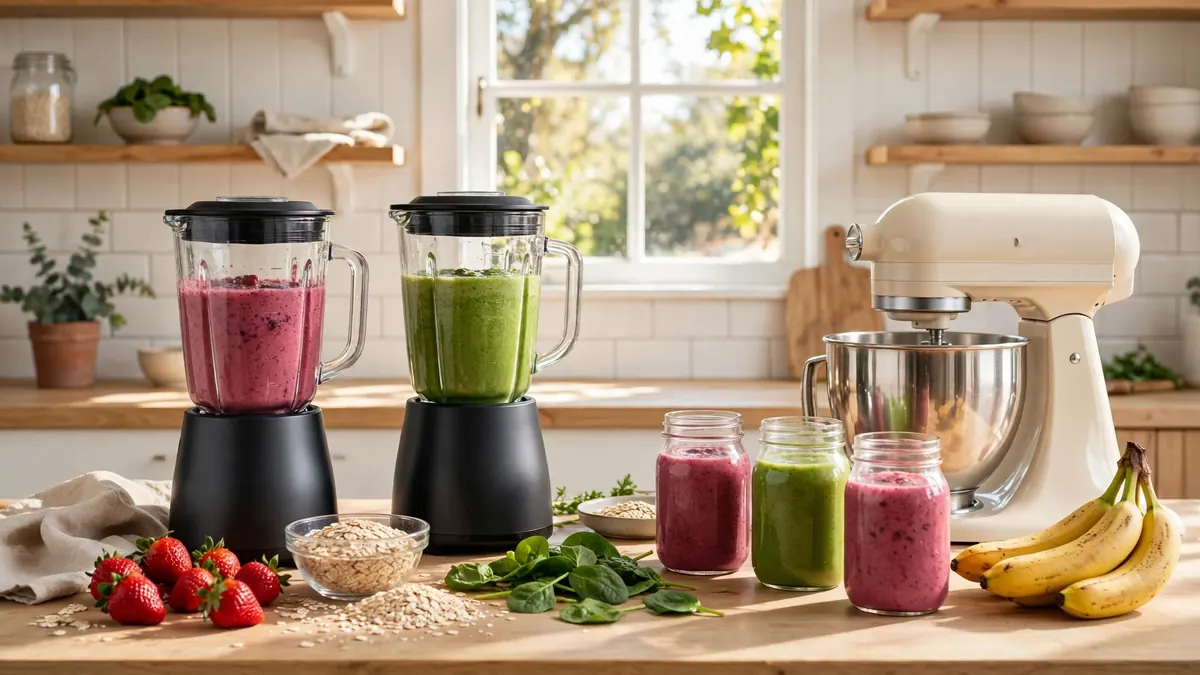
A great blender and a great stand mixer are the two hardest-working motors in a kitchen. The blender handles the daily rhythm — smoothies that are actually smooth, crushed ice, nut butters, soups and sauces — while the stand mixer takes over the heavy labour of baking: kneading dough, whipping cream and creaming butter without tiring your arm. Both categories have sharpened up recently, with auto-sensing blender programs that adjust themselves mid-blend and stand mixers that can fold ingredients at half speed.
We built this list from the hands-on testing and published findings of RTINGS, TechGearLab, Serious Eats, Wirecutter, America’s Test Kitchen and Good Housekeeping, cross-checked against manufacturer specifications and current Canadian and US availability. Where an expert source publishes a numerical score for an exact model, we show it under that product with the source named. Short on time? The Vitamix Ascent X2 is the best blender for most people, the KitchenAid Artisan Series 5 is the stand mixer benchmark, and the Ninja Professional BL610 proves a tight budget can still crush ice properly.
Disclosure: CookSmartPicks is reader-supported. When you buy through links on this page, we may earn an Amazon commission at no extra cost to you. Prices and availability change often — check the current price on Amazon before you decide.
Our Top Picks at a Glance
- Vitamix Ascent X2 — Best Overall Blender
- Ninja Detect Duo Power Blender Pro (TB301) — Best Smart Blender
- Vitamix Ascent X5 — Best Premium Smart Blender
- Vitamix 5200 — Best Manual-Control Blender
- Ninja Professional Blender (BL610) — Best Budget Full-Size Blender
- NutriBullet Blender Combo 1200 — Best Blender Combo Value
- KitchenAid Artisan Series 5 Tilt-Head Stand Mixer, 5-Quart — Best Stand Mixer Overall
- KitchenAid 5.5-Quart Bowl-Lift Stand Mixer — Best for Bread and Big Batches
- Cuisinart Precision Master 5.5-Quart Stand Mixer — Best Budget Stand Mixer
- Ankarsrum Assistent Original — Best for Serious Bread Bakers
1. Vitamix Ascent X2 — Best Overall Blender
The Ascent X2 is the sweet spot of Vitamix’s current line: the full high-performance blending the brand is famous for, plus the modern conveniences of the Ascent X series. Five automatic programs driven by BlendSense-style sensing adjust speed and time as the blend changes, SELF-DETECT recognizes which container is attached, and a digital timer and tamper indicator take the guesswork out of thick mixtures. RTINGS found it excellent with fibrous greens — the test that separates great blenders from good ones — and TechGearLab scored it at the top of their blender testing. The 48-oz container suits households of two to four, and the 10-year warranty is the best in the business.
Yay · Pros
- Superb results with smoothies, fibrous greens, nut butters and hot soup
- Auto programs, digital timer and tamper indicator make it nearly foolproof
- SELF-DETECT containers unlock personal-cup and food-processing attachments
- 10-year full warranty — the strongest coverage here
Hmm · Cons
- 48-oz jar is small for big families and entertaining batches
- Premium pricing, and extra containers cost extra
- Still loud at full power, like every high-performance blender
Check Price on Amazon.ca Check Price on Amazon.com
2. Ninja Detect Duo Power Blender Pro (TB301) — Best Smart Blender
The Detect Duo is Ninja’s answer to the set-and-forget blender. Its BlendSense technology senses the ingredients and automatically adjusts speed and time, so a smoothie cycle adapts instead of blindly following a timer. Power is not a problem — 1700 peak watts drive a 72-oz full-size pitcher for family batches, and the Duo package adds a 24-oz personal cup for single servings and travel lids. Ten manual speeds plus pulse keep hands-on control available when you want it. Tom’s Guide’s reviewers praised the BlendSense results on smoothies and frozen drinks, making this the smart pick for households that blend daily and want the machine to do the thinking.
Yay · Pros
- BlendSense auto-adjusts speed and time to the ingredients
- 1700 peak watts with a big 72-oz pitcher for family-size batches
- Includes a personal blending cup for single servings
- Strong ice-crushing and frozen-drink performance
Hmm · Cons
- Very loud at full power
- Bulky base and tall pitcher need storage space
- Auto mode occasionally needs a manual second cycle for very fibrous loads
Check Price on Amazon.ca Check Price on Amazon.com
3. Vitamix Ascent X5 — Best Premium Smart Blender
The X5 is Vitamix’s flagship: everything the X2 does, wrapped in a stainless-steel-finished base with the full library of 11 automatic programs — smoothies, frozen desserts, hot soup, nut butter, non-dairy milk, spice grinding and more. The display tells you exactly when to use the tamper during certain cycles, a small detail that makes thick blends noticeably easier. RTINGS calls it the best Vitamix they have tested, with top multi-purpose marks and an exceptional build, backed by the same 10-year warranty. If you blend every day and want the machine that removes every excuse, this is it — just note the 48-oz jar, which suits quality over quantity.
Yay · Pros
- RTINGS’ best-tested Vitamix, with top marks across their test suite
- 11 automatic programs, including nut butter and spice grinding
- Stainless-wrapped base and the most informative display in the line
- 10-year full warranty
Hmm · Cons
- The most expensive blender on this list
- 48-oz jar limits single-batch size for crowds
- Several programs overlap what the cheaper X2 already does well
Check Price on Amazon.ca Check Price on Amazon.com
4. Vitamix 5200 — Best Manual-Control Blender
The 5200 is the original Vitamix formula, essentially unchanged because it works: a big variable-speed dial, a High switch, a tall 64-oz classic container, and laser-cut stainless blades that pull ingredients down into a vortex few rivals match. There are no programs and no touchscreen — you are the program — and generations of chefs and smoothie shops have preferred exactly that control. It self-cleans with warm water and a drop of soap, handles hot soup and frozen desserts, and RTINGS still scores its multi-purpose blending near the top of everything they test. One practical note: the tall jar may not fit under low kitchen cabinets, so measure before ordering.
Yay · Pros
- Full manual control with a simple, repairable-feeling design
- 64-oz classic jar handles family-size batches
- Legendary durability and a decades-long track record
- Excellent with fibrous ingredients, soups and frozen desserts
Hmm · Cons
- Tall profile may not fit under standard cabinets
- No presets, timer or display
- Loud, and the tamper is needed for thick mixtures
Check Price on Amazon.ca Check Price on Amazon.com
5. Ninja Professional Blender (BL610) — Best Budget Full-Size Blender
The BL610 has been the budget benchmark for years, and the recipe is simple: a 1000-watt motor, stacked Total Crushing blades, and a big 72-oz pitcher that turns ice into snow faster than blenders costing several times more. Frozen drinks, smoothie bowls and salsa are its home turf, and the pitcher, lid and blades are dishwasher-safe. TechGearLab’s testing confirms both halves of its reputation — genuinely strong crushing power for the price, with less polish on fibrous greens than a Vitamix. If your blending life is smoothies and margaritas rather than kale and nut butter, this is the value pick.
Yay · Pros
- Outstanding ice-crushing power for a budget blender
- Huge 72-oz pitcher suits families and parties
- Simple three-speed controls plus pulse — nothing to learn
- Dishwasher-safe parts and easy cleanup
Hmm · Cons
- Fibrous greens come out less silky than with premium blenders
- Loud, with a lightweight plastic pitcher
- No personal cup or auto programs
Check Price on Amazon.ca Check Price on Amazon.com
6. NutriBullet Blender Combo 1200 — Best Blender Combo Value
The Blender Combo is the flexible middle ground: a 1200-watt base that drives both a 64-oz pitcher for family batches and sealed personal cups (32-oz and 24-oz) with an Extract program designed to break down whole fruits, vegetables and seeds for smoothies. Swap the vessel, keep the base — counter clutter stays low. TechGearLab scored it solidly in the middle of their blender field, which matches its positioning: not a Vitamix rival for nut butter or hot soup, but a genuinely capable daily smoothie system at a combo price. Note the personal cups are for cold blending only; hot liquids belong in the vented pitcher.
Yay · Pros
- Full-size pitcher plus personal cups on one base
- Dedicated Extract program for nutrient-style smoothies
- 1200 watts handles ice and frozen fruit with ease
- Compact footprint for smaller kitchens
Hmm · Cons
- Sealed cups are not for hot liquids
- Not built for nut butters or heavy daily punishment like a Vitamix
- Base is wipe-clean only
Check Price on Amazon.ca Check Price on Amazon.com
7. KitchenAid Artisan Series 5 Tilt-Head Stand Mixer, 5-Quart — Best Stand Mixer Overall
The Artisan is the stand mixer other stand mixers are measured against. Its planetary mixing action touches 59 points around the bowl for thorough incorporation, the 10-speed all-metal drive handles everything from a gentle stir to fast whipping, and the tilt-head design makes swapping the flat beater, dough hook and wire whisk a two-second job. TechGearLab made it their best overall stand mixer with the highest score in their testing, noting near-perfect whipping and kneading marks. Add the front attachment hub — pasta rollers, grinders, ice cream makers and dozens more — and a colour range no rival matches, and it is the mixer most households will happily keep for decades.
Yay · Pros
- TechGearLab’s best overall stand mixer, with excellent whipping and kneading
- 59-point planetary mixing for thorough, even results
- The largest attachment ecosystem of any mixer, via the power hub
- Huge colour range and a 5-quart bowl sized for most home baking
Hmm · Cons
- Tilt-head can rock slightly under very stiff dough loads
- Attachments beyond the core three are sold separately
- Heavy to move in and out of a cupboard — it earns a permanent counter spot
Check Price on Amazon.ca Check Price on Amazon.com
8. KitchenAid 5.5-Quart Bowl-Lift Stand Mixer — Best for Bread and Big Batches
When the baking gets serious — double batches of bread dough, big cookie runs, holiday volume — the bowl-lift design is the professional answer. Instead of tilting, the head stays fixed and the bowl cranks up into the beater, which keeps the machine stable and planted under heavy, stiff loads. This 5.5-quart model adds 11 speeds, including a half-speed fold setting gentle enough for folding berries into batter, and KitchenAid rates it to mix up to 11 dozen cookies in a single batch. Serious Eats and America’s Test Kitchen both favour bowl-lift KitchenAids for bread bakers, and the all-metal construction is built for exactly that workload.
Yay · Pros
- Bowl-lift stability excels with stiff bread and pizza dough
- 11 speeds with a half-speed fold for delicate work
- Large 5.5-quart bowl handles double batches
- Same attachment hub as the Artisan for pasta, grinding and more
Hmm · Cons
- Taller profile — check clearance under your cabinets
- Heavier and less colour choice than the Artisan
- Bowl removal is a touch less convenient than a tilt-head for casual use
Check Price on Amazon.ca Check Price on Amazon.com
9. Cuisinart Precision Master 5.5-Quart Stand Mixer — Best Budget Stand Mixer
The Precision Master is the sensible way into stand mixing without the premium badge. A 500-watt motor and 12 speeds give it more speed range than the KitchenAids here, the die-cast metal body feels a class above its price, and the 5.5-quart stainless bowl, chef’s whisk, dough hook, flat paddle and splash guard are all in the box. It handles cakes, cookies, whipped cream and moderate doughs with confidence, and its tilt-back head keeps access simple. Good Housekeeping rates it among the best budget stand mixers; the honest limit is very stiff dough, where its lighter frame can walk a little on the counter — a damp towel underneath fixes most of it.
Yay · Pros
- Stand-mixer essentials at a genuinely accessible price
- 500 watts and 12 speeds — the widest speed range here
- Die-cast body, 5.5-quart bowl and splash guard included
- Compact footprint for a full-size mixer
Hmm · Cons
- Can walk on the counter with very stiff dough
- Smaller attachment ecosystem than KitchenAid
- Less low-speed finesse for delicate folding
Check Price on Amazon.ca Check Price on Amazon.com
10. Ankarsrum Assistent Original — Best for Serious Bread Bakers
The Ankarsrum is built like nothing else on this list: instead of a beater moving in a fixed bowl, its 7-litre stainless bowl rotates while a dough roller and self-adjusting scraper knead against it — a design Swedish bakers have sworn by for decades, and one that handles up to about 5 kg of dough without strain. A powerful 1500-watt motor, a continuous speed dial and a timer suit long, slow dough development, and an extensive attachment system turns it into a full kitchen machine. Serious Eats and dedicated bread communities consistently rank it at or near the top for dough specifically. It asks for a learning curve and a serious budget, but for high-volume bread it is in a class of its own.
Yay · Pros
- Unmatched dough capacity — up to roughly 5 kg in the 7-litre bowl
- Rotating-bowl design kneads gently and thoroughly without overheating dough
- Powerful motor with timer, made in Sweden
- Extensive optional attachments, from grain mill to pasta rollers
Hmm · Cons
- Premium pricing — the most expensive mixer here
- Technique differs from planetary mixers; expect a learning curve
- Large footprint, and attachments add significantly to the cost
Check Price on Amazon.ca Check Price on Amazon.com
How to Choose the Right Blender or Stand Mixer
For blenders, match the machine to the ingredient
Ice and frozen drinks are easy — even the budget Ninja BL610 excels there. The real tests are fibrous greens, nut butters and hot soup: those need a high-performance machine with a tamper and a jar designed to fold ingredients back into the blades, which is Vitamix territory. If your blending is 90% smoothies for one, a combo system like the NutriBullet saves money and counter space.
Jar size and height matter more than wattage claims
Peak-watt numbers are marketing; jar geometry and blade design decide results. Do check two practical things: capacity (48 oz is plenty for two to four servings; 64–72 oz suits families) and total height — tall jars like the Vitamix 5200’s may not fit under standard upper cabinets, which decides whether the blender lives on the counter or in a cupboard.
For stand mixers, choose tilt-head or bowl-lift by dough
Casual and varied baking — cakes, cookies, occasional bread — is tilt-head territory: the Artisan is easier to live with day to day. Frequent or stiff bread dough, double batches and big holiday runs favour a bowl-lift’s stability, or the Ankarsrum’s rotating bowl if bread is truly the main event. Also weigh the attachment ecosystem: KitchenAid’s hub is the deepest, which matters if pasta or grinding is in your future.
Buy the warranty, not just the machine
These are decade-scale purchases. Vitamix’s 10-year coverage and KitchenAid’s service network are real parts of their value, and a cheap blender replaced three times costs more than a good one bought once. Check that the brand sells replacement jars, beaters and seals in your country before you commit.
Frequently Asked Questions
Is a Vitamix really worth it over a Ninja or NutriBullet?
It depends on what you blend. For smoothies and frozen drinks, mid-range machines get you most of the way for far less money. The Vitamix difference shows up with fibrous greens (no flecks), nut butters, hot soup blended safely in the jar, and longevity — a 10-year warranty and machines that routinely serve for decades. Daily, varied blending justifies it; weekend margaritas do not.
What size blender jar do I need?
For one or two people, 48 oz is comfortable. Families of four or more, or anyone batching soup and smoothies, should look at 64–72 oz. Remember you should not fill a jar to the brim — hot liquids especially need headroom — so usable capacity is roughly three-quarters of the stated size.
Tilt-head or bowl-lift stand mixer — which is better?
Neither is universally better. Tilt-heads (Artisan) are simpler to use, easier to add ingredients to, and ideal for cakes, cookies and light doughs. Bowl-lifts are more stable under heavy, stiff dough and larger batches, at the cost of height and a little convenience. Match the design to the heaviest thing you realistically bake.
Can a stand mixer replace a bread machine?
For most bakers, yes — and with better results. A stand mixer kneads dough to proper gluten development (the dough should stretch thin without tearing), and you control the recipe, shape and bake. The Ankarsrum and bowl-lift KitchenAids handle even large, stiff batches. A bread machine still wins on pure set-and-forget convenience, but the mixer is far more versatile overall.
How long should a good blender or stand mixer last?
A quality stand mixer should last 15 years or more with home use, and premium blenders commonly pass a decade — Vitamix warranties run 7–10 years for a reason. Longevity habits help: do not overload motors with oversized stiff batches, hand-wash blade assemblies where advised, and keep seals and beaters clean and dry between uses.
Blending and baking pair naturally with fast weeknight cooking — see our guide to the best air fryers in Canada & the USA, and browse every pick in our Blenders & Mixers category for more comparisons and deals.
Working right in the pot instead? Our guide to the best immersion blenders covers the hand blenders worth buying.
Last updated: October 30, 2026