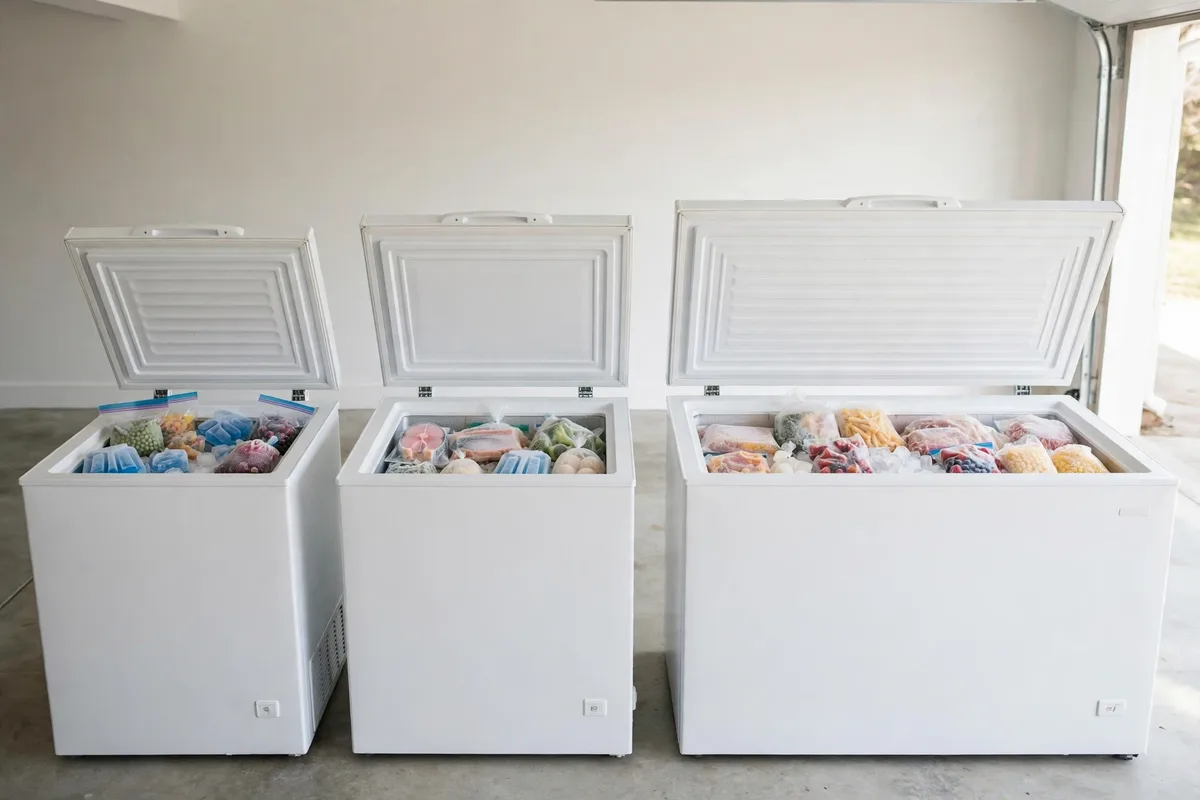
The best chest freezer is the appliance that turns a warehouse-club run, a garden harvest or a holiday turkey sale from a fridge Tetris problem into a non-event. Chest freezers beat uprights on the physics that matter — cold air sinks, so an opening lid spills almost none of it — and they are cheaper per cubic foot than any other freezer format. But the five machines in this guide split on the question most US roundups never ask and Canadian buyers cannot afford to skip: will it keep working in an unheated garage in January? A freezer rated only for room-temperature surroundings can stop freezing properly when the garage drops below freezing, because its thermostat reads the cold room and cycles the compressor off. The picks below are organised around capacity and that garage rating together — and if your chest freezer is part of a meal-prep system, our guide to the best vacuum sealer for meal prep in Canada and the USA is the partner purchase that makes frozen food keep its quality for months.
Timing matters too. November is the category’s annual spike — turkeys, baking marathons and holiday bulk buying all land at once — and a chest freezer bought now earns its floor space within weeks. A note on honesty before the lineup: freezer marketing is full of manufacturer claims — ambient temperature ranges, hours of food protection during an outage, capacities measured to the brim — that no independent lab verifies model by model. Where a claim below comes from the manufacturer, we label it as a manufacturer claim and weigh it against what long-term owners actually report. That distinction, more than any single specification, is what this guide is for.
Disclosure: CookSmartPicks is reader-supported. When you buy through links on this page, we may earn an Amazon commission at no extra cost to you. Prices and availability change often — check the current price on Amazon before you decide.
How we chose these chest freezers
CookSmartPicks is a research-based guide. We do not run a test lab, and we never claim hands-on testing we have not done. For this list we compared manufacturer specifications — capacity, dimensions, temperature range, defrost style and warranty — with current ranked roundups refreshed through September and October 2026 and with long-term owner reports from verified buyers in Canada and the USA, paying particular attention to owners running their freezers in unheated garages and basements. The criteria were usable capacity against footprint, the stated low-ambient (garage) rating, manual versus frost-free defrost, and cost per cubic foot. Manufacturer performance claims are flagged as claims wherever they appear; owner-proven behaviour is described as such.
The lineup at a glance
| Product | Best for | Why it stands out |
|---|---|---|
| Kismile 3.2 Cu Ft Chest Freezer | Best small & most reviewed | The most-reviewed small chest freezer in the category, with 2,181 ratings |
| Midea 3.5 Cu Ft Convertible Chest Freezer | Best convertible | Switches between fridge and freezer; manufacturer-rated for garages from 0 to 110°F |
| Igloo 5.0 Cu Ft Chest Freezer | Best compact | Category number-two seller at the five-cubic-foot family sweet spot |
| Frigidaire 7.0 Cu Ft Garage-Ready Freezer | Best garage-ready | Frigidaire’s garage-ready line at the most useful family capacity |
| Hamilton Beach 14 Cu Ft Chest Freezer | Best for big families | Fourteen cubic feet at the strongest cost-per-cubic-foot value here |
1. Kismile 3.2 Cu Ft Chest Freezer — Best small & most reviewed
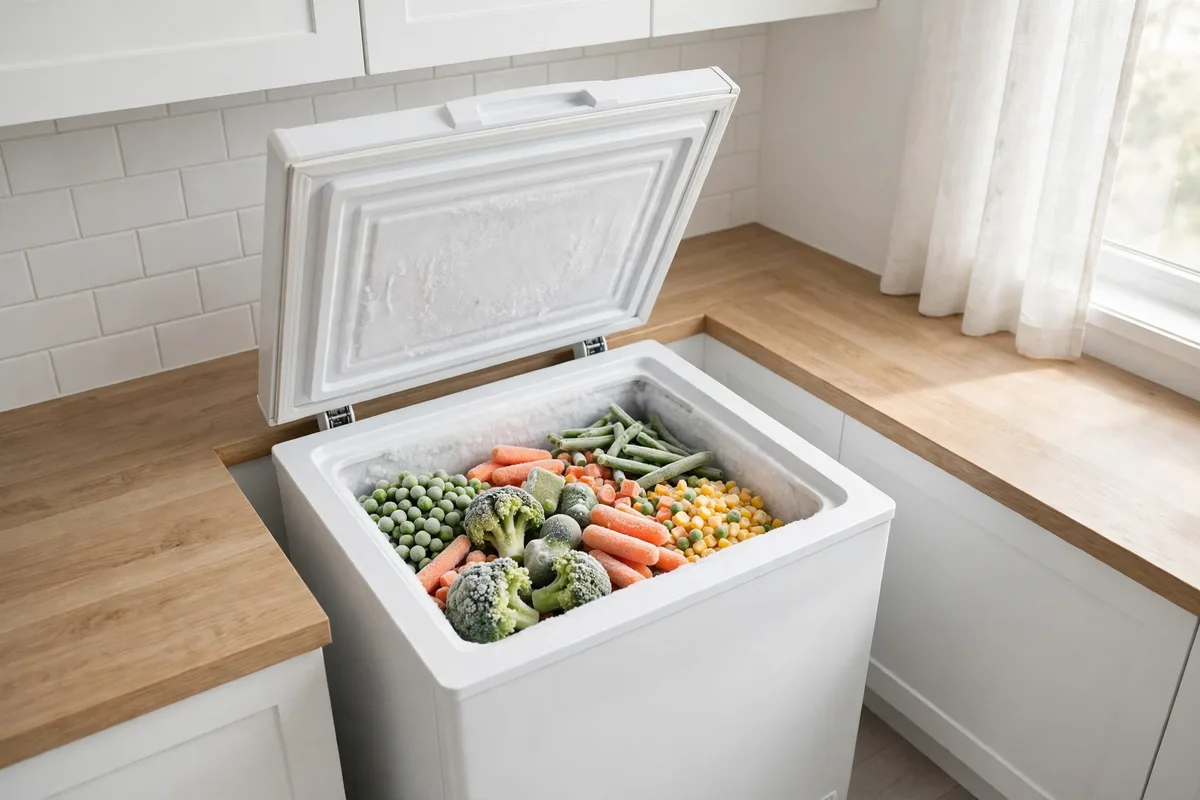
The Kismile 3.2 is the small chest freezer with the deepest owner record in the category: 2,181 ratings make it the most-reviewed compact pick in current roundups, and that volume matters for an appliance category where reliability stories only emerge after winters of use. The format is the classic apartment-and-overflow size — 3.2 cubic feet is roughly a week-plus of family groceries, a quarter of a bulk meat order, or a serious ice-cream and frozen-meal reserve — in a footprint that fits a laundry-room corner, a basement nook or beside the garage workbench. A removable storage basket keeps small items from vanishing to the bottom, the temperature dial covers the standard freezer range with a proper deep-cold end, and the door’s balanced hinge holds position part-open while you load with both hands — a small detail owners praise out of proportion, because they use it every single shop.
The honest limits are the ones shared by most value compacts, plus one Canadian caveat. Defrost is manual, as it is on nearly every chest freezer here: once or twice a year the contents move to coolers while frost melts out, a half-day ritual the category has never engineered away at this price. Kismile does not publish a low-ambient garage rating for this model, so despite plenty of owners running it in garages, the manufacturer’s silence means a Prairie or northern-US unheated garage in deep January is a risk the spec sheet does not underwrite — the Midea and Frigidaire below carry explicit ratings for exactly that job. Indoors, in a basement or a heated garage, the owner record says it simply works: quiet, cold and unglamorous, which is the whole brief for a first chest freezer.
Yay · Pros
- The most-reviewed small chest freezer in the category — 2,181 ratings of owner evidence
- Apartment-friendly footprint with a removable basket and a stay-open hinged lid
- Proper deep-cold dial range for long-term meat and meal storage
Hmm · Cons
- Manual defrost, once or twice a year, like nearly every model here
- No published low-ambient garage rating — unheated northern garages are on you
- 3.2 cu ft fills fast for warehouse-club households; size up if in doubt
Best for: apartments, couples and first-time buyers adding overflow freezing indoors or in a heated garage. Skip if: the freezer will live in an unheated garage through a Canadian winter — choose a model with a stated low-ambient rating.
2. Midea 3.5 Cu Ft Convertible Chest Freezer — Best convertible
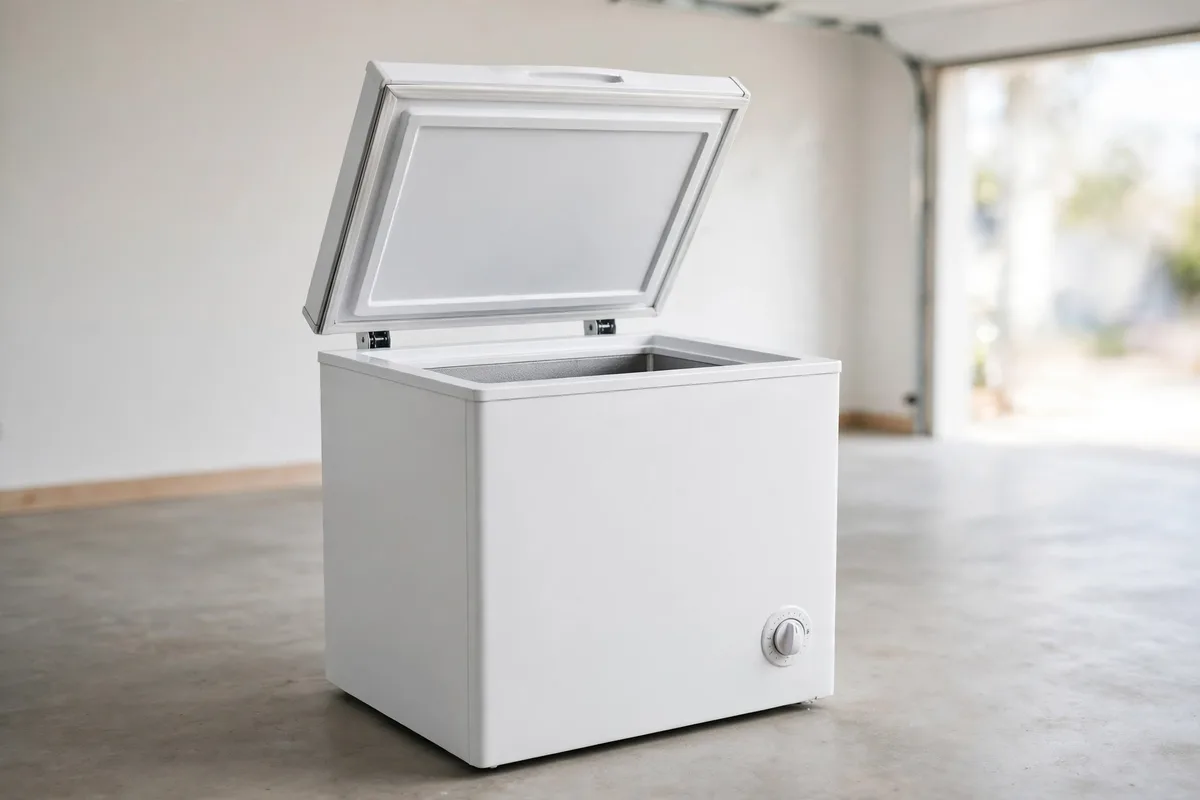
The Midea 3.5 convertible is the most flexible small freezer in this guide because it is not always a freezer. A single dial sweeps its temperature range from refrigerator territory down to deep freeze, so the same box is a drinks-and-produce fridge for a summer party, a freezer for the autumn harvest, and a fridge again when a holiday overflow of desserts needs chilling rather than freezing. Midea — one of the largest appliance makers in the world — rates this model for garage use across a manufacturer-stated ambient range of 0 to 110°F, the explicit low-temperature rating the Kismile lacks, and adds a manufacturer claim of up to 48 hours of temperature hold during a power outage when the lid stays closed. Treat both figures as manufacturer claims rather than lab findings — that is how the better roundups present them — but the garage rating at least puts the promise in writing, and owner reports from cold-climate buyers broadly support the machine keeping temperature in unheated spaces.
Convertibility is a dial, not magic, and it brings the usual compact compromises. At 3.5 cubic feet this is still a small box; a household that discovers it needs eight cubic feet of freezer will not be saved by the fridge mode. The single removable basket and open-well layout are standard for the class, which means organisation is your job — bins and a written inventory beat archaeological digging. Defrost is manual. And the very flexibility that sells it can confuse a household’s habits: more than one owner report describes food stored at the wrong setting after a well-meaning mode switch, so the dial deserves a label-maker note if the box changes roles often. Bought deliberately — as a swing-space appliance for households whose needs genuinely change with the seasons — it is the smartest small freezer here, and the safest small pick for a cold garage.
Yay · Pros
- Converts between refrigerator and freezer on one dial — two appliances in one footprint
- Manufacturer-rated for garages from 0 to 110°F, with a 48-hour outage-hold claim (both manufacturer figures)
- From one of the world’s largest appliance makers, with a wide service network
Hmm · Cons
- Still a small box — 3.5 cu ft will not rescue a big-family bulk habit
- Manual defrost; organisation is bins-and-inventory manual too
- Mode switches invite mistakes — label the dial if roles change often
Best for: households whose needs swing by season, and cold-garage buyers who want a small freezer with the rating in writing. Skip if: you need permanent, maximum freezer volume — the Igloo and Frigidaire below are bigger dedicated boxes.
3. Igloo 5.0 Cu Ft Chest Freezer — Best compact
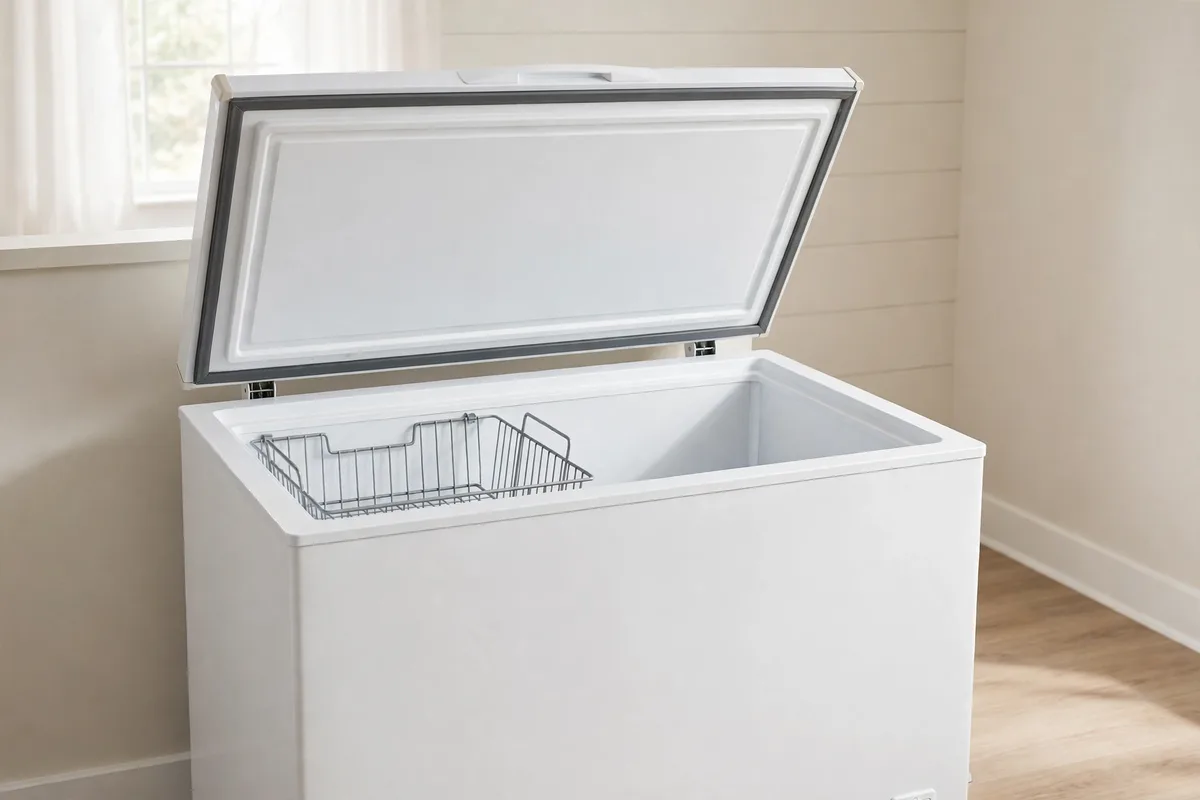
Five cubic feet is the chest-freezer sweet spot for a typical family — big enough for a warehouse-club run plus a month of batch cooking, small enough to fit the average garage wall or basement corner — and the Igloo 5.0 sits at number two in Amazon’s category best-seller ranks in current roundups, which makes it the compact most buyers are cross-shopping. The formula is deliberately plain: a single deep well with a removable basket, a front-mounted temperature dial with seven settings, a power indicator light you can check at a glance, and a recessed handle that keeps the front profile clean against a wall. Igloo’s long history in North American cooling gives it retail presence in both Canada and the USA that pure import brands cannot match, and owner reports consistently describe a machine that gets cold fast, runs quietly and then disappears from conscious thought — the highest praise a freezer can earn.
Plainness has edges worth knowing. Like the Kismile, the Igloo does not headline a formal low-ambient garage rating in its consumer materials, so the unheated-garage question gets the same honest answer: many owners do run this model in garages successfully, including through cold winters, but the manufacturer has not published the 0°F-class rating that would make it a promise — buyers for whom January garage performance is the whole point should weigh the Midea’s and Frigidaire’s stated ratings. The interior has no light, so a basement unit benefits from a nearby lamp, and defrost is manual with a drain that owners advise testing before the first real defrost day. None of this dents its slot: at the family sweet-spot size, with category-topping sales and a clean owner record, it is the compact default for heated spaces and mild garages alike.
Yay · Pros
- The five-cubic-foot family sweet spot, at number two in the category’s sales ranks
- Front dial, power indicator and recessed handle — simple, checkable, wall-friendly
- Strong retail and support presence in both Canada and the USA
Hmm · Cons
- No formally published low-ambient garage rating despite many garage owners
- No interior light; manual defrost with a drain to learn before you need it
- Single basket — larger items still need your own bin system below it
Best for: typical families wanting one compact, proven freezer for a basement, utility room or heated garage. Skip if: an unheated northern garage is the destination and you want the rating in writing — see the Frigidaire.
4. Frigidaire 7.0 Cu Ft Garage-Ready Freezer — Best garage-ready
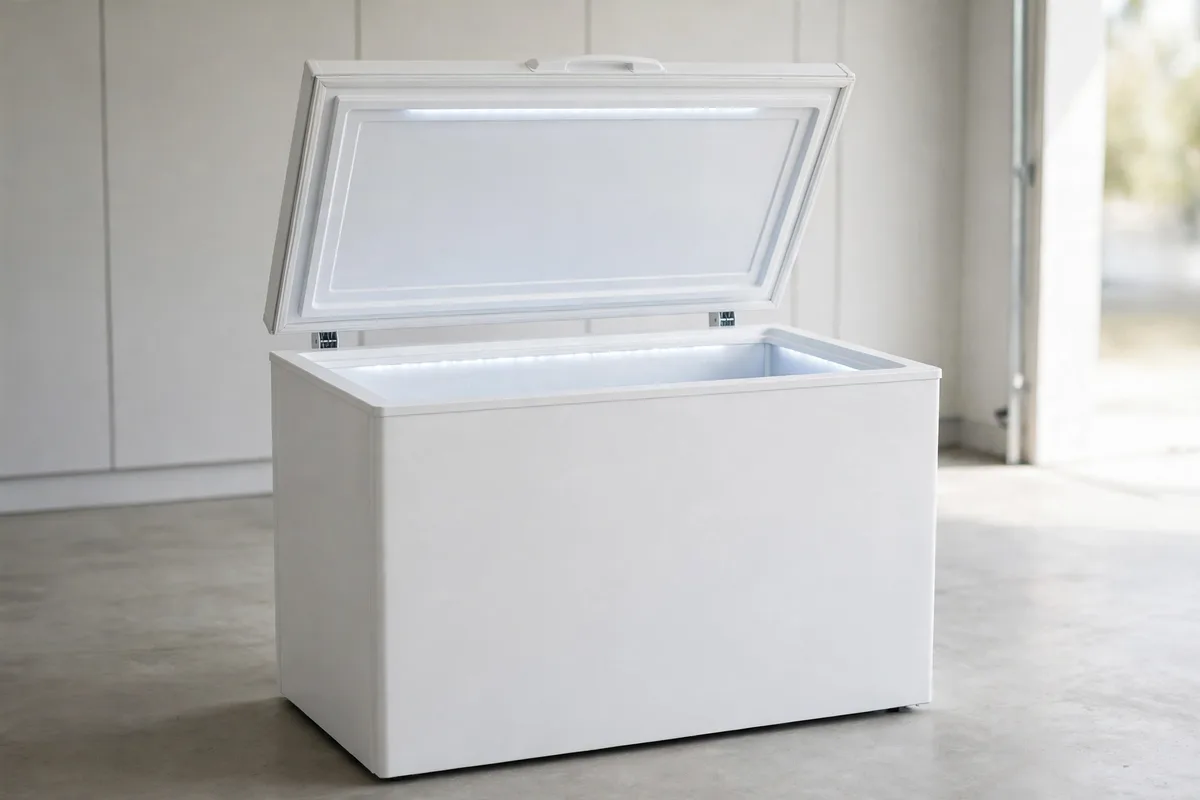
Frigidaire is the name this category runs on in North America, and its garage-ready line exists to answer the exact question this guide opened with. Garage-ready, in Frigidaire’s usage, means the freezer is designed and rated to keep freezing in ambient temperatures far outside the kitchen comfort zone — the manufacturer builds these models to perform in garages that swing from near-freezing winters to hot summers, where a standard freezer’s thermostat can be fooled by a cold room into letting food soften. The 7.0 cubic foot size is the line’s family centre: room for a serious bulk habit — a side of beef shares space with the holiday baking — without the floor claim of the fourteen-foot class. Current roundups place the Frigidaire 7 at number five in the category’s best-seller ranks, and the model adds the touches owners actually use: a power-on indicator, a lock for households that need one, and sliding storage baskets that tame the deep-well dig better than a single basket does.
Two honest qualifications keep this review credible. First, garage-ready is a manufacturer designation, not an independent certification — there is no third-party garage test every brand submits to — so the rating means Frigidaire designed and warrants the machine for that use, which is still materially stronger than a brand that says nothing. Second, seven cubic feet in a chest format is a lot of archaeology without a system: owners who skip bins and an inventory list will lose food to the bottom, and the manual defrost ritual at this size is a genuine half-day project once a year. The machine also costs more per cubic foot than the Hamilton Beach below — you are paying for the rating, the brand’s service network and the build, not raw volume. For a Canadian or northern-US buyer whose freezer must live in an unheated garage, that is exactly the right trade: this is the pick the whole guide bends toward for that job.
Yay · Pros
- Purpose-built garage-ready line — rated by the manufacturer for out-of-kitchen temperatures
- Seven cubic feet: the family capacity that still fits a garage wall
- Sliding baskets, power indicator and a lock — the useful extras, all present
Hmm · Cons
- Garage-ready is a manufacturer designation, not an independent certification
- Costs more per cubic foot than the big Hamilton Beach — you pay for rating and network
- Manual defrost at this size is a real half-day, once-a-year job
Best for: unheated-garage buyers in Canada and the northern USA, and families wanting a rated, serviced, brand-backed freezer. Skip if: the freezer lives indoors and volume per dollar is all that matters — the Hamilton Beach wins that maths.
5. Hamilton Beach 14 Cu Ft Chest Freezer — Best for big families
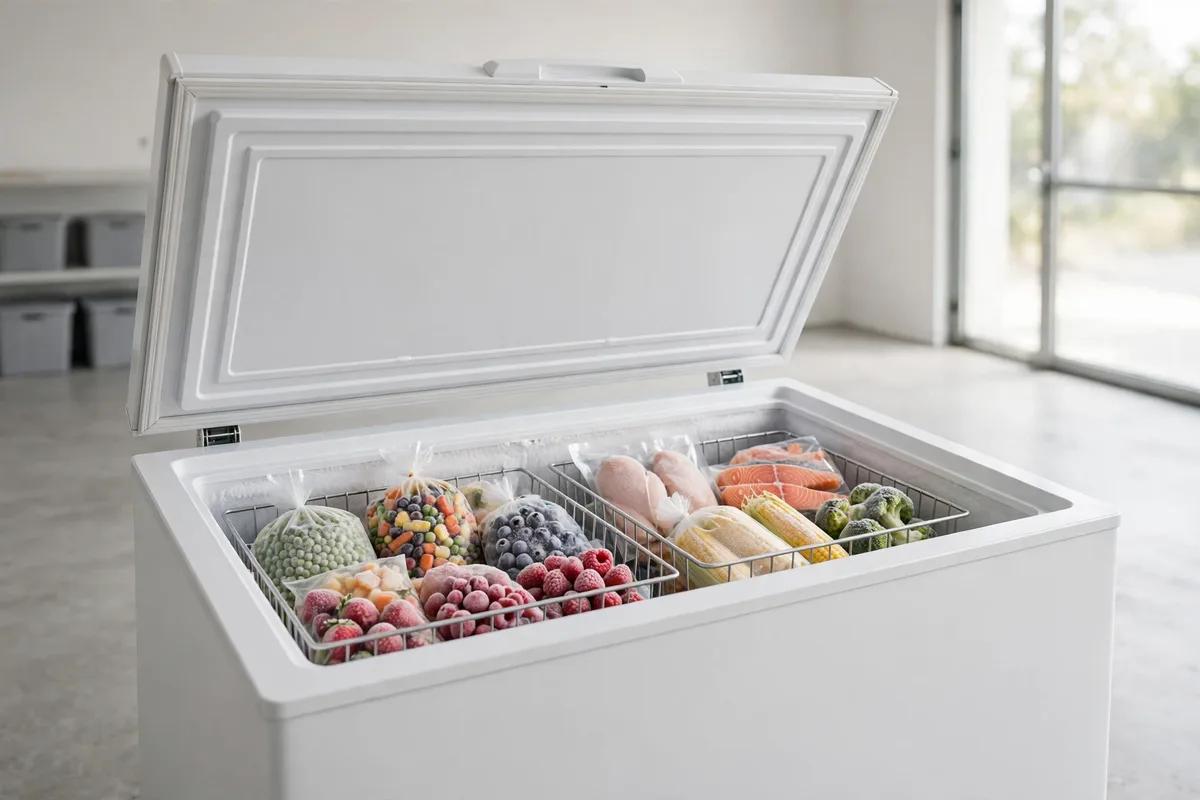
Fourteen cubic feet changes what a household can do. A whole hunting season, half a cow from a local farm, a garden’s entire autumn output, or a big family’s warehouse-club habit all fit at once — and the Hamilton Beach delivers that volume at the strongest cost per cubic foot in this guide, which is the honest reason it anchors the large end. The layout acknowledges the scale: multiple removable baskets ride the top layer for the weekly rotation, a power indicator confirms at a glance that the big box is running, and the temperature dial spans the full freezer range. For rural households, homesteaders and families who buy protein in bulk a few times a year, the economics are decisive — the freezer pays for its floor space in avoided small-pack pricing, and chest format keeps the running cost per cubic foot low because so little cold escapes at each opening.
Scale is also the warning label. Fourteen cubic feet needs a measured doorway, a planned path into the garage or basement, and a household that will genuinely fill it — a half-empty giant is just an expensive room that hums. Hamilton Beach does not market this model with the Frigidaire’s garage-ready designation, so cold-garage buyers should treat its unheated-winter performance as unproven by the manufacturer, however many owners report success; the rated picks above exist for that job. Organisation at this volume is a discipline, not a feature: without dated labels, bins by category and a door inventory, food archaeology stops being a joke and starts being waste. Defrost day, when it comes, is the biggest here. Buy it with the system in place — vacuum-sealed, labelled, inventoried — and it is the most capable food-storage purchase in this guide; buy it on impulse and it is a very large box of good intentions.
Yay · Pros
- Fourteen cubic feet at the best cost per cubic foot in this guide
- Multiple top baskets for the weekly rotation over the deep store
- The bulk-buyer’s pick — farm orders, hunting seasons and warehouse runs fit whole
Hmm · Cons
- Needs measured doorways and a real plan for the floor space
- No garage-ready designation — unheated-winter performance is not manufacturer-promised
- Organisation is entirely on you; unlabelled food at this scale becomes waste
Best for: big families, rural and bulk-buying households with the space and the system to fill it. Skip if: you are a small household (the Kismile or Midea is your size) or the garage is unheated and unproven performance worries you (choose the Frigidaire).
Garage ratings, sizing and defrost: what actually matters
The garage question, plainly. A standard freezer’s thermostat senses the room as well as the box. In a garage below about 0°C, a basic model can cycle its compressor off and let the interior drift upward — food stays cold but may not stay properly frozen. A stated low-ambient or garage-ready rating (the Midea’s manufacturer-stated 0 to 110°F range, Frigidaire’s garage-ready designation) means the maker designed and warrants the machine against that failure. No rating does not prove a freezer will fail in your garage — owners run unrated models in garages all over both countries — it means the risk is yours rather than the manufacturer’s. Indoors, in a basement or heated garage, ignore the whole issue and buy on size and price. Sizing: a useful rule is roughly 1.5 cubic feet per person for overflow storage, doubling it for bulk-protein households — and however big the box, what you freeze keeps best in dated, airtight portions; our guide to the best food storage containers in Canada and the USA covers the freezer-safe side of that system.
Defrost and running costs. Every pick here is manual-defrost, and that is a feature disguised as a chore: manual chest freezers have no defrost heater cycling warmth through your food, which is part of why chest-frozen food keeps its quality so long. Budget an hour or two, once or twice a year, with coolers standing by. Running costs favour the format too — chest freezers are among the cheapest appliances in the house to run per cubic foot, and a full freezer costs barely more to keep cold than a half-empty one, because the food itself holds the temperature. If your cold-storage problem is the opposite end of the scale — drinks, dorm rooms and small spaces rather than bulk — our guide to the best mini fridges in Canada and the USA covers that territory instead.
Chest freezer questions, answered
Can I keep a chest freezer in an unheated garage in Canada?
Yes — with the right model. Choose a freezer with a stated low-ambient or garage-ready rating, like the Midea convertible’s manufacturer-stated 0 to 110°F range or Frigidaire’s garage-ready line, and it is designed to keep freezing when the garage drops below freezing. An unrated model may work — many owners report success — but its thermostat can be fooled by a very cold room into cycling off, and the manufacturer has not promised otherwise. Also leave the ventilation clearance the manual specifies, and expect any freezer to work harder in a hot summer garage than a cold one.
What size chest freezer does a family of four need?
For overflow storage alongside a fridge freezer, five to seven cubic feet suits most families of four — that is the Igloo 5.0 and Frigidaire 7.0 territory. Households buying meat in bulk, freezing garden produce or shopping warehouse clubs monthly should look at seven and up, while couples and apartment households are honestly served by the 3.2 to 3.5 cubic foot compacts. When torn between two sizes, buy the larger only if the floor space is genuinely free; a slightly-too-small freezer that is full is more efficient and better organised than a cavernous one that is not.
How long does food keep in a chest freezer during a power outage?
A full chest freezer with the lid kept closed typically holds safe temperatures for roughly 48 hours — the figure food-safety agencies cite and the same hold time Midea states as a manufacturer claim for its convertible. Half-full freezers hold for closer to 24 hours. The rules that protect the food are simple: do not open the lid to check, cover the freezer with blankets for extra insulation if the outage stretches, and when power returns, food with ice crystals or at refrigerator temperature can generally be refrozen or cooked, while anything that sat warm for hours should be discarded. When in doubt, throw it out.
Chest freezer or upright freezer — which should I buy?
Chest freezers win on purchase price per cubic foot, running cost, outage hold time and food quality over long storage, because the cold stays in the box when the lid opens and there is no defrost heater cycling. Uprights win on organisation and footprint — shelves beat digging, and they fit kitchen-adjacent spaces a chest cannot. This guide covers chests because the value and garage cases are stronger for most buyers; if bending and digging are genuine problems for anyone in the household, that accessibility point can outweigh every number on this page, and an upright is the honest recommendation instead.
The short version
Small households should buy the Kismile 3.2 for its unmatched owner record, or the Midea 3.5 Convertible if the box will change roles with the seasons or live in a cold garage on a stated rating. Typical families land on the Igloo 5.0, the sweet-spot default. Unheated-garage buyers in Canada and the northern states should choose the Frigidaire 7.0 Garage-Ready — the rating is the product — and bulk buyers with the space and the system should take the Hamilton Beach 14 and its unbeatable cost per cubic foot. Measure the doorway, decide the garage question honestly, and the right freezer is the one that disappears into your routine for a decade.
Last updated: November 16, 2026. We refresh this guide each season and whenever a pick is replaced by a better one.