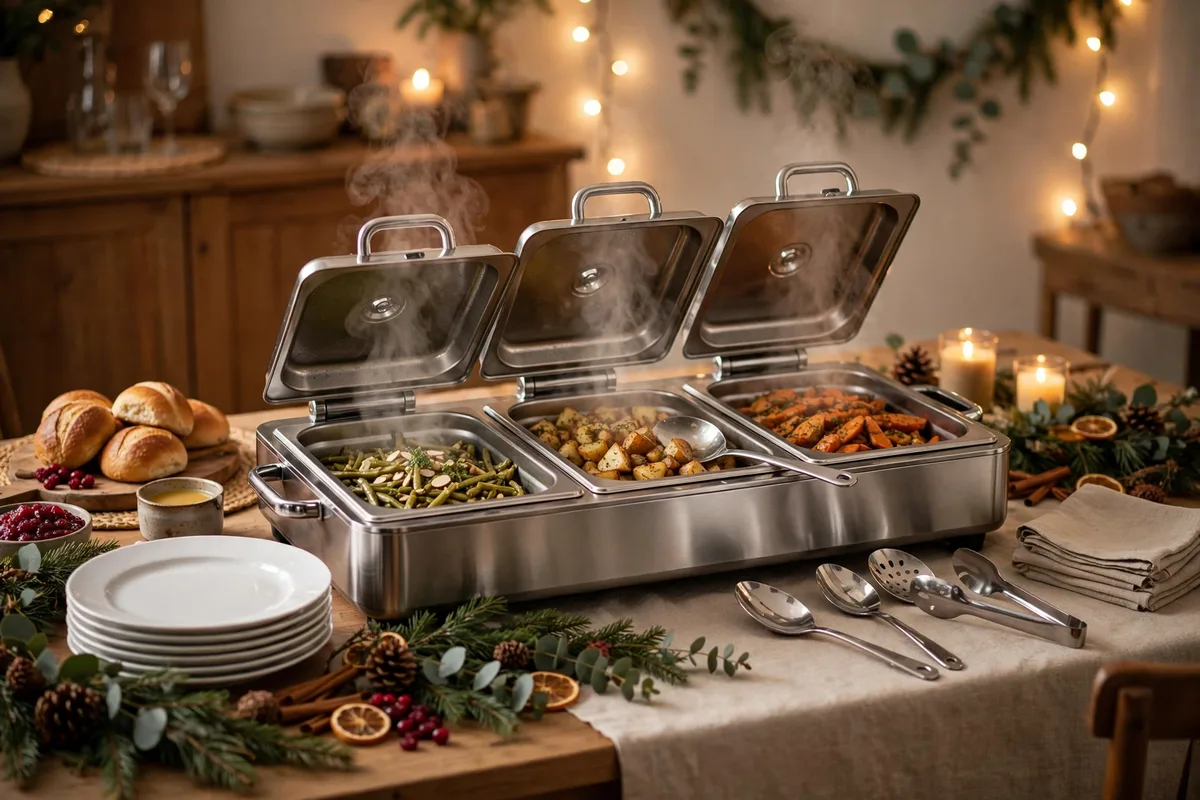
A warming tray has one job, and it is a food-safety number: keep served food at or above 140°F (60°C) for the length of the party — the floor below which hot food enters the bacterial danger zone. The best all-round answer for most hosts is a buffet server with lidded pans, and the Chefman and Proctor Silex picks below lead this guide for exactly that reason; the bare-slab trays that follow are the flexible specialists for the dishes you already own.
The five picks divide by format and scale: two family buffet servers, a three-pan party workhorse, a premium stainless server, and a compact tray for small gatherings. Each was checked for holding power, surface evenness, thermostat range and the storage reality of a seasonal appliance in a Canadian kitchen. Pair the tray with the best charcuterie boards in Canada and the USA from our boards guide for the cold side of the table, plan the spread with the best hosting and serving essentials in Canada and the USA guide, and keep the best slow cookers in Canada and the USA picks close for the slow-cooked dishes that feed the tray all evening.
Disclosure: CookSmartPicks is reader-supported. When you buy through links on this page, we may earn an Amazon commission at no extra cost to you. Prices and availability change often — check the current price on Amazon before you decide.
How we chose these electric warming trays
Food safety set the shortlist’s floor before any feature did: a pick had to credibly hold serving dishes above 140°F (60°C) across its surface — judged by element wattage and coverage, pan or slab design, and the pattern of owner reports about hot and cold spots — because a tray that holds food at 110°F is worse than no tray at all. Models whose reviews repeatedly described lukewarm corners were cut, however handsome their buffets looked.
Format came second: buffet servers with lidded pans hold temperature more evenly and suit sauced dishes, while bare slabs offer flexibility for any dish you own; this guide includes both and labels which menu each serves. We also checked cord length and storage footprint (these are seasonal appliances that live in cupboards), thermostat range from maker specifications, and Canadian retail availability. Every pick is sold through normal channels in Canada — a holiday appliance that cannot be replaced by December is no use in November.
The lineup at a glance
| Product | Best for | Why it stands out |
|---|---|---|
| Chefman Electric Buffet Server & Warming Tray | Best overall buffet server | Two formats in one: lidded buffet pans over a tray that also works bare |
| Proctor Silex Buffet Server & Food Warmer (3-Pan) | Best value buffet server | The holiday workhorse: three pans, proven element, thrift-store price |
| Oster Buffet Server & Warming Tray (Stainless, 3-Pan) | Best for large gatherings | The big-room server: deep stainless pans and an element that keeps up |
| NutriChef Electric Warming Tray & Buffet Server | Best premium finish | The dressed-table server: stainless throughout, pans and slab in one |
| Elite Gourmet Buffet Server & Warming Tray (EWMST-325 class) | Best compact server | The small-kitchen server: gravy-and-sides duty at a cupboard-friendly size |
1. Chefman Electric Buffet Server & Warming Tray — Best overall buffet server
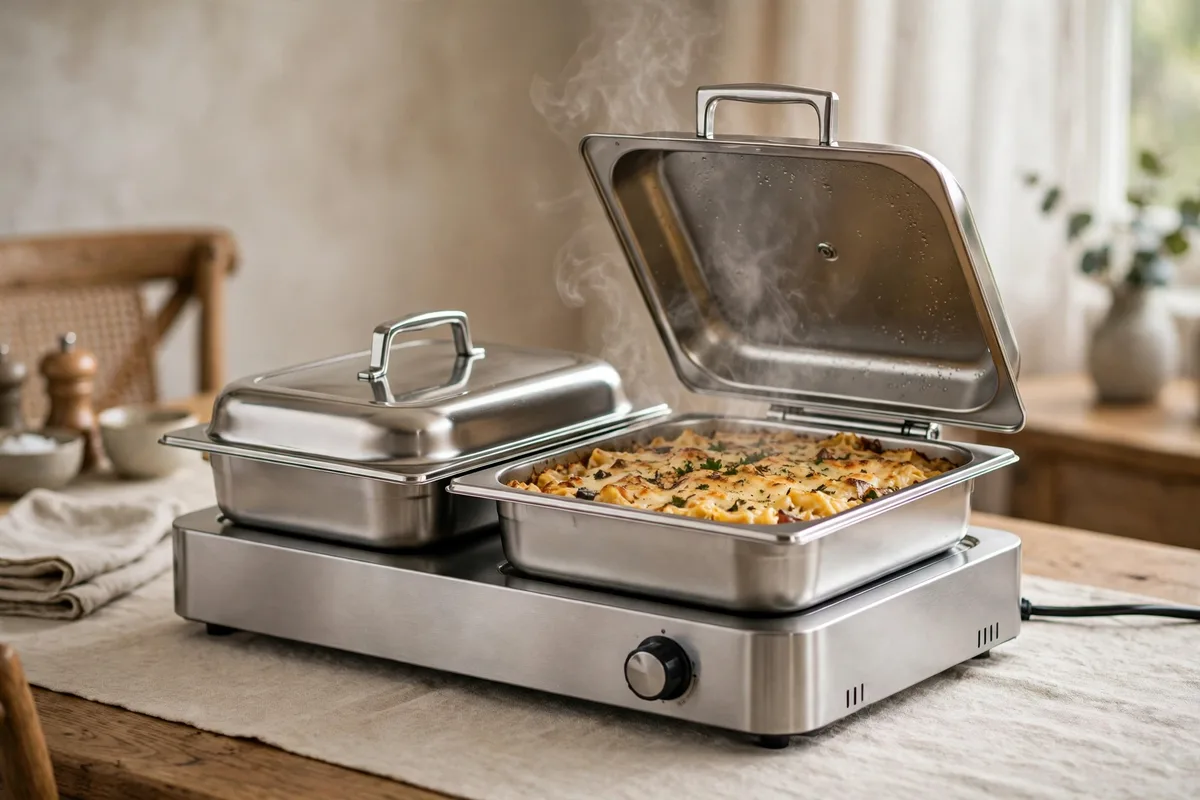
The Chefman buffet server is the format done sensibly: a heated base with an adjustable thermostat, a set of lidded serving pans that sit directly over the element, and a warming-tray surface underneath the pans’ frame that doubles as a bare slab for your own dishes when the pans come off. That two-in-one design is why it leads the guide — most hosts need both formats across a season, and this buys them in one cupboard footprint. The thermostat’s range (the maker rates the surface up to about 265°F) gives the headroom to hold lidded pans genuinely above the 140°F food line at medium settings.
In service, the lidded pans do what lids do: trap steam, even out the temperature, and keep a casserole’s top as safe and moist as its middle. Owner reports praise the evenness for the category — no notorious cold corner — and the pans’ dishwasher manners after the party. The whole unit stores flat-ish and light, which for a November-to-January appliance is a real specification.
Canadian availability is broad and the price sits in the sensible middle. For the household hosting two or three real gatherings a year — the holiday dinner, the birthday, the game day — this is the tray that covers all of them without a second purchase, and the guide’s default recommendation.
The Chefman’s bare-tray mode earns its keep at breakfast: pancakes and bacon for a slow Saturday hold beautifully on the open slab while the pans wash, a second shift the spec sheet never advertises and owners discover by appetite.
Yay · Pros
- Server pans plus a bare tray in one unit
- Adjustable thermostat with real headroom
- Even holding; dishwasher-friendly pans
Hmm · Cons
- Pans are modest depth for big casseroles
- Lids are vented plastic on some configurations
- Cord length suits wall-adjacent buffets only
Best for: Most families — the all-round buffet answer Skip if: You host crowds of 20+ — size up to the three-pan Oster class
2. Proctor Silex Buffet Server & Food Warmer (3-Pan) — Best value buffet server
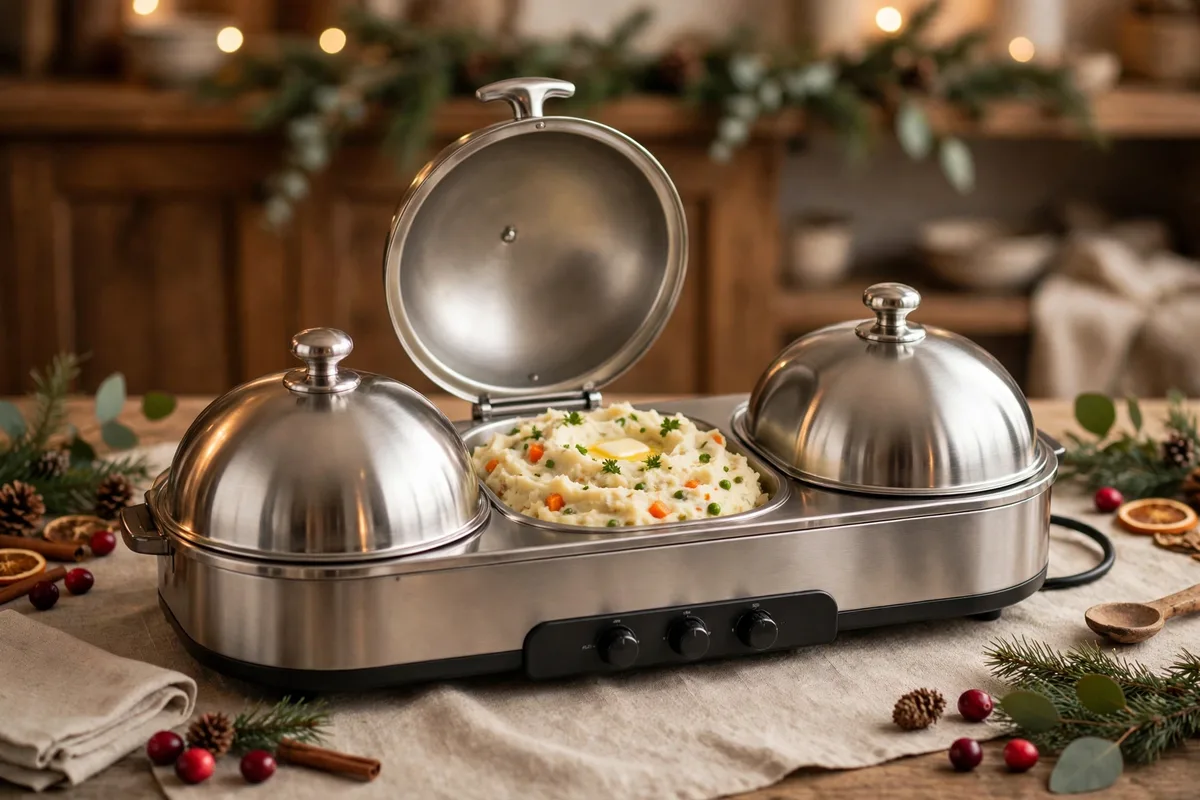
Proctor Silex builds the buffet server your aunt already owns: a sturdy heated base, three lidded pans, and a thermostat that does its one job without interface design. The three-pan format is the party configuration — a main and two sides, or three sides for the big holiday spread — and the pans’ modest individual size is secretly a food-safety feature: smaller batches hold temperature more evenly and get replaced by fresh hot refills rather than ageing in place, which is exactly how the two-hour rule wants a buffet to run.
The brand’s virtues are durability and price: these servers accumulate decades of holiday service in owner reports, the elements are simple and strong, and the whole unit costs what a single catered tray would. The lids are domed enough for a small chicken’s worth of contents, the pans wash up easily, and the base doubles as a bare warming tray with the pan frame removed — the same dual-format trick as the guide’s leader, at a thriftier specification.
For Canadian households, Proctor Silex is a Hamilton Beach sibling brand with normal domestic retail presence, so replacement and warranty conversations happen in-country. If your hosting is concentrated in the holiday season and the budget is honest, this is the server that has quietly fed more December dinners than any other pick on this page.
Proctor Silex’s pans have a quiet virtue for the two-hour rule: their modest size empties at the pace of a real party, so the food guests eat at hour two is usually the fresh refill, not the original batch — portioning as a safety system.
Yay · Pros
- Three lidded pans — the classic party layout
- Decades-proven durability at a value price
- Base doubles as a bare warming tray
Hmm · Cons
- Utilitarian looks
- Pan capacity suits sides better than mains
- Thermostat dial is unnumbered on some versions
Best for: Holiday hosts feeding a crowd on a schedule Skip if: You want a sleek countertop look for open-plan serving
3. Oster Buffet Server & Warming Tray (Stainless, 3-Pan) — Best for large gatherings
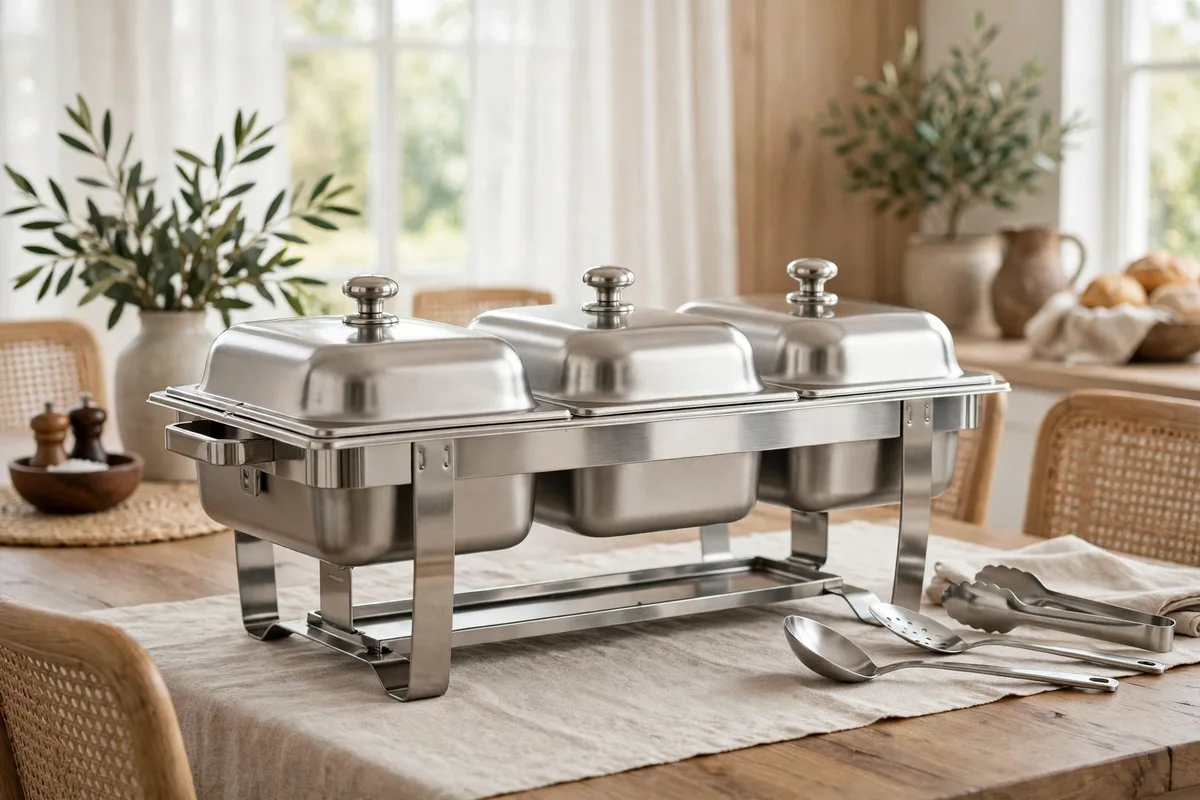
Oster’s buffet server is the scale pick: a larger heated base with a three-pan layout in deeper stainless pans, built for the gatherings where the Chefman class runs out of room — the extended-family holiday, the team party, the church-hall-adjacent home event. The stainless construction reads more formal on the table, the domed lids accommodate bulkier contents, and the thermostat carries the headroom to keep a full load of dense food — scalloped potatoes, baked pasta — above the safety line, which is where underpowered servers quietly fail.
Capacity honesty matters here: three deep pans of hot food is a serious thermal load, and Oster’s element sizing matches it, with owner reports describing even holding across a full service rather than the centre-hot, edges-lukewarm pattern of cheaper big servers. The pans and lids are stainless and dishwasher safe, and the base, pans removed, serves as the largest bare tray in this guide for sheet-pan duty.
The costs are storage and presence: this is the biggest object in the guide, and it wants a cupboard shelf of its own. Canadian retail carries Oster broadly. For the household whose hosting regularly reaches fifteen or twenty, the size is not excess — it is the correct tool, bought once, that ends the borrow-a-server era.
The Oster’s stainless pans double as respectable serving dishes off the base, which matters at the big gatherings it serves: a pan can travel from oven to base to table without a transfer, and every transfer a hot dish skips is a temperature loss avoided.
Yay · Pros
- Deep stainless pans for serious capacity
- Element sized for full loads — even holding
- Largest bare-tray surface here, pans removed
Hmm · Cons
- Bulkiest storage footprint here
- Stainless shows every fingerprint
- Overkill for couples’ dinners
Best for: Large gatherings needing maximum pan capacity Skip if: Your gatherings top out at eight — the Chefman covers them for less
4. NutriChef Electric Warming Tray & Buffet Server — Best premium finish
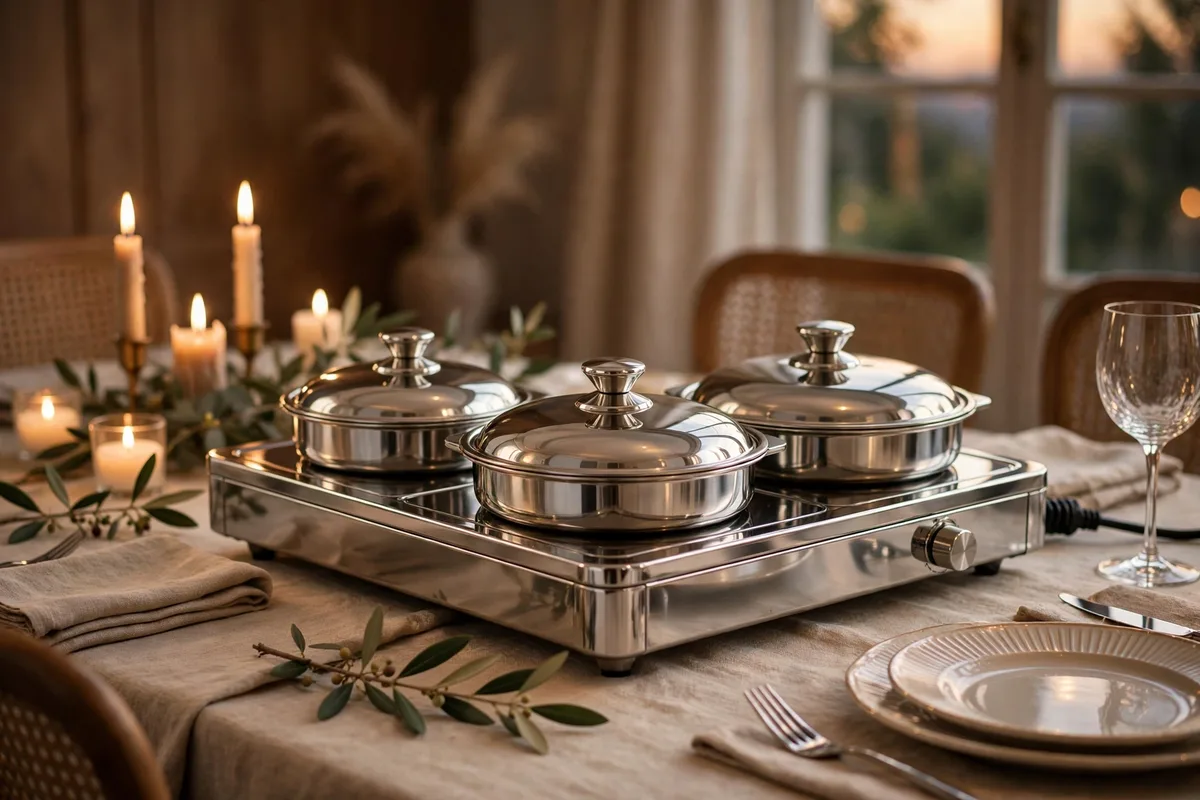
NutriChef’s entry is the buffet server as tableware: a polished stainless warming tray with a set of lidded stainless pans, a thermostat dial with a broad range, and a finish that belongs on a dressed table rather than a folding one. Functionally it splits the difference between the guide’s formats — the pans for the sauced and delicate, the bare stainless slab for everything else — with an element owners describe as strong and even, and a surface that doubles as a respectable griddle-warmth holder for rolls and roasted items.
The details lean premium: the pans’ lids are stainless rather than plastic, the tray’s edges are rolled and finished, and the whole unit wipes to a shine that survives the party’s photographs. Temperature control is a simple dial — set it by the food thermometer, as this guide preaches, rather than by the numbers printed around it — and the holding performance at real buffet loads matches the category leaders.
Canadian availability runs through online retail at a premium over the Proctor Silex class. The buyer for this pick is the host who entertains in a dining room rather than a rec room and wants the appliance to dress accordingly; the food-safety performance is table stakes, and the finish is the feature.
NutriChef’s tray surface, pans removed, is the right size for a standard half sheet pan — a fit owners use for appetizer batches at scale, and a reminder that a warming tray’s second career is measured in the cookware you already own.
Yay · Pros
- Stainless pans and tray — dining-room looks
- Strong, even element per owner reports
- Dual format: lidded pans or bare slab
Hmm · Cons
- Premium price over the value servers
- Smaller retail footprint in Canada
- Shiny finish needs a wipe to stay formal
Best for: Hosts who want a premium look with pan-and-tray flexibility Skip if: Budget leads — the Proctor Silex holds food just as safely
5. Elite Gourmet Buffet Server & Warming Tray (EWMST-325 class) — Best compact server
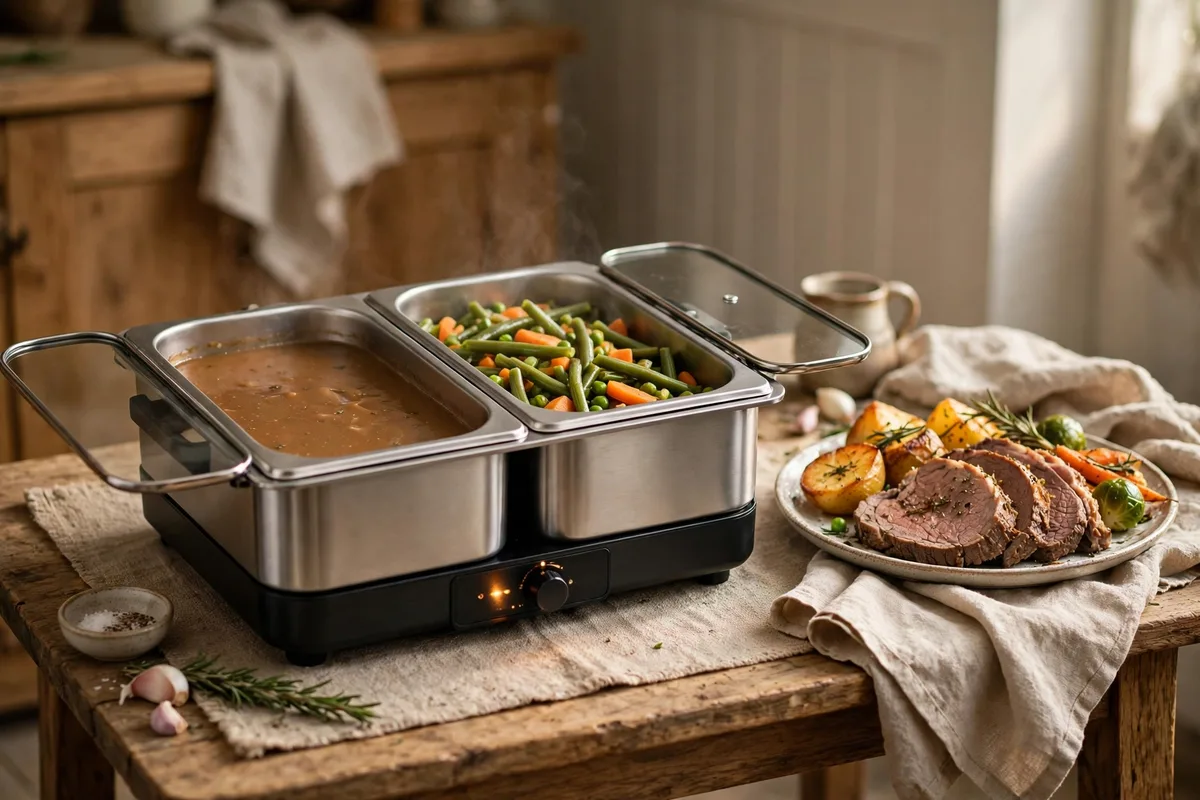
The Elite Gourmet buffet server is the category in miniature: a compact heated base with two modest lidded pans (configurations vary around the EWMST-325 format), sized for the jobs most warming actually is — keeping the gravy and the vegetables hot while the turkey rests, holding a couple’s taco fillings through a long movie night, or serving a small family buffet without heating the dining room with the oven. Its thermostat covers the useful range, and at this scale the element has no trouble holding the safety line evenly, because there is simply less surface to lose heat from.
Smallness is the feature set: it stores in a normal cupboard, sets up in a minute, and costs a fraction of the big servers — the rare seasonal appliance a small kitchen can actually justify owning. The pans are sized for sides and sauces rather than mains, and the guide is plain that a holiday crowd will outgrow it; within its scale, owner reports describe reliable, unglamorous service year after year.
For Canadian small households it is an easy online purchase. Buy it for the gravy-and-sides duty that happens at every roast dinner, and it will be used fifty times for every once the giant servers see daylight — the most honest cost-per-use in this guide.
The Elite Gourmet’s small pans suit the sauce course best, and sauces are where holding temperature matters most invisibly: a gravy that skins and cools between the roast and the table is a small sadness this little server exists to prevent.
Yay · Pros
- Compact footprint; stores in a normal cupboard
- Even holding at small scale
- Lowest price in the guide
Hmm · Cons
- Smallest capacity here
- Basic thermostat control
- Not a crowd tool — and does not pretend to be
Best for: Small households and single-dish keeping-warm duty Skip if: You host more than eight — this is a sides-and-sauces tool
140°F and the two-hour clock: the food-safety maths of keeping food warm
Hot food is safe food only above 140°F (60°C) — that is the floor of the USDA’s danger-zone rule, and it is the single number that separates a warming tray from a bacteria incubator with a power cord. Between 40°F and 140°F, bacteria in perishable food can double every 20 minutes or so, which is why the second number matters as much: the two-hour rule, after which hot-held food should be discarded rather than refrigerated and reheated. A warming tray’s entire job is to hold the line at 140°F for the length of a party — measure any model’s promise against that line.
Tray surfaces do not hold one temperature: the centre above the element runs hottest, the corners coolest, and a glass or stone slab’s edges can sit 20°F or more below its middle. The practical technique follows from the physics — keep food in shallow layers (deep pots insulate their own tops below the line), stir casseroles occasionally to redistribute heat, and park the most perishable dishes (anything egg, cream or seafood based) in the tray’s hot centre. An inexpensive probe thermometer, touched to the food rather than the tray, settles every argument about whether a given setup is actually safe.
Preheating is the step hosts skip and food safety remembers: a tray needs 15 to 20 minutes to reach holding temperature, and cold food placed on a cold tray spends its first half hour climbing through the danger zone. Food should arrive at the tray already hot — cooked or reheated to temperature first — because a warming tray holds heat; it is not built, or certified, to create it from cold. That single distinction is the difference between the category’s promise and its misuse.
The buffet-server format (tray plus covered pans) holds temperature more honestly than a bare slab, because lids trap the steam that does most of the holding. Bare trays shine for the dry and the sturdy — rolls, roasted potatoes, fried items that would sog under a lid — while sauced and delicate dishes belong under cover. Match the format to the menu and the 140°F line is easy to hold; mismatch them and no wattage saves the evening.
Finally, the cord is a safety feature too: a buffet line’s trailing cable across a walkway is the category’s most common real-world accident. Place the tray against the wall, run the cord behind the table, and let the only drama at the party be the food — which, held above 140°F and retired after two hours, will have done its job exactly as promised.
One wattage note ties the category together: buffet servers cluster in a modest power band, and the difference between a good and a poor one is rarely raw watts — it is element coverage, how much of the surface the heat actually reaches. When you compare models, a smaller tray with full-coverage heating will out-hold a larger tray with a hot ring in the middle, every service, which is why this guide weighted owner reports of cold corners above specification sheets.
Warming tray questions, answered
What temperature should a warming tray hold food at?
At or above 140°F (60°C) — the floor of the USDA danger-zone rule — measured in the food, not on the tray surface. Tray centres run hotter than corners, so keep perishable dishes in the middle, in shallow layers, and check with a probe thermometer if you are unsure. Food between 40°F and 140°F should not sit for more than about two hours in total.
Can a warming tray cook or reheat cold food?
No — and this is the category’s most important honesty. Warming trays are holders, not cookers: food must arrive already cooked and hot (reheated to at least 165°F / 74°C for leftovers per food-safety guidance), and the tray’s job is to keep it above 140°F. Putting cold food on a tray spends too long in the danger zone while it warms.
How long can food sit on a warming tray at a party?
About two hours at serving temperature is the standard guidance for hot-held perishable food at events; after that, discard rather than refrigerate and reheat. In practice, plan party food in waves — a first tray for the main event, fresh hot refills for the late crowd — instead of asking one batch to survive the whole evening.
Buffet server or bare warming tray — which is better?
Choose a buffet server (tray with lidded pans) for sauced, delicate or long-held dishes — lids trap steam and hold temperature evenly. Choose a bare tray for dry, sturdy items like rolls, roast potatoes and fried foods that would go soggy under a lid, and for flexible dish sizes. Many serious hosts own one of each; the formats are complements, not rivals.
What do the temperature settings on a warming tray mean?
Adjustable thermostats on these trays typically run from about 100°F to over 200°F at the surface (maker’s figures vary); you set the dial so the food — not the slab — sits above 140°F, which usually means a medium-high setting for lidded pans and higher for open dishes. The dial numbers are surface claims; the food’s temperature is the one that counts.
Can I put any dish on a warming tray?
Yes, within the tray’s stated load: glass, ceramic, stainless and enamelled cast iron all conduct well from a hot surface. Avoid plastic and melamine (they insulate and can warp), and give heavy cast iron extra preheat time — it holds heat beautifully once hot but is slow to climb. Thin metal pans respond fastest; stoneware is the buffet’s happy middle.
A word on where these trays live between parties, because seasonal appliances die of storage, not use: pans washed and fully dried before stacking (trapped moisture is what pits stainless over a summer), cords coiled loosely rather than wrapped tight around the unit, and the whole server kept in its box or a cupboard rather than a garage whose temperature swings age the thermostat. Stored that way, the value picks in this guide measure their lives in decades of Decembers; stored carelessly, even the premium finishes arrive at the next holiday diminished.
The short version
Buy the Chefman for the all-round buffet answer, the Proctor Silex for holiday value, or the Oster when the crowd reaches twenty. The NutriChef dresses the table, and the Elite Gourmet covers small households’ gravy-and-sides duty. Whatever you buy: preheat it 15 to 20 minutes, load it with food that is already hot, keep the food above 140°F, and retire the batch after two hours.
Last updated: November 18, 2026. We refresh this guide each season and whenever a pick is replaced by a better one.