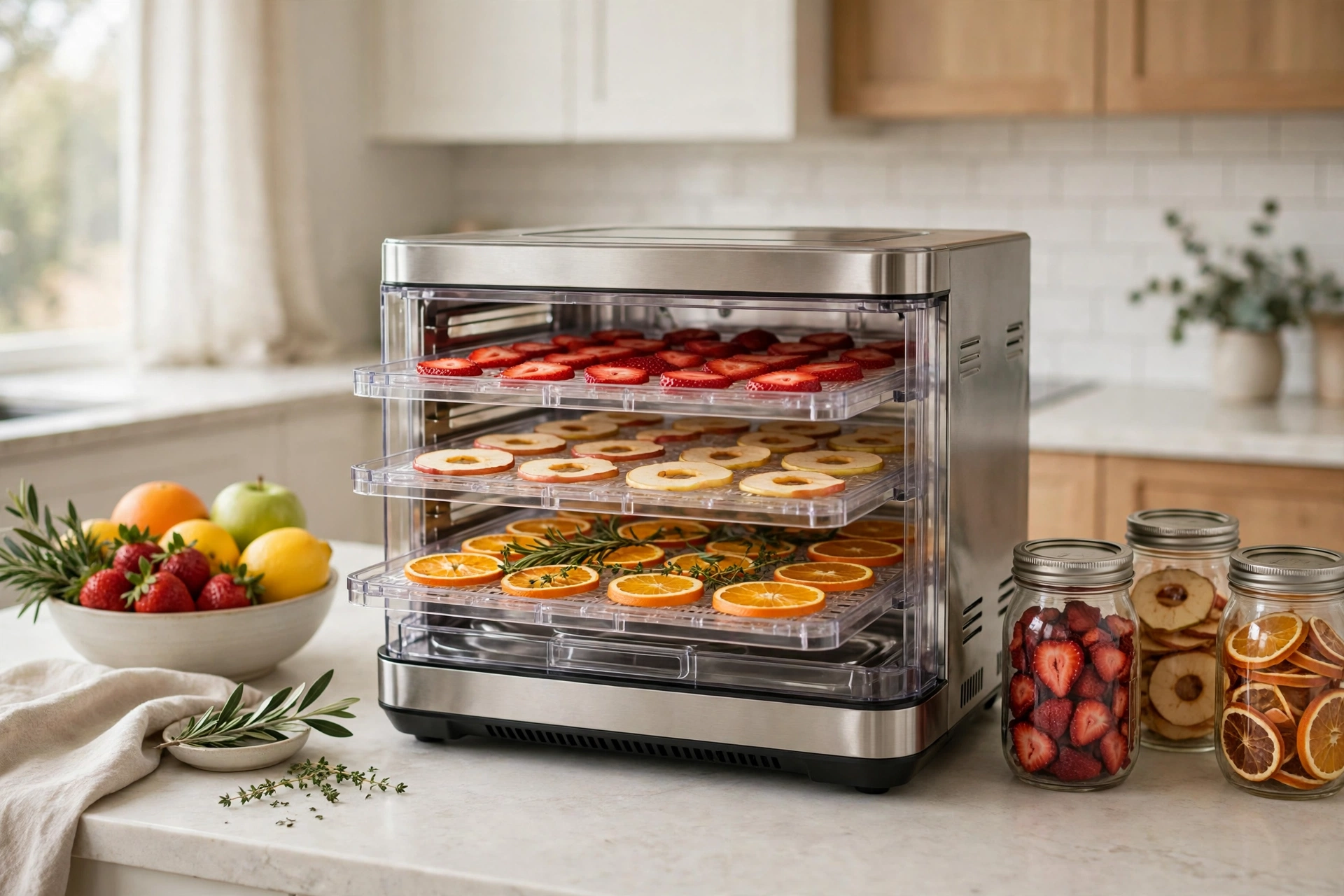
A food dehydrator is the appliance nobody thinks about until the garden delivers forty pounds of tomatoes in one week, or a hunting trip ends with more venison than the freezer can hold. Then the choice matters more than expected: fan placement decides whether every tray dries evenly or the bottom ones finish hours before the top, tray material decides whether you are scrubbing sticky fruit leather off plastic or wiping down steel, and temperature range decides whether jerky is merely dried or actually safe to eat. We compared the dehydrators that the specialist roundups keep putting at the top — and the ones Canadian and American owners keep re-ordering — to build the shortlist below.
The honest headline: airflow design is the whole game, and it does not track price neatly. A mid-range machine with a rear-mounted fan and horizontal airflow dries more evenly than a taller stack that costs more, while the cheapest pick here still turns out perfectly good apple chips. Everything below is split by the two decisions that actually matter — what you plan to dry most, and how much of it at once.
How we chose these food dehydrators
We built this list from the tested roundups that revisit dehydrators every year — KitchenGuide101's owner-rating analysis, BuyKitchenStuff's and CrispyPicks' category comparisons, the two Canada-specific guides (The Canada Report and One Clear Winner), and TruePicked's long-running entry-level notes — then checked every model's tray count, fan placement, temperature range and extras against the manufacturers' own specifications. Where testers disagree, we say so. CookSmartPicks does not run its own dehydrator lab; what we do is reconcile the published evidence and flag the trade-offs the roundups bury.
Three things separated the picks. Airflow design — horizontal airflow from a rear fan dries every tray at the same rate, while vertical airflow from a top or bottom fan needs tray rotation mid-batch. Temperature range and control — a wide range with a real thermostat matters, because herbs want low heat and jerky needs the 160°F range the USDA guidance points to. Tray material and capacity — stainless trays clean easier and last longer, and honest capacity is measured in square feet of drying space, not just the tray count.
The lineup at a glance
| Dehydrator | Best for | Why it made the cut |
|---|---|---|
| COSORI 6-Tray | Best overall | KitchenGuide101's best overall — the most-reviewed dehydrator in the category, with a rear fan and a quiet overnight run |
| Excalibur 9-Tray 3926T | Best for serious preservers | The category's long-standing gold standard — horizontal airflow across 15 sq ft, and the brand America's Test Kitchen recommends |
| Magic Mill Pro 7-Tray | Best for jerky & fruit leather | KitchenGuide101's jerky pick, with stainless trays and fruit-leather sheets in the box |
| NESCO FD-75A Snackmaster Pro | Best expandable mid-range | The category's staple name — starts at 5 trays and grows to 12 as your harvest grows |
| Hamilton Beach 32100A | Best budget with digital controls | The budget pick at both BuyKitchenStuff and KitchenGuide101 — digital controls without the premium price |
| Presto 06300 Dehydro | Best bare-bones entry | TruePicked's reliable entry-level choice for 20+ years — the simplest way into drying food |
1. COSORI 6-Tray — Best overall
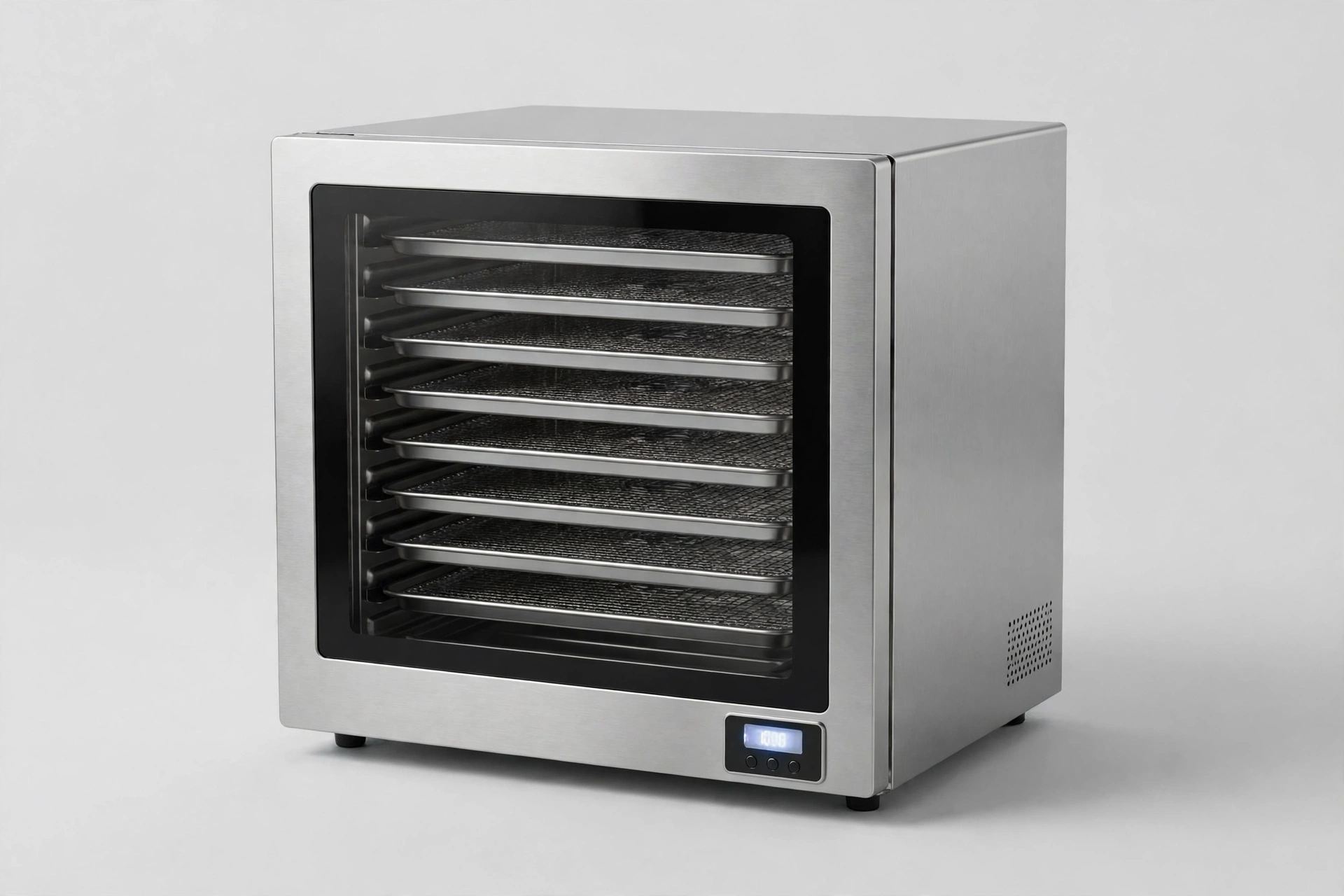
The COSORI 6-Tray earns the top spot the boring way: it is the most-reviewed dehydrator in the category, at 4.7 stars from 21,623 ratings per KitchenGuide101, and it is KitchenGuide101's best overall as well as the top-scored pick at One Clear Winner in Canada, at 9.8. The design explains the consensus. A rear-mounted fan pushes air horizontally across six stainless trays, so every tray dries at roughly the same rate, and the 95–165°F range covers herbs at the low end and jerky at the high end without a second machine.
The other reason owners keep re-ordering it is the noise — or lack of it. The COSORI runs quietly enough for overnight batches, which matters because most drying takes eight to twelve hours and nobody wants a whirring box in the kitchen all night. The trade-offs are capacity and construction. Six trays is a family-sized load, not a harvest-preserving one, and the housing is steel-framed rather than the full commercial build of the Excalibur below. For most homes drying fruit, herbs and the occasional jerky batch, that is the right compromise.
Yay · Pros
- Most-reviewed dehydrator in the category — 4.7 stars from 21,623 ratings per KitchenGuide101
- Rear fan with horizontal airflow dries all six trays evenly, no rotation needed
- Quiet enough for overnight runs, with a 95–165°F range
Hmm · Cons
- Six trays is a family load, not a serious harvest-preserving capacity
- Not the full commercial build of the Excalibur
- Fruit-leather sheets and extra trays are add-ons, not in the box
Best for: most homes — fruit, herbs, dog treats and occasional jerky, dried evenly and quietly. Skip if: you preserve whole harvests or run jerky in bulk — go straight to the Excalibur below.
2. Excalibur 9-Tray 3926T — Best for serious preservers
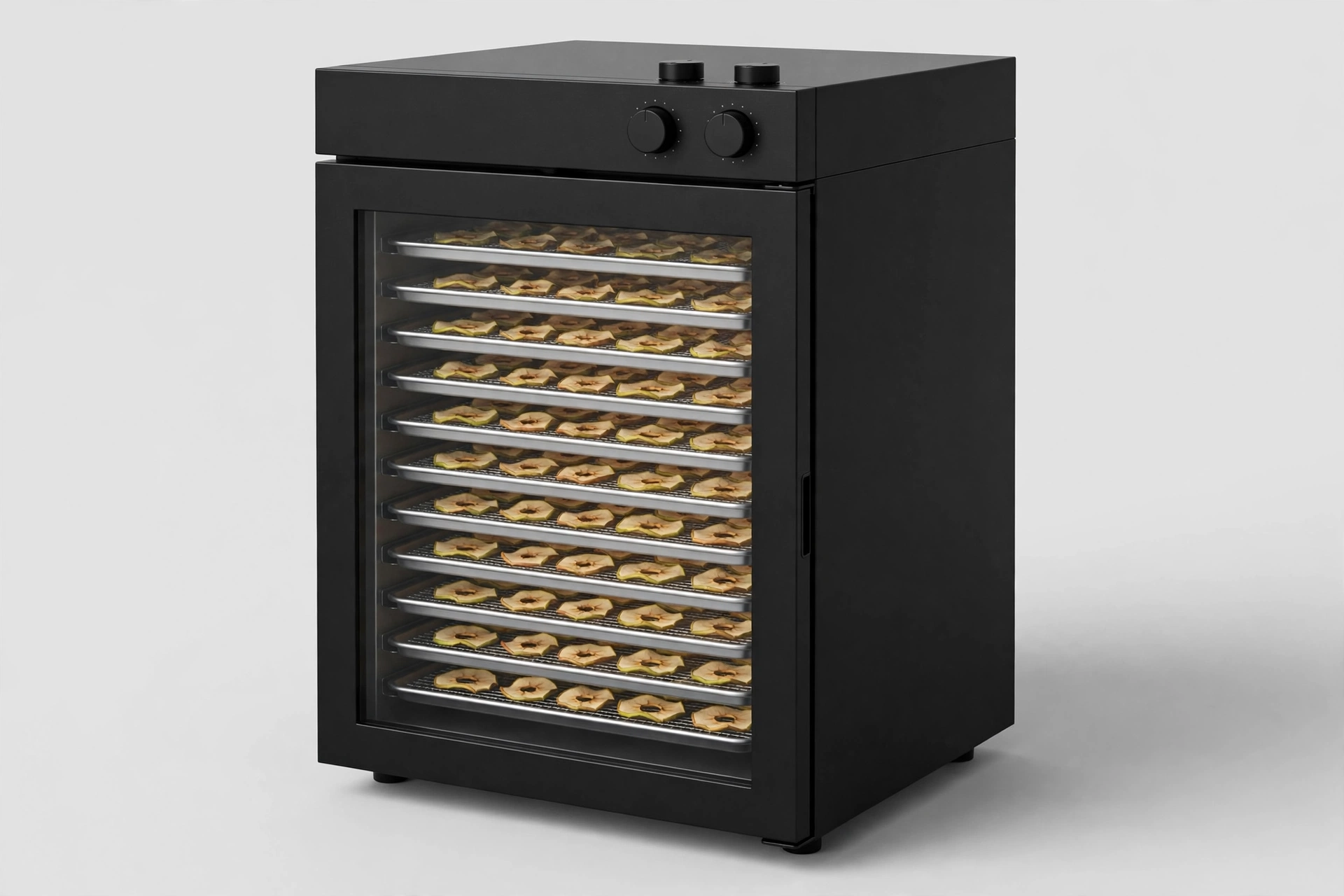
The Excalibur is the dehydrator every other dehydrator is measured against. BuyKitchenStuff names it its best overall, and it is the brand America's Test Kitchen recommends, per OfZenAndComputing. The 3926T is a nine-tray cabinet with 15 sq ft of drying space, a rear fan that pushes air horizontally across every tray, and a 26-hour timer — the combination that serious preservers actually need, because a big harvest does not wait for a small machine to catch up.
Horizontal airflow is the real difference here, and it is worth understanding before you buy anything else. In a vertical stack, hot air rises and the bottom trays finish first; in the Excalibur, air moves front to back across all nine trays at once, so a full load of jerky or tomato slices dries evenly without mid-batch rotation. The costs are size and simplicity: this is a countertop cabinet, not a cupboard appliance, and the controls are a straightforward dial-and-timer setup rather than a digital display. For anyone who preserves in volume, those are the right trade-offs.
Yay · Pros
- The category's gold standard — best overall at BuyKitchenStuff, and the brand ATK recommends
- Horizontal airflow across 15 sq ft dries nine trays evenly, no rotation
- 26-hour timer handles the longest jerky and fruit-leather runs
Hmm · Cons
- A full cabinet — it needs a permanent countertop or shelf spot
- Dial controls rather than a digital display
- Overkill if you dry a batch of apple chips once a month
Best for: gardeners, hunters and bulk preservers who dry whole harvests and jerky runs. Skip if: counter space is tight or drying is an occasional hobby — the COSORI above covers it.
3. Magic Mill Pro 7-Tray — Best for jerky & fruit leather
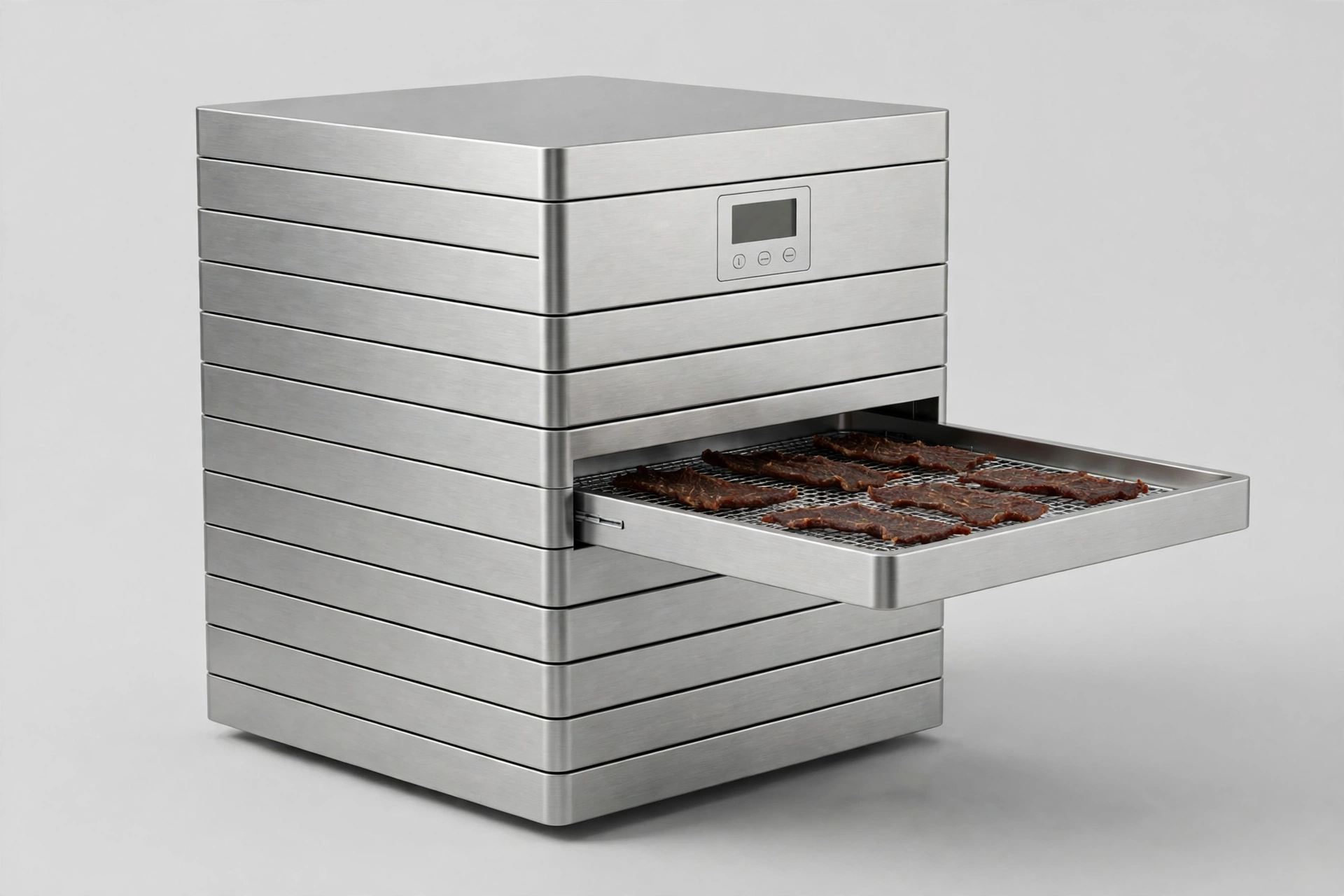
The Magic Mill Pro is the pick for buyers who know exactly what they will dry: jerky and fruit leather. KitchenGuide101 names it its jerky pick, and it is a headline pick in The Canada Report's Canada-targeted roundup. Seven stainless trays give it more room than the COSORI, and the fruit-leather sheets come in the box rather than as an add-on — a small detail that matters, because buying them separately is the hidden cost of most dehydrators.
The other thoughtful touch is the keep-warm function, which holds a finished batch at serving temperature instead of letting it cool and stiffen while you are still slicing the next load. The trade-offs are the usual ones for a mid-range stainless machine: it is heavier and louder than the COSORI, and the digital controls are functional rather than refined. If jerky and fruit leather are your main projects, those trade-offs are easy to live with.
Yay · Pros
- KitchenGuide101's jerky pick and a headline pick in The Canada Report
- Stainless trays with fruit-leather sheets included in the box
- Keep-warm function holds a finished batch ready to eat
Hmm · Cons
- Heavier and louder than the COSORI
- Digital controls are functional, not refined
- Seven trays still fall short of the Excalibur for big harvests
Best for: jerky makers and fruit-leather families who want the right accessories in the box. Skip if: you mostly dry herbs and fruit — the COSORI is quieter for the same job.
4. NESCO FD-75A Snackmaster Pro — Best expandable mid-range
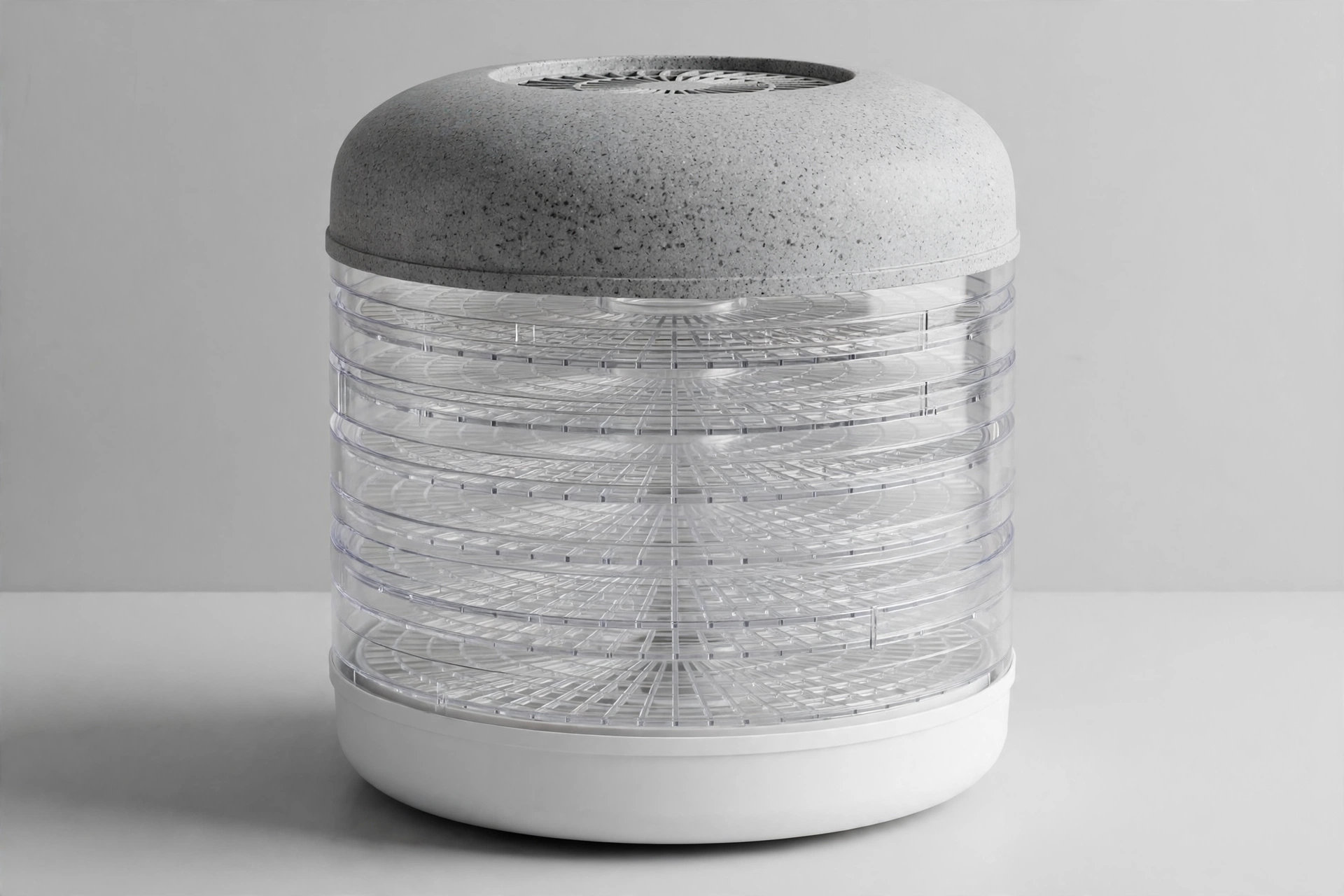
The NESCO FD-75A Snackmaster Pro is the category's staple name — the machine that shows up in roundup after roundup at BuyKitchenStuff and CrispyPicks, and the one many families buy first. It starts at five trays and expands to twelve, so capacity grows with your ambitions instead of forcing a second purchase when the garden gets bigger. The top-mounted Converga-Flow fan pushes air down and across the trays, which keeps the motor and heating element out of the drip zone and out of the cleaning.
The expandable design is the honest reason to choose it over the fixed-tray machines above. Buy five trays now for fruit and herbs; add trays later for a jerky season or a mushroom haul. The trade-off is airflow: a top-mounted fan is a vertical design, so trays dry at slightly different rates and benefit from a mid-batch swap — less even than the horizontal-flow machines, and a real consideration if you hate babysitting a batch. For buyers who want to start small and grow, it is still the most sensible mid-range pick.
Yay · Pros
- Expands from 5 trays to 12 — capacity grows with your harvest
- Top-mounted Converga-Flow fan keeps the motor out of the drip zone
- The category's staple name, in roundup after roundup
Hmm · Cons
- Vertical airflow dries trays unevenly — plan on a mid-batch tray swap
- Plastic trays rather than stainless
- Add-on trays are a separate purchase
Best for: first-time buyers who want to start small and expand as drying becomes a habit. Skip if: you want set-and-forget evenness — the rear-fan machines above do that better.
5. Hamilton Beach 32100A — Best budget with digital controls
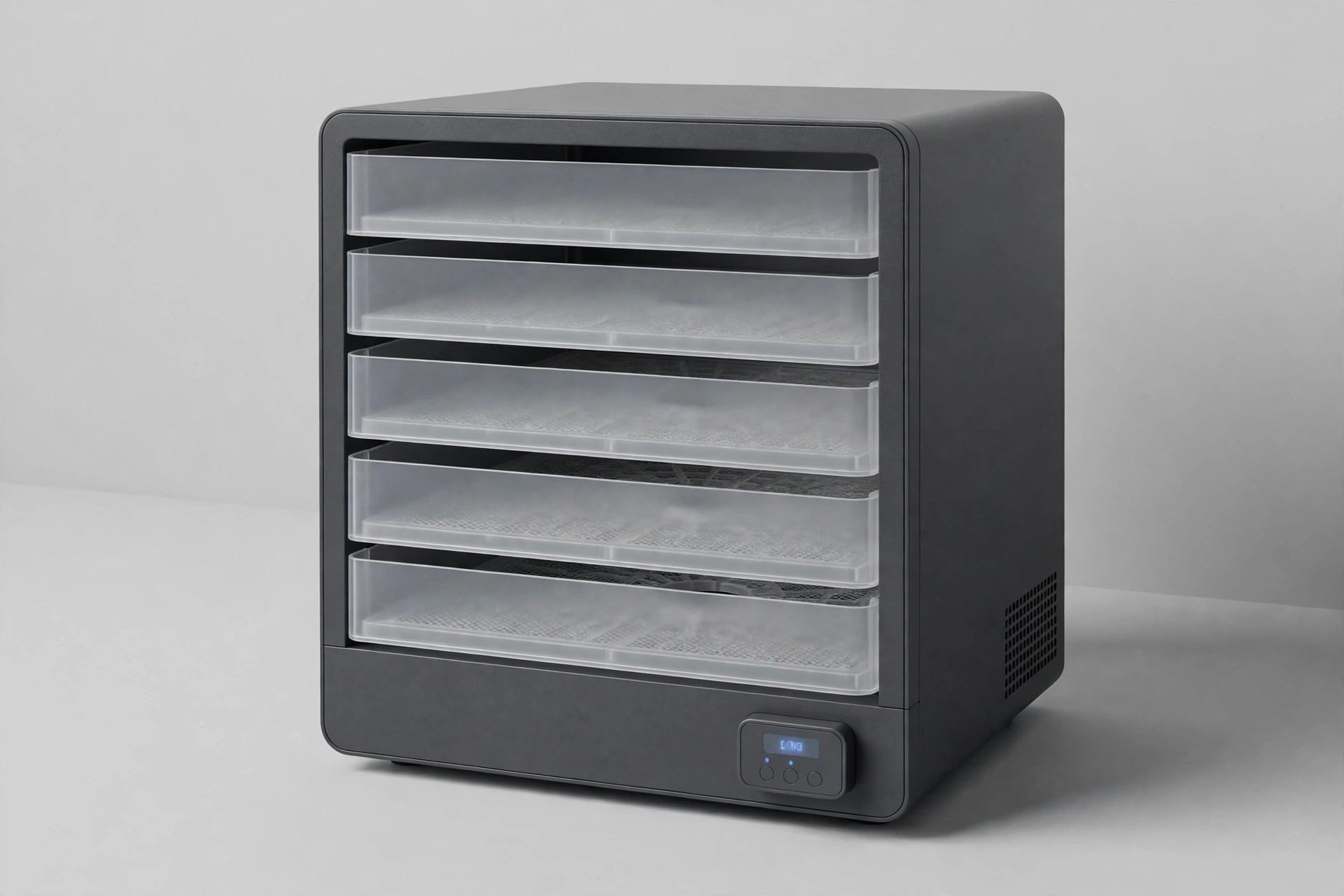
The Hamilton Beach 32100A is the budget pick at both BuyKitchenStuff and KitchenGuide101, and it earns that slot in an unusual way for a budget machine: it has digital controls. Most entry-level dehydrators make you guess with a dial; the 32100A lets you set a temperature and a timer and walk away, which is the difference between dried food and dried-out food when a batch runs long.
What the budget price gives up is refinement. The trays are plastic, the fan is a vertical design that dries the lower trays faster, and the capacity suits a household rather than a harvest. As a first dehydrator, a gift for a curious cook, or the honest answer for a family that dries fruit a few times a month, it remains the value benchmark of the category.
Yay · Pros
- Budget pick at both BuyKitchenStuff and KitchenGuide101
- Digital temperature and timer controls at an entry-level price
- Simple to use — the easiest first dehydrator here
Hmm · Cons
- Plastic trays rather than stainless
- Vertical airflow means uneven trays without rotation
- Household capacity, not harvest capacity
Best for: budget buyers, first-timers and anyone who wants digital controls without paying for them. Skip if: you dry in volume or hate rotating trays — the NESCO or the COSORI serve you better.
6. Presto 06300 Dehydro — Best bare-bones entry
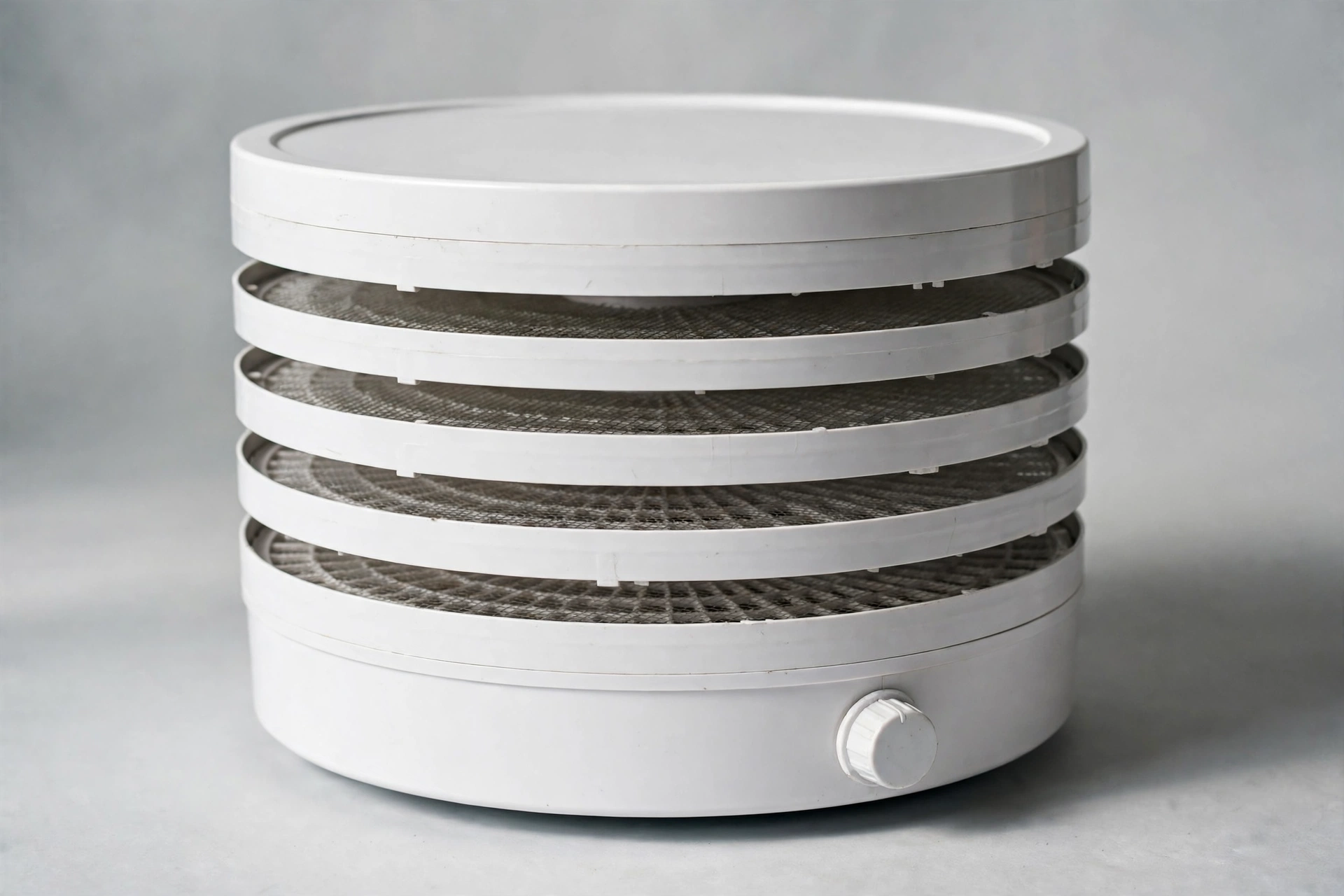
The Presto 06300 Dehydro is the simplest dehydrator on this list, and that is exactly why it is here. TruePicked notes it has been the reliable entry-level choice for 20+ years — a round stack of trays over a bottom fan, with a single dial and no timer. It does one job, drying food, and it has been doing it unchanged while fancier machines came and went.
The honesty here is about what you give up. There is no timer, so a batch that finishes at 2 a.m. sits until morning; there is no temperature display, so jerky safety depends on you checking doneness and finishing in the oven where needed; and the trays are plastic and need rotation. For a buyer who wants to try dehydrating before committing, or a cottage and camping setup where simple and cheap beats fancy, it remains the right first step — just buy it with open eyes.
Yay · Pros
- Reliable entry-level choice for 20+ years, per TruePicked
- The simplest, cheapest way to try dehydrating
- Light and easy to store between uses
Hmm · Cons
- No timer and no temperature display
- Bottom-fan design needs tray rotation
- Jerky needs an oven finish step for safety
Best for: trying dehydrating for the first time, cottages and camping setups, and tight budgets. Skip if: you already know you will dry regularly — the Hamilton Beach adds digital controls for little more.
Airflow, trays and temperature: what actually matters
Fan placement beats wattage. A rear fan blowing horizontally across the trays dries every tray at the same rate; a top or bottom fan blowing vertically dries the nearest trays first. If you hate rotating trays mid-batch, buy horizontal airflow — it is the single biggest quality-of-life difference in the category.
Tray material is a cleaning decision. Stainless trays wipe clean and take sticky fruit leather without a fight; plastic trays stain and need soaking. If fruit leather and jerky marinades are your main projects, stainless earns its keep. If you mostly dry apple slices and herbs, plastic is fine and lighter to handle.
Plan the storage before you buy the machine. Dried food keeps only as long as its storage does — airtight jars for the pantry, and vacuum sealing for anything you want to keep for months. Our pantry organizers guide covers the jars and bins, and our vacuum sealers guide covers the other half of the preservation workflow.
Food dehydrator questions, answered
Do I need to rotate trays while drying? On horizontal-airflow machines like the COSORI and Excalibur, no — every tray dries at the same rate. On vertical designs like the NESCO, Hamilton Beach and Presto, yes — swap the top and bottom trays halfway through the batch for even results.
Is jerky safe from a home dehydrator? Jerky needs to reach 160°F to be safe, per the USDA guidance, and most home units struggle to hold that temperature evenly — per TheConsumersGuide, most home jerky needs an oven finish step after dehydrating. Use a dehydrator with a real thermostat, check the temperature, and finish in the oven when in doubt.
Stainless or plastic trays? Stainless cleans easier, lasts longer and handles sticky foods better; plastic is lighter and cheaper. Heavy jerky and fruit-leather users should go stainless; occasional fruit and herb dryers will be happy with plastic.
How should I store dried food? Cool it fully first, then pack it airtight — jars with good seals for the pantry shelf, and vacuum-sealed bags for long storage. Our food storage containers guide covers the jars, and vacuum sealing is the best option for anything kept longer than a few weeks.
The short version
Buy the COSORI 6-Tray if you want the best all-rounder for a family kitchen. Buy the Excalibur 9-Tray if you preserve whole harvests and jerky in bulk. Buy the Magic Mill Pro if jerky and fruit leather are the whole point. Buy the NESCO FD-75A if you want to start small and expand, the Hamilton Beach 32100A if the budget leads, and the Presto 06300 if you just want to try dehydrating before committing. Everything else is airflow: buy horizontal if you hate rotating trays.
Last updated: November 16, 2026. We refresh this guide each season and whenever a pick is replaced by a better one.