One universal wine glass is enough for nearly every wine you will pour: a tulip bowl of roughly 400 to 650 ml with a thin, polished rim serves reds, whites and sparkling, and the Schott Zwiesel Pure is the most durable version of that glass. The wine-glass aisle wants you to believe you need a different vessel for every grape, in crystal that fears the dishwasher. The truth, which sommeliers have quietly acted on for a decade, is that one well-shaped universal glass serves nearly everything beautifully — and that the money is better spent on the wine. This guide ranks the universal glasses worth owning at three budgets, adds the classic varietal pair for households that drink seriously in one direction, and finishes with the mouth-blown flagship for people who simply want the finest object.
Every pick was checked for the things that actually change a sip: bowl shape and volume, a rim thin enough to disappear, lead-free crystal, and — because a broken set is a useless set — the maker’s dishwasher rating and the pattern of how owners say these glasses survive real kitchens in Canada and the US. If your wine life is mostly bottles rather than glasses, the best wine decanters and aerators in Canada and the USA guide handles what happens before the pour, and the best insulated tumblers in Canada and the USA guide covers the glasses’ everyday cousins for water, juice and everything else.
Disclosure: CookSmartPicks is reader-supported. When you buy through links on this page, we may earn an Amazon commission at no extra cost to you. Prices and availability change often — check the current price on Amazon before you decide.
How we chose these wine glasses
We built the shortlist around the question households actually face — one universal glass or a varietal set — and required every pick to state its case on the measurable basics: bowl volume and shape, rim thinness (a rolled bead rim disqualifies a glass at this level), stem weld quality, and the maker’s own dishwasher rating, because a glass that cannot survive your kitchen’s real washing routine is a rental, not a purchase. Crystal composition was checked from maker specifications — lead-free formulations only.
Durability evidence came from the pattern of owner reports over years rather than star averages: how a glass dies (stem snap, rim chip, dishwasher clouding) tells you more than how it arrives. Canadian availability and replacement singles mattered too — a set you cannot top up after a breakage is a countdown. Two fashionable oversized designs were cut for bowls so large that a standard pour looks lost and swirling becomes weightlifting.
The lineup at a glance
| Product | Best for | Why it stands out |
|---|---|---|
| Schott Zwiesel Pure (Tritan Crystal, Universal) | Best overall (universal) | The universal glass that survives real life: Tritan crystal, dishwasher-safe, sommelier-shaped |
| Riedel Vinum Cabernet/Merlot (Set) | Best varietal classic | The varietal original: machine-blown Austrian crystal tuned for Bordeaux reds |
| Gabriel-Glas StandArt (Universal) | Best refined universal | The tasters’ universal: Austrian, feather-fine, one glass for everything |
| Libbey Signature Greenwich (Set of 12) | Best for entertaining in quantity | The party fleet: proper bowls, restaurant toughness, a price that forgives breakage |
| Zalto Universal (Mouth-Blown) | Best splurge (mouth-blown) | The summit: mouth-blown, impossibly light, the sommeliers’ desert-island glass |
1. Schott Zwiesel Pure (Tritan Crystal, Universal) — Best overall (universal)
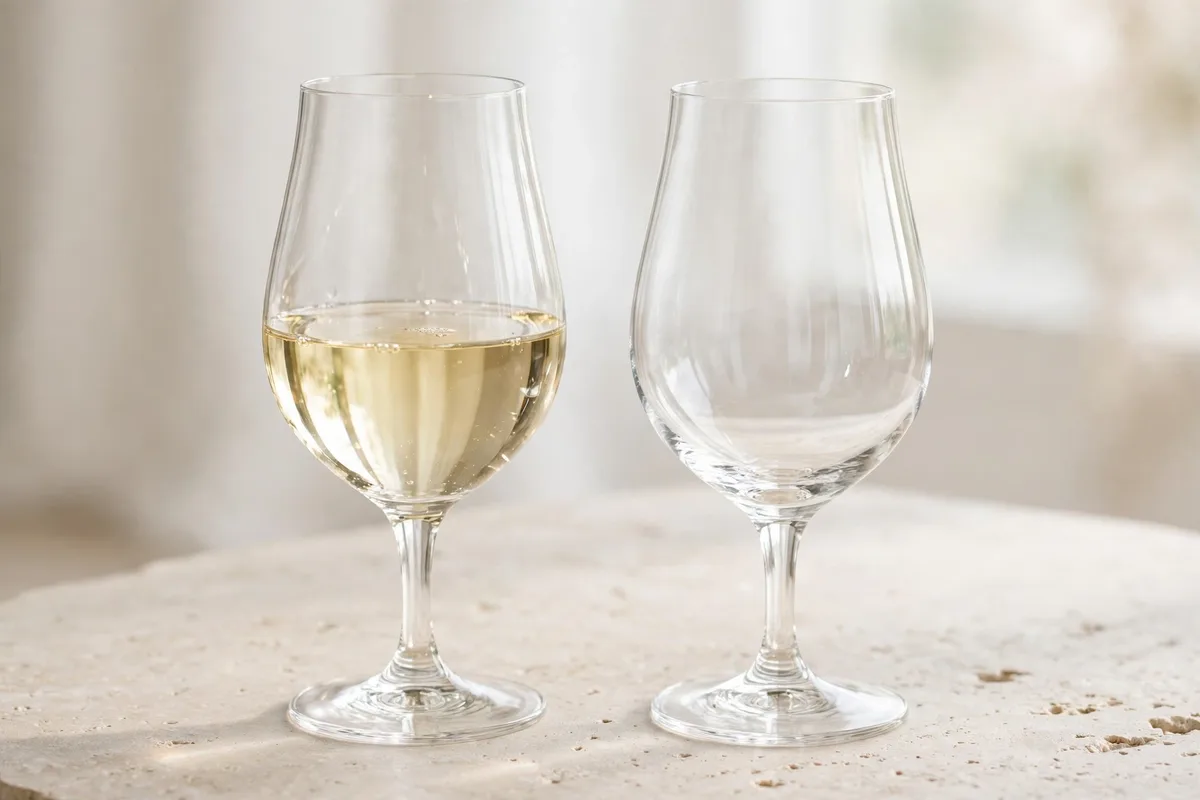
The Pure line is the strongest argument in this guide for buying one glass and stopping: a Tritan crystal universal with a tulip bowl that flatters reds, whites and sparkling in turn, a thin polished rim, and a durability record — Tritan is Schott Zwiesel’s titanium-strengthened, lead-free crystal — that survives dishwashers and dinner parties at rates ordinary crystal cannot match. The maker rates the line dishwasher safe outright, and years of owner reports agree: these are the good glasses that do not die.
The bowl shape deserves its reputation. At roughly 18 ounces of capacity with the widest point low and a gently narrowing chimney, it swirls a standard pour generously and delivers aroma the way the textbooks describe — concentrated, not scattered. The stem is pulled with the bowl for a seamless, stronger joint, and the whole glass has the balanced, slightly substantial hand-feel that makes people guess it costs twice its price. Pure comes in several sizes; the all-purpose is the one to stock.
For Canadian households this is also the logistically kind pick: widely stocked domestically, sold in sets that go on sale predictably, and replaceable one breakage at a time without orphaning the set. Buy six or twelve, run them through the dishwasher, and spend the savings on the second bottle. If this guide had to be one sentence, the Pure would be most of it.
Pure’s decade-scale owner pattern is the set that never got replaced: households report the same glasses in service after years of weekly dishwashing, with losses counted in single stems rather than sets — the durability claim, verified in the only laboratory that matters.
Yay · Pros
- Tritan crystal: break-resistant, dishwasher safe
- True universal bowl — reds, whites, sparkling
- Replaceable singles; widely stocked in Canada
Hmm · Cons
- Machine-blown uniformity lacks handmade character
- Popular sizes sell out in Canadian retail
- Not the lightest glass here
Best for: Most households — the one-glass answer, in quantity Skip if: You want the feather-light, mouth-blown experience and accept the care it needs
2. Riedel Vinum Cabernet/Merlot (Set) — Best varietal classic

Riedel invented the varietal glass, and Vinum — the company’s machine-blown crystal line, in production since 1986 — remains the reference set for households that drink one style deeply. The Cabernet/Merlot glass pairs a generous bowl with a rim diameter tuned, in Riedel’s varietal doctrine, to frame tannin and dark fruit; whether or not you buy the full doctrine, the glass is beautifully made, with a fine polished rim and the balanced thinness that makes a big red feel composed rather than bulky.
Machine-blown in Austria from lead-free crystal, Vinum glasses are dishwasher safe per the maker (top rack, stem holders, no heated dry is the prudent reading of that claim), and they carry the line’s decades-long owner record: the stems are slimmer than Tritan’s and snap more readily in careless handling, while the bowls are tougher than their delicacy suggests. Buy the shape for the wine you actually drink — Cabernet for Bordeaux varieties, the XL or the Riesling glass if whites rule your table.
In Canada, Vinum is the easiest premium line to source and top up, sold through the brand’s own store and national retailers, which matters for a varietal investment you will extend over years. For the household whose cellar leans red and whose dinners are built around it, this remains the classic, defensible splurge — the varietal exception this guide happily makes.
Vinum’s stems reward a moment of technique: lift by the stem or the base, never twist a glass by the bowl while its stem is held by a dishwasher rack — the classic snap that owners blame on the glass and physics blames on the torque. Handled sanely, the line serves for decades.
Yay · Pros
- The original varietal system, machine-blown in Austria
- Fine rim and balance for serious reds
- Deep Canadian retail; easy to extend the set
Hmm · Cons
- Varietal commitment — a second shape for whites
- Thinner stems than Tritan; handle with respect
- Replacement singles cost more
Best for: Serious red-wine households that want the classic varietal benchmark Skip if: You drink widely across styles — a universal serves you better
3. Gabriel-Glas StandArt (Universal) — Best refined universal

Gabriel-Glas built its reputation on a single idea executed beautifully: one glass — the StandArt — shaped to serve every wine, with a slightly wider bowl base and a distinctive gentle cone that concentrates aroma toward the rim. It is machine-blown in Austria from lead-free crystal, noticeably lighter and finer than the workhorse picks, with a rim that approaches the mouth-blown flagship’s disappearing act. Wine professionals adopted it as a tasting glass for a reason: it is honest to the wine in a way tasters describe as transparent.
In the hand and on the table, the StandArt splits the difference between the durable universals and the Zalto: finer than Tritan, sturdier than mouth-blown, dishwasher tolerant per the maker though most owners hand-wash out of respect for the price. The bowl (about 16.5 ounces) is sized for standard pours with room to work, and the glass photographs like stemware three times its price — not a trivial virtue in the hosting era.
Canadian availability runs through specialty wine retailers rather than the big boxes, which is the pick’s one friction. For the household that drinks thoughtfully, entertains modestly, and wants one beautiful glass rather than a cupboard of compromises, the StandArt is the connoisseur’s universal — the step up that does not yet demand the flagship’s ritual.
The StandArt has become a quiet standard in winery tasting rooms, which gives home buyers an unusual evidence base: if a glass survives being poured, swirled and washed hundreds of times a season by professionals, its delicacy at your table is a manageable quantity.
Yay · Pros
- One-glass design beloved by wine professionals
- Feather-fine rim; lighter than workhorse crystal
- Machine-blown consistency at near-flagship feel
Hmm · Cons
- Fewer Canadian stockists than the big two
- Costs more than the Tritan workhorse
- Delicate enough to reward careful handling
Best for: The one-glass purist who wants near-flagship feel at a mid price Skip if: Your dishwasher does the washing and breakage is a weekly sport
4. Libbey Signature Greenwich (Set of 12) — Best for entertaining in quantity

Every hosting household eventually faces the dozen-glass problem: a dinner for ten should not require a mortgage of crystal. Libbey’s Signature line is the working answer — proper tulip bowls in sensible sizes, a rim that, while not crystal-fine, is honestly finished, and soda-lime glass thick enough to survive the party, the cleanup and the dishwasher’s worst behaviour. Libbey, an American glassmaker since 1818, builds these for the restaurant trade’s realities, and it shows in the breakage pattern: they die rarely and cheaply.
The Greenwich and Greenwich-style stems in the Signature family pour a handsome table: the bowl shape follows the universal logic (generous base, narrowing top), the stems are short and sturdy, and a dozen on a white cloth read as intentional rather than economized — especially once the wine is in them, which is rather the point. They are the glasses guests get handed without the host’s stomach tightening at every toast.
Buy these as the party fleet even if finer glasses anchor the two-person dinners; the arithmetic of entertaining demands a glass whose loss is a shrug. Widely available in Canada through restaurant-supply and home retailers, replaceable forever, and honest about what they are — the fleet pick that makes the flagship picks possible.
Libbey’s fleet economics complete themselves at the first party: when a glass inevitably falls, the host who stocked Signature shrugs and sweeps, while the host who stocked flagships remembers the moment. Entertaining is a mood, and this pick is priced to protect it.
Yay · Pros
- Restaurant-tough; priced for a dozen
- Proper universal bowl shape
- Dishwasher-proof in practice, not just in print
Hmm · Cons
- Rim thicker than the crystal picks
- Heavier, less refined hand-feel
- Not crystal — soda-lime glass
Best for: Hosts who need a dozen good glasses without a flagship invoice Skip if: You are buying two glasses for fine wine, not twelve for a party
5. Zalto Universal (Mouth-Blown) — Best splurge (mouth-blown)

The Zalto Universal is the glass sommeliers name when asked what they would drink from on a desert island, and holding one explains why: mouth-blown in Austria, it weighs almost nothing, the bowl flexes perceptibly in the hand, and the rim is so fine the wine seems to arrive without an intermediary. The shape — bowl angles reportedly inspired by the tilt of the Earth’s axis, in the maker’s telling — gives a standard pour a wide surface and a focused chimney, and tasters consistently describe wines as more expressive in it than in machine-made glass.
The terms are absolute: hand-wash, always, with the ritual the brand prescribes; store it where nothing can knock it; accept that a tile floor is a death sentence and a careless guest a bereavement. Zalto owners do not describe these as costs so much as the terms of a relationship, and the glass rewards the devotion every single pour. It is dishwasher-rated by no one, including Zalto, whatever the internet claims.
In Canada it is a specialty-retail purchase with intermittent stock — buy when you find it, in pairs. This is not the practical recommendation; it is the summit the guide acknowledges honestly, for the reader whose wine budget already lives at a level where the glass is the cheapest part of the evening. For that reader, nothing else on this page is the answer.
Zalto ownership has a recognizable arc: the first glass is bought with ceremony, the second pair within the year, because drinking the same wine from the Zalto and from anything else, side by side, is the demonstration that converts — and owners warn each other about exactly that.
Yay · Pros
- Feather-light; the finest rim in the category
- Tasters’ consensus favourite for fine wine
- Mouth-blown Austrian craftsmanship
Hmm · Cons
- Hand-wash ritual; fragile by design
- The most expensive glass here by far
- Canadian stock is specialty-only and sporadic
Best for: The fine-wine devotee buying the finest object, eyes open Skip if: Your household breaks glasses — this one demands a hand-wash ritual
One great glass or six specific ones? The honest shape debate
Bowl volume between roughly 400 and 650 ml covers nearly all still wine with room to swirl; beyond that range, varietal shape differences shrink below what most palates can detect. The wine-glass industry’s fondest hope is that you buy a shape per grape. The physics supports only a fraction of that hope. What genuinely matters: a bowl wide enough to swirl without spilling (surface area for aroma), a rim narrower than the bowl’s widest point (to concentrate what you swirled loose), thin walls (the wine, not the glass, should set the temperature of the sip), and a stem if you drink whites chilled (hands warm bowls). Bowl volume between roughly 400 and 650 ml covers nearly all still wine with room to swirl; beyond that, shape differences shrink below most palates’ resolution.
The varietal extremes — a balloon for pinot, a flute-narrow tower for riesling — make real but small differences, detectable in side-by-side tastings and largely irrelevant across a Tuesday dinner. Sommeliers themselves have been migrating to one universal glass for a decade, which is why this guide’s spine is universal designs at three budgets, with the varietal pair included as the honest exception for households that drink a lot of cabernet and want its tannins framed.
Flutes deserve the myth-busting paragraph: the tall narrow flute preserves bubbles but strangles aroma, and sparkling wine — especially good sparkling wine — shows better in a universal or white-wine glass where it can breathe. Keep the flutes for the toast photograph if you love them; pour the good bottle into the universals. Your guests will taste the difference even if they cannot name it.
Dishwasher reality, stated once for the whole category: modern machine-blown glasses from the major makers are engineered for dishwashers — the killer is not the wash but the handling (loading collisions, unloading chips, detergent etching over hundreds of cycles in soft water). Stemless designs and short stems survive households best; the mouth-blown flagship survives best with a hand-wash ritual its price justifies. Match the glass to the household’s actual washing behaviour, not its aspirations — a chipped varietal set serves worse wine than a whole universal set.
And stemless, briefly: it trades temperature control (your hand is on the bowl) and table elegance for stability, dishwasher friendliness and price. For casual reds at room temperature, stemless is entirely respectable; for chilled whites and fine wine, a stem earns its fragility. Several makers in this guide offer stemless siblings of their stems — buy the shape you will still own, unbroken, in three years.
One specification quietly predicts a glass’s lifespan better than its price: stem construction. A pulled stem — drawn from the same gather of glass as the bowl — has no seam to fail, while a joined stem carries a weld line that is where most stems eventually snap; every pick in this guide uses quality construction, but the workhorse Tritan’s reinforced stem is precisely why its breakage pattern runs years behind ordinary crystal’s.
Wine glass questions, answered
Do I really need different glasses for red and white wine?
For most households, no. A well-designed universal glass (roughly 400–500 ml, tulip-shaped) serves reds, whites and sparkling beautifully — the differences between varietal shapes are real but small, and they vanish entirely next to serving temperature and the wine itself. Add a varietal pair only if one style (big reds, delicate whites) dominates your drinking.
Can good wine glasses go in the dishwasher?
The quality machine-blown glasses in this guide are explicitly made for it — Schott Zwiesel’s Tritan and Riedel’s Vinum lines are dishwasher-rated by their makers. The rules: load stems secured and not touching, skip the heated-dry cycle, and use modest detergent. Mouth-blown glasses like the Zalto should be hand-washed; the ritual is part of their price.
How many wine glasses should I own?
Four to six universals cover a couple and small dinners; entertainers should think in dozens of a mid-priced glass rather than six of a flagship, because parties break glasses and matching replacements matter. A common professional pattern: one good universal for daily use in quantity, plus a pair of something special for the two-glass evenings.
What does ‘thin rim’ actually mean for taste?
Thinner than a wedding ring’s edge, ideally — a thin, polished (not beaded) rim disappears on the lip and lets the wine land where it should. Rolled or beaded rims are durability features on cheap glassware and you can taste them. Run a fingertip around the rim in the store: the best glasses in this guide feel like almost nothing.
What is Tritan crystal, and is it really more durable?
It is a lead-free crystal formulation with titanium and zirconium oxides, made by Schott Zwiesel; the maker’s claim is breakage and chipping resistance well beyond ordinary crystal, plus dishwasher durability. Independent owner experience over years backs the durability story — Pure and its siblings survive households that eat ordinary crystal. It will not survive a tile floor; nothing glass does.
Is a universal glass really okay for Champagne?
Yes, and better than in a flute for anything you actually want to taste: a universal or white-wine glass gives sparkling wine surface area to open up while keeping the bead lively for the length of a normal pour. Flutes win only on bubble preservation over a long, slow toast — a fair trade for a wedding, a poor one for a good bottle at dinner.
Weight is the last quality signal your hand reads before your eyes do: a well-made glass balances at the stem’s midpoint when empty and never feels bowl-heavy, which is why a full set should be handled, not just admired, before committing. The picks above all pass that hand test — it is the unglamorous reason none of them feels tiring across a long dinner, and the first thing a cheap set gets wrong.
The short version
For one glass that does everything and survives the dishwasher, buy the Schott Zwiesel Pure; step up to the Gabriel-Glas StandArt for a finer, lighter universal. Riedel Vinum remains the varietal classic for red-wine households, Libbey Signature solves the dozen-glass party problem, and the Zalto Universal is the mouth-blown summit for those who accept its ritual. Spend the difference between them on wine.
Last updated: November 18, 2026. We refresh this guide each season and whenever a pick is replaced by a better one.