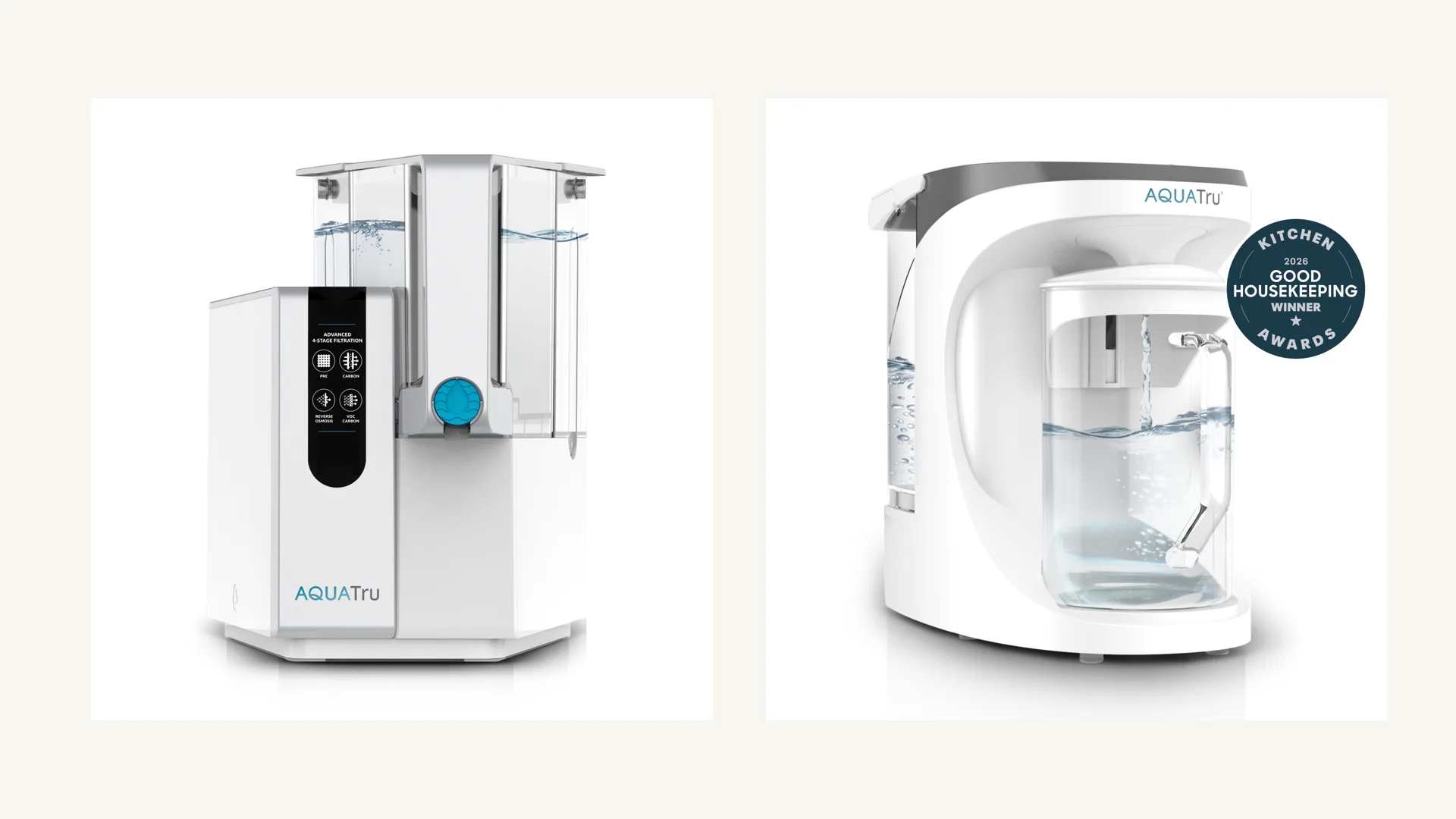
A countertop reverse osmosis filter does the same job as the big under-sink systems — pushing water through a membrane fine enough to strip out lead, PFAS chemicals and microplastics — without a plumber, a drill, or permission from a landlord. You fill a tank, press a button, and get a carafe or a glass of purified water a few minutes later. It is the easiest serious upgrade you can make to your drinking water.
One distinction runs through this whole guide, and it matters more than any feature list: the difference between a certified reduction and a lab-tested claim. Only the two AquaTru models here carry independent certification (IAPMO, to NSF/ANSI standards) for the contaminant reductions they advertise. Every other brand below bases its numbers on SGS or manufacturer laboratory testing — which can be perfectly good work, but it is the brand grading its own homework. We say which is which in every single pick, so you can decide how much that matters to you.
Countertop RO Filters at a Glance
| Filter | Format | Pure-to-drain | Standout point |
|---|---|---|---|
| AquaTru Classic | Internal tank dispenser | Not the focus — certified depth is | Only fully certified claim set here (IAPMO to NSF/ANSI 42/53/58/401/372) |
| AquaTru Carafe | 64 oz glass carafe | Not stated by maker | Certified filtration in a slim 7.5-inch body |
| Bluevua RO100ROPOT | Borosilicate glass carafe | 2:1 | Glass carafe plus remineralization (SGS-tested claims) |
| Bluevua RO100ROPOT-UV | Glass carafe + UV | 2:1 | UV stage for stored water, plus minerals |
| Waterdrop CoreRO C1S | Compact dispenser | 3:1 | Smallest footprint here, about 8.3 inches wide |
| Waterdrop C2SL Mineral | 40 oz glass pitcher | 3:1 | Mineral stage tuned for taste |
| Waterdrop K19-H | Instant-hot dispenser | — | Purified hot water at four temperatures |
| SimPure Y7P-BW UV | Dispenser + UV | 4:1 | Best water efficiency in this guide |
| SimPure Y7T-A | Glass pitcher, alkaline | 4:1 | Alkaline stage with a serving pitcher |
| Frizzlife WB99 | Pitcher system | 3.5:1 | Alkaline filter, TDS display, preset volumes |
How We Researched This Guide
CookSmartPicks is a research-based guide. We do not run a test kitchen, and we never claim hands-on testing we have not done. For this guide we compared manufacturer specifications and certification listings, independent specialist coverage from water-filter publications, retailer listings in Canada and the USA, and owner reviews, then ranked the picks by filtration evidence first and everyday usability second. Product photos are the makers' own listing photos.
Where a product carries scores in this guide, they are CookSmartPicks editorial scores, set from the research in each section — the certification record, the water efficiency, the filter-change burden and the format. Where a score leans on a published test or certification, the basis line under the bars says so.
How we score
The scores in this guide are CookSmartPicks’ own editorial ratings. We set them from our research of the expert reviews and sources listed in this post — they are our ratings, not scores quoted from another publication.
1. AquaTru Classic — Best Overall
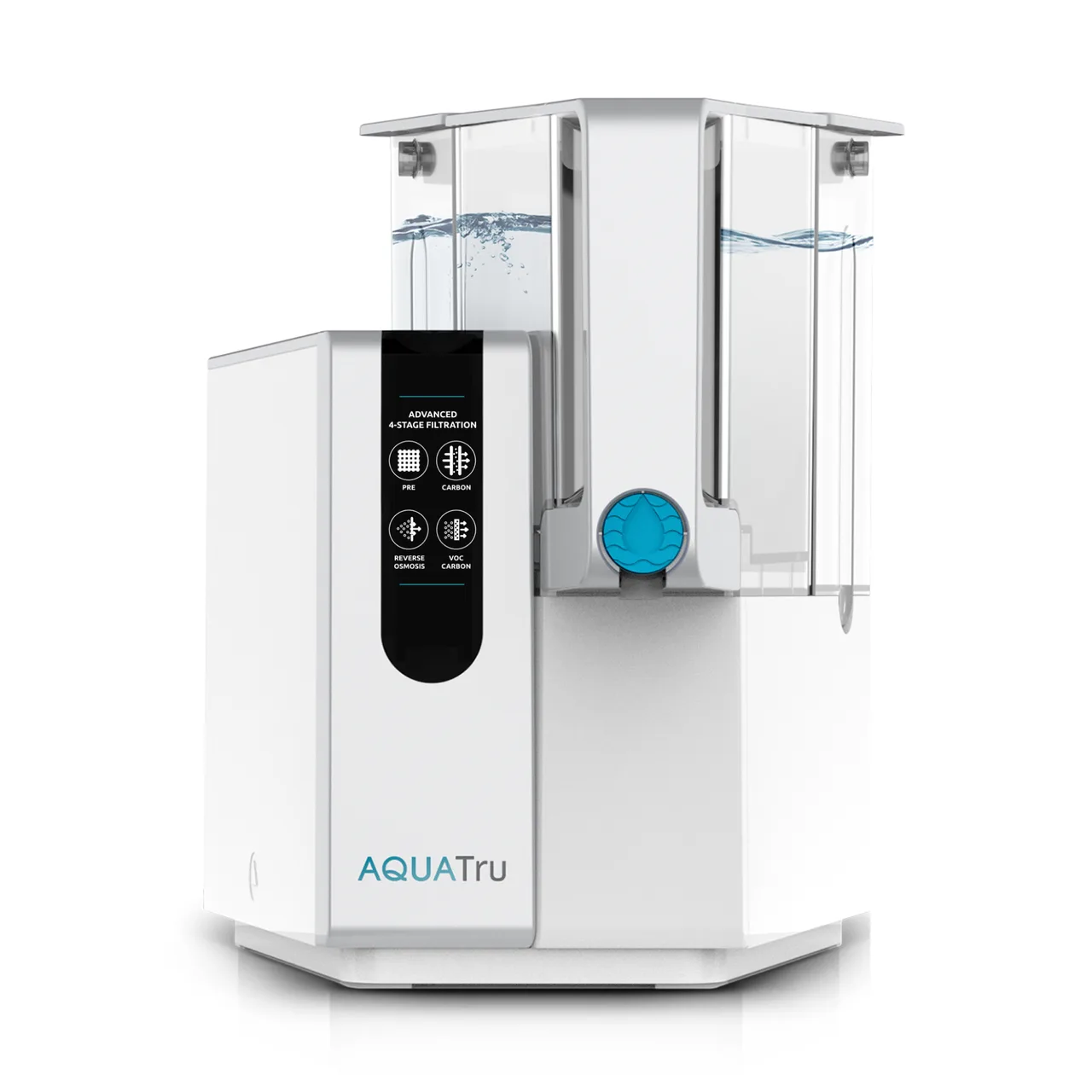
If you are buying an RO filter mainly because of what might be in your water, this is the one where the reassurance is documented rather than promised. The Classic is IAPMO certified to NSF/ANSI standards 42, 53, 58, 401 and 372, covering 84 contaminants — including certified reduction of PFOA and PFOS (the headline PFAS chemicals) under Standard 53 and microplastics under Standard 401. No other machine in this guide can say that; it is why the Classic sits at number one despite doing nothing flashy.
Day to day, it is a straightforward tank dispenser: fill it, let it filter, pour. The RO filter is rated for up to two years, the longest change interval here, which quietly lowers the running cost. What it does not do: add minerals back (some people find the taste flat), chill or heat the water, or store it in glass. Buy it for the certificate, not the features.
Yay · Pros
- Certified PFOA and PFOS reduction under NSF/ANSI 53
- Certified microplastics reduction under NSF/ANSI 401
- IAPMO certified to NSF/ANSI 42, 53, 58, 401 and 372 for 84 contaminants
- RO filter rated up to two years — the longest cadence here
Hmm · Cons
- No remineralization stage, so taste can seem flat
- Room-temperature water only — no hot or chilled dispensing
- Internal plastic tank rather than a glass carafe
Best for: anyone buying mainly for PFAS, lead or microplastics who wants those reductions certified, not promised. Skip if: anyone who wants minerals added back, a glass carafe, or hot water.
2. AquaTru Carafe — Best Glass Carafe, Certified
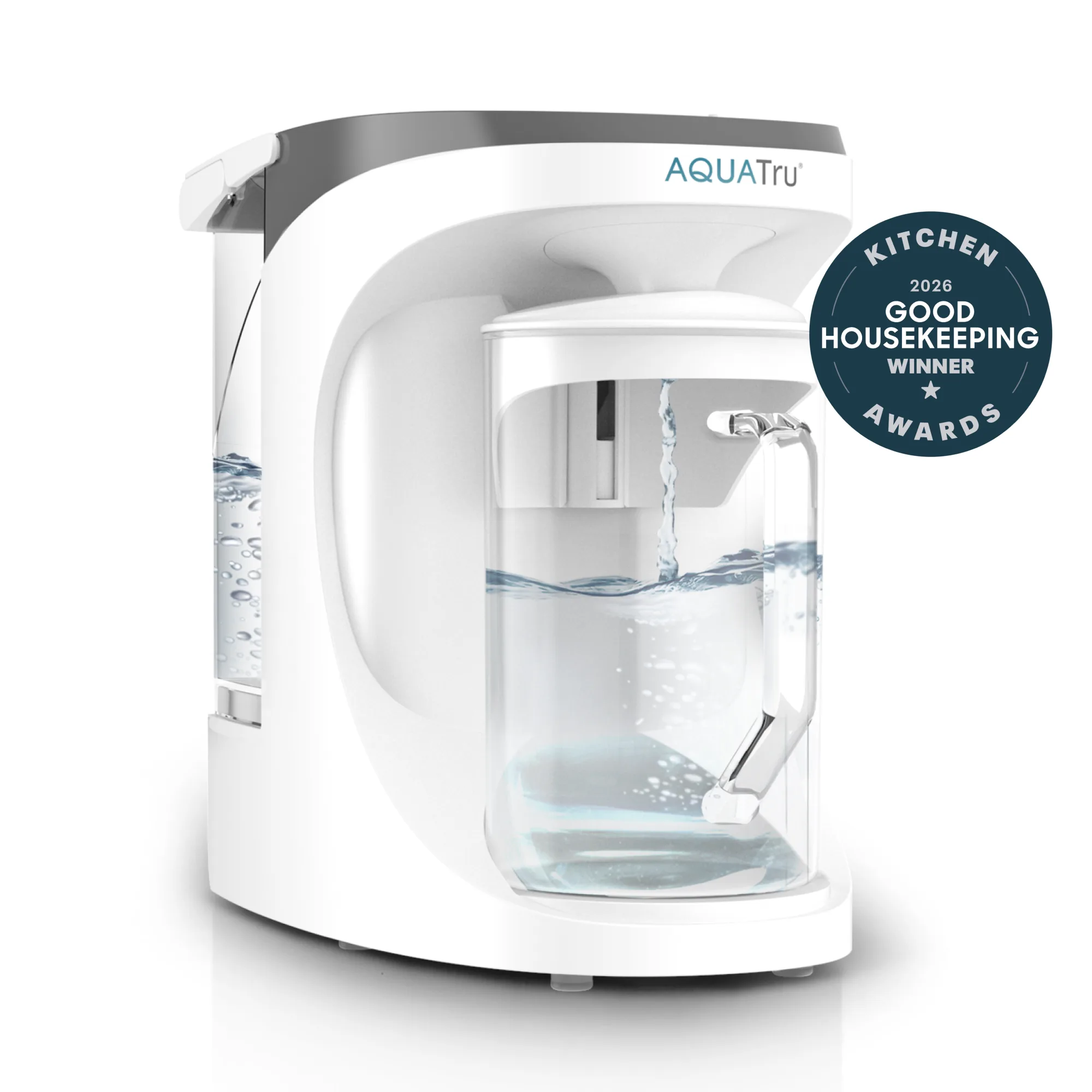
The Carafe takes the Classic's certified filtration and puts the clean water in a 64-ounce glass carafe instead of a plastic tank — the format a lot of people actually want on the table. The certified story carries over: PFOA/PFOS reduction under NSF/ANSI 53 and microplastics under 401, in a body only about 7.5 inches wide, which makes it the slim certified option for small counters. Specialist coverage at WaterFilterGuru rated it their top countertop RO pick.
The trade-offs are about volume and filters. One carafe per cycle means a bigger household will run it again and again through the day, and the Carafe's filters are its own — they do not swap with the Classic's, so check replacement costs for this model specifically. The maker does not state a pure-to-drain ratio in the materials we reviewed.
Yay · Pros
- Certified PFOA/PFOS and microplastics reduction in a glass-carafe design
- Narrow 7.5-inch-wide body suits small counters
- 64-ounce glass carafe for the table or fridge
- Ranked the top countertop RO pick in WaterFilterGuru coverage
Hmm · Cons
- One carafe per cycle means repeat runs for larger households
- Carafe filters are model-specific and not shared with the Classic
- Pure-to-drain ratio not stated in manufacturer materials reviewed
Best for: one- to three-person households who want certified filtration and glass storage in a slim body. Skip if: larger families who would be re-running the cycle all day.
3. Bluevua RO100ROPOT — Best Glass Carafe with Remineralization
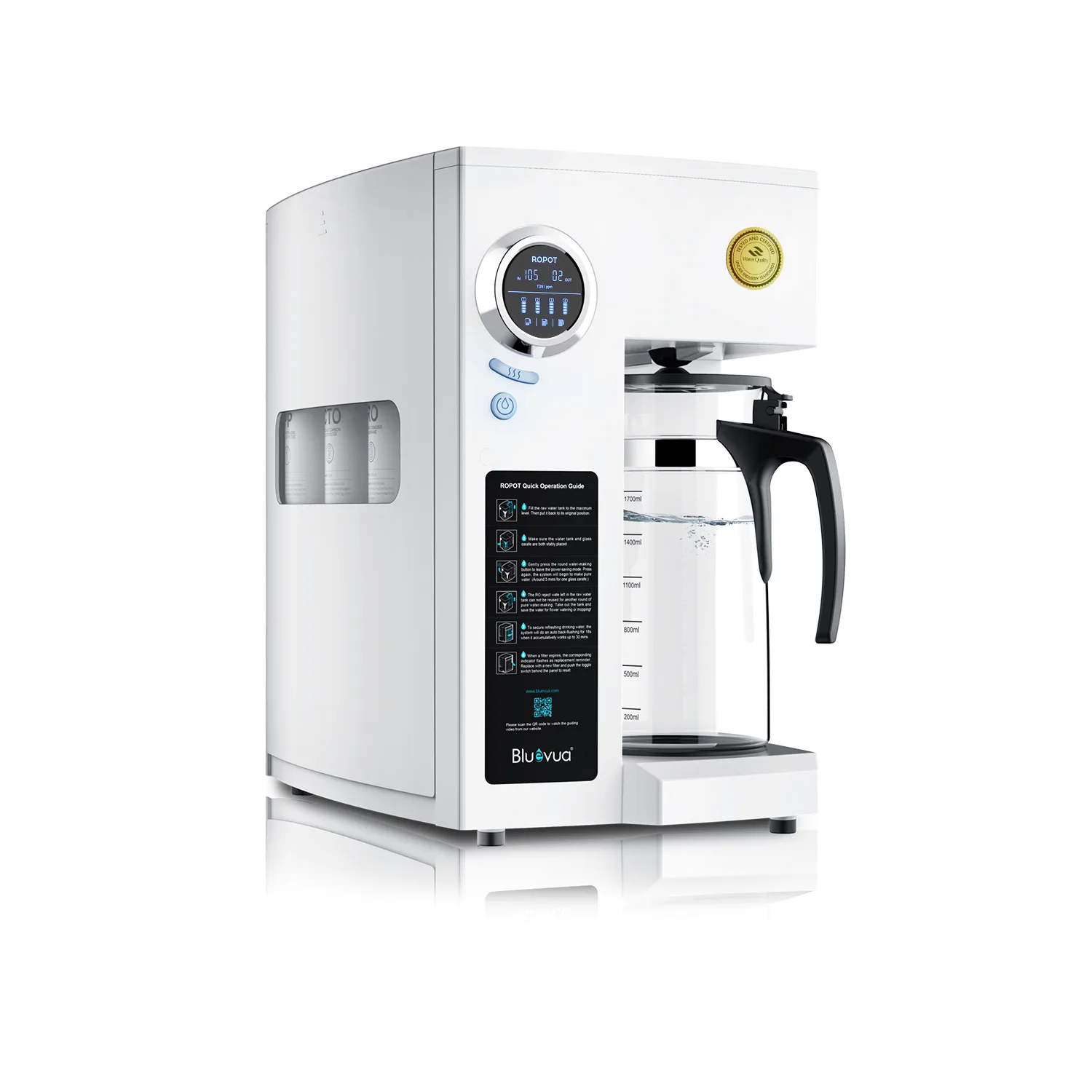
Bluevua's ROPOT line shows up in specialist roundup after roundup, and the pitch is easy to understand: a borosilicate glass carafe, five-stage filtration, and a remineralization filter that puts minerals back so the water tastes like water instead of nothing. A display tracks filter life and water quality, and the reject water stays in the tank where you can see it — many owners reuse it for plants and cleaning rather than pouring it away.
Hold the evidence to the right standard, though. Bluevua's reduction numbers are SGS lab-tested claims, not certified reductions, and the WQA certification attached to this model covers lead-free materials (NSF/ANSI/CAN 372) — a materials credential, not a filtration one. The 2:1 pure-to-drain ratio is also the thirstiest in this guide alongside its UV sibling. A good package — just know what kind of proof sits behind it.
Yay · Pros
- Borosilicate glass carafe instead of a plastic tank
- Remineralization filter adds minerals back for taste
- Display tracks filter life and water quality
- Reject water stays in the tank for household reuse
Hmm · Cons
- Reductions are SGS lab-tested claims, not certified reductions
- WQA certification covers lead-free materials (NSF/ANSI/CAN 372) only
- 2:1 ratio is less efficient than the 3:1 and 4:1 picks here
Best for: readers who want a glass carafe and mineral taste, and accept lab-tested rather than certified claims. Skip if: anyone who needs certified PFAS reduction — choose an AquaTru above.
4. Bluevua RO100ROPOT-UV — Best with UV and Remineralization
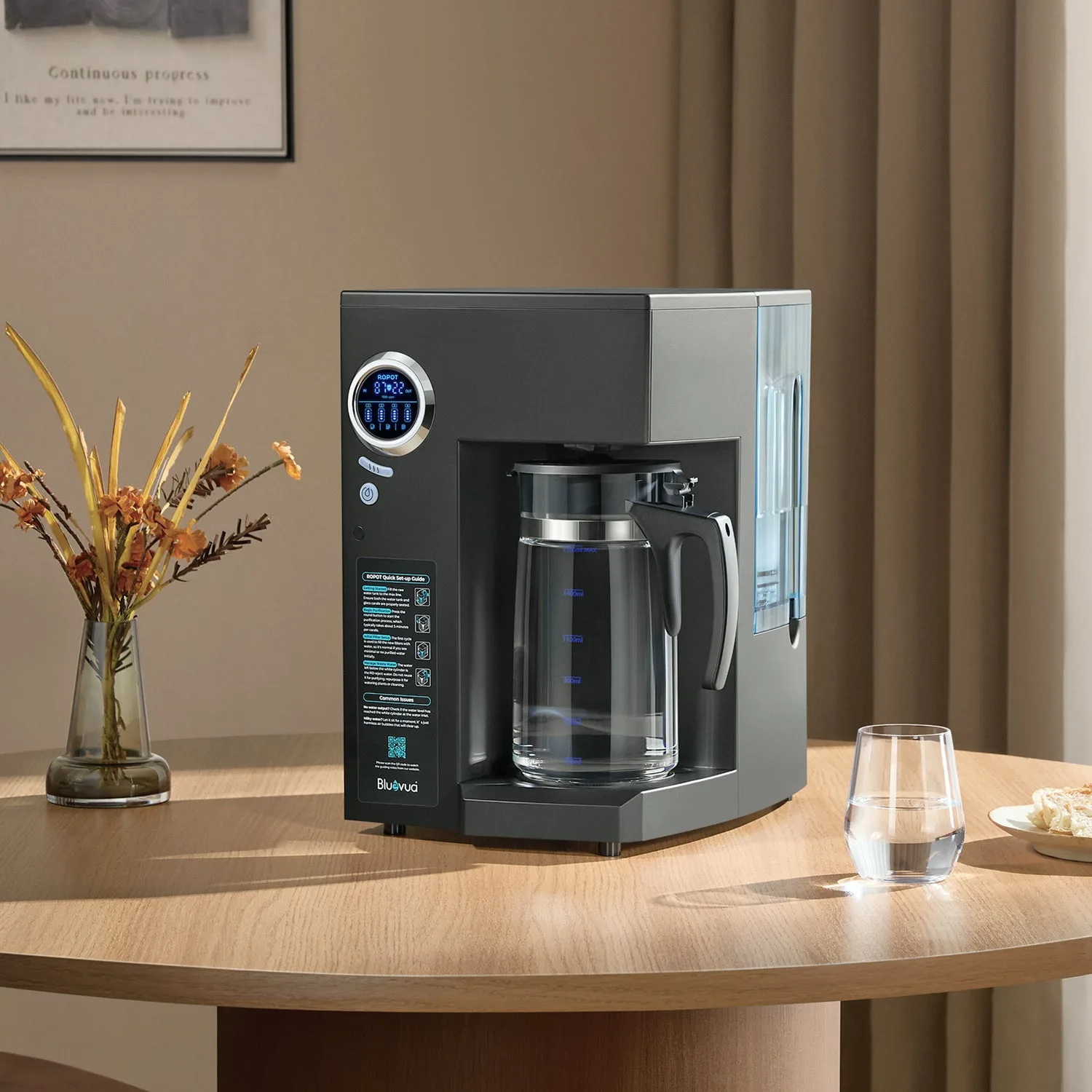
The ROPOT-UV adds a sixth stage — ultraviolet light — to the same glass-carafe formula. UV does a different job from the membrane: RO handles what is dissolved in the water, while UV deals with the hygiene of water sitting stored in a carafe between uses. Add the remineralization filter, the filter-life and water-quality display, and a power-saving standby, and this is the most complete glass-carafe feature set in the guide.
The evidence basis is the same as its sibling's, and we score it the same way: reductions are SGS lab-tested claims, certification is lead-free materials only (NSF/ANSI/CAN 372), and the 2:1 pure-to-drain ratio uses more water than the 3:1 and 4:1 machines below. If you store purified water rather than drinking it straight away, the UV stage is a sensible reason to pick this one over the standard ROPOT.
Yay · Pros
- UV stage addresses stored-water hygiene between uses
- Remineralization filter for a less flat taste
- Glass carafe with filter-life and water-quality display
- Power-saving standby when idle
Hmm · Cons
- Reductions remain SGS lab-tested claims, not certified reductions
- Certification is lead-free materials (NSF/ANSI/CAN 372) only
- 2:1 pure-to-drain ratio trails the most efficient picks
Best for: households who store purified water in the carafe and want UV plus minerals. Skip if: anyone prioritising certified reductions or the lowest water waste.
5. Waterdrop CoreRO C1S — Best Compact
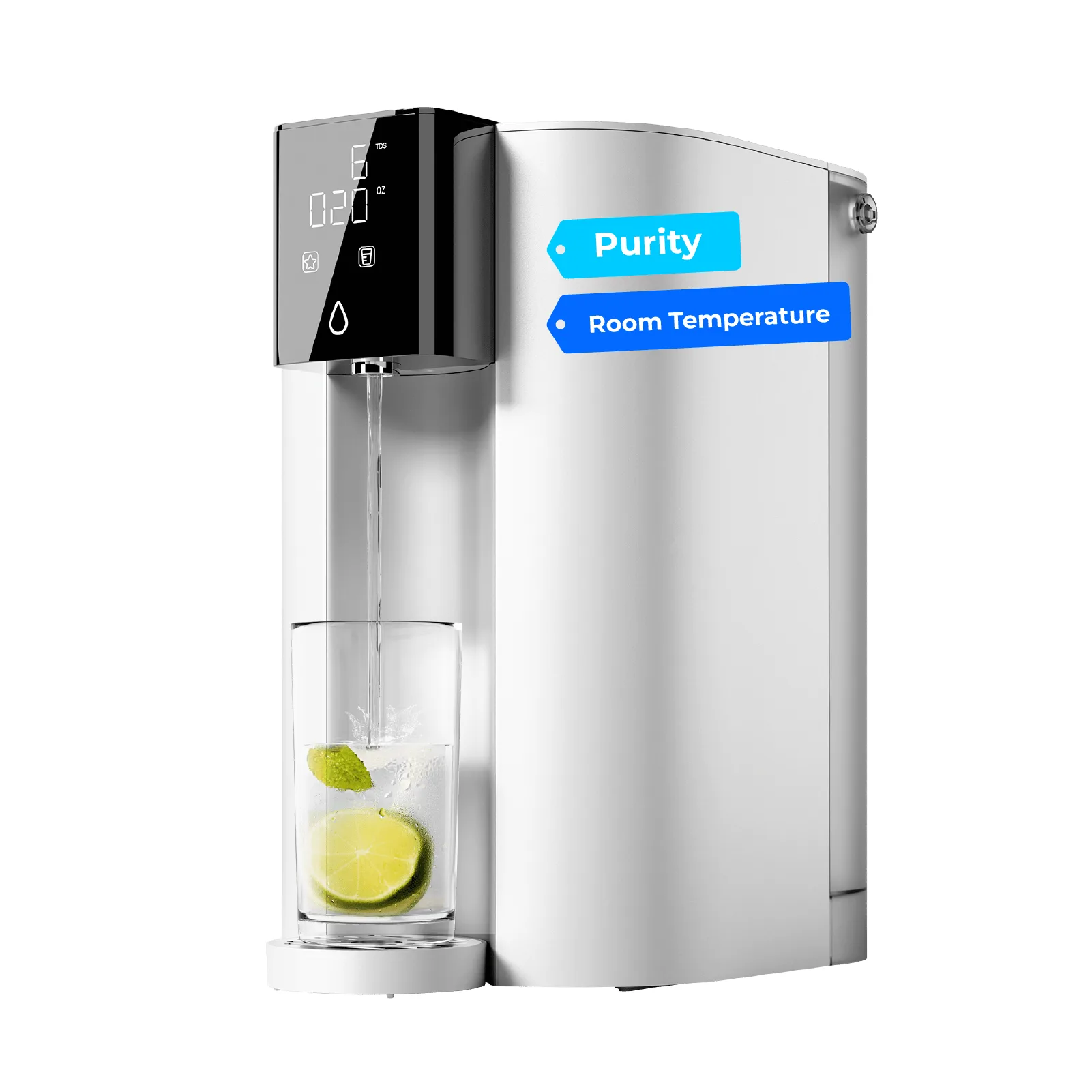
Counter space decides a lot of these purchases, and the CoreRO C1S is built for kitchens that have almost none: about 8.3 inches wide, the smallest footprint in this guide, with a clean single-composite-filter design — one cartridge, six stages inside it, changed on a 12-month cadence. The 3:1 pure-to-drain ratio is respectable, and the pure-water tank lifts out so it can live in the fridge.
The limits are the flip side of the size. It is room-temperature only, there is no mineral stage, and Waterdrop rates it unsuitable for well water or source water above 500 ppm TDS. The certification is NSF/ANSI 372 (lead-free materials) and the reduction figures are SGS lab results. For a renter or a desk setup, those are fair trades; for a family, look further down the list.
Yay · Pros
- Smallest footprint here at about 8.3 inches wide
- Single composite filter with a 12-month cadence
- 3:1 pure-to-drain ratio
- Portable pure-water tank can be chilled in the fridge
Hmm · Cons
- Reductions are SGS lab-tested claims; certification is NSF/ANSI 372 lead-free materials
- Room-temperature only, with no mineral stage
- Not for well water or source water above 500 ppm TDS
Best for: one- or two-person households, renters and office-desk users with limited counter space. Skip if: anyone who wants minerals, hot water, or certified reductions.
6. Waterdrop C2SL Mineral — Best for Mineral Taste
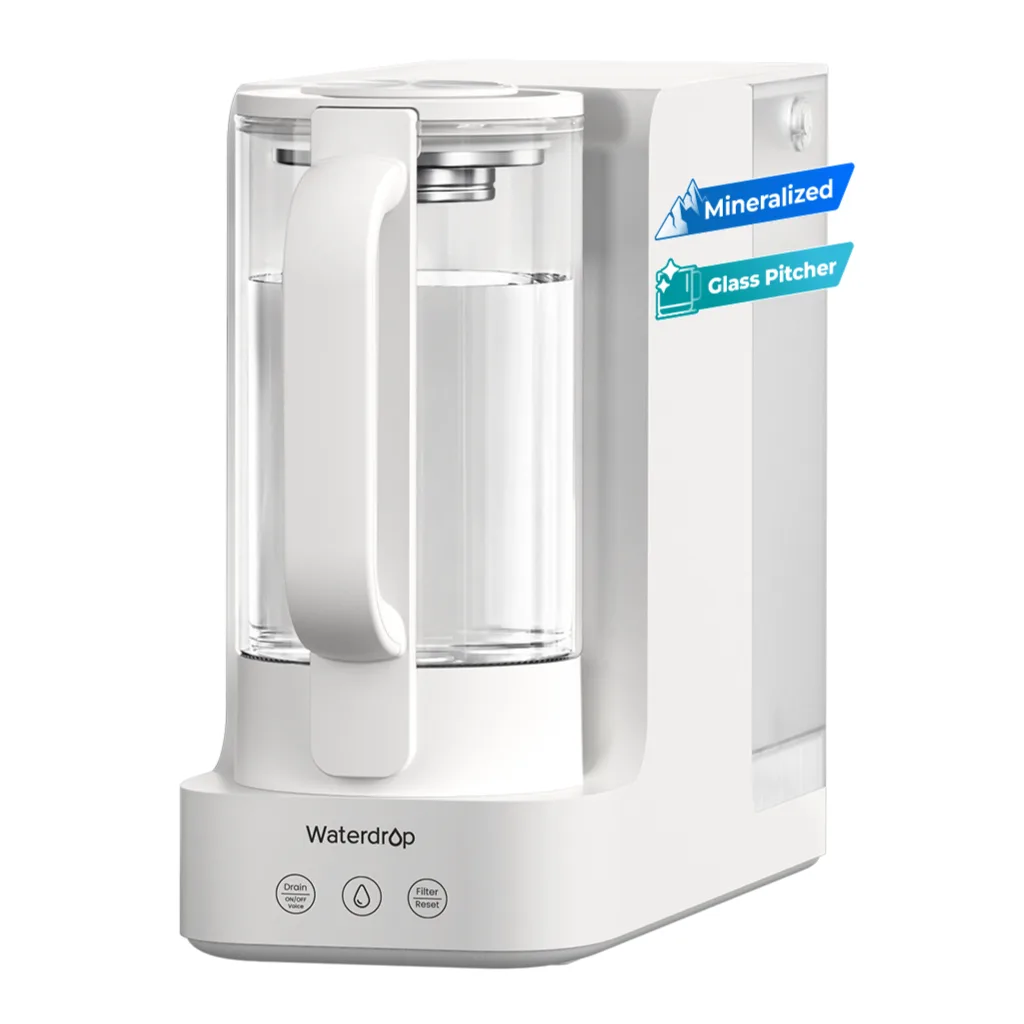
The flat, empty taste of RO water is the main reason people stop using these machines, and the C2SL is designed squarely at that problem. Its seven stages include a mineral stage adding back calcium, magnesium, potassium and sodium, and the water collects in a 40-ounce detachable glass pitcher that auto-fills — filter, lift, pour, done. The 3:1 ratio matches the better machines here, and filter life runs to about 12 months for a small household.
Keep the scale in mind: a 40-ounce pitcher and a compact body make this a one- or two-person machine, and families will cycle it constantly. The percentage reductions Waterdrop quotes are SGS laboratory results, not certified reductions, and certification is again NSF/ANSI/CAN 372 lead-free materials. As a taste-first small-household pick, it makes its case well.
Yay · Pros
- Mineral stage adds calcium, magnesium, potassium and sodium
- Auto-filling 40-ounce detachable glass pitcher
- 3:1 pure-to-drain ratio
- Filter life up to 12 months for one- to two-person households
Hmm · Cons
- Percentage reductions are SGS laboratory results, not certified reductions
- Sized for one or two people, so families cycle it often
- Certification is NSF/ANSI/CAN 372 lead-free materials only
Best for: one- or two-person households who dislike the flat taste of standard RO water. Skip if: larger households, and anyone who wants certified reductions.
7. Waterdrop K19-H — Best Instant Hot
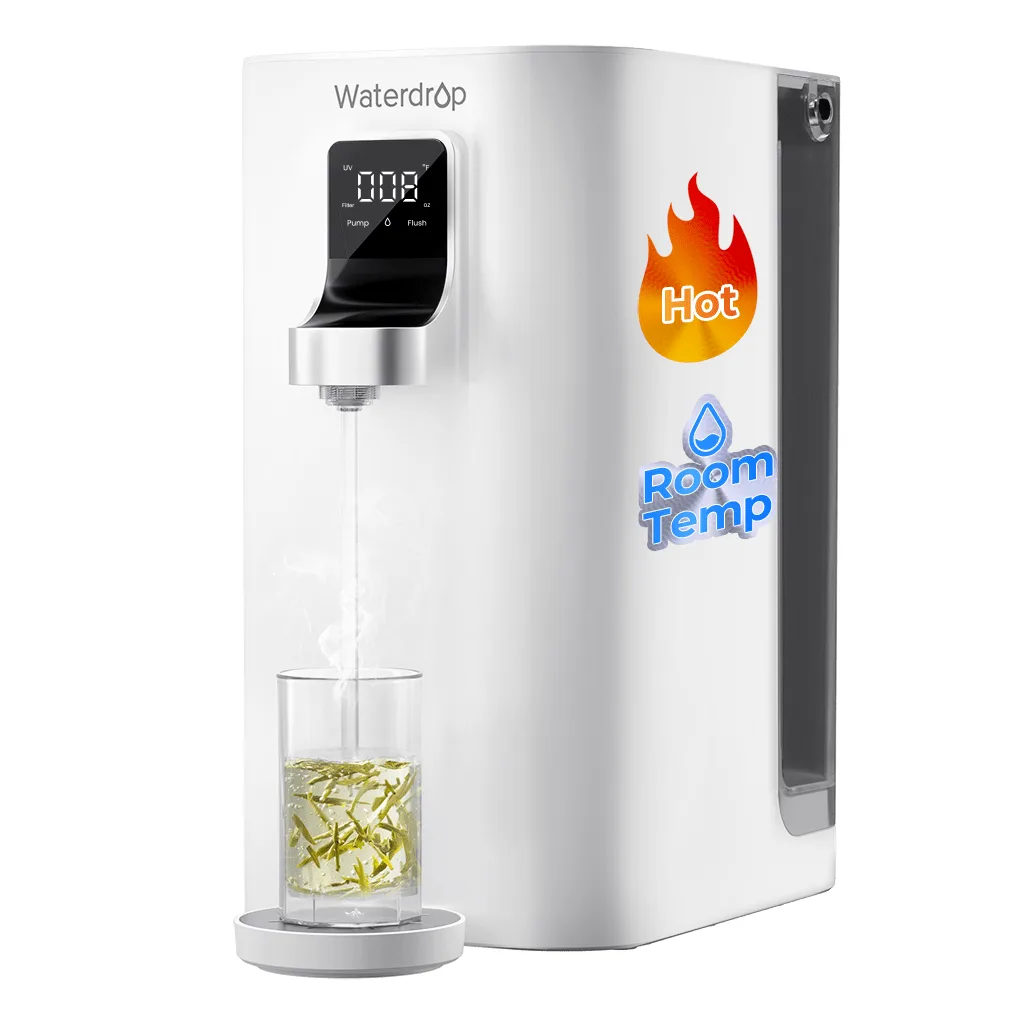
Tea drinkers, coffee drinkers and anyone making bottles or instant meals will see the point of the K19-H immediately: purified water, heated instantly, at four temperature settings up to about 203°F. No kettle, no waiting, and the water being heated is RO water, so the kettle-scale problem disappears with it. A UV stage sits in the filtration path, the feed tank is large enough for family use, and a single filter runs on a 12-month cadence.
Heating is also this machine's cost: it is the most power-hungry design here, and it takes more counter depth than the compact Waterdrops. On credentials, the brand states NSF/ANSI 372 and 58 plus CSA B483.1 — check the exact scope of the 58 claim on the current listing, because the wider reduction claims around this model are brand-stated rather than independently listed. The fullest hot-water package here, with that homework attached.
Yay · Pros
- Instant hot purified water at four settings up to about 203°F
- UV stage in the filtration path
- Large feed tank suits family use
- Single filter with a 12-month cadence
Hmm · Cons
- Heating makes it the most power-hungry design here
- NSF/ANSI 58 scope should be checked, as wider claims are brand-stated
- More counter depth than the compact Waterdrop models
Best for: tea and coffee drinkers and families who will use purified hot water daily. Skip if: anyone who never needs hot water — you would be paying for a heater you don't use.
8. SimPure Y7P-BW UV — Best Water Efficiency
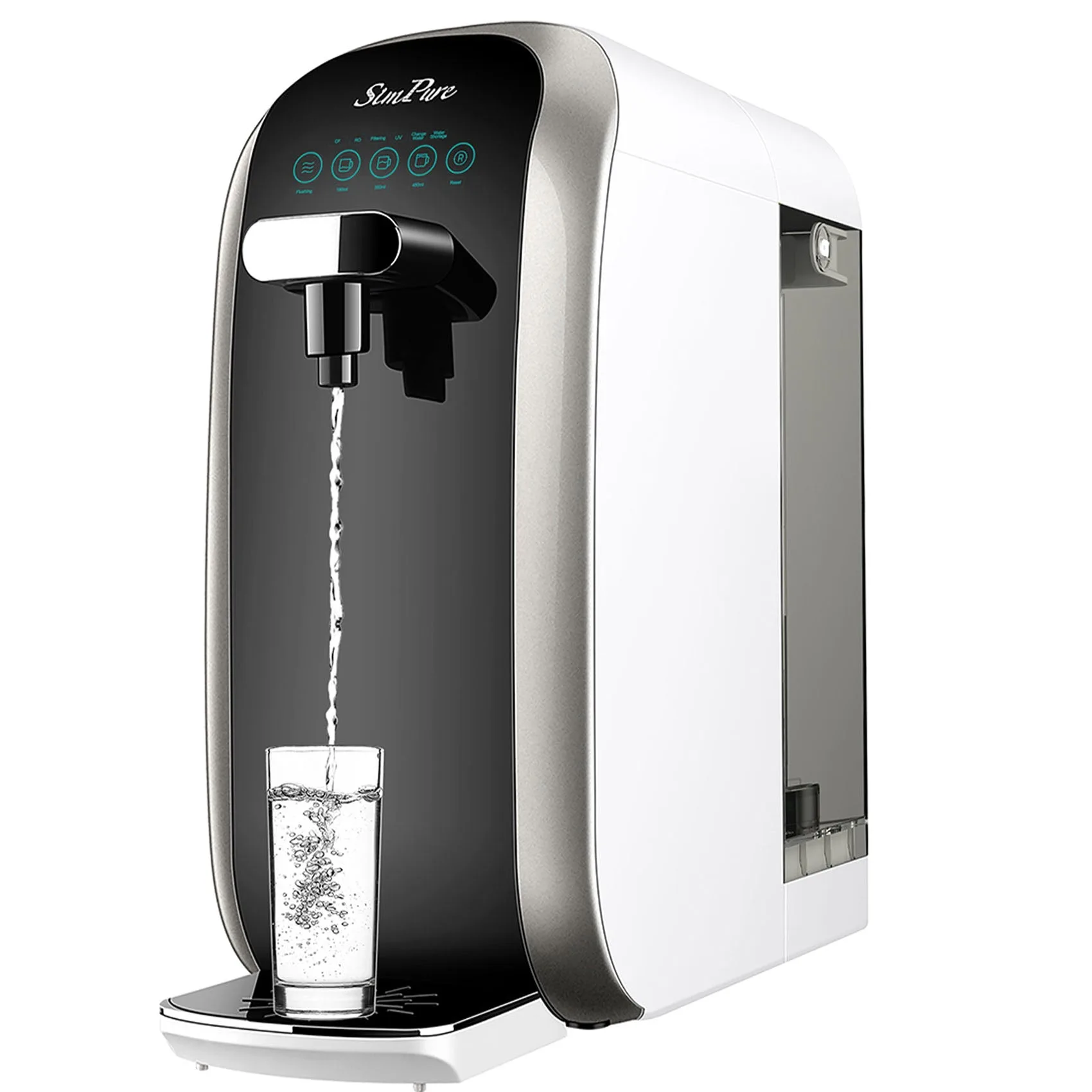
Every RO system sends some water down the drain — the question is how much. The Y7P-BW's 4:1 pure-to-drain ratio is the best in this guide, which matters if you are on metered water or simply dislike waste. Around that efficiency sits a five-stage system with a UV stage, preset dispensing at 6, 12 and 15 ounces, and twist-and-seal filters that change in seconds.
Two practical warnings. The evidence here is an SGS test report written against NSF/ANSI 58 — a test report, not a certification listing; we mark Filtration Confidence accordingly. And the upkeep is the most frequent in the guide: the CF filter runs roughly six months, the RO six to twelve. It also needs about 22 inches of height to open its lid, so measure under your cabinets before ordering.
Yay · Pros
- 4:1 pure-to-drain ratio is the best in this guide
- UV stage plus five-stage RO filtration
- Preset 6, 12 and 15-ounce dispensing volumes
- Twist-and-seal filters are simple to change
Hmm · Cons
- Evidence is an SGS test report against NSF/ANSI 58, not a certification listing
- Shortest filter cadence here, roughly six months for the CF filter
- Needs about 22 inches of clearance to open the lid
Best for: water-conscious households who want UV and the lowest reject-water ratio. Skip if: anyone with low cabinets, or who wants a serving pitcher.
9. SimPure Y7T-A — Best Glass Pitcher with Alkaline Stage
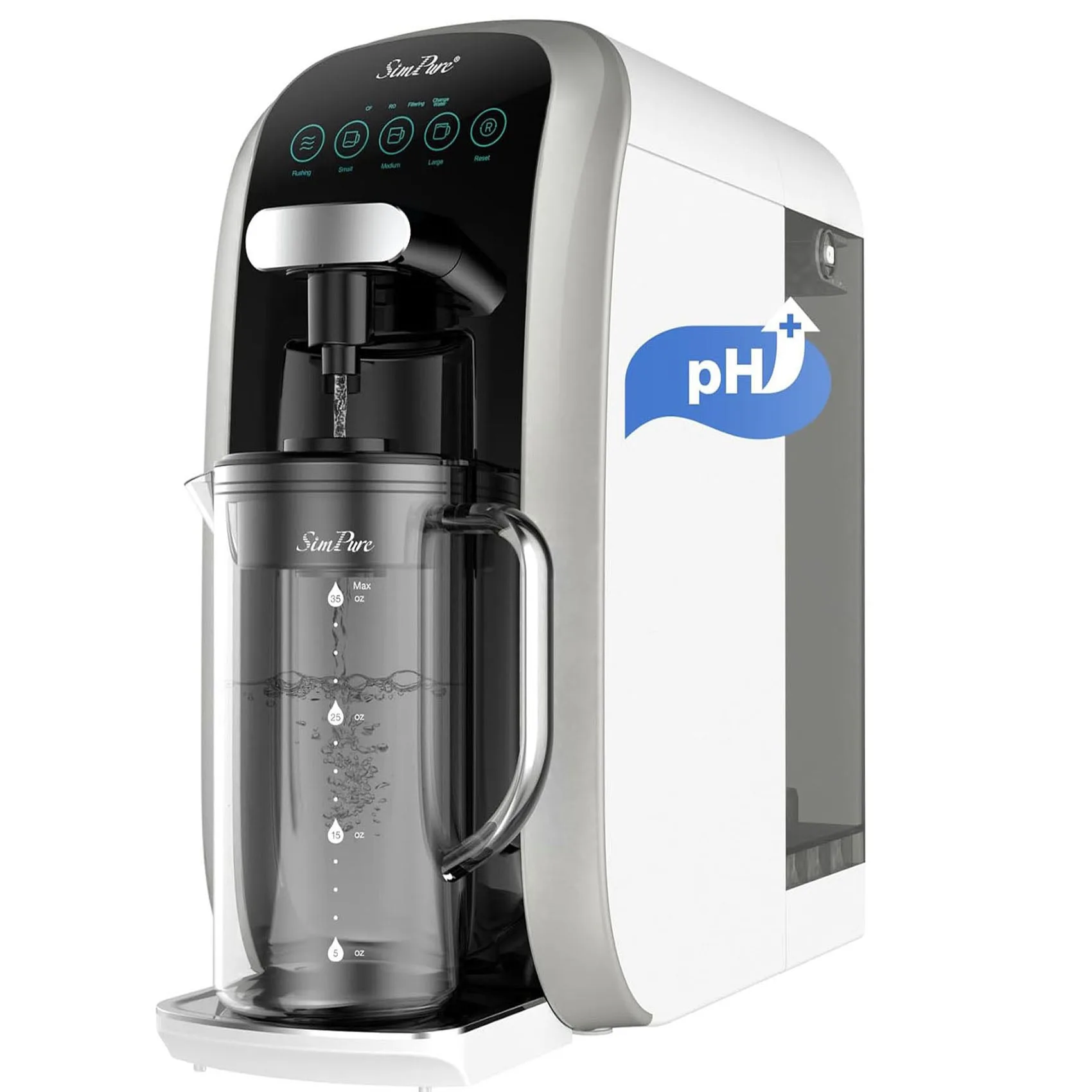
The Y7T-A takes the same compact Y7 platform as the pick above and rearranges it around the table instead of the tap: filtered water collects in a portable glass pitcher, and an alkaline (ALK) stage adjusts taste and pH on the way. The 4:1 pure-to-drain ratio matches the best in the guide, so the efficiency story survives the format change.
What grows is the shopping list. Three cartridges — CF, RO and ALK — run on roughly six-month cadences, the most upkeep of any machine here. There is no UV stage on this configuration, and the claims rest on SGS testing rather than a certification listing. Choose it if the pitcher-and-alkaline combination is exactly your household's shape; otherwise its dispenser sibling is less work.
Yay · Pros
- Portable glass pitcher for serving away from the counter
- Alkaline remineralization stage for taste and pH balance
- 4:1 pure-to-drain ratio matches the best here
- Same compact Y7 footprint as the dispenser model
Hmm · Cons
- Three cartridges on roughly six-month cadences is the most upkeep here
- Claims rest on SGS testing, not a certification listing
- No UV stage on this configuration
Best for: households who serve water at the table and want an alkaline mineral stage with a glass pitcher. Skip if: anyone who wants minimal filter maintenance, or UV.
10. Frizzlife WB99 — Best Alkaline Pitcher System
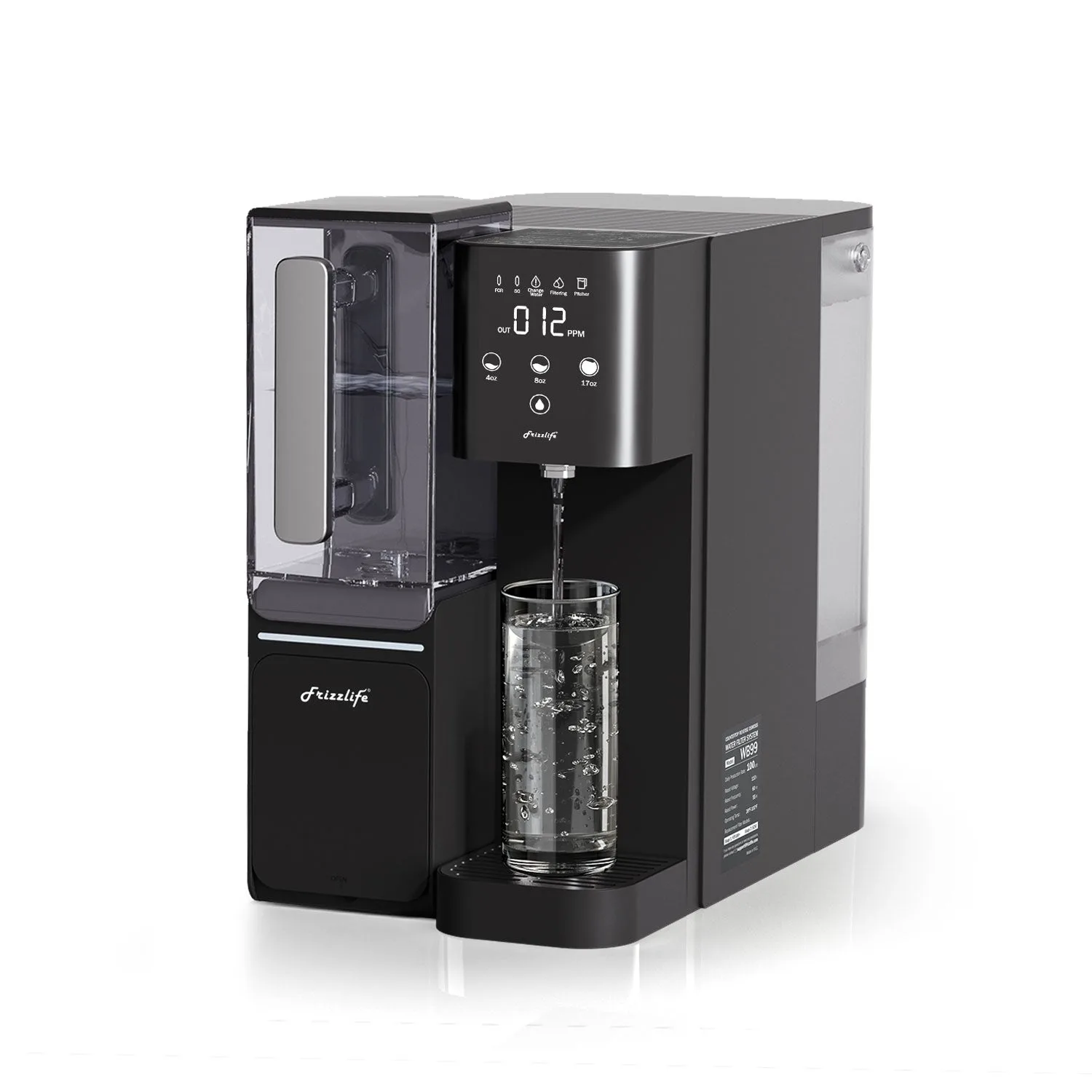
The WB99 is the current successor to Frizzlife's discontinued WA99, and it packs a lot into a pitcher format: an alkaline post-filter (Frizzlife's SC90), a real-time TDS display so you can watch the numbers drop, preset dispensing at 4, 8 and 17 ounces plus a continuous mode, and a large 152-ounce raw-water tank feeding the pitcher. Its 3.5:1 pure-to-drain ratio is second-best in this guide.
The credential needs its exact wording: Frizzlife's NSF/ANSI 58 reference is an element-level certification — the membrane element, for material and structural integrity — not whole-system certified reductions, and the contaminant list is a manufacturer claim. As a successor model it also has a shorter owner history than the WA99 it replaces. Efficient, well-featured, and honestly filed under lab-and-maker evidence.
Yay · Pros
- 3.5:1 pure-to-drain ratio is second-best in this guide
- Alkaline post-filter and real-time TDS display
- Preset 4, 8 and 17-ounce dispensing plus continuous mode
- Portable pitcher format with a large raw-water tank
Hmm · Cons
- NSF/ANSI 58 credential covers the membrane element, not whole-system reductions
- Contaminant-reduction list is a manufacturer claim
- Successor model, so owner history is shorter than the WA99's
Best for: readers who want alkaline taste, preset dispensing and strong water efficiency in a pitcher system. Skip if: anyone who needs whole-system certified reductions.
How to Choose a Countertop RO Filter
Start with the evidence, not the feature list. If a specific contaminant worries you — PFAS, lead, microplastics — a certified reduction (IAPMO or NSF listings, like the AquaTru pair) is a different class of promise from a lab-tested claim. Lab reports from SGS are real testing, but the brand chose the lab and published the result. Decide which standard your household needs before you fall for a carafe shape.
Check the pure-to-drain ratio. A 2:1 machine sends half a glass to the drain (or the storage tank) for every glass you drink; a 4:1 machine sends a quarter. On metered water, over years, that gap is real money. Then pick the format: dispensers are fastest glass-by-glass; carafes and pitchers suit tables and fridges; instant-hot models replace a kettle but draw the most power.
Price the filters, not just the machine. Cadences here run from six months to two years, and some models need two or three cartridges. The cheapest machine with three six-month cartridges can cost more over three years than a pricier one with a two-year RO filter. Finally, check the basics: source-water limits (several of these exclude well water and very hard water), the height the lid needs to open, and whether the tank or carafe size matches how much water your household actually drinks.
Frequently Asked Questions
Is a countertop RO filter as good as an under-sink system?
For filtration, yes — the membrane technology is the same, and the certified countertop models carry the same NSF/ANSI certifications as plumbed systems. The differences are practical: countertop units filter in batches into a tank or carafe, so flow is slower, and they take counter space instead of cupboard space. For renters and small households they are usually the better trade.
What is the difference between "certified to NSF/ANSI 58" and "tested to NSF/ANSI 58"?
It is the most important wording trick in this category. Certified means an independent body (like IAPMO or NSF itself) tested the product and lists it — you can look the listing up. Tested to means a laboratory ran tests following the standard's methods, often commissioned by the brand, with no listing to check. Both can describe real filtration, but only one is independently verified.
How much water does reverse osmosis waste?
It depends on the machine's pure-to-drain ratio. In this guide the range runs from 2:1 (two glasses purified for every one rejected) to 4:1. Many owners keep the reject water — it is concentrated tap water, not poison — for watering plants, rinsing and cleaning, which softens the waste question considerably.
Do I need remineralization or an alkaline stage?
Need, no — RO water is safe to drink without it. Want, quite possibly: minerals are a large part of how water tastes, and many people find plain RO water flat. Mineral and alkaline stages add back calcium, magnesium and similar minerals for taste and a higher pH. If you have never minded distilled-style water, skip the stage and the extra cartridge.
How often do countertop RO filters need changing?
In this guide, anywhere from about six months (some SimPure cartridges) to two years (the AquaTru Classic's RO filter). Composite-filter machines like the Waterdrop CoreRO run about twelve months on a single cartridge. The honest cost of any of these machines is the purchase plus its filter cadence — compare both before you buy.
The Short Version
Buy the AquaTru Classic if certified contaminant reduction is the point — it is the only fully certified claim set here, with the AquaTru Carafe as its glass-carafe sibling. Choose the SimPure Y7P-BW for water efficiency, the Waterdrop K19-H for purified hot water, the Waterdrop CoreRO C1S for a tiny counter, and the Bluevua ROPOT-UV or mineral-stage Waterdrop and Frizzlife models if taste is what will decide whether the machine gets used. Whatever you pick, compare the filter cadence alongside the machine — that is where the real cost lives.