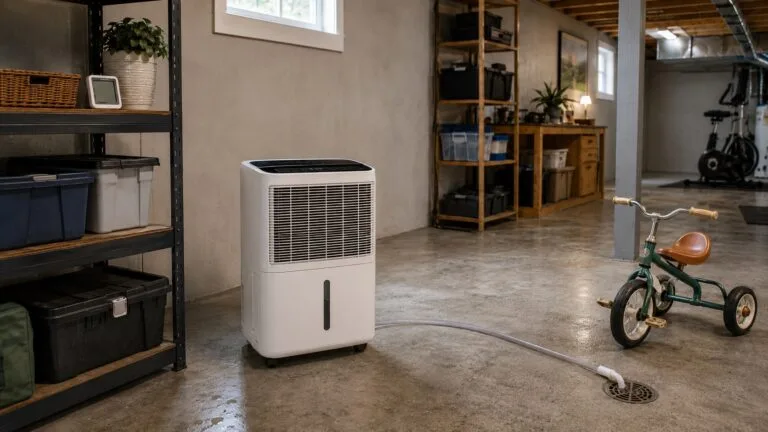
A Canadian basement has two seasons: damp and damper. The right dehumidifier keeps the musty smell away, protects stored furniture and paint, and stops mould before it starts. This guide compares five dehumidifiers for Canadian basements — a smart 50-pint best overall, a built-in-pump model, a quiet smart unit, a value pick, and a commercial crawl-space machine. Together with our air purifiers guide, it is the indoor-air pair every Canadian home eventually needs.
Best Dehumidifiers at a Glance
| Pick | Best for | Key strength | Watch out for |
|---|---|---|---|
| Midea Cube 50-Pint — Best Overall | Most basements | Big lift-out bucket, smart app, nests small for storage | Heavy when the bucket is full |
| GE 50-Pint with Built-in Pump — Best with Pump | Basements with no floor drain | Pump pushes water up to a sink or window | Pump hose routing needs a plan |
| Dreo Smart 50-Pint — Best Quiet Smart | Finished basements and living spaces | Quiet running with app and voice control | Smaller bucket than the Midea |
| KNKA 34-Pint — Best Value | Small basements and condos | Honest features at a low price | Too small for big wet basements |
| AlorAir Sentinel HD55 — Best for Crawl Spaces | Crawl spaces and serious damp | Commercial build, made to run for years | Costs like the pro tool it is |
How We Researched
We do not buy and test products ourselves. Our guides are built on research: manufacturer specifications, independent expert reviews, and the patterns that show up again and again in owner feedback. Each pick below also gets a CookSmartPicks score out of 10. That score is our own editorial rating, set from the research behind this guide — it is not a retailer star rating. Our full method is on our How We Research page. For this guide we compared capacity under the current test standard, how each unit drains (bucket, gravity hose or pump), low-temperature behaviour — auto defrost and the lowest working temperature — and Energy Star standing, because a dehumidifier runs for months at a time.
How we score
The scores in this guide are CookSmartPicks’ own editorial ratings. We set them from our research of the expert reviews and sources listed in this post — they are our ratings, not scores quoted from another publication.
1. Midea Cube 50-Pint — Best Overall
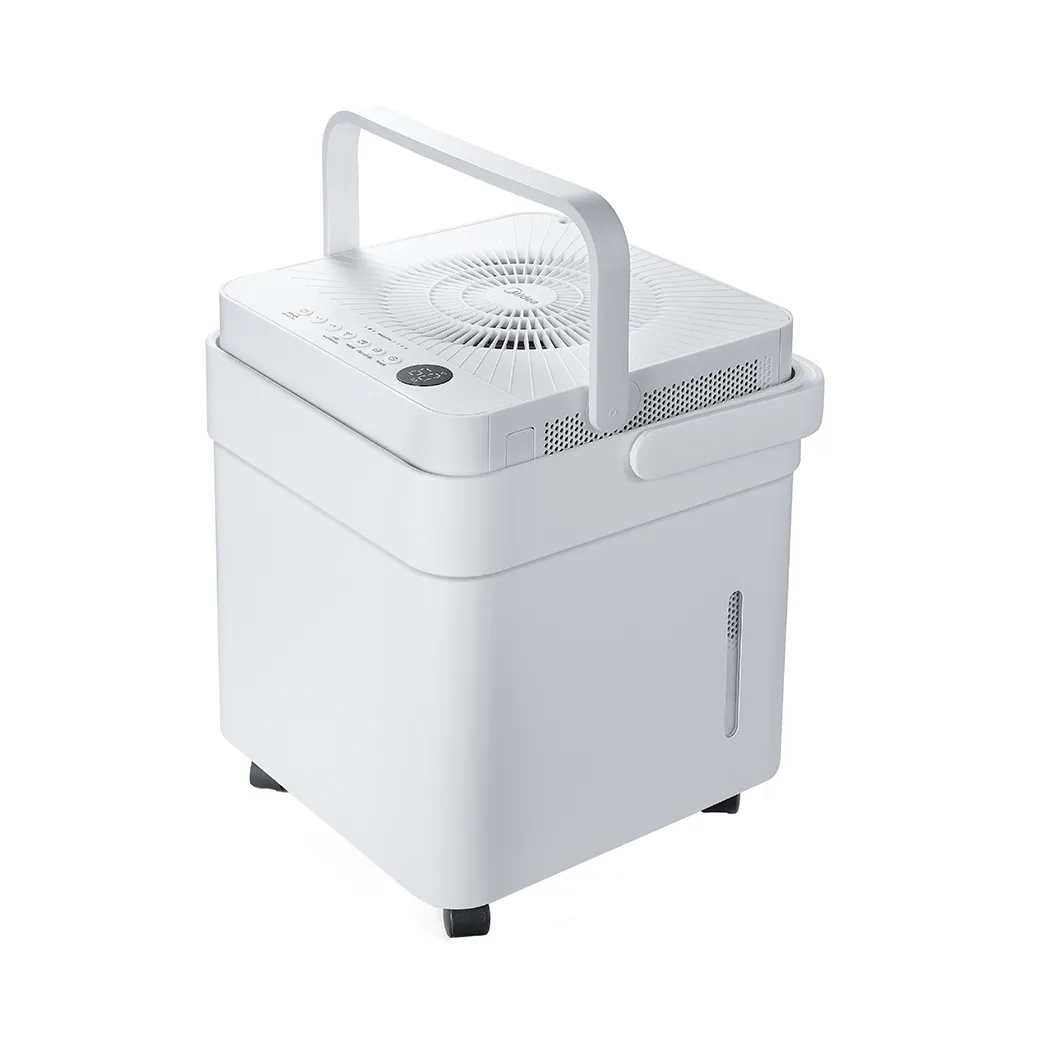
The Cube solves the two annoyances of ordinary dehumidifiers. First, the bucket: it is a big lift-out tank (about 16 litres) that empties far less often than the small drawers on most units. Second, storage: the whole unit nests down into its own bucket, so in the dry months it takes up half the shelf space. In between, it is a strong, smart 50-pint machine with app and voice control, an Energy Star rating, and coverage rated up to about 4,500 square feet.
For cold basements it has the features that matter: auto defrost, so the coils keep working instead of icing up, and operation rated down to about 5°C. Owners' recurring praise is the bucket design; the recurring grumble is that a full bucket is genuinely heavy — carry it with two hands or use the hose drain for the wettest months.
Yay · Pros
- huge lift-out bucket — fewer trips to the sink.
- nests into its bucket for compact storage.
- smart app and voice control; Energy Star rated.
- auto defrost for cool Canadian basements.
Hmm · Cons
- a full bucket is heavy to carry upstairs.
- the cube shape needs floor space, not a corner slot.
- app setup takes a few minutes the first time.
Best for: most basements and whole-home damp control. Skip if: you have no drain and hate emptying buckets — the GE pump model below exists for you.
2. GE 50-Pint with Built-in Pump — Best with a Pump
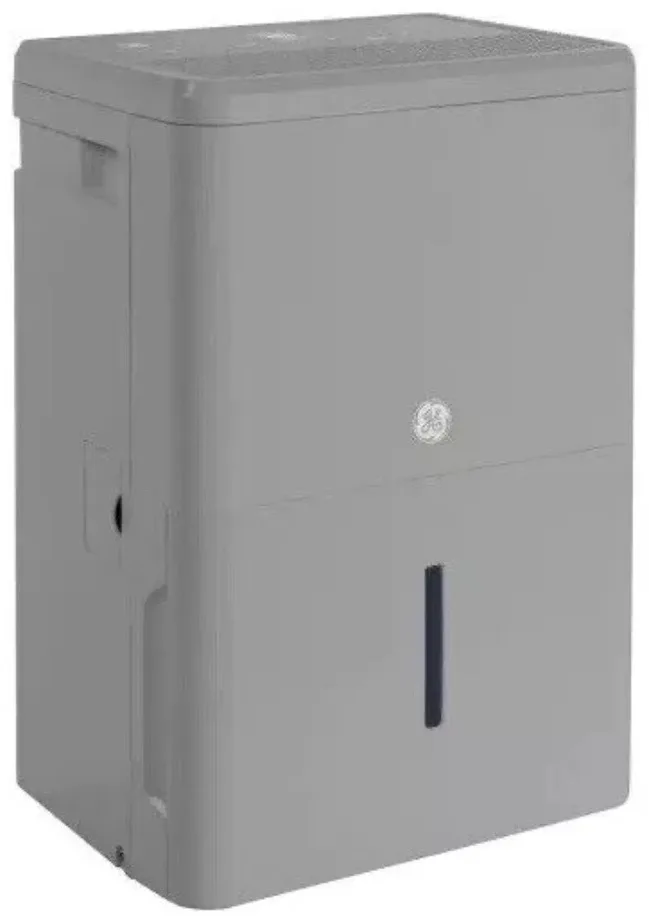
Here is the basement problem nobody mentions in the store: the drain is uphill. Most basements have no floor drain where the damp is, and a gravity hose only runs downhill. GE's answer is a built-in pump that pushes collected water up and out — to a sink, a laundry tub or out a window — up to about 16 feet vertically. That single feature is the difference between a dehumidifier you use and one you abandon after a month of bucket trips.
The rest of the machine is proper GE fare: 50-pint capacity, Energy Star, auto defrost for cool spaces, a clean-filter alert, and an adjustable humidistat. If your basement has a floor drain in the right place, save the money and buy the Midea. If it does not, this is your pick.
Yay · Pros
- built-in pump drains uphill — sink, tub or window.
- 50-pint capacity with Energy Star rating.
- auto defrost for cold basements.
- empty-bucket alarm and filter alert.
Hmm · Cons
- costs more than the same unit without a pump.
- pump hose needs a sensible route.
- bucket is smaller since the pump shares the space.
Best for: basements with no floor drain, and anyone done with bucket duty. Skip if: you have a drain right where the unit will sit.
3. Dreo Smart 50-Pint — Best Quiet Smart Pick
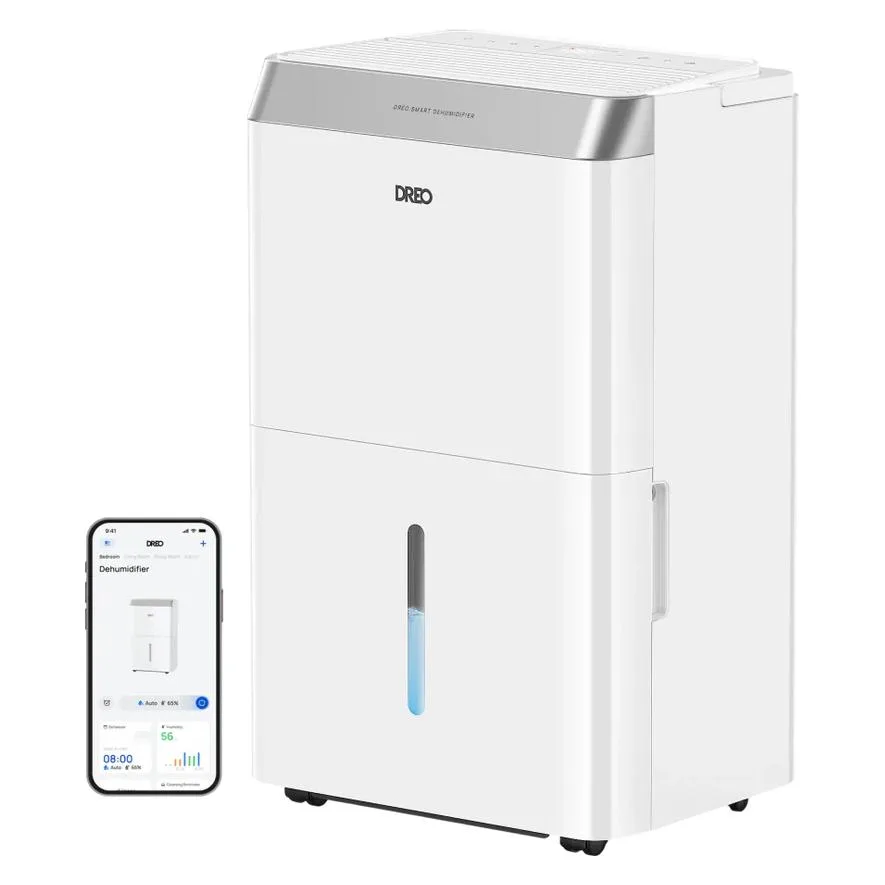
A finished basement is a living room that happens to be downstairs, and a loud dehumidifier ruins it. Dreo built its name on quiet fans, and its 50-pint smart dehumidifier is the one to look at when the unit will run near people: low-noise operation, a clear humidity display, app and voice control, and auto mode that follows the room instead of a fixed guess.
It drains by bucket or hose like the others, and the bucket is mid-size — fine for a finished space that is damp, not dripping. For a raw, wet basement, the Midea or GE move more water with less emptying. For a family room that smells faintly of cellar every August, this is the civilised fix.
Yay · Pros
- among the quietest full-size units owners report.
- app, voice and auto humidity control.
- sleek enough for finished rooms.
- 50-pint capacity — a real basement machine, not a toy.
Hmm · Cons
- mid-size bucket needs regular emptying without a hose.
- smart features cost more than basic rivals.
- less low-temperature focus than the Midea.
Best for: finished basements, dens and bedrooms near the damp zone. Skip if: your basement is unfinished and very wet — go bigger and simpler.
4. KNKA 34-Pint — Best Value
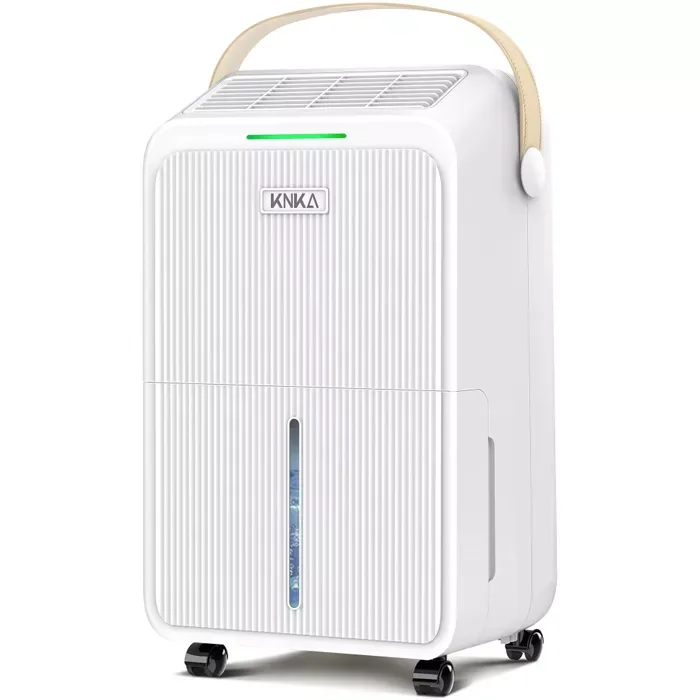
KNKA is one of the better Amazon-native brands, and its 34-pint unit is the value play: rated for spaces up to about 2,300 square feet, with auto defrost, a drain hose in the box, a laundry-dry mode for the clothes rack, and a proper humidistat — the features that used to cost twice as much. For a condo, a small basement or a single problem room, it is honestly enough machine.
The limits are size and pedigree. A big, genuinely wet basement will run it flat out and fill it daily — step up to a 50-pint pick. And as a younger brand, its long-term parts and support story is shorter than GE's or Midea's. At this price, most owners accept the trade happily.
Yay · Pros
- real features — auto defrost, hose drain, dry mode — at a low price.
- compact and light, with a carry handle.
- quiet enough for bedrooms and condos.
- simple controls anyone can run.
Hmm · Cons
- 34 pints is too small for large wet basements.
- smaller bucket — empty it often in peak season.
- younger brand, shorter support track record.
Best for: condos, small basements and single damp rooms on a budget. Skip if: your basement is large or visibly wet.
5. AlorAir Sentinel HD55 — Best for Crawl Spaces
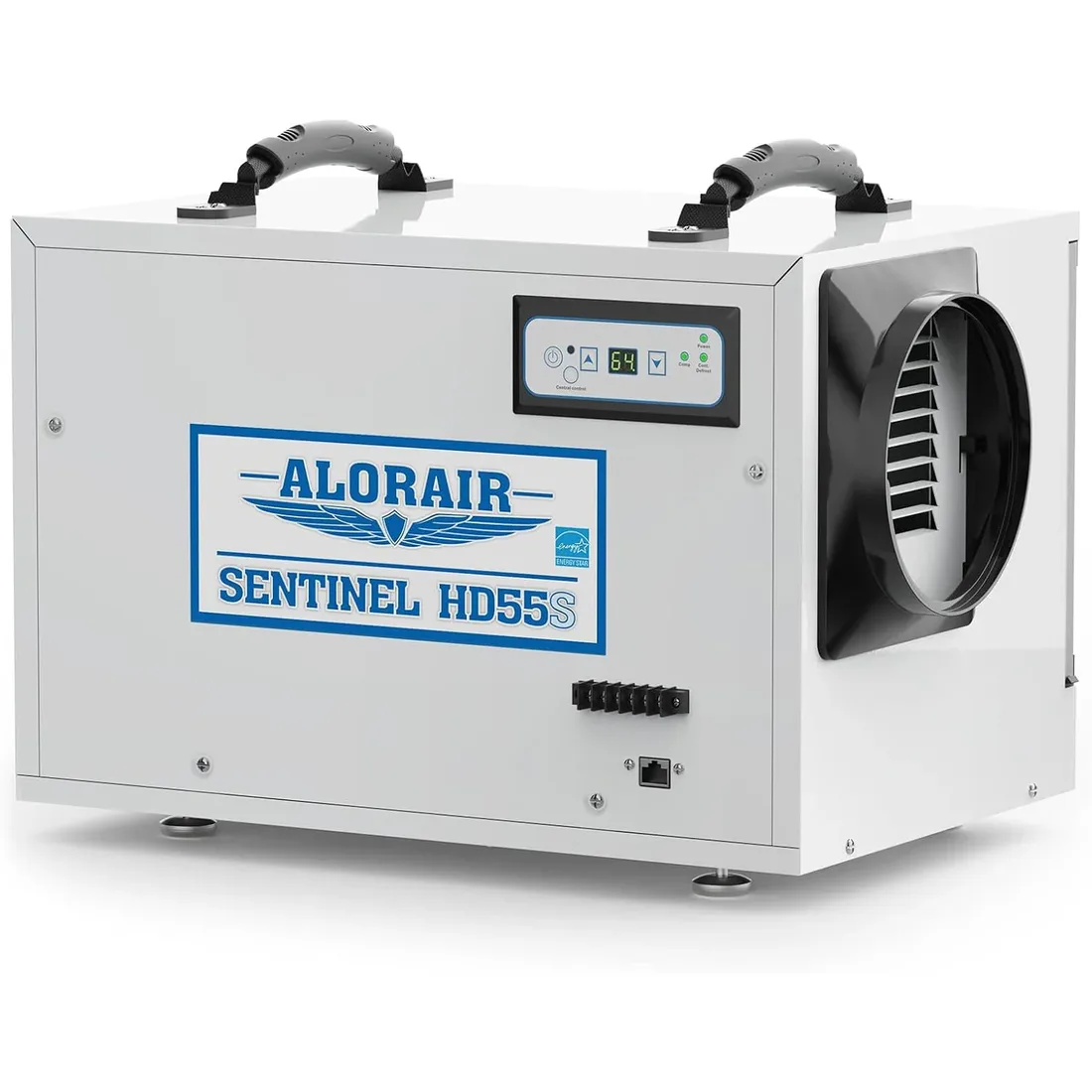
The HD55 is not a home appliance — it is a compact commercial dehumidifier built to be lowered into a crawl space and forgotten. It pulls 55 pints a day at the standard test condition (and far more in hot, saturated air), covers up to about 1,300 square feet of crawl space, and is built with a metal housing, an auto-defrosting system for cold spaces, and optional remote control so you never crawl in to check it.
It drains by gravity hose or an optional pump, runs a proper filter, and is designed for years of continuous duty in a place no plastic home unit survives. The price is professional too. If your problem is a damp living-space basement, the picks above are better value; if it is a crawl space quietly rotting your floor joists, this is the correct tool.
Yay · Pros
- commercial build made for crawl spaces.
- 55 pints at test conditions; much more in saturated air.
- auto defrost and low-temperature operation.
- optional remote control — check it without crawling in.
Hmm · Cons
- professional price.
- no bucket — it must drain by hose or pump.
- heavier and louder than home units.
Best for: crawl spaces, and serious damp under any building. Skip if: you need a friendly living-room appliance.
The Pint Rating Lie (and How to Read It)
A few years ago the official test for dehumidifier capacity changed: the test room got cooler and less humid, closer to a real basement. The machines did not change — the numbers did. A unit sold as "50 pints" under the old test is about a "35 pint" unit under the new one, and a "70 pint" classic is roughly today's 50. Only compare pints measured under the same standard — every pick in this guide is described in current-standard terms where the maker provides them. When in doubt, shop by the room: small spaces and condos, 30–35 pints; typical basements, 50 pints; crawl spaces, a commercial rating.
Cold Basements: The Two Features That Matter
Auto defrost keeps the coils from icing when the basement is cool — below about 18°C, a unit without it spends its time frozen instead of drying. Low-temperature operation (rated down to about 5°C on the Midea here) means it keeps working in an unheated Canadian basement in March. If your basement is cold, these two lines in the spec sheet matter more than any smart feature.
Frequently Asked Questions
What size dehumidifier do I need for my basement?
For a typical basement up to about 1,500 square feet with moderate damp, a 50-pint unit under the current test standard is the safe default. Small spaces and condos do well with 30 to 35 pints. Very wet basements, or ones with visible water, may need a 50-pint unit plus fixing the water source itself.
Why did my old 70-pint dehumidifier become a 50-pint?
The official capacity test changed to cooler, less humid conditions that match real basements. The same machine now earns a lower number. A classic 70-pint unit and a current 50-pint unit are roughly the same class — compare only ratings from the same era.
Should I empty the bucket, use a hose, or get a pump?
A hose to a floor drain is the cheapest set-and-forget option if the drain is downhill from the unit. A built-in pump, like the GE in this guide, is the answer when the only drain is a sink or window above the unit. Buckets suit small units and light damp.
What humidity should a basement be kept at?
Between 30% and 50% relative humidity is the healthy band; around 45% is a good target. Above 60% invites mould and dust mites, and below 30% the air dries out wood and throats. Most of these units hold a set point automatically once you choose it.
Can a dehumidifier run in a cold basement?
Yes, if it has auto defrost and a low enough operating rating — the Midea Cube in this guide is rated to about 5°C. Without defrost, coils ice up in cool rooms and the unit stops drying while still using power.
The Verdict
Buy the Midea Cube for the best all-round basement machine and the bucket you will empty half as often. Buy the GE if your drain is uphill and you are done carrying water. Buy the Dreo if the basement is a living space and noise matters, the KNKA if the space and the budget are both small, and the AlorAir if the damp lives in a crawl space and you want it handled like a pro job.