The best drawer organizer is an adjustable system, not a fixed tray — because the drawer’s contents change, and a fixed grid fossilizes the day it was bought — and the Vtopmart modular set and Joseph Joseph DrawerStore below lead this guide because they adapt in opposite, complementary ways: one rearranges, the other was designed around the knives and tools that defeat ordinary trays. Measure your drawer’s interior in all three dimensions before buying anything; half the returns in this category are a height nobody measured.
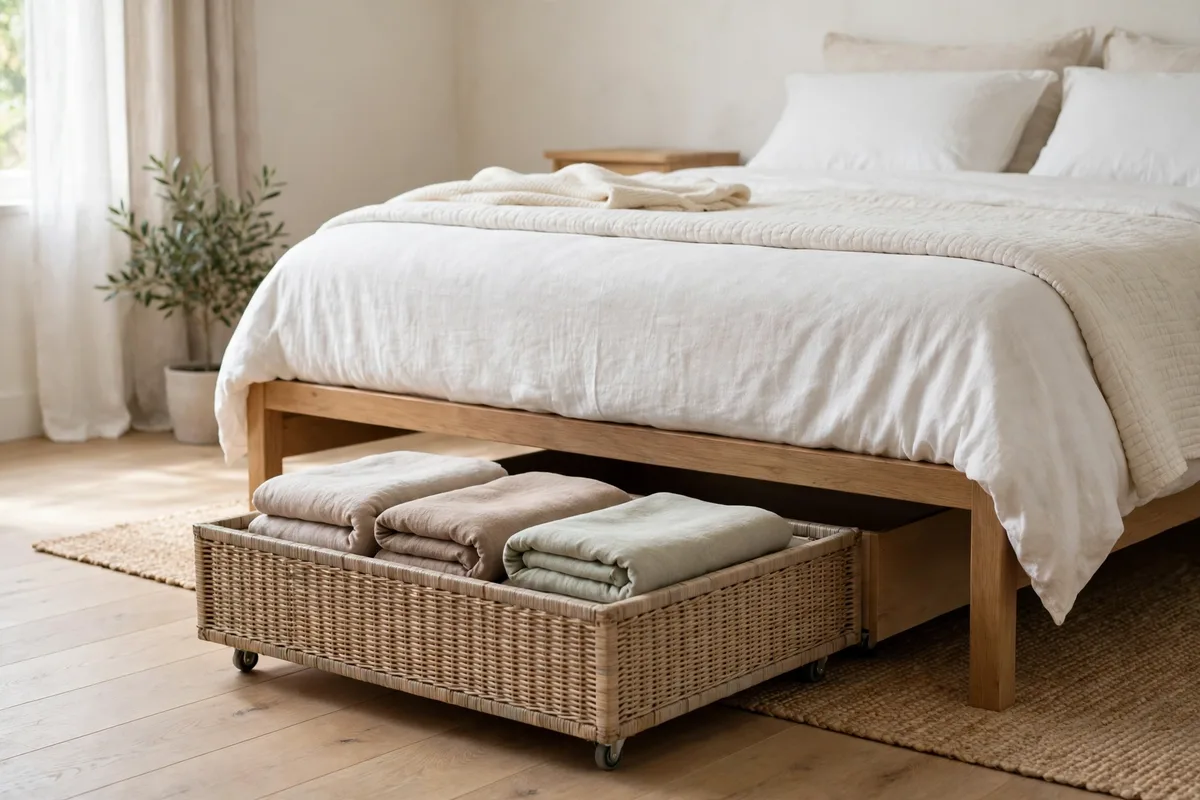
The five picks divide by drawer: a modular clear system, a cutlery-and-knife specialist, a two-tier deep-drawer answer, an expanding bamboo organizer, and a bamboo cutlery tray. Each entry states its dimensions and true drawer in the open. The organizers pair with the best under-bed storage in Canada and the USA space below the bed, the best closet organizers in Canada and the USA system in the closet, and the best food storage containers in Canada and the USA containers in the kitchen.
Disclosure: CookSmartPicks is reader-supported. When you buy through links on this page, we may earn an Amazon commission at no extra cost to you. Prices and availability change often — check the current price on Amazon before you decide.
How we chose these drawer organizers
Adjustability gated this list: every pick had to adapt — expanding, modular or reconfigurable — because a fixed grid fossilizes the day it is bought and drawers change jobs. Dimensions and heights were read from the makers’ specifications with the drawer’s reality in mind (interior height is the spec that exiles organizers), and systems whose compartments match no real object category were cut.
Material honesty followed: washable clear systems for the kitchen’s crumb front line, bamboo where looks and low dirt allow, and a two-tier design for the deep drawers that waste their volume in a single layer. Each pick was assigned its true drawer — cutlery, junk, clothing, vanity, deep utility — and ranked inside that assignment rather than against a fantasy of one universal tray. All five are stocked through normal Canadian home retail.
The lineup at a glance
| Product | Best for | Why it stands out |
|---|---|---|
| Vtopmart Clear Drawer Organizer Set (Modular Trays) | Best overall | The modular language: clear trays that organize every drawer in the house |
| Joseph Joseph DrawerStore (Cutlery & Knife Organizer) | Best for cutlery & knives | The stacked tray: a drawer and a half of cutlery in one footprint |
| madesmart 2-Tier Organizer (Sliding Basket) | Best two-tier | The deep-drawer redeemer: two sliding tiers where one avalanche lived |
| SpaceAid Bamboo Drawer Organizer (Expandable) | Best expanding bamboo | The expanding frame: one bamboo tray that fits this drawer and the next house’s |
| Utoplike Bamboo Cutlery Tray (Expandable) | Best bamboo cutlery tray | The classic, perfected: bamboo, expandable, and invisible for a decade |
1. Vtopmart Clear Drawer Organizer Set (Modular Trays) — Best overall
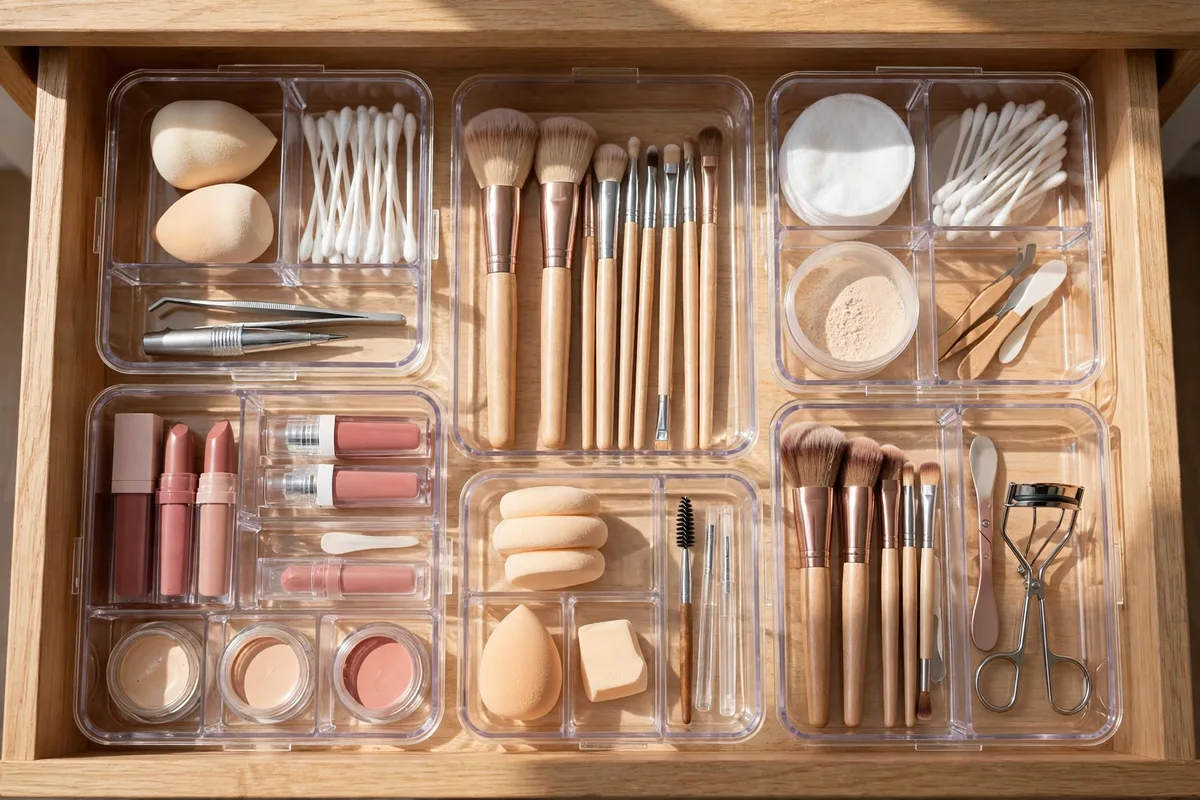
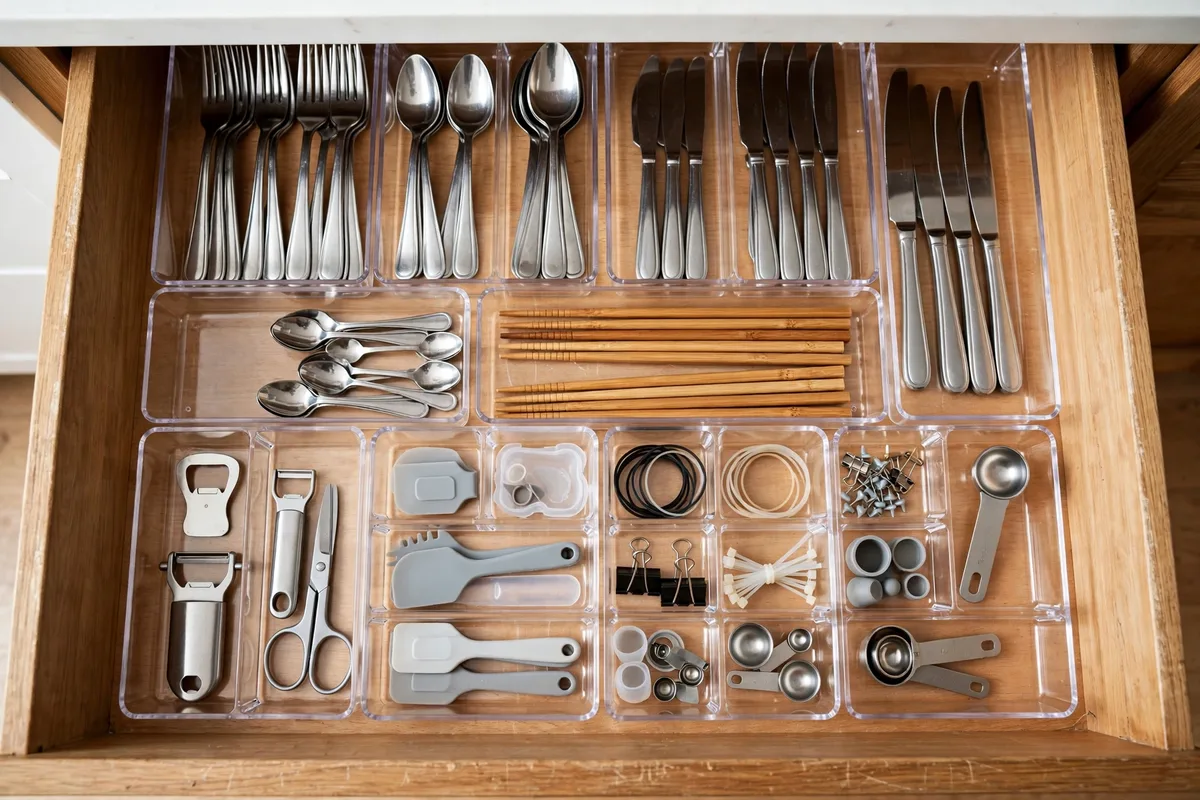
Vtopmart’s clear tray sets are the modular standard: a box of interlocking transparent trays in graduated sizes that tile any drawer’s footprint, rearrange as its contents change, and make the inventory visible at a glance — the system households buy for one junk drawer and then, inevitably, for every drawer they own. The plastic washes clean in the sink, the trays’ low profile respects shallow drawers, and the per-set price is the category’s value benchmark, which is how a single purchase becomes a house-wide standard.
The modularity is the philosophy: instead of a designer’s guess at your categories, the set lets the drawer’s actual objects dictate the map — long tray for the utensils or the toothbrushes, squares for the batteries and the hair ties — and next year’s map costs nothing but a rearrangement. Clear is the honest material for drawers, whose contents are searched for, not displayed; visibility is the feature, and Vtopmart’s clarity holds up through years of washes.
Canadian availability is online at a budget-friendly price for the multi-tray sets. For the household organizing drawers as a project — kitchen this weekend, vanities next — this is the guide’s default buy, in the largest set, because the marginal trays are nearly free and always find a drawer.
Ownership is standardization’s pleasure again: one tray language in every room, spares in the cupboard, and a new drawer organized in minutes from stock — the system effect that turns organizing from a purchase into a habit.
Household-standard tip: buy the second set at the same time as the first if the price allows — the trays’ sizes are consistent across sets, and the household that standardizes early never faces the discontinued-size hunt that punishes the drawer-by-drawer buyer in year two.
Yay · Pros
- Modular trays tile any drawer; fully rearrangeable
- Clear — inventory at a glance; washes clean
- Best value per tray in the guide
Hmm · Cons
- Clear plastic shows scratches over years
- Pieces can migrate in a half-empty drawer
- The aesthetic is utility, not décor
Best for: Every drawer in the house — one modular language Skip if: You want one perfect cutlery tray — the Utoplike bamboo below is the single-object answer
2. Joseph Joseph DrawerStore (Cutlery & Knife Organizer) — Best for cutlery & knives
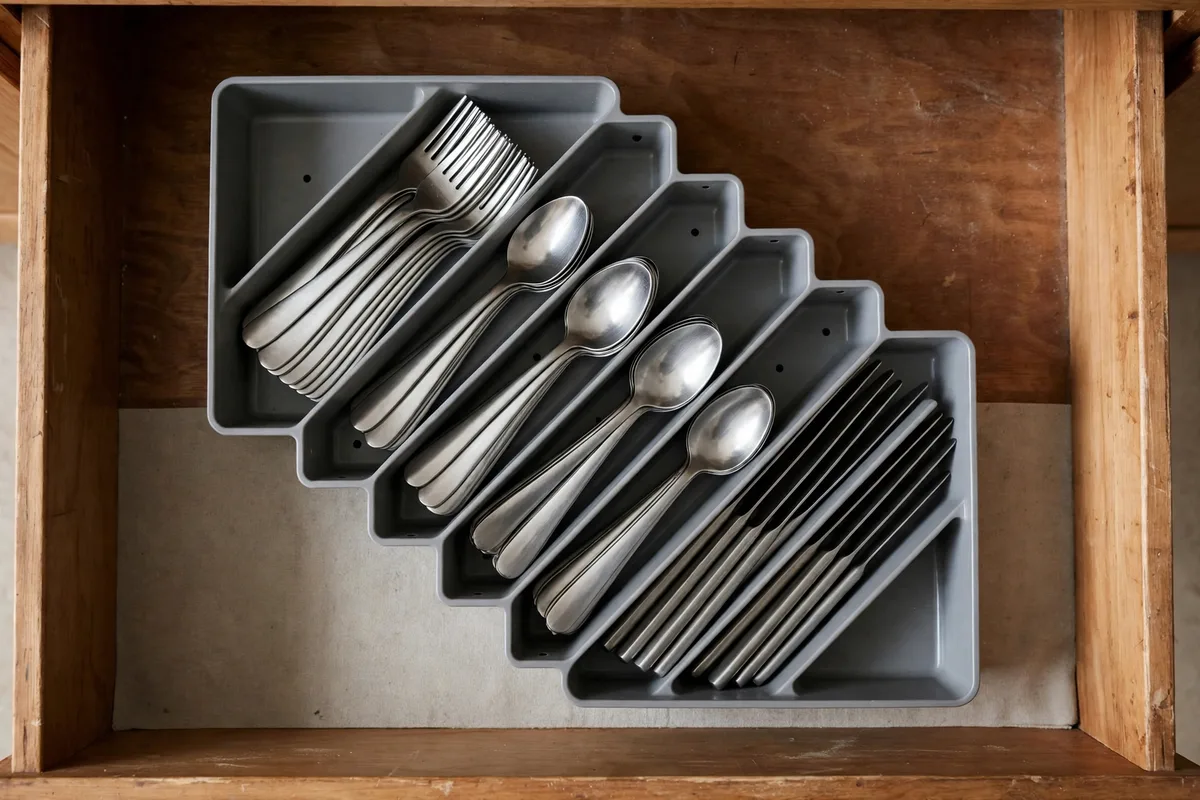
The DrawerStore is the cutlery tray redesigned by people who measured real drawers: a compact footprint with stacked, angled compartments that layer the cutlery vertically — forks over spoons over knives in a cascading block — plus, in the knife-drawer variant, dedicated slots that store blades safely in the drawer instead of a counter block. Joseph Joseph’s trick doubles a standard tray’s capacity in the same footprint, which in small kitchens is not a convenience but a drawer recovered for other duty.
The stacked design’s usability is its proof: each category presents at its own level, visible and grabbable, and the whole tray lifts out for the wash. The fixed layout is the honest trade — your cutlery set’s shape must match the designer’s assumptions, and oversized or odd pieces will not file — so the guide’s advice is to measure the drawer and eyeball the set before ordering, the category’s standing rule applied to its most designed object.
Canadian availability is through kitchen retailers at a premium single-drawer price. For the small kitchen whose cutlery drawer is also the knife drawer is also the utensil overflow, the DrawerStore is the engineered answer — one tray that behaves like a drawer and a half.
Ownership’s delight is the cascade: opening the drawer to a stepped display instead of a jumbled flatland is a small daily pleasure that owners mention years later — design’s dividend, paid in the kitchen’s most-opened drawer.
Measure your longest knife before ordering the knife variant: chef’s knives beyond the standard length and cleavers sit outside the slots’ design envelope, and the honest outcome for outliers is a magnetic strip or a block — the DrawerStore governs the standard set superbly and should not be forced past it.
Yay · Pros
- Stacked design doubles cutlery capacity
- Knife-slot variant replaces the counter block
- Lifts out whole for washing
Hmm · Cons
- Fixed layout — measure your drawer and your knives
- Premium price for a single drawer
- Knife slots fit standard blades; outliers need a home elsewhere
Best for: The cutlery drawer, knives included Skip if: Your cutlery is oversized or eclectic — modular trays forgive more
3. madesmart 2-Tier Organizer (Sliding Basket) — Best two-tier
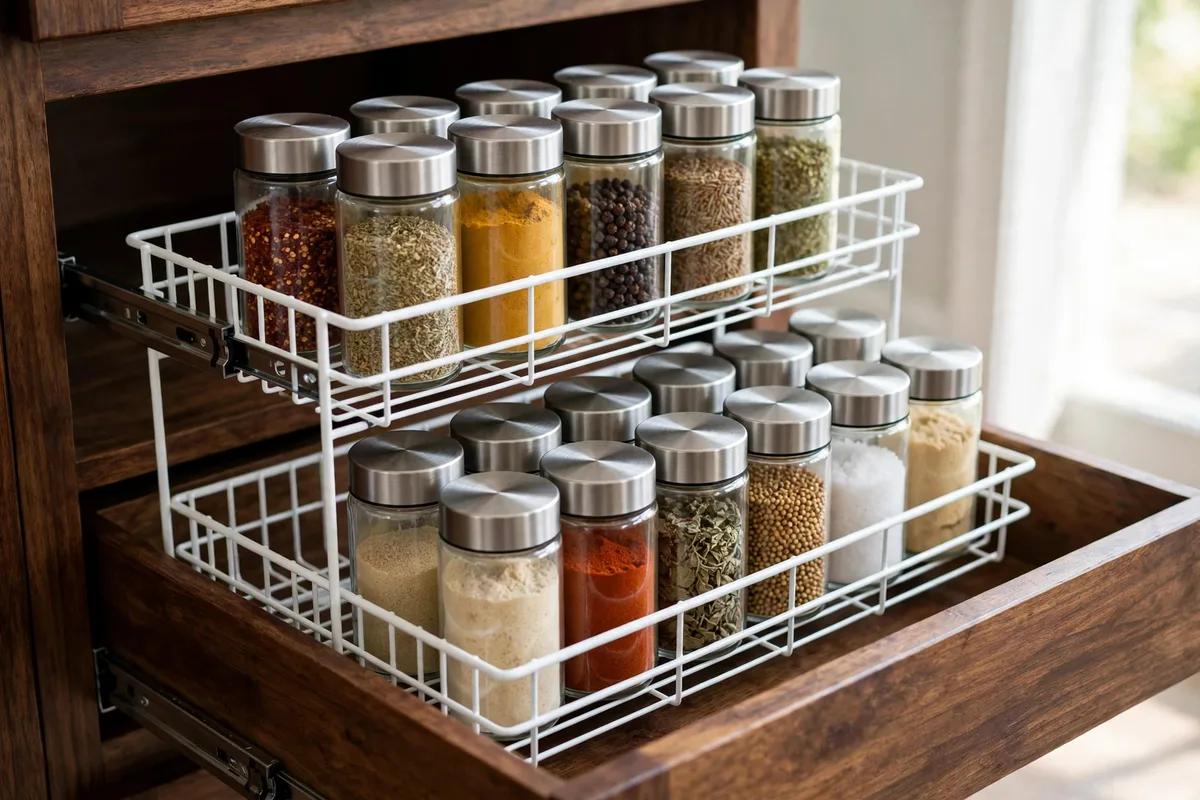
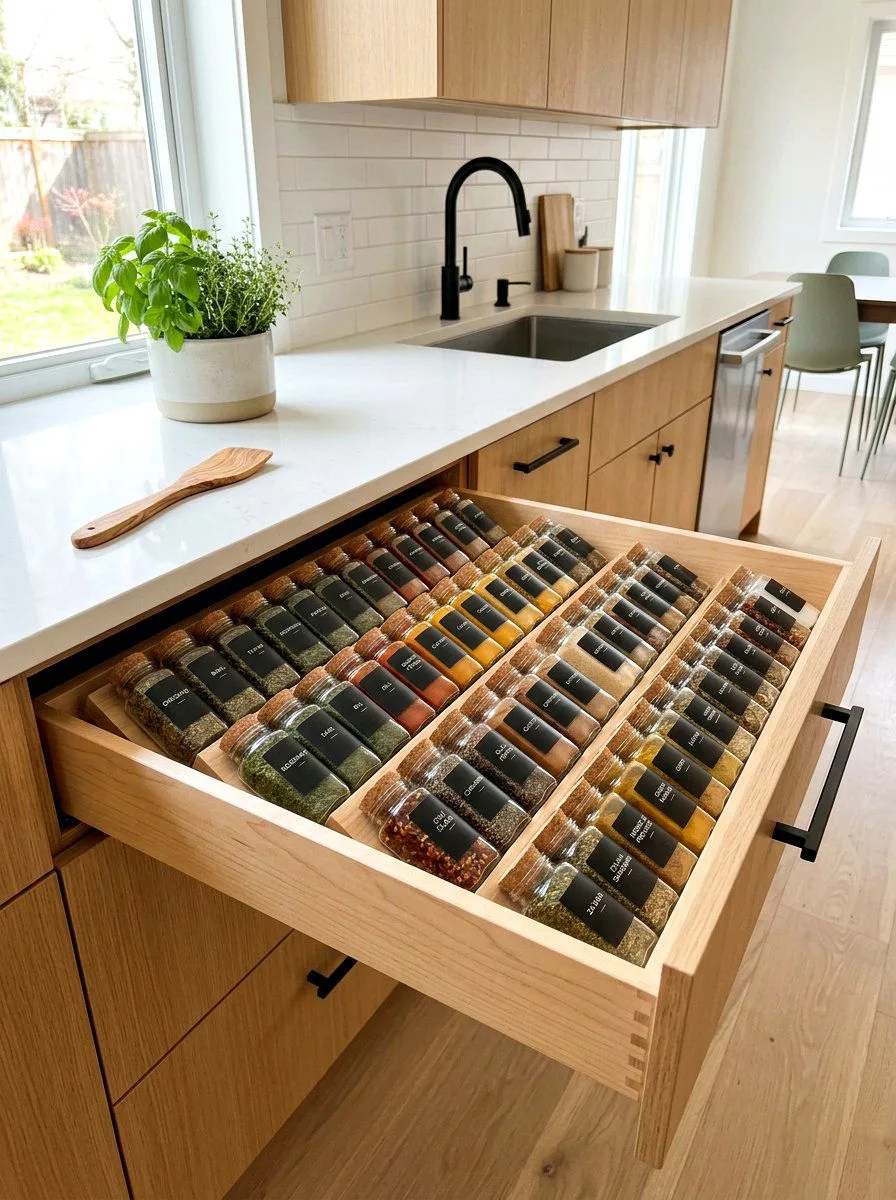
The madesmart 2-Tier Organizer answers the deep drawer’s wasted volume: a sliding upper basket over a lower bin, doubling the usable surface for the small uniform objects deep drawers swallow — spice jars, cosmetics, medications, craft supplies. The top tier glides back for access to the layer beneath (the design’s whole point, executed with the smoothness the category often promises and rarely delivers), and the non-slip feet and liners keep the system planted through the drawer’s daily slamming.
madesmart, an American storage house, builds the tier in washable plastic with a soft, modern finish that suits bathroom and vanity duty as happily as the kitchen’s spice chaos. The height discipline from this guide’s deep-dive applies absolutely: measure the drawer’s interior height, add the tier and the tallest jar, and confirm the clearance before the purchase — the 2-tier’s only failure mode is arithmetic.
Canadian availability is broad at a mid-range price. For the deep drawer currently functioning as a spice avalanche or a cosmetics dig site, this is the transformation pick — the drawer becomes shelving, and shelving can be searched.
Ownership’s moment is the first retrieval: the jar that used to require excavation is simply there, on its tier, labelled side out — the deep drawer’s redemption, available at the price of one organizer and one honest measurement.
Spice-jar arithmetic for the tier: standard spice jars run about four inches tall, so the tier plus jar needs roughly nine inches of drawer — deep kitchen drawers qualify, standard ones do not, and the measurement takes twenty seconds with the tape the deep-dive keeps prescribing.
Yay · Pros
- Doubles a deep drawer’s usable surface
- Top tier slides smoothly for access below
- Washable; non-slip feet and liners
Hmm · Cons
- Deep drawers only — height discipline required
- Plastic tiers flex under heavy loads
- Best with uniform containers (spice jars, bottles)
Best for: Deep drawers — spices, cosmetics, craft Skip if: Your drawers are shallow — the Vtopmart’s low trays respect them
4. SpaceAid Bamboo Drawer Organizer (Expandable) — Best expanding bamboo
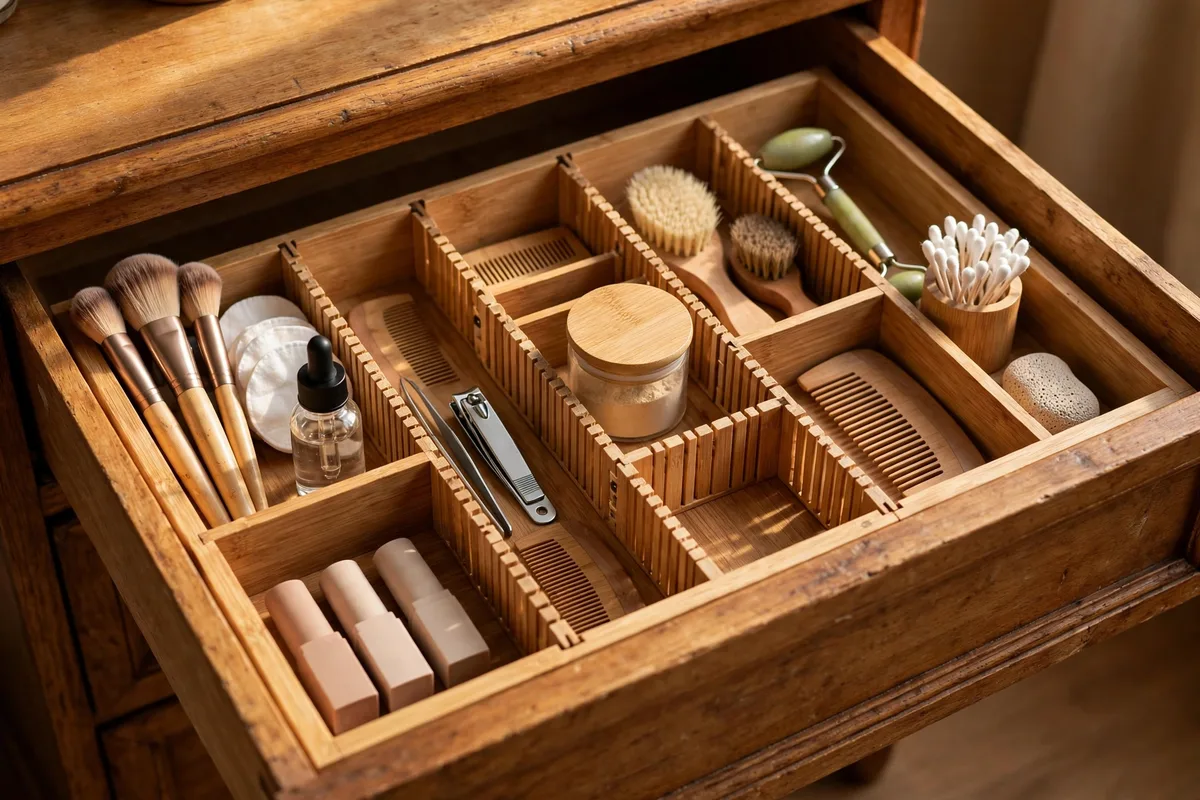
SpaceAid’s bamboo organizer is the expanding tray: a handsome bamboo frame whose sides slide outward to fit the drawer’s width, with movable dividers subdividing the interior for utensils, vanity cargo or desk miscellany. The expansion is the forgiveness feature — one tray serves the narrow drawer in this apartment and the wide one in the next house — and bamboo’s warmth makes it the organizer for drawers that open in front of guests: the vanity, the dining-room sideboard, the desk.
The construction is the solid, joined-bamboo class rather than the veneered kind, and the finish wipes clean under the low-dirt conditions bamboo asks for. As a clothing-drawer or utensil solution it splits the difference between the Vtopmart’s utility and the Utoplike’s single-purpose purity: adjustable like the first, beautiful like the second.
Canadian availability is online at a mid-range price. For the renter whose drawers are unknown quantities, and the household that wants one organizer to look like furniture, the SpaceAid’s expanding frame is the adaptable aesthetic — the tray that moves house well.
Ownership is migratory: these trays follow their owners from drawer to drawer and home to home, re-expanding to each new width — the organizer as a permanent possession in a category of disposable fits.
The expanding frame’s hidden talent is the rental drawer: no two rentals share a width, and the tray that re-expands at every move is the one organizer a serial renter buys once — pack it in the kitchen box, and the new home’s first drawer is organized on moving day.
Yay · Pros
- Expands to fit the drawer’s exact width
- Solid bamboo — the furniture look
- Movable dividers for any cargo
Hmm · Cons
- Expansion joints can drift without a snug fit
- Bamboo dislikes soaking — wipe only
- Dividers are fewer than modular sets’
Best for: Expanding fit and bamboo warmth in any drawer Skip if: You need many small compartments — modular trays subdivide finer
5. Utoplike Bamboo Cutlery Tray (Expandable) — Best bamboo cutlery tray
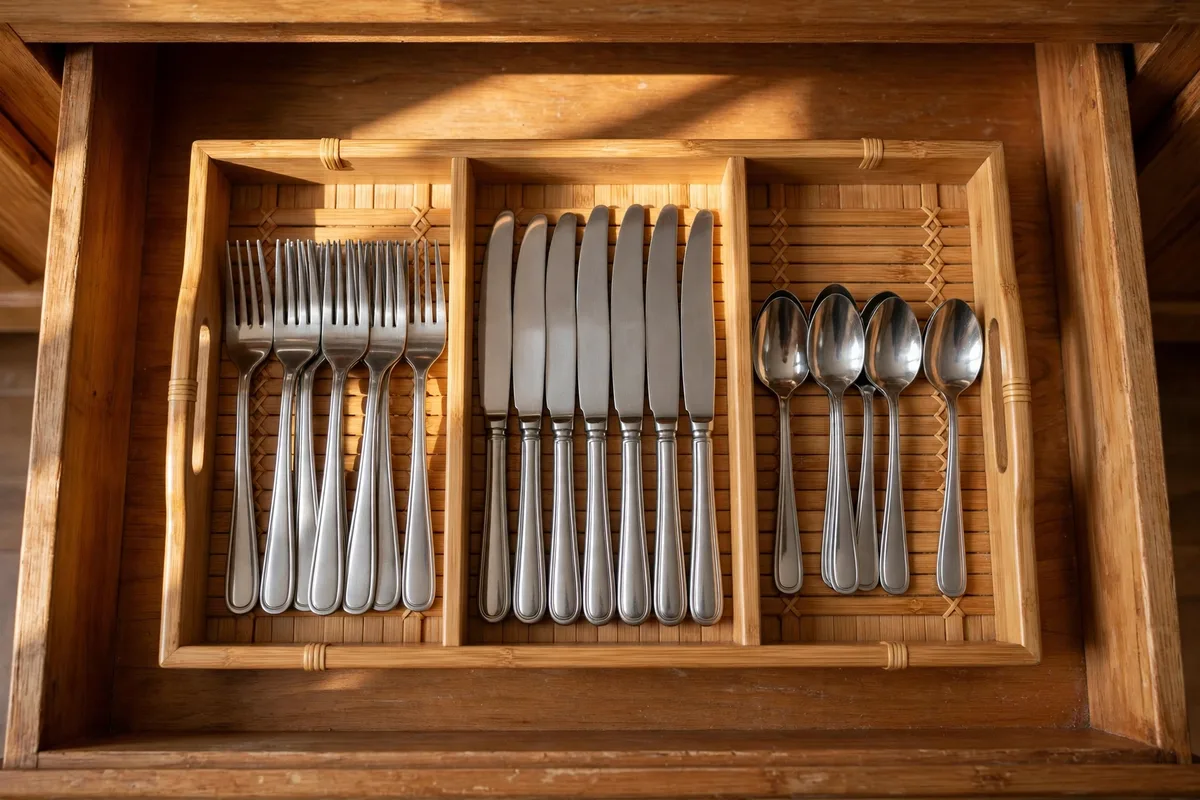
Utoplike’s bamboo cutlery tray is the traditional object perfected: an expandable-width tray in solid bamboo with the classic compartment map — the long slots for knives and serving pieces, the banks for forks, spoons and teaspoons — executed with the joinery and finish that make bamboo the cutlery drawer’s heritage material. It expands to the drawer’s width like the SpaceAid, locks its fit, and turns the most-opened drawer in the kitchen into the calmest.
Against the DrawerStore’s stacked innovation, Utoplike is the flat classic: everything visible in one layer, nothing cascaded, the format most households already understand in their hands. The bamboo’s warmth against steel cutlery is the daily aesthetic the plastic trays cannot offer, and its weight keeps it planted where lighter trays skate.
Canadian availability is online at a mid-range price, in size variants the guide reminds you to measure for. For the standard family cutlery drawer in a standard kitchen, this is the tray that will be lifted out, washed and replaced for a decade without a thought — tradition as a feature.
Ownership is invisible in the best way: the tray never becomes a topic, never fails, never dates — the cutlery drawer simply works, which is the entire ambition of the object and the definition of its success.
Bamboo’s one care rule bears repeating at the point of sale: wipe, never soak, and dry it the same minute — the tray treated like the cutting board it resembles will outlast the drawer it sits in; the one left soaking in the sink will not see spring.
Yay · Pros
- Classic compartment map, solid bamboo
- Expands to the drawer’s width
- Weight keeps it planted; a decade-class object
Hmm · Cons
- Cutlery-shaped compartments — one job, done well
- Bamboo care: wipe, never soak
- Size variants matter — measure before ordering
Best for: The classic cutlery drawer, in bamboo Skip if: Your kitchen is small and stacked capacity matters — the DrawerStore doubles up
Measure the drawer, not the dream: the sizing system that decides everything
Drawer organizers fail by millimetres, so the category’s first skill is measurement: record the drawer’s interior width, depth and height (all three, at the narrowest points — drawer boxes taper and bow), then subtract a finger’s width of total slack, because an organizer that must be forced will be removed at the first frustration. Height is the forgotten dimension: a tray taller than the drawer’s interior collides with the frame on every close, and the soft daily scrape of that collision is how organizers get exiled to the garage. The picks in this guide list their dimensions plainly; the tape measure arbitrates between them.
Adjustability is the honest answer to the fact that no two households own the same objects: expanding trays (the bamboo picks), modular trays that rearrange (the Vtopmart and madesmart systems), and spring-loaded dividers all solve the same problem — the drawer’s contents change, and a fixed grid fossilizes the day it was bought. The guide ranks adjustable systems above fixed ones at equal quality, because the organizer that adapts survives the drawer’s next life, and drawers change jobs more often than organizers get replaced.
The junk drawer deserves its own doctrine, since it is the test every system secretly faces: it cannot be eliminated, only governed. The working method is containment by category — batteries, tools, tape-and-string, chargers, the household’s small miscellany — in separate shallow trays with the highest-turnover category at the front, and a ruthless annual census. A junk drawer with five honest compartments is a supply station; the same objects loose are the drawer everyone apologizes for. Every system here can govern it; the madesmart and Vtopmart modularity govern it best.
Material is a cleaning decision wearing an aesthetic costume: clear plastic wipes and washes cleanest (crumbs, ink, the kitchen’s grease film), bamboo wipes adequately and looks warmest but dislikes soaking, and fabric bins hide sins while holding dust. Kitchen drawers — the crumb-and-spill front line — argue for washable plastic or bamboo-with-wiping; clothing drawers forgive fabric and reward its softness against delicates. Match the material to the drawer’s dirt, and the organizer’s tenth year looks like its first.
And the behavioural truth the whole category rests on: an organizer works when putting the object back is exactly as easy as dropping it in — one motion, no lid, no precision parking. The moment a system demands a ritual (the knife that must slot just so, the lid that must be lifted), the drawer’s contents begin their migration to the counter. Buy the system whose compartments match the shapes you actually own, leave one compartment deliberately unassigned for the drawer’s future, and the order will hold itself.
One drawer deserves mention as the system’s final exam: the cutlery drawer’s neighbour, the utensil drawer, whose long, awkward cargo — ladles, tongs, the rolling pin — defeats most trays. The working answer is lengthwise long compartments with nothing subdivided that does not need it: two or three long channels, one small tray nested at the front for the peelers and thermometers. Every system in this guide can build it; the households that do, stop keeping utensils in a countertop crock they never wanted.
Drawer organizer questions, answered
How do I measure a drawer for an organizer?
Measure the interior width, depth and height at their narrowest points, then choose organizers totalling a finger’s width less in width and depth, and at least half an inch under the height. Expanding and modular systems forgive measurement error best. If between sizes, the slightly small system with a gap beats the forced fit — a gap can hold a divider; a collision just gets removed.
Plastic, bamboo or fabric organizers — which is best?
Clear modular plastic, for most households: it wipes and washes clean (drawers collect crumbs, ink and grease film), the contents are visible at a glance, and the trays rearrange as the drawer’s job changes. Bamboo is the warmer-looking alternative for low-dirt drawers and wipes adequately. Fabric suits clothing drawers, where the dirt is lint and the cargo is delicate.
How do I organize a junk drawer?
Do not eliminate it — govern it. Divide it into category trays (batteries, tools, tape and adhesives, chargers, small miscellany), put the highest-use category at the front, and census it once a year without mercy. A junk drawer with honest compartments is a supply station; the same objects loose are chaos. Modular systems like the Vtopmart and madesmart in this guide are built for exactly this government.
Can I use a cutlery tray in a bathroom or desk drawer?
Yes — the bamboo trays here (Utoplike, SpaceAid) are cutlery-tray shaped but sized for any shallow drawer, and their warm finish suits a vanity or desk drawer better than plastic’s utility look. Match the tray’s height to the drawer (vanities are often shallower than kitchen drawers) and the compartments to the objects: brushes and bottles want longer, fewer slots than cutlery’s many.
How do I clean drawer organizers?
Plastic systems wash in warm soapy water or the dishwasher’s top rack (check the maker’s guidance); bamboo wipes with a damp cloth and dries immediately — never soak it. Do the whole drawer while you are at it: empty, vacuum the crumbs, wipe, and let everything dry before the organizers go back. A twice-yearly reset keeps the system honest.
Are two-tier drawer organizers worth it?
Usually, yes — a two-tier organizer doubles a deep drawer’s usable surface and suits spices, cosmetics and craft supplies whose containers are uniform. The condition is height discipline: the combined tiers plus the tallest container must clear the drawer’s frame with room to spare, and the top tier should slide or lift without a wrestling match. The madesmart in this guide is the tiered pick designed around exactly that clearance.
A closing note on the drawer nobody organizes: the nightstand’s. It accumulates the household’s smallest, most personal miscellany — chargers, books’ companions, medications, the 2 a.m. necessities — and it responds to the same modular government as the junk drawer, in miniature: one tray, three compartments, a census each season. Organize it with the kitchen’s leftovers; the modular sets in this guide always have a tray to spare, and the nightstand is where the spare earns its keep nightly.
The short version
Buy the Vtopmart set to organize every drawer in one modular language, the Joseph Joseph for cutlery-plus-knives in a small kitchen, the madesmart for deep drawers, and the SpaceAid or Utoplike bamboo where the drawer deserves furniture. Measure all three interior dimensions first — height is the one that exiles organizers — and leave one compartment unassigned for the drawer’s future.
Last updated: November 18, 2026. We refresh this guide each season and whenever a pick is replaced by a better one.