The best under-bed storage is decided by two measurements, not by capacity claims: your bed’s floor clearance, and how often you will open the container — rigid wheeled boxes win the monthly rotation, fabric bags win the seasonal swap — and the Sterilite and Lifewit picks below lead this guide because they are the strongest examples of each honest format. A container half an inch too tall is not storage; it is a purchase stored beside the bed, mocking you.
The five picks divide by format and frequency: two wheeled rigid boxes, two fabric bag systems, and a low-profile specialist for platform beds. Each entry states its true height and best rhythm in the open. The under-bed pairs with the best closet organizers in Canada and the USA guide above it, compresses further with the best vacuum storage bags in Canada and the USA picks, and files the small things with the best drawer organizers in Canada and the USA guide.
Disclosure: CookSmartPicks is reader-supported. When you buy through links on this page, we may earn an Amazon commission at no extra cost to you. Prices and availability change often — check the current price on Amazon before you decide.
How we chose these under-bed storage
Clearance governed the shortlist before capacity was allowed to speak: every pick’s true height (wheels included, for the boxes) had to fit a standard bed frame’s roughly 6–7 inches, and low-profile options were required for platform beds. Formats were then split by access rhythm — rigid wheeled boxes for the monthly rotation, fabric bags for the seasonal swap — because the format-access match is what makes the space work.
Dust and pest honesty was the second filter: lidded rigid picks had to genuinely seal, and the fabric picks’ breathability is described here as the trade it is, not hidden. Handles, zips and wheel quality were weighed from the products’ construction, and every pick is available through normal Canadian home retail at prices that let a household do both beds in a weekend.
The lineup at a glance
| Product | Best for | Why it stands out |
|---|---|---|
| Sterilite 60-Qt Wheeled Under-Bed Storage Box | Best wheeled box | The rolling standard: a sealed box that joins the monthly rotation |
| Lifewit 90L Under-Bed Storage Bags (Multi-Pack) | Best fabric bags | The seasonal workhorse: 90 litres of breathable, handled, windowed storage |
| Zober Under-Bed Storage Bags (Divided) | Best structured bags | The tidy bag: dividers and structure in a soft format |
| Onlyeasy Low-Profile Under-Bed Storage Bags | Best for low beds | The platform-bed answer: storage for the clearance nothing else fits |
| IRIS USA Wheeled Under-Bed Storage Box | Best rigid system | The system box: IRIS discipline in the under-bed format |
1. Sterilite 60-Qt Wheeled Under-Bed Storage Box — Best wheeled box
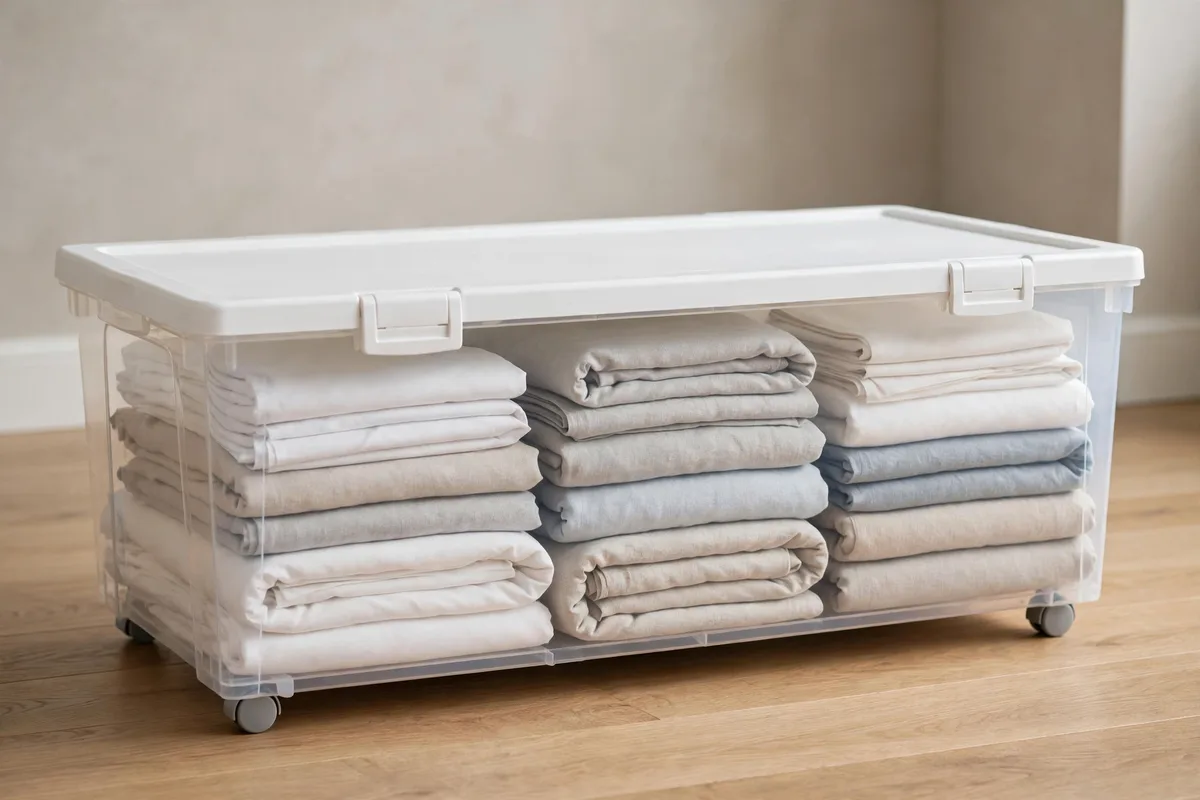
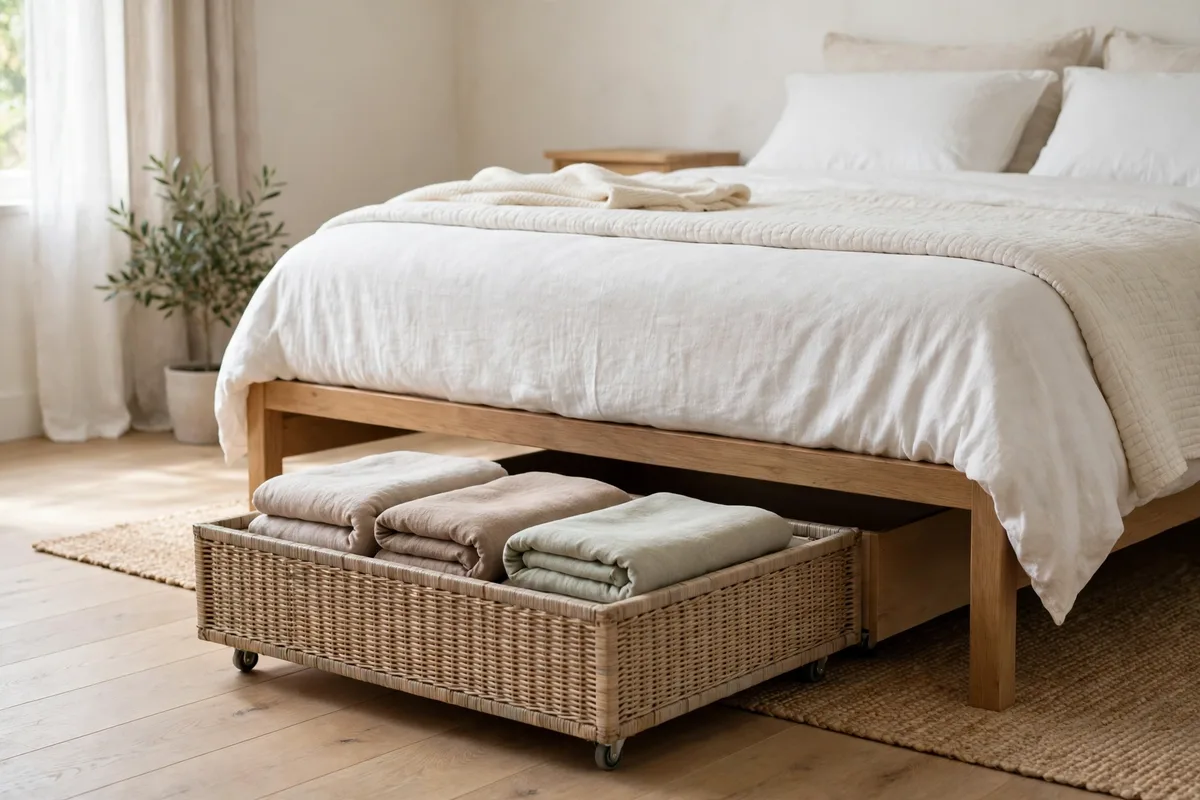
Sterilite’s 60-quart wheeled under-bed box is the format’s reference: a long, low rigid box on smooth-rolling wheels, with a latching lid that keeps the dust negotiation won, sized for the standard frame’s clearance and long enough to take folded duvets, spare sheet sets and the guest bedding that otherwise colonizes a closet. The wheels are the product — the box glides out one-handed for the monthly linen change and glides back, which is the difference between storage that participates in the household and storage that merely exists beneath it.
The capacity is the honest 60 quarts of the name, and the box’s rigidity lets it stack its contents without the bulge math of bags: what fits is knowable, repeatable, and the same at every opening. Sterilite’s plastics are the category’s commodity standard — not beautiful, not fragile, and consistent across a production history long enough that a box bought in five years will match today’s.
Canadian availability is universal in home retail at a mid-range price. For the primary bed’s working storage — the rotation of linens and layers the household actually cycles — this is the guide’s default, and the second one for the guest bed is the usual sequel.
Ownership’s rhythm is the seasonal deep-clean: the boxes roll out, the floor beneath gets its twice-yearly vacuum, the contents rotate — a small household ceremony the wheels make painless enough to actually happen.
The 60-quart figure rewards a translation: it swallows a king duvet folded with discipline, or two pillows and a sheet set, or a season of one adult’s sweaters — plan the box’s job in those units before buying the second, because the under-bed fills by plan or by accident, and only one of those ends labelled.
Yay · Pros
- Wheels glide one-handed; latching dust lid
- True standard-frame clearance sizing
- Rigid — capacity is knowable and repeatable
Hmm · Cons
- Needs standard clearance — measure first
- The lid is a dust seal, not a gasket
- Wheels are small; carpet slows the glide
Best for: The monthly rotation — spare linens and guest bedding Skip if: Your frame is a low platform — the Onlyeasy bags below squish under it
2. Lifewit 90L Under-Bed Storage Bags (Multi-Pack) — Best fabric bags
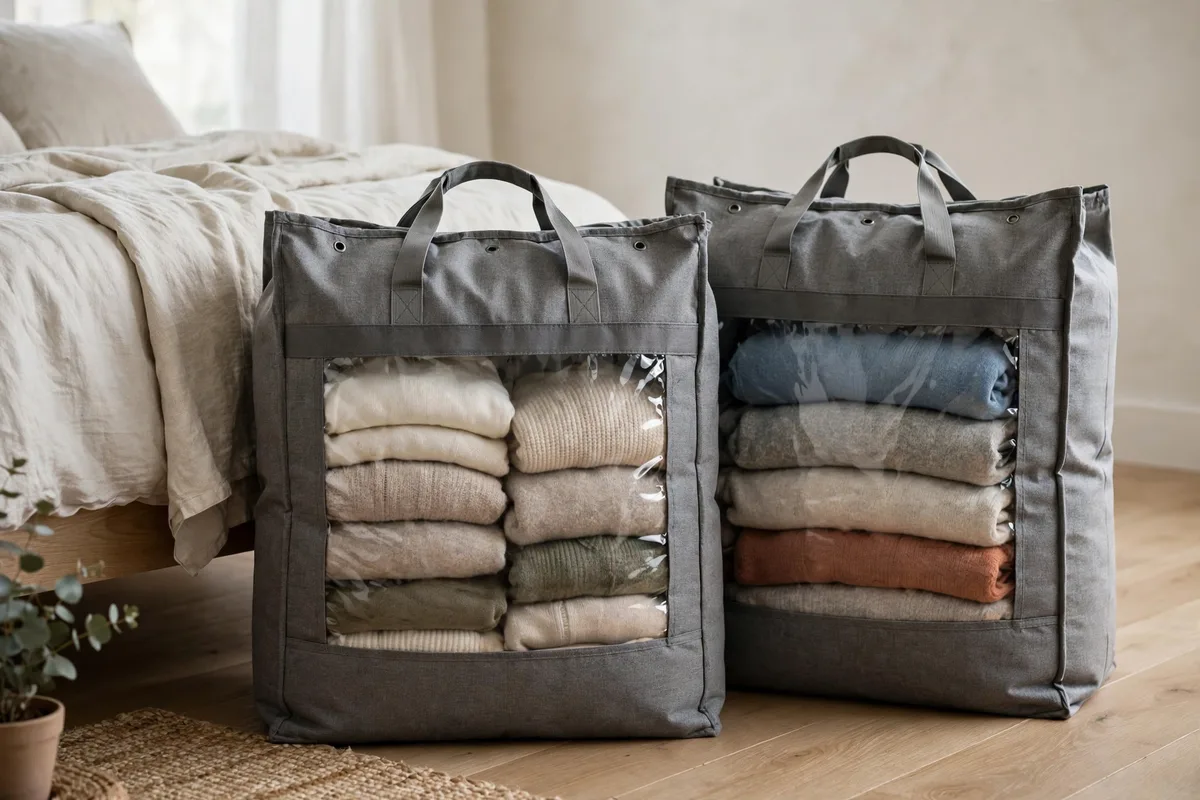
Lifewit’s 90-litre storage bags are the seasonal swap’s workhorse: large soft containers with reinforced handles, a clear window for the contents census, and a two-way zip that survives the twice-yearly wrestling a stuffed bag of sweaters demands. Sold in multi-packs at the category’s value tier, they turn the under-bed into the wardrobe’s annex — the winter clothes in May, the summer clothes in October — at a cost per litre nothing rigid approaches. The fabric’s breathability is the honest trade: no mustiness in a humid room, and a slow dust film the seasonal wash erases.
The handles deserve their mention, because a 90-litre bag of clothing is a genuinely heavy object and the handle stitching is where cheap bags die — Lifewit’s reinforced handles are the reason this brand, among a hundred near-identical listings, anchors the slot. The bags also fold flat when empty, so the off-season container itself needs no storage — the recursive elegance of the soft format.
Canadian availability is online at a budget multi-pack price. For the clothing rotation — the under-bed’s commonest job — Lifewit is the guide’s default bag, bought in the pack size that does both beds at once.
Ownership is calendared: the bags emerge at the equinoxes, swap their contents, get shaken or washed, and disappear again — storage as a twice-yearly ritual rather than a permanent negotiation.
Lifewit’s clear window has a discipline attached: pack the bag so the window shows the contents’ identity — the top sweater’s colour, the duvet’s edge — rather than an anonymous wad of fabric, and the census the window promises actually happens at a glance, twice a year, without an unzip.
Yay · Pros
- Huge capacity per dollar; clear contents window
- Reinforced handles — the survival detail
- Fold flat when empty; breathable fabric
Hmm · Cons
- Breathable fabric admits dust over a season
- No structure — contents define the shape
- Not a moth barrier for woolens
Best for: Seasonal clothing swaps in bulk Skip if: You are storing fine woolens long-term — a rigid box is the barrier they need
3. Zober Under-Bed Storage Bags (Divided) — Best structured bags
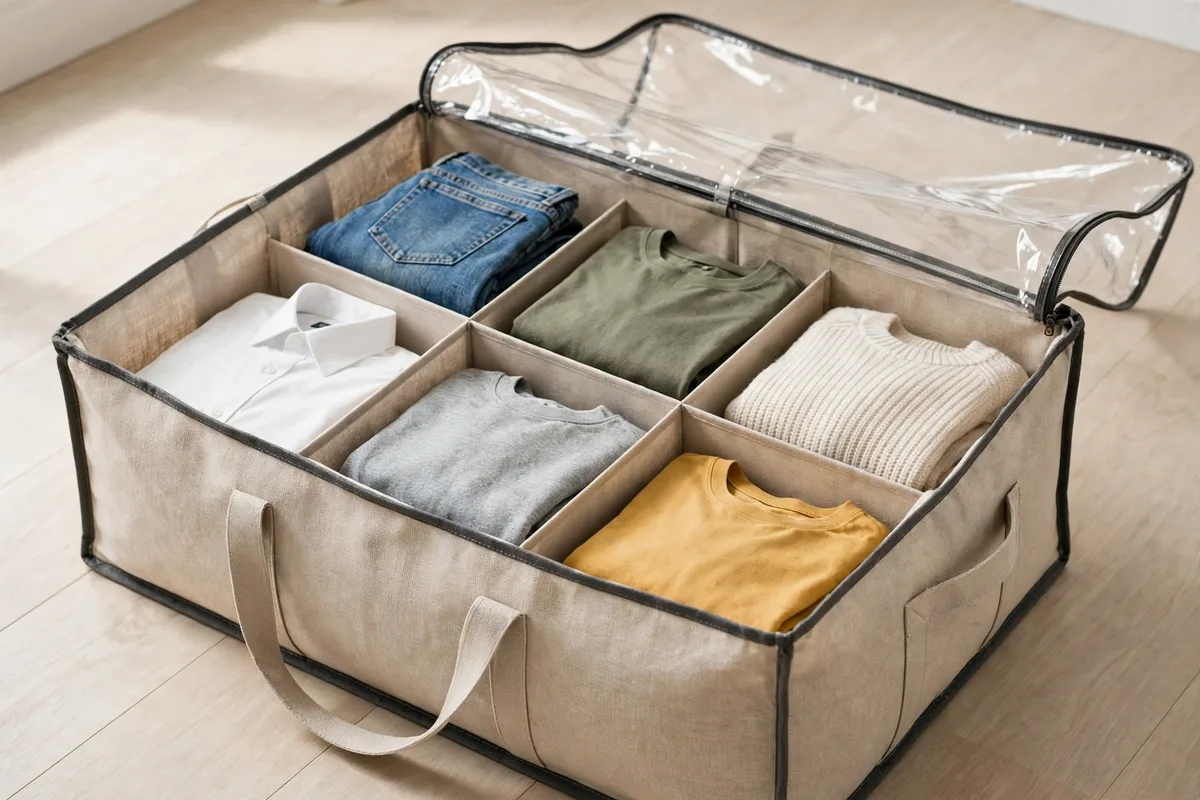
Zober’s under-bed bags answer the soft format’s chaos with structure: internal dividers and a more rigid construction that keeps folded clothes folded and the bag’s profile rectangular, so it slides under the bed like a drawer rather than a duffel. The clear top panel runs the contents census without unzipping, the handles are the reinforced class, and the whole object behaves — in a category where behaviour is the exception — like luggage designed by someone who has used luggage.
The dividers are the real feature for clothing storage: sweaters stay in their stacks, the kids’ next-size-up clothes stay sorted, and the bag’s contents emerge in the order they entered, which cannot be said of the unstructured sacks. The price steps up from the Lifewit class accordingly, buying order rather than volume.
Canadian availability is online at a mid-range price. For the household whose under-bed is clothing-forward and whose tolerance for rummaging is zero, Zober is the bag that respects the fold — the organiser’s choice in a soft format.
Ownership shows at the swap: the Zober’s contents come out presentable enough to skip the refold, and over years of seasons that small saved labour is the premium’s entire justification, paid back twice annually.
Zober’s dividers have a second assignment beyond the bedroom: the same bag under a guest bed becomes the visitors’ drawer — spare towels, the travel toiletries, a phone charger — the hospitality kit that turns a spare room into a guest room in one slide of the bag.
Yay · Pros
- Dividers keep folded clothes folded
- Rectangular profile — slides like a drawer
- Clear top for the no-unzip census
Hmm · Cons
- Structure costs capacity versus pure soft bags
- Premium over basic bag multi-packs
- Still fabric — dust honesty applies
Best for: Structured bags that hold a shape Skip if: You want maximum litres per dollar — the Lifewit packs more, cheaper
4. Onlyeasy Low-Profile Under-Bed Storage Bags — Best for low beds
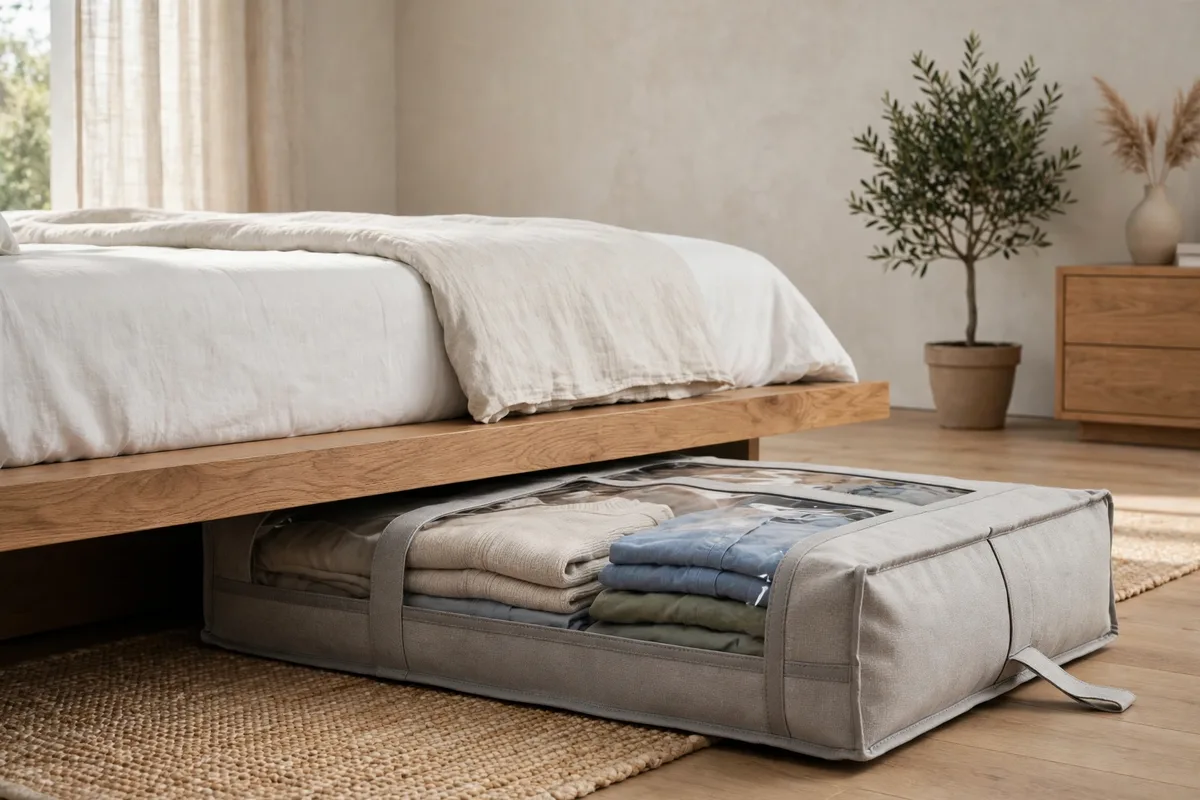
Onlyeasy’s low-profile bags exist for the beds the boxes cannot serve: platform frames with clearances under five inches, where the under-bed space is real but shallow. The bags’ slim profile — long, wide and deliberately flat — slides where rigid containers cannot, and their foldable design lets a household stuff to the exact height the frame allows, using the squish as the sizing system. For the platform-bed generation of bedrooms, this is frequently the only under-bed storage that exists, which makes it the most valuable pick in the guide for its owners.
The construction follows the bag class’s honest rules: breathable fabric, reinforced handles, a clear window, and the seasonal rhythm as the intended use. Capacity per bag is modest — the price of the profile — and the multi-pack pricing compensates in the usual way: two shallow bags cover the bed’s footprint between them.
Canadian availability is online at a budget price. Measure your platform’s clearance first (this pick exists because that number disappoints), and if it reads under five inches, the decision has been made for you — by geometry, the fairest of all product selectors.
Ownership’s satisfaction is found space: the platform bed’s dead zone becomes the linen closet the small bedroom never had, and found storage in a small home is worth more than bought storage in a large one.
Onlyeasy’s slim bags stack a second talent: two of them side by side map a queen bed’s footprint almost exactly, so the platform bed’s shallow zone stores a full season’s rotation in a single layer — no stacking, no digging, everything at the front line.
Yay · Pros
- Slim profile fits platform beds under 5 inches
- Stuff-to-fit height — the squish is the sizing
- Budget multi-pack pricing
Hmm · Cons
- Low height caps the capacity per bag
- Fabric format — the dust trade applies
- Handles work hard at full stuffing
Best for: Low platform beds nothing else fits under Skip if: Your frame has standard clearance — the wheeled boxes serve it better
5. IRIS USA Wheeled Under-Bed Storage Box — Best rigid system
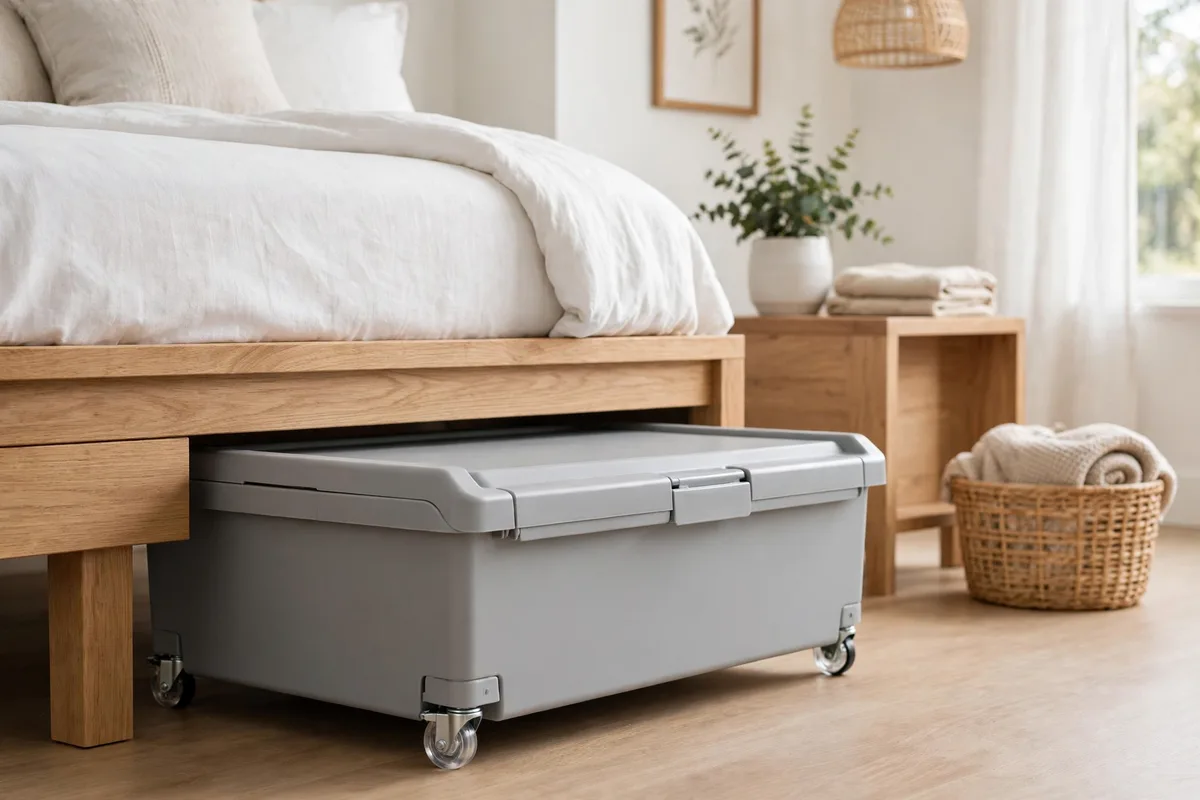
IRIS USA’s wheeled under-bed boxes are the rigid alternative with a system’s discipline: consistent sizing across the line, smooth casters, and lids that latch with the positive feel the brand’s storage range is known for. The boxes serve the same monthly-rotation brief as the Sterilite — linens, guest bedding, the working wardrobe’s overflow — with a slightly more finished object, and households already invested in IRIS bins elsewhere in the home get the aesthetic consistency that makes storage look intentional.
The capacity and clearance sit in the same standard-frame class as the leader’s; the deciding factors are the latch feel, the caster quality, and the line’s availability in your stores — the guide lists IRIS as the co-equal rigid pick for households whose local shelves or existing systems favour it, because at this level the brand choice is logistics, not performance.
Canadian availability is good online and in larger home retailers, at a mid-range price. Buy the pair for the bed, label the ends, and the under-bed joins the rest of the home’s IRIS system as one more solved surface.
Ownership is standardization’s quiet pleasure: every box in the house the same language of lids and latches, spares and replacements always findable — the argument for a system, made under the bed.
IRIS sizing varies subtly between markets and model years, so the guide’s tape-measure rule applies with double force: verify the listed height against your frame’s lowest point before the pair is ordered, because the system’s pleasure depends on the glide, and the glide depends on the half-inch.
Yay · Pros
- Positive latching lids; smooth casters
- Consistent sizing across a whole storage line
- Finished look for system households
Hmm · Cons
- Lid seal is dust-grade, not gasket-grade
- Sizing varies by market — verify the height
- Less ubiquitous in Canadian stores than Sterilite
Best for: Households standardizing on one rigid system Skip if: You want the surest Canadian shelf availability — Sterilite is everywhere
The dust-and-pest honesty paragraph every storage guide owes you
Under-bed storage lives in the house’s dustiest microclimate: the space beneath a bed collects dust, pet hair and carpet fibres continuously, and any container stored there is in a long negotiation with that fallout. Rigid lidded boxes win the negotiation outright — a sealed lid is a dust answer, full stop — while fabric bags breathe, which prevents the mustiness that sealed plastic can brew in a humid room, and admits a slow dust film over a season. The honest rule: rigid and sealed for storage measured in seasons and years; breathable bags for the monthly rotation, washed or shaken out at every swap.
Pests raise the stakes in some homes and regions: moths find wool and cashmere in the dark, undisturbed under-bed dark exactly as they find a closet, and no soft bag is moth-proof — cedar, lavender and cleanliness are deterrents, while a rigid box with a gasket-class lid is a barrier. For heirloom textiles and the good winter woolens, this guide’s rigid picks (or a vacuum bag inside a rigid box, the belt-and-braces method) are the responsible answer, and the fabric bags’ honesty box says so.
Height is the measurement that decides everything and gets skipped by everyone: measure your bed’s floor clearance at its lowest point — the centre beam and the side rails differ — and buy containers at least half an inch under it, remembering that a stuffed fabric bag’s height is whatever you make it, which is both the bag’s advantage (it squishes under) and its trap (it also bulges over). Wheeled boxes add their wheel height to the box; the Sterilite and IRIS picks here are sized for standard frames, but the tape measure, not the listing, is the authority.
Access frequency should pick the format before aesthetics do: the weekly-access container (spare linens for the guest room, the kids’ current-size clothes) wants wheels and a lid that opens without full extraction; the twice-a-year container (the duvet swap, the holiday décor overflow) can be a bag dragged out by its handles without ceremony. Households that mismatch these — bags for weekly, boxes for annual — feel a low-grade friction at every use that no product quality can fix, because the format is the experience.
And the out-of-sight discipline: label every container on its end (the face that shows when stored), photograph the contents into a phone note for the deep-storage boxes, and keep a one-in-one-out rule for the space, because the under-bed is finite and its amnesia is total — the unlabelled box under a bed is the household’s Bermuda Triangle, entered by objects and never searched again. Storage that cannot be inventoried is just tidier hoarding, and the label is the whole difference.
A final discipline that makes the whole space pay: the under-bed should hold nothing that exists nowhere else in the household’s memory. Keep a simple inventory — a phone photo of each open container, refreshed at every seasonal swap, filed in one album — and the space becomes searchable from the sofa. It takes ninety seconds twice a year, and it is the entire difference between storage and burial, which is the line this category exists to draw.
Under-bed storage questions, answered
How much clearance do I need for under-bed storage?
Measure the clearance at the bed’s lowest point (check the centre beam as well as the side rails), then buy containers at least half an inch shorter. Standard frames offer roughly 6–7 inches; low platform beds can be under 5, which rules out most wheeled boxes and points to the low fabric bags. Remember that wheeled containers’ listed heights include their wheels — and that a stuffed bag’s height is negotiable in both directions.
Wheeled boxes or bags — which is better?
Wheels, if you will open it more than a few times a year: the container glides instead of dragging, sparing the floor and your back. For twice-a-year storage (seasonal duvets, décor), a handled bag dragged out twice is no hardship and stores flatter when empty. Match the format to the access rhythm — that match, more than any brand, is what makes under-bed storage feel organised.
Can I use vacuum bags under the bed?
Yes, with the right partner: a vacuum bag inside a rigid box gives you compression plus a dust-and-pest barrier, and this site’s vacuum-bag guide covers the bags themselves. On their own under a bed, vacuum bags can slowly leak air over months and their plastic can be punctured by bed-frame hardware — the box protects the bag, and the bag protects the duvet. For monthly-access items, skip the vacuum step entirely.
Do fabric storage bags keep dust and moths out?
Not perfectly — soft bags breathe, which prevents mustiness but admits dust over a season and offers no moth barrier. For long-term textile storage, use a rigid lidded box (ideally with the item in a vacuum bag inside it), add cedar for woolens, and store the container clean: wash or shake out fabric bags at every seasonal swap, and vacuum the under-bed space itself while the containers are out.
What should I store under the bed?
The high-value rotation: off-season clothing and duvets, spare linens, guest bedding, outgrown kids’ clothes awaiting the next child, and shoe overflow. Avoid: anything needed weekly (it belongs in the closet system), heavy books (the floor and the box both object), and anything you would be sad to forget exists — under-bed storage is the house’s amnesia zone, so label every container on its stored end.
How do I clean under-bed storage containers?
Wipe rigid boxes inside and out at every seasonal swap, wash fabric bags per their labels (most are machine washable or wipe-clean), and let everything dry fully before refilling — a sealed box of slightly damp textiles is a mustiness farm. While the containers are out, vacuum the under-bed space itself; it is the one time the house’s dustiest square metres are reachable.
The guest bed deserves the final word, because its under-space is the household’s most wasted: guests arrive twice a year, and beneath them sleeps a full footprint of prime storage. Stock it with the hospitality rotation — the spare duvet, the extra towels, the visitors’ drawer of chargers and toiletries this guide described — and the guest room stops borrowing from every other closet in the house each time the doorbell announces family.
The short version
Buy the Sterilite or IRIS wheeled boxes for the monthly rotation, the Lifewit bags for the seasonal clothing swap, the Zober for folded order, and the Onlyeasy for low platform beds. Measure your clearance first, label every container’s end, and remember the dust rule: rigid and sealed for the long term, breathable bags for the rotation.
Last updated: November 18, 2026. We refresh this guide each season and whenever a pick is replaced by a better one.