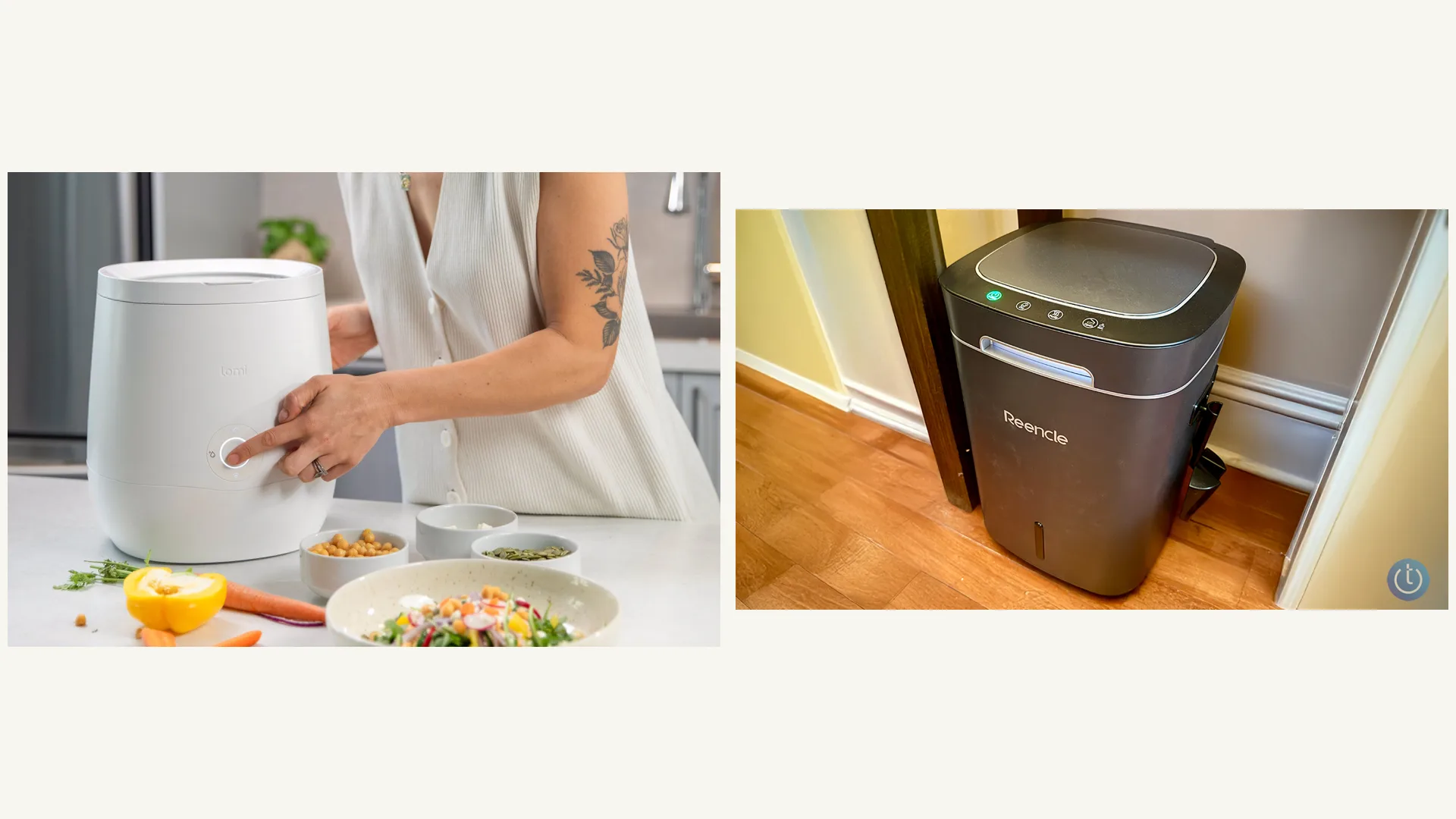
Start with the honest sentence most of this category avoids: most "electric composters" do not actually compost. Eight of the ten machines here are food recyclers — they heat, grind and dry your scraps into a shelf-stable, soil-like material in a few hours. That output is genuinely useful, but it is pre-compost: it needs time in soil to finish becoming compost. The other two, from Reencle and GEME, keep living microbe cultures and make the real thing, slowly and continuously. Both approaches beat the landfill. They are not the same product, and this guide scores them as what they are.
Why bother at all? Food scraps in landfill rot without oxygen and produce methane. A countertop or floor-standing machine cuts the weight and smell of your kitchen waste the day you make it, kills the fruit-fly problem, and turns scraps into something your garden, your green bin or your houseplants can use. The ten picks below split by household size, by method, and by how much ongoing fuss — filters, pods, charcoal — each one asks of you.
Electric Kitchen Composters at a Glance
| Machine | Method | Capacity | Best for |
|---|---|---|---|
| Lomi 3 | Dry-grind recycler | 3L bucket | Most kitchens — fastest, smallest Lomi |
| Lomi 2 | Dry-grind recycler | 3L bucket | Bioplastics and the most mode choice |
| Lomi Classic (Lomi 1) | Dry-grind recycler | 2.5L bucket | The proven original, via Amazon |
| FoodCycler Eco 5 | Dry-grind recycler | 5L bucket | Families; Canadian municipal programs |
| FoodCycler Eco 3 | Dry-grind recycler | 3.5L bucket | Compact pick for apartments |
| Vitamix FoodCycler FC-50 | Dry-grind recycler | 2.5L bucket | Legacy buy while stock lasts |
| Reencle Prime | Live microbial composter | 14L chamber | Real compost, continuous feeding |
| Reencle Gravity | Live microbial composter | 22L chamber | Real compost at family volume |
| GEME Smart Electric Composter (19L) | Live microbial composter | 19L chamber | Big households, zero filter changes |
| Vego Kitchen Composter | Dry-grind recycler + app | 4L bucket | Five modes, a built-in scale, app control |
How We Researched This Guide
CookSmartPicks is a research-based guide. We do not run a test kitchen, and we never claim hands-on testing we have not done. For this guide we compared manufacturer specifications and manuals with independent coverage — WIRED's long-term composter testing, Good Housekeeping, Bob Vila, Bon Appétit, one5c, Techlicious, The Gadgeteer and Compost Magazine — plus retailer listings in Canada and the USA and owner reviews. Electricity figures are the makers' own. Product photos are the makers' own listing photos, each checked against the named model.
Where a product carries scores in this guide, they are CookSmartPicks editorial scores. The Composting Result score is where the honesty line lives: true microbial compost scores highest, quality pre-compost next, and every basis line says which a machine makes.
How we score
The scores in this guide are CookSmartPicks’ own editorial ratings. We set them from our research of the expert reviews and sources listed in this post — they are our ratings, not scores quoted from another publication.
1. Lomi 3 — Best Food Recycler for Most Kitchens
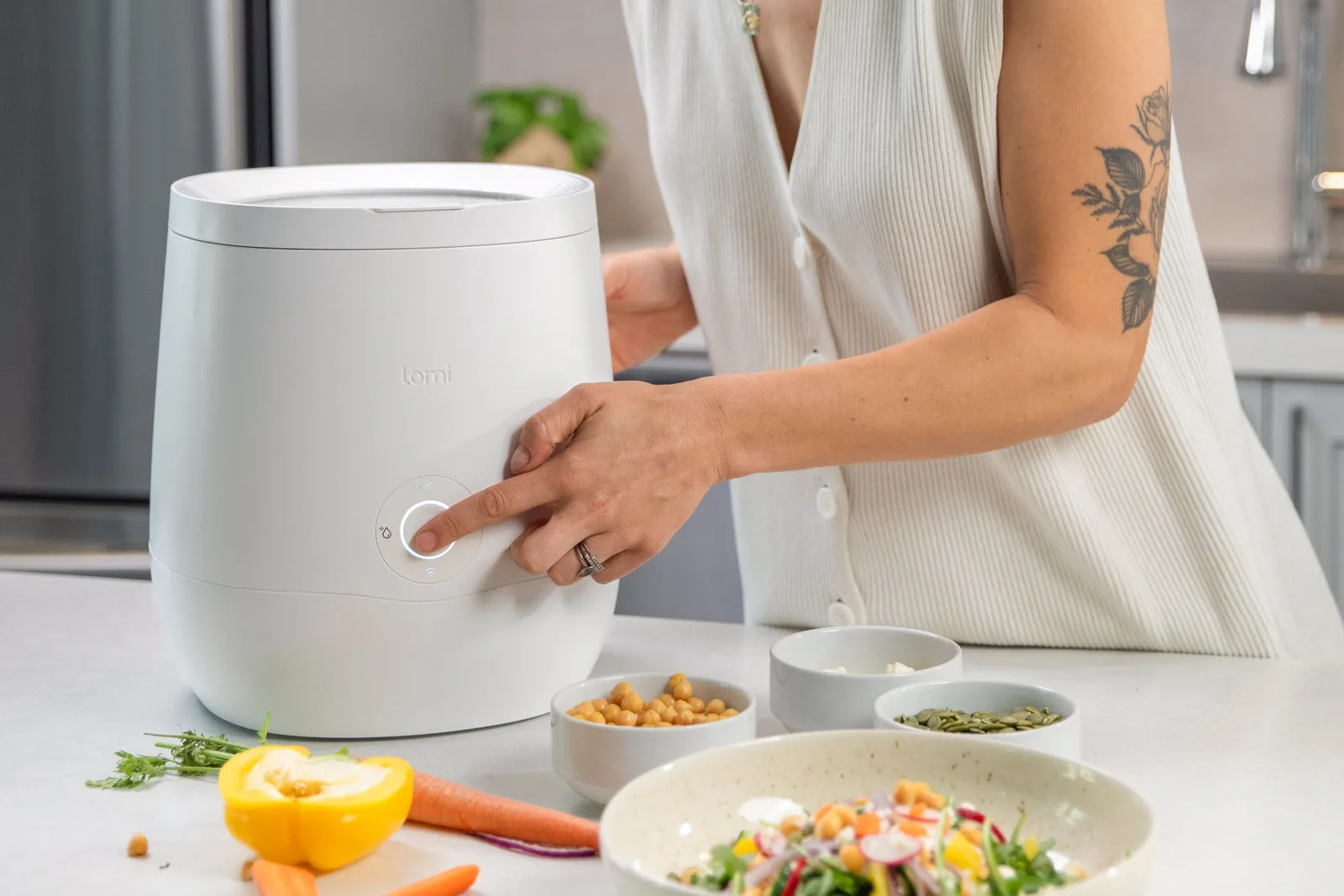
The Lomi 3 is the current, smallest Lomi: a 3-litre removable bucket, an Express mode that finishes in about three to six hours, and a Grow mode (11 to 17 hours) that runs cooler to keep more biology alive in the output. The charcoal filter is refillable rather than disposable, with a reminder light at roughly 45 cycles, and the maker rates a cycle at about 1 kWh. WIRED's long-term composter coverage gives the Lomi line its best grind-and-dry verdict, and the 3 is the easiest version to live with.
The category caveat applies in full: the output is pre-compost that needs curing in soil, not finished compost you can plant into the same day. Unlike the Lomi 2 below, the 3 also drops bioplastics processing. If your scraps are food and only food, and counter space matters, this is the default pick.
Yay · Pros
- Smallest Lomi footprint, with a removable 3-litre bucket
- Express mode finishes in about 3 to 6 hours
- Refillable charcoal cartridge, reminder light at about 45 cycles
Hmm · Cons
- Output is pre-compost needing curing, not finished compost
- Cannot process bioplastics, unlike the Lomi 2
Best for: most households wanting the fastest route to a dry, storable byproduct. Skip if: anyone who wants finished compost — see Reencle and GEME.
2. Lomi 2 — Best for Bioplastics and Mode Choice

The Lomi 2 (the machine launched as the Lomi Bloom) is the mode-choice Lomi. Its party trick is the Lomi Approved mode, which runs hotter and longer to process approved bioplastics and compostable packaging alongside food — something no FoodCycler here and not even the newer Lomi 3 can do. Eco-Express is rated under 0.60 kWh per cycle, the glass skylight lid lets you watch it work, and one5c's comparative coverage picked it overall among countertop recyclers.
You pay for the flexibility in size: the 2 is larger and heavier than the 3, so measure your counter. The output is the same story as every dry-grind machine — pre-compost that needs soil time before plants get it. Households that actually use compostable packaging will get real value from the extra mode; everyone else can save the space and take the 3.
Yay · Pros
- Lomi Approved mode handles approved bioplastics and packaging
- Eco-Express rated under 0.60 kWh per cycle
- Picked overall in one5c comparative coverage
Hmm · Cons
- Larger and heavier than the Lomi 3
- Output is pre-compost needing curing before garden use
Best for: households using compostable packaging, wanting the most mode choice. Skip if: anyone short on counter space — the Lomi 3 is smaller.
3. Lomi Classic — Best Established Entry Point to the Lomi Line
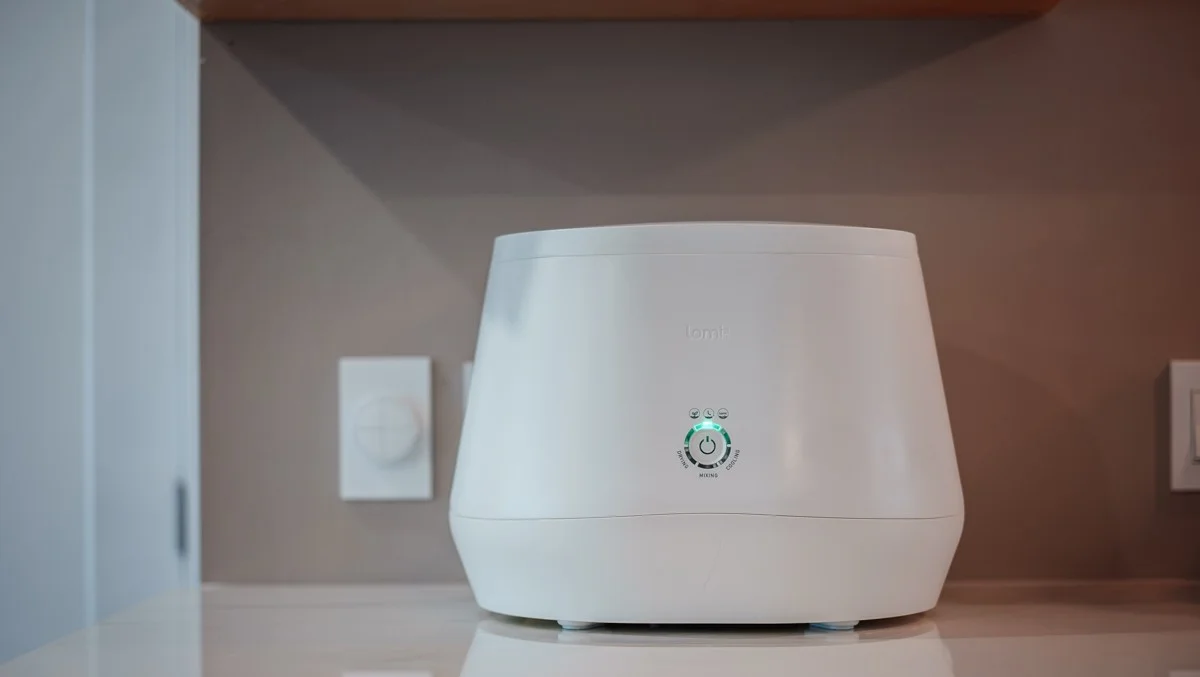
The Classic — sold later as the Lomi 1 — is the machine that started this category in 2021, and it still holds up: a 2.5-litre bucket, three modes (Eco-Express at three to five hours, Lomi Approved for bioplastics at five to eight, Grow at 16 to 20), two charcoal filters, and a long, well-documented owner record from Bob Vila and HGTV launch coverage onward. Because it is the original, its quirks and costs are the best understood of any machine here.
The catch is its age. Lomi no longer sells it direct, so you are buying through Amazon and marketplace sellers (Pela Labs sells it on Amazon.ca) — check the seller and the warranty terms on the listing you choose. It is also the bulkiest Lomi, at about 16 inches wide. A proven machine at the right listing, with homework attached.
Yay · Pros
- Original design with three modes, including bioplastics
- Long owner track record and a large installed base
- Two charcoal filters, top and back
Hmm · Cons
- No longer sold direct; check seller and warranty terms
- Bulkiest Lomi design, about 16 inches wide
Best for: buyers wanting the proven original Lomi via Amazon. Skip if: anyone wanting current-generation support — choose the Lomi 3.
4. FoodCycler Eco 5 — Best Large-Capacity Food Recycler
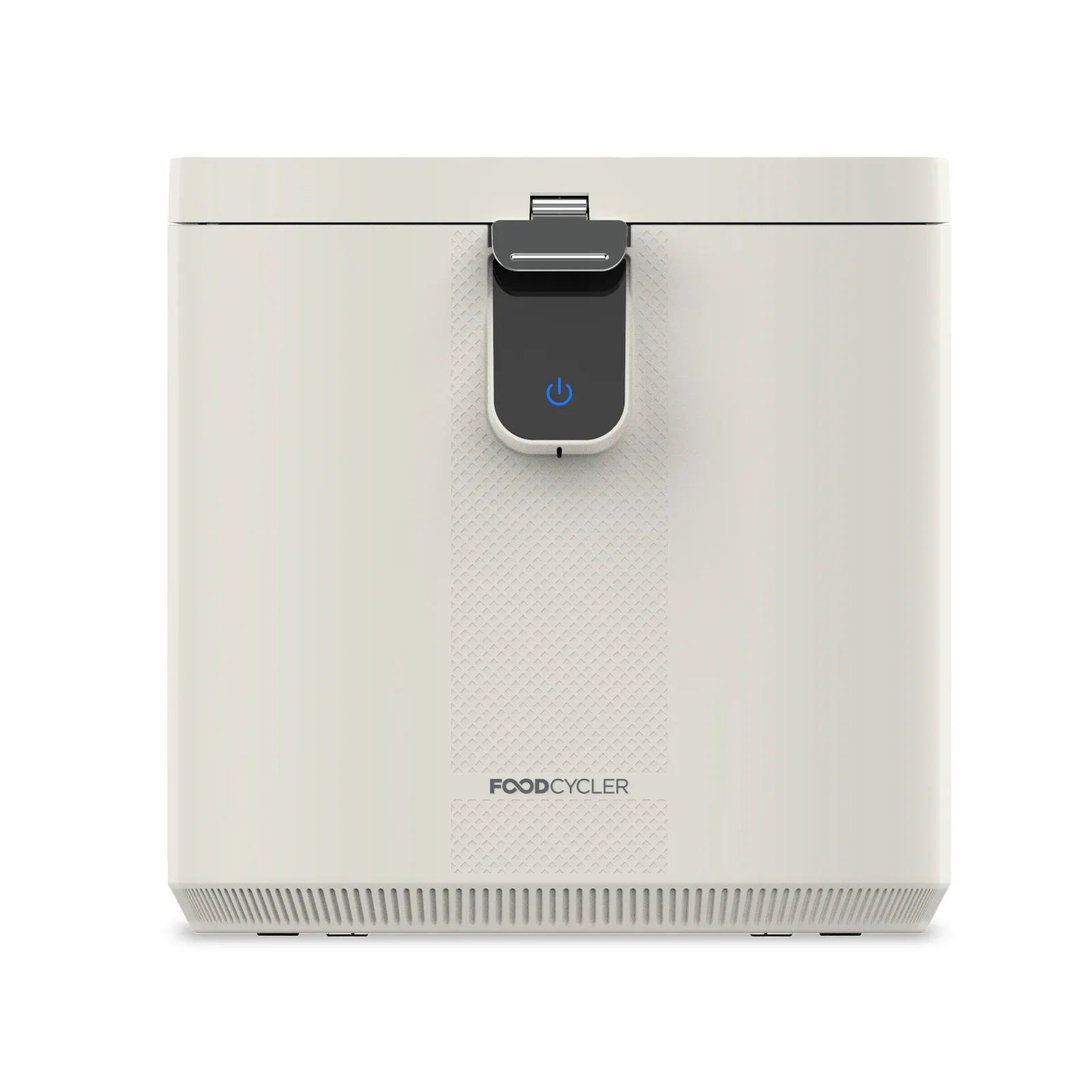
The Eco 5 is the family-size dry-grind machine: a 5-litre bucket — the largest countertop batch here — that swallows a full day of scraps for a household of four or more, runs a four-to-nine-hour cycle at roughly 1.3 to 1.5 kWh, and uses refillable carbon pellets instead of disposable filter cartridges. The bucket is dishwasher-safe and has its own carbon-filter lid, so scraps can collect in it without smelling up the kitchen. WIRED's long-term coverage notes it as large and quiet; Bon Appétit's family testing liked the capacity.
Canadian readers get a bonus angle: FoodCycler runs municipal programs reported in more than 200 Canadian municipalities, where subsidised machines appear from time to time — worth checking your town's site before paying full price anywhere. The honest limits: it is big (many owners end up keeping it on the floor), and the output is a dry byproduct, not finished compost.
Yay · Pros
- Largest countertop batch bucket here, at 5 litres
- Dishwasher-safe bucket with its own carbon-filter lid
- Municipal programs reported in 200+ Canadian municipalities
Hmm · Cons
- Big footprint; many owners keep it on the floor
- Output is a dry byproduct, not finished compost
Best for: families of four or more, and Canadians in a program municipality. Skip if: apartment cooks short on space — the Eco 3 is the smaller sibling.
5. FoodCycler Eco 3 — Best Compact Recycler for Apartments
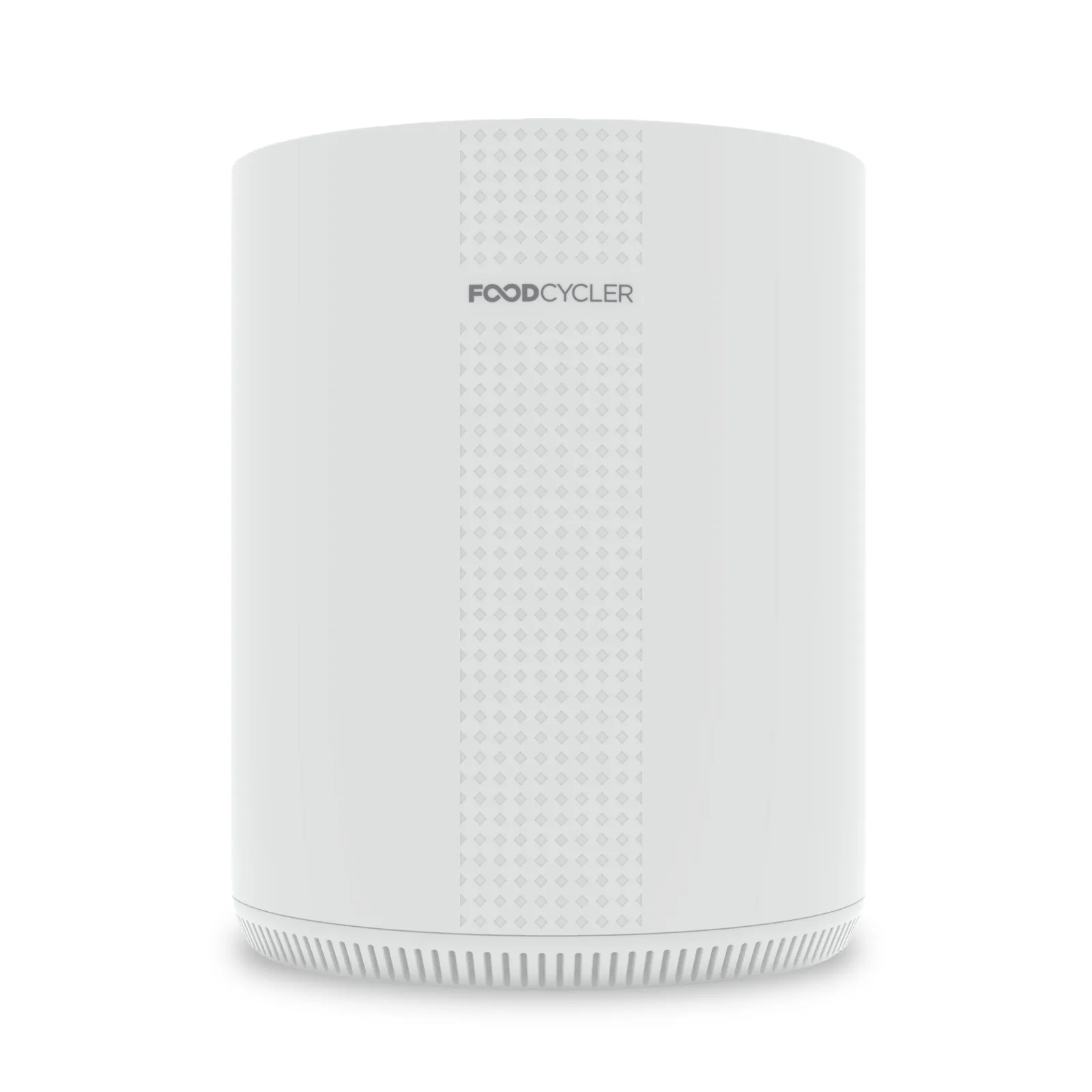
The Eco 3 shrinks the FoodCycler formula to apartment scale: a round body about nine inches wide, a 3.5-litre bucket sized for one to three people, four-to-nine-hour cycles at roughly 0.9 kWh, and the same refillable-pellet odour system as its big sibling. It is also the current-generation successor to the Vitamix FC-50 below — this is the FoodCycler design as it is made now. Canadian municipal pilot programs list it as their small-household option, the same program availability the Eco 5 enjoys.
Small means frequent: a household that cooks a lot will run it often, and each run is still a batch — fill, close, wait. The output, again, is pre-compost byproduct. For a condo kitchen that currently throws scraps in a smelly under-sink bin, those are easy trades.
Yay · Pros
- Compact round design, about 9 inches wide
- 3.5-litre bucket suits one-to-three-person households
- Same Canadian municipal-program availability as the Eco 5
Hmm · Cons
- Small bucket means frequent cycles for families
- Output is pre-compost byproduct, not finished compost
Best for: apartment and condo households of one to three people, especially in program municipalities. Skip if: families filling a bucket daily — step up to the Eco 5.
6. Vitamix FoodCycler FC-50 — Best Legacy Buy While Stock Lasts
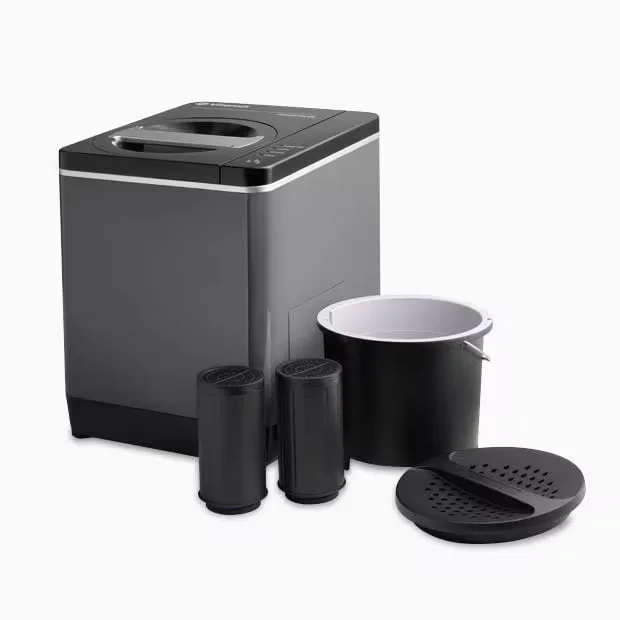
The FC-50 is the original FoodCycler wearing a Vitamix badge: a 2.5-litre bucket, one-button dry-grind-cool operation over four to eight hours at about 0.8 kWh per cycle, and a carbon-filter bucket lid that keeps collected scraps from smelling while they wait. It built the owner base this whole category stands on, and long-term reviews — including detailed Canadian owner coverage — rate the design as dependable years in.
It is in this guide as a legacy buy, labelled plainly: the model is an earlier generation, superseded in the current FoodCycler line by the Eco 3 above, and listings are marketplace stock rather than a current retail line. If you find one well-priced from a seller you trust, the machine itself is proven. If the price is close to an Eco 3, buy the Eco 3 — it is the same idea, current, and supported.
Yay · Pros
- Carbon-filter bucket lid controls odour while filling
- Simple one-button operation, dry-grind-cool phases
- About 0.8 kWh per cycle on manufacturer figures
Hmm · Cons
- Earlier-generation model, superseded by the Eco 3
- Output is a dry byproduct needing soil time
Best for: buyers finding a well-priced listing for the proven Vitamix design. Skip if: anyone wanting the current generation — the Eco 3 is its successor.
7. Reencle Prime — Best for Real Compost
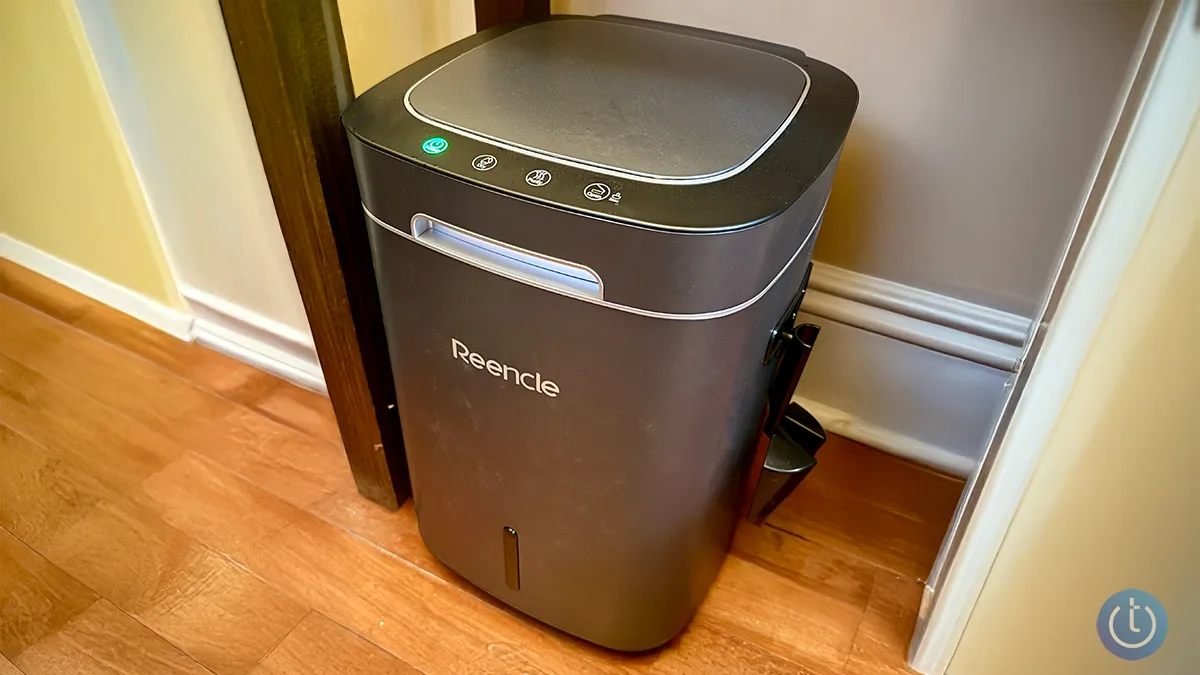
The Prime is a different species from everything above it. Inside its 14-litre chamber lives a Bacillus culture — ReencleMicrobe — that actually composts: you feed scraps in any time, continuously, up to about 2.2 pounds a day, and the culture breaks them down the way a garden pile does, just faster and without the smell or the yard. No pods, no subscriptions; the carbon filter lasts roughly nine to twelve months. WIRED's long-term coverage makes it their top recommendation for near-real compost, with Good Housekeeping and Bob Vila coverage behind it. It draws about 1.25 kWh a day, always on.
Two honest notes. The harvested material still benefits from about three weeks of curing in soil before it feeds plants — real compost, on compost's schedule, not a vending machine's. And it is a floor-standing appliance, not a countertop one; it needs a corner, not a shelf. For a gardener, it is the most satisfying machine in this guide.
Yay · Pros
- Living Bacillus culture — real compost, not dried grounds
- Continuous feeding; add scraps any time
- No pods or subscriptions; filter only, about yearly
Hmm · Cons
- Output benefits from about three weeks of curing in soil
- Floor-standing size, not a countertop appliance
Best for: gardeners who want real compost from kitchen scraps. Skip if: anyone wanting a sealed batch finished in hours, or with no use for compost.
8. Reencle Gravity — Best High-Capacity Microbial Composter
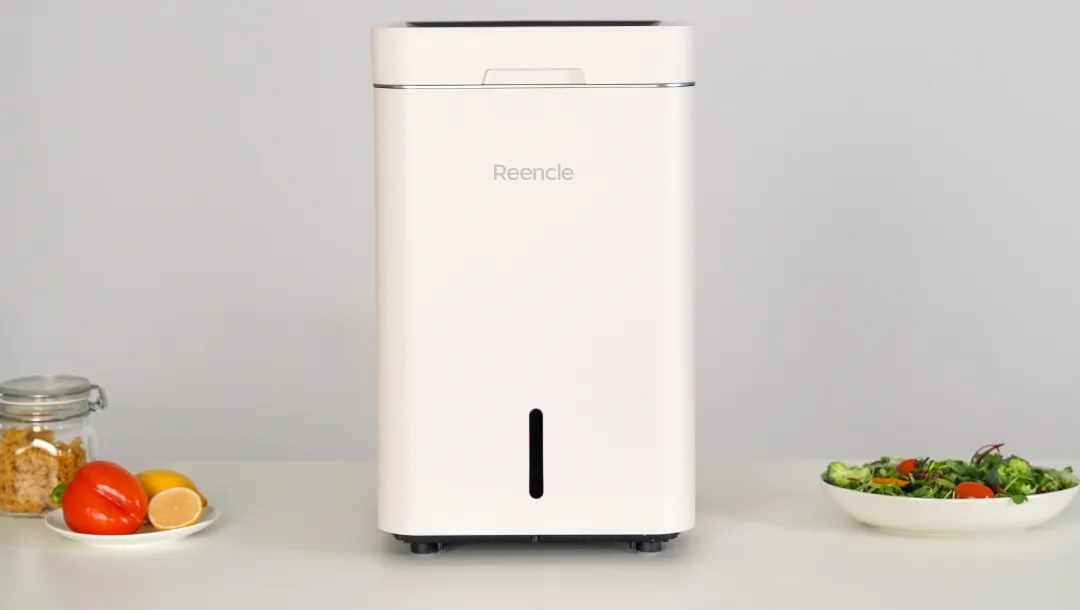
The Gravity scales the Reencle idea up: a 22-litre chamber handling up to about 3.3 pounds of scraps a day, the same self-perpetuating ReencleMicrobe culture, and built-in weight and time measurement so the machine tracks what it has taken. Reencle rates it under 28 dB — quieter than a fridge hum — at roughly 1.13 kWh a day. Long-term review coverage of the Prime/Gravity line (Techlicious among it) treats the system as the serious end of home composting.
It shares the family trade-offs, enlarged: a tall floor-standing footprint that needs dedicated space, and harvested material that still needs its curing time in soil. For a three- or four-person household producing real cooking volume, the Prime starts to feel small; the Gravity is the version that keeps up.
Yay · Pros
- 22-litre chamber, up to 3.3 pounds of scraps a day
- Same self-perpetuating ReencleMicrobe system
- Built-in weight and time measurement
Hmm · Cons
- Tall floor-standing footprint needs dedicated space
- Harvested material still needs curing
Best for: households of three or four wanting real compost at volume. Skip if: small households — the Prime covers one-to-two-person volumes in less space.
9. GEME Smart Electric Composter (19L) — Best for Large Households Wanting Real Compost
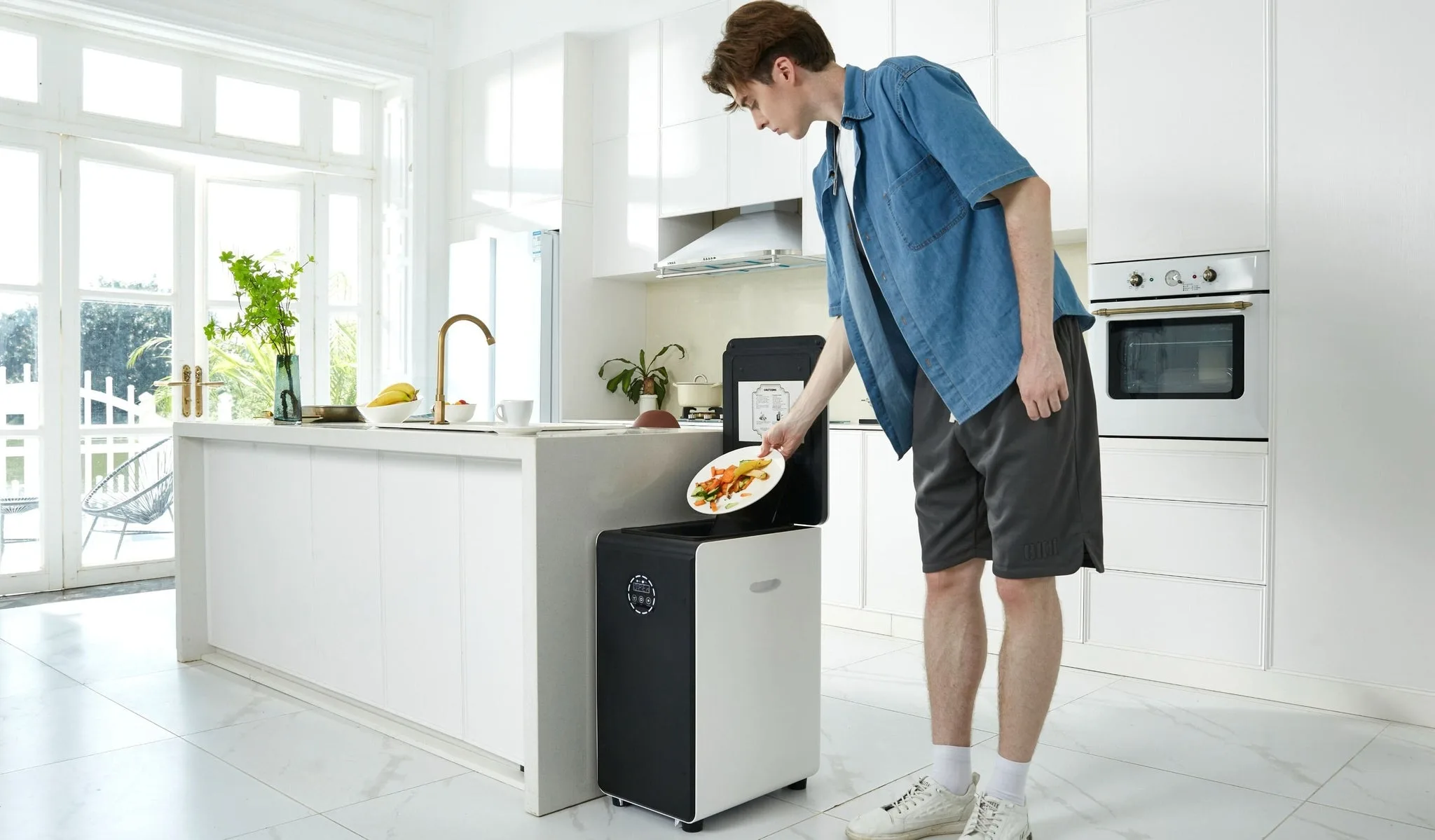
GEME is the other true-composting system here, and it goes biggest and simplest on upkeep: a 19-litre chamber rated for up to 5 kg of scraps a day, a self-replicating Kobold microbe culture, and a permanent metal-ion odour system — there are no filters to buy, ever, and no pods or subscriptions. Compost Magazine has covered the line, and GEME's own Amazon buyer's guide confirms the 19L listing. For a large household that cooks seriously, the zero-consumables design is a genuine running-cost advantage.
The costs it does have: space and electricity. It stands about 66 cm tall — floor space, planned for — and at roughly 1.85 kWh a day it is the hungriest machine in this guide, the price of keeping a big culture warm and working around the clock. Its independent review record is also thinner than Reencle's, which is reflected in the scores.
Yay · Pros
- Largest microbial chamber here, up to 5 kg a day
- Permanent metal-ion odour system — no filter replacements
- Self-replicating Kobold culture; no pods or subscriptions
Hmm · Cons
- Floor-standing and tall, at about 66 cm
- About 1.85 kWh a day, the highest electricity figure here
Best for: large households wanting real compost and zero filter upkeep. Skip if: apartment households, and anyone wanting the deepest review record — see Reencle.
10. Vego Kitchen Composter — Best Multi-Mode Recycler with an App
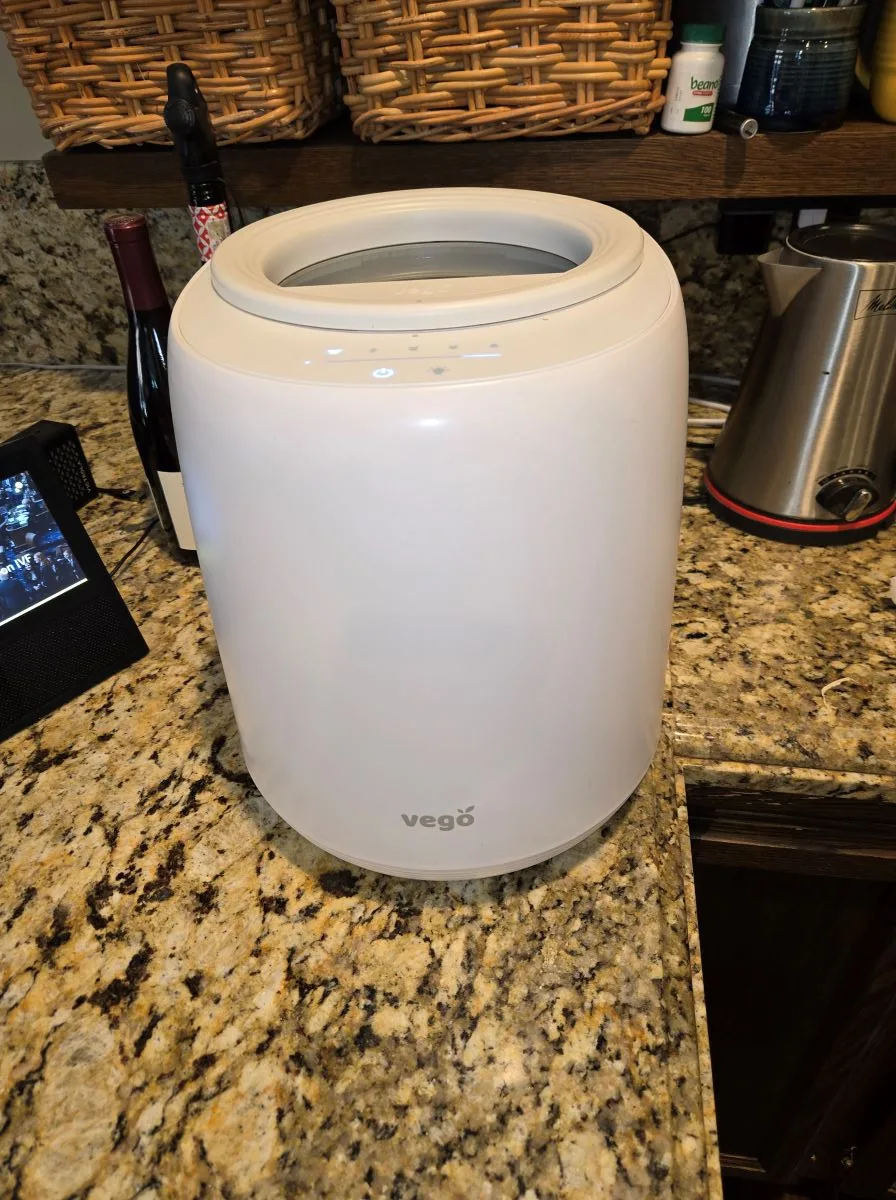
Vego comes at the recycler formula from the garden ecosystem it sells into, and it adds the most modes here: five, including an Express at two to eight hours and a slow Vego mode at nine to 24 — plus the rare trick of letting you add scraps mid-cycle in Vego mode. A built-in scale weighs each load and adjusts processing automatically, the app monitors the run, and the 4-litre bucket is bigger than any Lomi bucket in this guide. Bob Vila's reviewers named it a favourite electric composter; The Gadgeteer reviewed it positively.
It stays on the recycler side of the honesty line: even tab-assisted, the output needs soil time, and Vego Tabs plus carbon filters are recurring consumables to budget for. Gardeners already in Vego's raised-bed world will find it the natural fit; compost purists should look at the two microbial machines above it.
Yay · Pros
- Five modes, including mid-cycle scrap adding in Vego mode
- Built-in scale adjusts processing automatically, with app monitoring
- 4-litre bucket, larger than the Lomi buckets here
Hmm · Cons
- Tab-assisted output still needs soil time
- Vego Tabs and carbon filters are recurring consumables
Best for: gardeners who like the Vego ecosystem and want flexible modes with app oversight. Skip if: anyone wanting proven microbial composting — choose Reencle or GEME.
How to Choose an Electric Kitchen Composter
First, pick your method. Dry-grind recyclers (Lomi, FoodCycler, Vego) suit people whose goal is a smaller, smell-free garbage life: scraps in, dry flakes out, same day. Microbial composters (Reencle, GEME) suit gardeners: they are always on, always hungry, and produce material that becomes real compost. Neither is better in the abstract — they answer different questions, and the wrong one will sit unused.
Then count your scraps and your consumables. Bucket sizes here run from 2.5 to 5 litres for batch machines; a cooking household of four fills the small ones daily. Continuous machines are rated in pounds per day instead. On costs: charcoal and filters run from refillable pellets (FoodCycler), to a roughly yearly filter (Reencle), to GEME's none at all; LomiPods and Vego Tabs are optional-but-encouraged extras. Add a year of consumables to any price before you compare.
Finally, place it before you buy it. The microbial machines and the Eco 5 are floor appliances in practice, whatever the brochure shows. Batch machines need counter space plus clearance to open and vent. If the only honest spot is a utility-room floor, buy for that spot — the best composter is the one that ends up where the scraps are.
Frequently Asked Questions
Do electric composters make real compost?
Mostly, no — and it is the most important thing to understand before buying. Dry-grind machines (Lomi, FoodCycler, Vego) dehydrate and grind scraps into a pre-compost that must finish in soil. Microbial machines (Reencle, GEME) keep living cultures and produce real compost, though even their output benefits from a few weeks of curing. Both divert waste from landfill; only the second group completes the composting process indoors.
What can I put in an electric composter?
Fruit and vegetable scraps, coffee grounds, eggshells, bread and grains are safe everywhere. Most dry-grind machines also handle soft bones, cheese and cooked food — check your model's list, because it varies. The microbial machines prefer a balanced diet of scraps without heavy oils or large bones. Bioplastics are the special case: among these picks, only the Lomi 2 and Lomi Classic have a mode for approved compostable packaging.
How much do these machines cost to run?
Electricity is the small part: batch cycles run roughly 0.6 to 1.5 kWh, and the always-on microbial machines about 1.1 to 1.9 kWh a day. Consumables are the real budget line — charcoal filters and pellets, optional LomiPods or Vego Tabs. Reencle's filter lasts about a year and GEME has no filters at all, which is why their Running Costs scores lead this guide.
Will an electric composter smell?
A working one, no — that is rather the point. Every machine here manages odour with carbon filtration (charcoal cartridges, refillable pellets, or GEME's permanent metal-ion system), and the output itself is dry and close to odourless. Smell complaints in owner reviews almost always trace back to a filter that was run long past its change date.
Can I get a FoodCycler through a Canadian municipal program?
Possibly. FoodCycler has run subsidised-machine programs with municipalities across Canada — reported in more than 200 of them — and town pilot pages commonly offer the Eco 3 for small households and the Eco 5 for larger ones. Check your municipality's waste or sustainability page before buying at retail; program pricing, when it is open, is usually the best deal in this guide.
The Short Version
For most kitchens, buy the Lomi 3 — fast, small, simple pre-compost. Choose the Lomi 2 if compostable packaging is part of your waste, the FoodCycler Eco 5 for family volume, and the Eco 3 for an apartment counter. For real compost, it is the Reencle Prime for most gardeners, the Gravity for volume, and the GEME 19L if you never want to buy a filter again. And to close the loop, grow something worth composting for — the indoor herb garden guide is the natural companion to this guide.