If you are shopping for the best knife sharpeners, the honest starting point is that a dull knife is not a knife problem — it is a maintenance problem. Every edge dulls with use, and the right sharpener restores it in minutes. The wrong one can do real harm: in America’s Test Kitchen’s testing, many electric sharpeners they tried over the years were, in their words, truly terrible — devouring metal, scraping blades and chewing up cutting edges — while the best models restored good-as-new edges quickly, neatly and without damage.
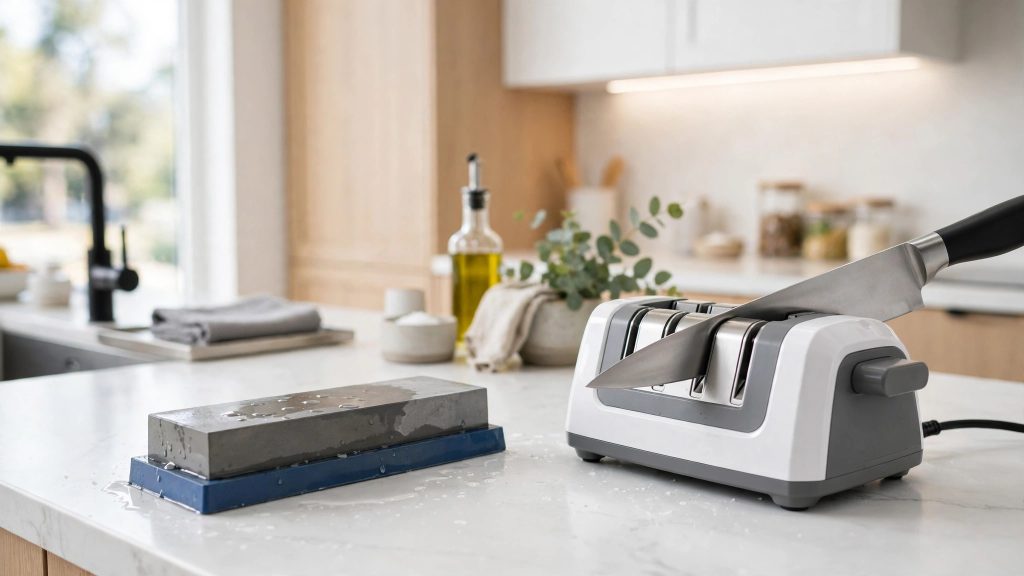
That spread is why the type matters as much as the brand. An electric sharpener does the angle work for you and can even repair a chipped blade. A manual pull-through is smaller, cheaper and fine for regular upkeep, but cannot fix serious damage. A whetstone gives you the most control over angle and finish and works on the widest range of knives — including asymmetrical Japanese blades — at the cost of skill and practice. This guide keeps all three honest, and says plainly where the experts disagreed.
This guide ranks the eight sharpeners that matter in 2026 for home cooks in Canada and the USA. We built the list from the hands-on testing and published findings of the expert outlets that test this category — including America’s Test Kitchen’s electric knife sharpener testing, Wirecutter, Serious Eats, Good Housekeeping, The Spruce Eats and Bon Appétit — cross-checked against manufacturer specifications and current Canadian and US availability. One honest note on scores: these outlets do not publish comparable numeric scores for this category — America’s Test Kitchen rates on its own star scale and the others use named picks — so we report their verdicts and named awards rather than inventing a common score. Where testers disagreed about a model, we say so.
Best Knife Sharpeners at a Glance
- Chef’sChoice Trizor XV EdgeSelect 15XV — Best Overall Electric Knife Sharpener
- Chef’sChoice Model 1520 AngleSelect — Best Electric for Mixed 15- and 20-Degree Knives
- Chef’sChoice Pronto Diamond Hone 463 — Best Manual Pull-Through Sharpener
- AccuSharp Gourmet Series 15 Degree Knife Sharpener — Best Budget Manual Sharpener
- Work Sharp Professional Precision Adjust Knife Sharpener — Best Guided Sharpening System
- Shapton Pro 1000 Whetstone (Ha No Kuromaku 1000) — Best Whetstone for Most Cooks
- King 1000/6000 Combination Whetstone — Best Beginner and Budget Whetstone
- Spyderco Tri-Angle Sharpmaker 204MF — Best System for Serrated Knives
How we score
The scores in this guide are CookSmartPicks’ own editorial ratings. We set them from our research of the expert reviews and sources listed in this post — they are our ratings, not scores quoted from another publication.
1. Chef’sChoice Trizor XV EdgeSelect 15XV — Best Overall Electric Knife Sharpener
Among the best knife sharpeners, this is the consensus electric pick. America’s Test Kitchen named the Trizor 15XV its winner for 15-degree knives, and Wirecutter has likewise named it its top choice, with testers reporting it quickly and reliably put a razor edge on almost any kind of knife and was basically impossible to use incorrectly. ATK found it produced truly exceptional and consistent results in about two minutes from start to finish — a polished, razor-sharp edge, heel to tip — and it rapidly removed a notch they cut into a blade to simulate a chipped edge.
The design explains the results: three stages — two with diamond-coated disks, coarse then medium, and a flexible stropping disk to polish — with narrow, spring-loaded slots that hold the angle for you. It converts a conventional 20-degree Western edge to a keener 15-degree edge, and it can also sharpen serrated and single-bevel blades, though ATK notes it did not test those functions. One honest trade-off before you buy: converting a 20-degree knife is a real change, not just a touch-up. ATK’s own guidance is that a knife designed for 20 degrees is usually made of softer steel that will not hold a narrower angle for long and will need more frequent sharpening — so know that the conversion is permanent in practice.
Yay · Pros
- America’s Test Kitchen winner for 15-degree knives; Wirecutter top pick
- Exceptional, consistent results in about two minutes, with no skill required (ATK)
- Repairs chipped edges — removed ATK’s test notch rapidly
- Spring-loaded guides hold the angle; three stages sharpen, hone and polish
Hmm · Cons
- Converts 20-degree knives to 15 degrees — softer Western steel may then need more frequent sharpening (ATK)
- Left very light cosmetic scratches along the sides of blades in ATK testing
- The largest and most counter-hungry format in this guide compared with manual picks
Check Price on Amazon.ca Check Price on Amazon.com
2. Chef’sChoice Model 1520 AngleSelect — Best Electric for Mixed 15- and 20-Degree Knives
Most real knife drawers are mixed — a Japanese santoku at 15 degrees beside older European knives at 20 degrees — and this is the electric America’s Test Kitchen built its recommendation around for exactly that household. ATK named the Model 1520 its winner for collections with both 15- and 20-degree knives, finding it easy to use and able to restore both styles to like-new sharpness in a matter of minutes.
It is a two-stage machine: a diamond stage shapes either a 15- or a 20-degree edge, and a stropping disk polishes the edge or sharpens serrated blades; ATK also notes it can sharpen single-beveled Japanese blades. Crucially, unlike the Trizor XV above, it sharpens each knife at its own angle instead of converting everything to 15 degrees — the choice ATK’s angle guidance favours for keeping a knife at the edge it was designed to hold. Expect the family trait: ATK notes it may leave light cosmetic scratches along the sides of the blade, which do not affect function.
Yay · Pros
- America’s Test Kitchen winner for mixed 15- and 20-degree collections
- Sharpens each knife at its own angle — no forced conversion
- Restored both edge styles to like-new sharpness in minutes (ATK)
- Also handles serrated and single-bevel Japanese blades (ATK)
Hmm · Cons
- Two stages rather than the Trizor XV’s three
- May leave light cosmetic scratches on blade sides (ATK)
- You must know each knife’s angle before you start — check with the maker if unsure
Check Price on Amazon.ca Check Price on Amazon.com
3. Chef’sChoice Pronto Diamond Hone 463 — Best Manual Pull-Through Sharpener
If you want a sharpener that lives in a drawer and needs no outlet, America’s Test Kitchen’s manual winner is this one. ATK named the Pronto Diamond Hone (model 463) its winner for 15-degree knives — its previous top-ranked manual sharpener, which once again performed well against new competition — praising it as effective, inexpensive, simple to operate and small enough to store in a drawer between uses.
You push and pull the blade through two deep V-shaped slots: the first holds coarser diamond abrasives for sharpening, the second finer diamond abrasives for honing and polishing, and ATK found the deep slots made the angle easy to control, leaving a smooth, sharp edge under the microscope. It also sharpens serrated knives. Know the honest limits of the whole manual category, which ATK states plainly: manual sharpeners are slower than electrics and cannot repair deep damage such as chips. The Pronto also scratched the sides of blades slightly in testing — cosmetic only, with no effect on performance.
Yay · Pros
- America’s Test Kitchen winner among manual sharpeners for 15-degree knives
- Two diamond stages — coarse to sharpen, fine to hone and polish
- Deep V-slots make the angle easy to control; smooth edge under ATK’s microscope
- Compact and drawer-sized; also sharpens serrated knives
Hmm · Cons
- Fixed at 15 degrees — not the tool for 20-degree Western knives
- Cannot repair chips or serious damage (true of all manual picks here)
- Slight cosmetic scratching on blade sides in ATK testing
Check Price on Amazon.ca Check Price on Amazon.com
4. AccuSharp Gourmet Series 15 Degree Knife Sharpener — Best Budget Manual Sharpener
The AccuSharp Gourmet is the smallest, fastest and cheapest serious sharpener in this guide, and America’s Test Kitchen named it its Best Buy for 15-degree blades. In ATK’s testing the compact handheld tool quickly established a sharp edge — in seconds, it brought a completely dull knife to razor sharpness — and the testers called it excellent for everyday knives and the perfect tool to take along to a vacation kitchen where the knives will be iffy.
Be clear about how it works and what it trades away. You draw the sharpener itself over the upturned, exposed blade — a bit unnerving at first, though ATK’s testers quickly got used to it — and its diamond-honed tungsten carbide abrasives cut aggressively. Under the microscope the edge looked ragged and rough, what knife professionals call toothy rather than polished; ATK used a honing rod afterwards and recommends that finishing step if you want a more polished edge. The carbide blades are reversible to extend their life, and replacements are available — worth knowing, because ATK notes tungsten carbide is less durable than diamond abrasives.
Yay · Pros
- America’s Test Kitchen Best Buy for 15-degree knives
- Fastest result here — a dull knife to razor sharp in seconds (ATK)
- Tiny, lightweight and drawer- or travel-friendly
- Reversible, replaceable carbide abrasives extend its working life
Hmm · Cons
- Leaves a toothy, unpolished edge — pair it with a honing rod (ATK)
- Drawn over an exposed blade, which takes a use or two to feel natural
- Tungsten carbide wears faster than diamond abrasives (ATK)
Check Price on Amazon.ca Check Price on Amazon.com
5. Work Sharp Professional Precision Adjust Knife Sharpener — Best Guided Sharpening System
This is the bridge between a pull-through and a whetstone: a controlled-angle system that clamps the knife and guides the abrasive for you, so the angle stays exact without freehand skill. America’s Test Kitchen named the Professional Precision Adjust its upgrade pick among manual sharpeners, for cooks who do not mind spending more and following a longer process in exchange for a customized edge on blades ranging from 15 to 30 degrees.
In ATK’s testing you swap through five diamond abrasive stones from coarse to fine, then a ceramic hone and a leather strop to polish, sliding each along the clamped blade on a rod at your chosen angle — set precisely with a digital angle indicator. The payoff was real: after sharpening, ATK’s knives were unblemished, because the padded clamp held snugly without marking the knife and the stones touched only the cutting edge. The honest costs are time and learning: ATK found a learning curve that takes persistence, a clamped blade-out setup that feels a little intimidating at first, and a process several times slower than a simple pull-through. Practice on an inexpensive knife first, as ATK advises.
Yay · Pros
- America’s Test Kitchen upgrade pick — continuous adjustment from 15 to 30 degrees
- Five diamond stones plus ceramic hone and leather strop, coarse to polished
- Digital angle indicator for precise, repeatable angles
- Left knives unblemished in ATK testing; also sharpens serrated knives
Hmm · Cons
- A real learning curve — persistence and practice required (ATK)
- Far slower than a pull-through; up to five times as long per knife in ATK’s wider manual testing
- The largest, heaviest manual system here — a benchtop tool, not a drawer tool
Check Price on Amazon.ca Check Price on Amazon.com
6. Shapton Pro 1000 Whetstone (Ha No Kuromaku 1000) — Best Whetstone for Most Cooks
Ask experienced sharpeners which single stone to buy first and the Shapton Pro 1000 is the name that keeps coming back: a hard, fast-cutting ceramic water stone at the 1000 grit that does the core work of sharpening — restoring a dull but undamaged edge — in one stone. It is widely recommended as the step-up, mid-level stone, praised for sharpening very quickly and for being highly regarded among sharpeners at every level.
Its practical advantage is in the routine. Shapton Pro stones are splash-and-go: you wet the surface and start, with no soaking wait, and because the stone is hard it stays flat far longer than softer stones, so it needs flattening less often. The same hardness is the trade-off for beginners: a hard stone gives less feedback as you sharpen, so your angle errors are less forgiven while you learn. It is also a single grit — it sharpens beautifully, but for a polished finish you will eventually want a finer companion stone. America’s Test Kitchen’s whetstone guidance makes the broader case for the method: no other sharpener can hone and sharpen such a varied range of knives, including asymmetrical edges no slot machine can match.
Yay · Pros
- Fast-cutting 1000-grit ceramic stone — the core sharpening grit in one stone
- Splash-and-go: no soaking before use
- Hard stone stays flat longer, so it needs flattening less often
- Works on virtually any knife, including asymmetrical Japanese edges
Hmm · Cons
- Single grit — a finer finishing stone is a separate, later purchase
- Hard surface gives beginners less feedback while learning angle control
- Freehand skill required — nothing holds the angle for you
Check Price on Amazon.ca Check Price on Amazon.com
7. King 1000/6000 Combination Whetstone — Best Beginner and Budget Whetstone
The King combination stone is the most widely recommended first whetstone for beginners, and the logic is simple: one double-sided Japanese water stone gives you both halves of the job — the 1000-grit side for general sharpening and maintenance, and the 6000-grit side for polishing and finishing — so you can learn the full progression on a single, forgiving stone.
King stones, made in Japan by the Matsunaga Stone Company, are known for consistency, ease of use and accessible pricing, and their softness is genuinely beginner-friendly: a soft stone gives clear feedback and is forgiving of small angle wobbles while your hands learn. The same softness is the documented trade-off — King stones wear and dish faster than hard stones like the Shapton above, so you will flatten this stone more often to keep it true, and it needs a soak in water before use rather than a splash. Treat flattening as part of the craft, not a defect, and this remains the classic teaching stone.
Yay · Pros
- Two grits in one stone: 1000 to sharpen, 6000 to polish and finish
- Soft, forgiving surface with clear feedback — ideal for learning
- Japanese-made by a long-established stone maker; the classic beginner recommendation
- Works on Western and Japanese knives alike, at any angle you choose
Hmm · Cons
- Soft stone dishes with use and needs regular flattening
- Must be soaked before use — no splash-and-go convenience
- Freehand learning curve, like every whetstone here
Check Price on Amazon.ca Check Price on Amazon.com
8. Spyderco Tri-Angle Sharpmaker 204MF — Best System for Serrated Knives
The Sharpmaker takes a different approach to the angle problem: instead of holding the knife at an angle, it holds the stones at the angle and lets you simply keep the blade vertical. Its base sets the triangular ceramic rods at 30 degrees inclusive (15 degrees per side) or 40 degrees inclusive (20 degrees per side), so one system covers both Japanese-style and Western-style edges — you draw the knife straight down the rods, alternating sides.
What earns it the final slot is versatility nothing else here matches. The triangular rods present corners as well as flats, and those corners are what let it sharpen serrated blades — the use Spyderco built its name on — as well as scissors, fishhooks and other edged tools, with brass safety rods guarding your hand. It ships with medium and fine alumina ceramic rods, needs no lubricant, cleans easily and packs into its own base. The honest limits: the included rods are for sharpening and refining sound edges, and heavily dulled or damaged blades are slow work without the coarser optional rods sold separately; and like any fixed-angle system, it offers exactly two angles, not the free choice of a stone or the Professional Precision Adjust.
Yay · Pros
- Preset 15- and 20-degree-per-side angles — just keep the blade vertical
- Triangular rod corners sharpen serrated blades, its standout skill
- Also handles scissors, hooks and tools; brass safety guards included
- No lubricant needed; everything packs into the base for storage
Hmm · Cons
- Only two fixed angles — no in-between or custom edges
- Slow on very dull or damaged blades without optional coarser rods
- Ceramic rods are breakable if dropped — handle and store with care
Check Price on Amazon.ca Check Price on Amazon.com
How to Choose the Best Knife Sharpeners
Choose the type first: electric, manual or whetstone. America’s Test Kitchen’s testing draws the lines clearly. Electrics are fastest and easiest, need no special skill, and the best of them are the only home tools here that can repair a chipped blade. Manual pull-throughs are smaller, cheaper and good for regular maintenance of dull — not damaged — knives, and guided systems like the Work Sharp trade time for a customized edge. Whetstones demand practice but give the finest, most controlled edge, remove only the metal you intend to remove, and work on every knife including asymmetrical Japanese blades. Pick the type you will actually use every few weeks; that matters more than any single model.
Match the angle: 15 degrees versus 20 degrees. Traditionally, Japanese makers ground edges near 15 degrees per side and Western makers near 20 degrees, though many Western brands have moved narrower in recent years. Thinner 15-degree edges feel sharper because they concentrate force, but ATK’s guidance is to keep a knife at the angle it was designed for: the steel was chosen for that angle, and converting a softer 20-degree knife to 15 degrees means more frequent sharpening and more metal removed over time. If your drawer mixes both angles, choose a sharpener that handles both — the Model 1520, the Sharpmaker or an adjustable system — and check with the knife maker if you do not know an edge’s angle.
Know honing from sharpening — they are not the same job. Sharpening removes metal to form a new edge; honing removes almost none. Routine cutting bends the thin edge over, which makes a sharp knife feel dull, and a honing rod simply straightens that bent edge back to centre. ATK notes the gentlest, final slot of a good multistage sharpener also works as a hone for touch-ups. The practical rhythm: hone lightly and often, sharpen only when honing stops bringing the edge back, and for routine touch-ups start with the finest stage — do not regrind through every coarse stage each time, or you will remove metal you did not need to lose.
Respect the steel-removal trade-off. Every sharpening removes metal; the question is how much and how evenly. ATK found diamond abrasives the most effective across electric and manual testing — coarse to fine in sequence — while carbide and ceramic tend to grab at the blade and can leave a rougher, toothier edge, exactly what its microscope showed on the budget AccuSharp. Poorly designed electrics were the worst offenders, devouring metal and damaging heels and handles, which is why this guide only lists electrics ATK actually recommends. A well-designed sharpener, ATK’s FAQ concludes, removes no more metal than a whetstone — the skill is using the gentlest stage that does the job.
Sharpening only pays off on knives worth keeping sharp. Our best kitchen knives guide covers the individual chef’s, santoku and paring knives experts reach for, and our best knife sets guide covers full sets if you are building a block from scratch. Match either with the sharpener above that fits your angles and your patience, and dull-knife cooking is over.
Frequently Asked Questions
Are electric knife sharpeners bad for knives?
Badly designed ones are — America’s Test Kitchen has tested many that devoured metal, scraped blades and chewed up edges. But ATK’s own conclusion is that a well-designed electric sharpener removes no more metal than a whetstone and has no ill effect on the knife. The safeguard is restraint: for routine care, use only the final, finest slot for a touch-up rather than regrinding through every stage.
Should I convert my 20-degree knives to a 15-degree edge?
Only with your eyes open. A 15-degree edge feels sharper, and the Trizor XV in this guide is built to make that conversion. But America’s Test Kitchen advises keeping a knife at its designed angle: knives built for 20 degrees usually use softer steel that will not hold a narrower edge for long, so a converted knife needs more frequent sharpening and loses more metal over its life. If you want a 15-degree feel long-term, ATK suggests buying a knife designed with that angle.
How often should I sharpen my kitchen knives?
When the knife tells you: it slips on a tomato skin instead of biting in, mashes food instead of slicing cleanly, or fails the paper test — a sharp knife slices a held sheet of copy paper effortlessly from heel to tip, while a dull one drags, rips or bends it. Hone between sharpenings to straighten the bent edge, and sharpen only when honing no longer restores the bite; heavy chopping, frozen food and glass cutting boards all shorten the interval.
Can I sharpen serrated knives at home?
Yes, with the right geometry. The Chef’sChoice electrics and the Pronto manual in this guide list serrated sharpening among their functions, using a flexible stropping stage. The Spyderco Sharpmaker is the specialist: the corners of its triangular rods fit into serrations, and Spyderco recommends the fine white rods for that job because the medium rods are comparatively aggressive. A flat whetstone or a standard V-slot pull-through cannot reach into serrations properly.
What grit whetstone should a beginner start with?
Around 1000 grit is the standard starting point for a knife that is dull from normal use but not chipped — it removes steel efficiently and restores a working edge. A combination stone such as the King 1000/6000 adds a fine side for polishing once the edge is formed. Very dull or chipped blades need a coarser stone first, and finishing grits of 3000 and above only refine an edge that a medium stone has already created — starting fine on a dull knife will not work.
Last updated: November 1, 2026