If you are shopping for the best stand mixers, start with the decision that actually decides everything else: tilt-head or bowl-lift. A tilt-head is easier to live with day to day — the head flips back, the bowl is wide open, and adding ingredients mid-mix takes seconds. A bowl-lift is the honest answer for bread: the head stays fixed, the bowl locks in and cranks up, and the machine stays planted when a stiff dough starts pushing back. Get that choice wrong and even an excellent mixer will frustrate you, because bowl size on the box is the second lie to watch for — America’s Test Kitchen measured every bowl in its test and found no model used its full stated volume, with some using barely more than half.
The trade-offs after that are just as real. More wattage does not automatically mean better kneading — torque, how the machine turns power into rotational force, is what keeps a dough hook moving through bagel dough instead of slowing, stalling or overheating. Planetary KitchenAids carry a rule many buyers never hear before purchase: knead only on speed 2. Bottom-drive machines like the Ankarsrum and Bosch carry no such limit, but they ask you to learn a completely different way of mixing. And every stand mixer here is heavy enough that “putting it away” mostly means it lives on your counter — measure your cabinet clearance before you fall in love with a colour.
This guide ranks the nine stand mixers that matter in 2026 for home bakers in Canada and the USA, stand mixers only — no blenders. We built the list from the hands-on testing and published findings of the expert outlets that test this category — including America’s Test Kitchen’s stand mixer testing, Wirecutter, Serious Eats, Good Housekeeping and Consumer Reports — cross-checked against manufacturer specifications and current Canadian and US availability. Where testers disagreed about a model, we say so: America’s Test Kitchen, for example, crowns the Ankarsrum overall, while Wirecutter has kept a KitchenAid tilt-head on top for more than a decade.
Best Stand Mixers at a Glance
- KitchenAid Artisan Series 5 (KSM150) — Best Overall Stand Mixer
- Ankarsrum Assistent Original (AKM 6230) — Best for Bread and Heavy Dough
- KitchenAid 7-Quart Bowl-Lift (KSM70) — Best for Large Batches
- KitchenAid Classic Series 4.5-Quart (K45SS) — Best Mid-Priced KitchenAid
- Cuisinart Precision Master 5.5-Quart (SM-50) — Best Value Stand Mixer
- KitchenAid Artisan Mini 3.5-Quart (KSM3316X) — Best Small Stand Mixer
- Bosch Universal Plus (MUM6N10UC) — Best Bottom-Drive for Big Dough Batches
- Hamilton Beach Professional All-Metal (63240) — Best All-Metal Value
- Smeg 50’s Retro Style (SMF02) — Best Style Stand Mixer
How we score
The scores in this guide are CookSmartPicks’ own editorial ratings. We set them from our research of the expert reviews and sources listed in this post — they are our ratings, not scores quoted from another publication.
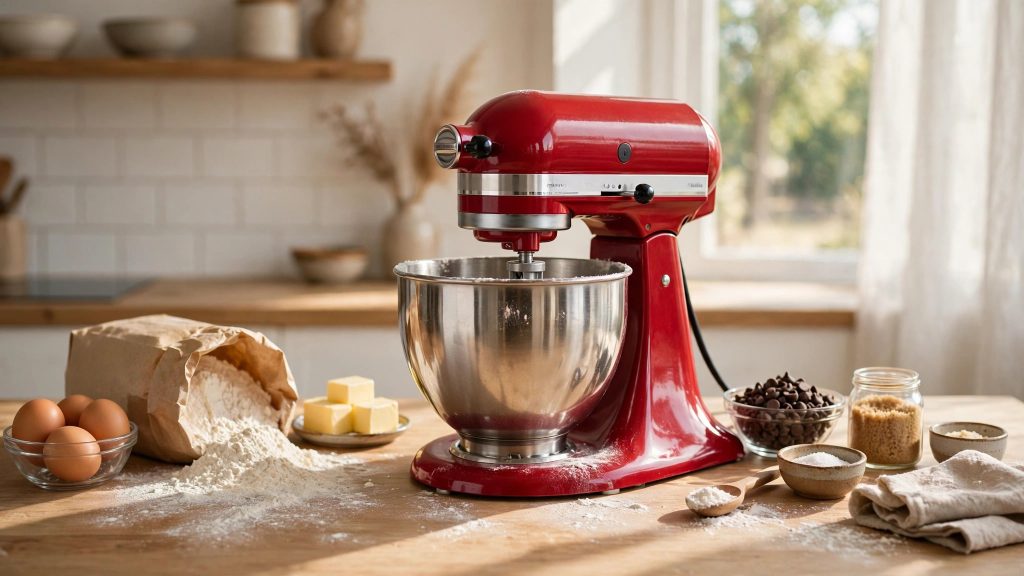
1. KitchenAid Artisan Series 5 (KSM150) — Best Overall Stand Mixer
Among the best stand mixers, this is still the default recommendation for most kitchens — and unusually, the testers agree on why. Wirecutter has kept the Artisan Series 5 as its top pick since 2013, finding after years of testing that it churns through chunky cookie dough, dense bagel dough, light batters and sticky pizza dough without stalling, wobbling or “walking” across the counter, and that it is one of the quieter mixers it has tried. Its deep-sided bowl also handles small quantities better than most full-size machines, which is the quiet spec that decides whether a big mixer gets used on weeknights.
America’s Test Kitchen is cooler on it, and that disagreement is worth hearing before you buy. ATK measured the Artisan’s actual usable capacity at about 3 quarts against the 5-quart label, heard a slight clicking as it kneaded bagel bread, and found the bowl can stick on its base after hard work — though it completed all 12 extra abuse-test batches of bread and pizza dough in a row. The Artisan runs 10 speeds at 325 watts, its tool height is adjustable, the bowl’s large vertical handle is genuinely comfortable, and it comes in upward of 20 colours. Buy it for varied, everyday baking; frequent stiff-dough bakers should read on to the bowl-lift and bottom-drive picks below.
Yay · Pros
- Wirecutter’s top pick since 2013 — handles cookie, bagel, batter and pizza dough without stalling or walking
- One of the quieter mixers in Wirecutter’s testing, and good with small quantities
- Adjustable tool height and a comfortable, large bowl handle
- The deepest attachment ecosystem in the category, via the front power hub
Hmm · Cons
- Actual usable capacity is about 3 quarts, not the 5 quarts on the box (America’s Test Kitchen measurement)
- Kneading is restricted to speed 2, so dough takes longer than in unrestricted machines (ATK)
- Bowl can stick on the base after heavy mixing, and it clicked under stiff bagel dough in ATK’s tests
Check Price on Amazon.ca Check Price on Amazon.com
2. Ankarsrum Assistent Original (AKM 6230) — Best for Bread and Heavy Dough
This is the machine America’s Test Kitchen puts above every KitchenAid. The Ankarsrum is a motor-in-base design made in Sweden since 1940: the 7-litre stainless bowl itself rotates while a dough roller, dough knife and scraper work the mixture, which is much closer to how hands — and professional spiral mixers — knead. ATK found that after a short, steep learning curve it aced its tests, whipping just two egg whites to airy, stiff peaks, creaming cake batter and cookie dough, and kneading pizza and bagel bread doughs quickly and effortlessly. Critically, it carries no speed restriction for kneading, which is exactly why ATK names it its ultimate winner.
Know what you are signing up for. ATK describes the thick manual as difficult for beginners, the machine is large with a lot of parts to store, and the open bowl demands respect — keep tools and fingers out of the vigorous mixing action. In return you get ATK-measured usable capacity of 5.25 quarts in the steel bowl, a relatively manageable 18.3 lb at 14 inches tall, and a 7-year warranty, by far the longest in this guide. For a weekly bread baker, this is the once-and-done purchase; for a casual cake baker, it is more machine — and more learning curve — than the job needs.
Yay · Pros
- America’s Test Kitchen’s overall winner — aced whipping, creaming and kneading tests
- No speed or time limits on kneading, unlike every KitchenAid here
- Rotating-bowl design kneads large, heavy doughs quickly and effortlessly (ATK)
- 7-year warranty; made in Sweden since 1940
Hmm · Cons
- Steep learning curve and a manual ATK found difficult for beginners
- Large, with many parts to store
- Open-bowl design requires care — nothing can reach in while it runs
Check Price on Amazon.ca Check Price on Amazon.com
3. KitchenAid 7-Quart Bowl-Lift (KSM70) — Best for Large Batches
If you want to stay with KitchenAid but outgrow the Artisan, this is the step up the testers praise most warmly. In America’s Test Kitchen’s testing, “Wow” kept appearing in its notes: butter and sugar creamed to fluffy heaps, cake batter was “smooth as silk,” and bread dough came out “gorgeous and elastic.” The updated 7-quart bowl-lift easily whipped just two egg whites — rare for a bowl this big — yet also powered through double batches of pizza dough and stiff bread dough and sailed through abuse testing with 12 extra batches in a row. Consumer Reports also places the KSM70 among its highest-rated stand mixers, holding four of its top 10 slots for KitchenAid as a brand.
The package explains the performance: 11 speeds including a half speed for folding, uncoated stainless-steel tools, a double flex-edge beater with silicone fins that saves scraping down the bowl, adjustable tool height, and a bowl with a comfortable vertical handle. KitchenAid rates the 7-quart bowl for 13 dozen cookies or over 8.5 lb of bread dough per batch, though ATK’s measured usable capacity is 5.25 quarts — still the largest planetary figure here. The costs are physical: ATK weighed it at 25.6 lb and 16.5 inches tall, and the KitchenAid speed-2 kneading rule still applies, so dough takes longer than in the Ankarsrum or Bosch.
Yay · Pros
- Elite all-round results in ATK’s tests, from two egg whites to double dough batches
- Stainless-steel tools and a double flex-edge beater that reduces scraping
- 11 speeds, including a half speed for folding delicate ingredients
- Bowl-lift stability with a 3-point locking bowl for heavy, dense loads
Hmm · Cons
- Heavy and tall at 25.6 lb and 16.5 inches (ATK) — a permanent counter resident
- Speed-2 kneading restriction makes dough slower than unrestricted rivals
- Usable capacity (5.25 qt measured) is less than the 7-quart label suggests
Check Price on Amazon.ca Check Price on Amazon.com
4. KitchenAid Classic Series 4.5-Quart (K45SS) — Best” Mid-Priced KitchenAid
America’s Test Kitchen calls this its best mid-priced mixer, and its verdict is the surprise of its whole test: this basic, compact, heavy machine’s across-the-board performance knocked out many competitors that were bigger and much more costly. It produced billowy egg whites as capably as a double batch of pizza dough, its beater height is adjustable, and it gives you the full KitchenAid attachment hub — the main reason to buy into this brand at any price — for noticeably less than the Artisan.
The concessions are small but real, and ATK names them plainly. The bowl has no handle, the flat beater and dough hook are white epoxy-coated rather than stainless steel, and there is no splash guard in the box — which ATK’s testing found mostly unnecessary anyway. Most seriously, its tilt head broke on an extreme abuse test, a data point heavy daily users should weigh. ATK measured usable capacity at 3.25 quarts — actually slightly more than the pricier Artisan — at 21.5 lb and 13.9 inches tall, with a 1-year warranty. For standard recipes at a moderate price, it is the KitchenAid the test kitchen itself points to.
Yay · Pros
- America’s Test Kitchen’s best mid-priced pick — outperformed bigger, costlier rivals
- Billowy egg whites and a double batch of pizza dough in the same test run
- Full KitchenAid attachment-hub compatibility at a lower entry price
- Measured usable capacity (3.25 qt) slightly beats the Artisan’s
Hmm · Cons
- Tilt head broke on ATK’s extreme abuse test
- Bowl has no handle; tools are coated, not stainless steel
- No splash guard included
Check Price on Amazon.ca Check Price on Amazon.com
5. Cuisinart Precision Master 5.5-Quart (SM-50) — Best Value Stand Mixer
The Precision Master is the value pick the labs keep returning to. Good Housekeeping names the SM-50 its best value stand mixer: in its lab tests it whipped fluffy egg whites and cream that did not weep, its flat beater handled a big “monster cookie” recipe well, and testers liked the gentle lowest speed — no flour clouds — and how easily the bowl and tools go on and off. The Spruce Eats has also named the 5.5-quart Cuisinart a best-overall runner-up, calling it affordable, powerful and versatile for beginners through experts, and in Serious Eats’ seven-mixer test it took third place, handling cookie dough and light bread recipes without strain.
On specifications it actually out-punches the KitchenAids above it: a 500-watt motor, 12 speeds, a 5.5-quart stainless bowl, die-cast metal construction, a splash guard with a pour spout, and a 3-year warranty — three times KitchenAid’s standard cover. The honest limits are at the extremes: keep very stiff, doubled bread doughs for the bowl-lift and bottom-drive machines, expect to scrape the bowl sides on some batters, and know its attachment range, while real (pasta and ice cream options exist), is far smaller than KitchenAid’s hub ecosystem.
Yay · Pros
- Good Housekeeping’s best value pick — fluffy whites, stable whipped cream, strong cookie-dough results
- 500 watts and 12 speeds with a gentle slow start that keeps flour in the bowl
- 5.5-quart bowl, die-cast body and splash guard included
- 3-year warranty — three times the standard KitchenAid cover
Hmm · Cons
- Best kept to light-to-moderate doughs; very stiff batches belong on heavier machines
- Some batters need manual scraping to fully incorporate
- Attachment ecosystem is much smaller than KitchenAid’s
Check Price on Amazon.ca Check Price on Amazon.com
6. KitchenAid Artisan Mini 3.5-Quart (KSM3316X) — Best Small Stand Mixer
Small kitchens usually get told to settle. The Artisan Mini is the exception America’s Test Kitchen singles out as its best small mixer: it aced nearly every test in ATK’s program, with simple speed controls and a tilt-head lever, and bowls and attachments that go on and off without a fight. At 16.05 lb and 12.3 inches tall it is meaningfully lighter and shorter than its full-size siblings, and Consumer Reports also includes the Artisan Mini among its highest-rated stand mixers. It fits nearly the whole KitchenAid attachment range — everything except the ice cream maker, per ATK.
The limits are capacity and torque, stated plainly by ATK itself. The Mini could not fit double batches of dough, its measured usable capacity is just 1.9 quarts, and the one test it failed was sticky, heavy, high-hydration pizza dough, where it lacked sufficient torque for a very difficult job. The bowl also has no handle, and ATK notes the price is not as small as the machine — the larger Classic above holds more and costs less. Buy the Mini because space is your binding constraint, not as a saving.
Yay · Pros
- America’s Test Kitchen’s best small mixer — aced nearly every test
- Compact and lighter at 16.05 lb and 12.3 inches tall (ATK)
- Simple controls; bowls and tools attach and remove easily
- Takes KitchenAid attachments (all but the ice cream maker, per ATK)
Hmm · Cons
- Failed ATK’s sticky, high-hydration pizza dough test — limited torque
- No double batches; usable capacity is only about 1.9 quarts measured
- Bowl has no handle, and it costs more than the larger Classic
Check Price on Amazon.ca Check Price on Amazon.com
7. Bosch Universal Plus (MUM6N10UC) — Best Bottom-Drive for Big Dough Batches
The Bosch takes the Ankarsrum’s motor-in-base idea and aims it squarely at volume bread baking. America’s Test Kitchen tested the Universal Plus and found a sturdy machine that made thick whipped cream in just 45 seconds and airy egg whites with stiff peaks in under 2 minutes, and — with its dough hook extender attachment helping to scrape down the bowl and develop the dough — did a good job of quickly kneading both stiff bagel bread dough and double batches of high-hydration pizza dough. It is strikingly light and low for its size: ATK measured 12.7 lb and just 9.75 inches tall, so it slides under cabinets that defeat every tilt-head here.
Bosch rates the 6.5-quart Universal Plus (500 watts, US rating) for up to 15 lb of dough — a manufacturer claim, and one no planetary mixer in this guide approaches — which is why dedicated bread bakers have kept it in production for decades. The compromises are workflow: like the other motor-in-base machines ATK tested, recipes that need creaming then dry ingredients can mean switching between wire whips and the dough hook mid-recipe, ATK found it a little loud on higher speeds, and its metal bowl is heavy with no handle, making one-handed scraping awkward. Bowl material also varies by bundle — many listings ship a plastic bowl — so check exactly what is in the box before ordering.
Yay · Pros
- Whipped cream in 45 seconds and stiff-peak egg whites in under 2 minutes (ATK)
- Good, fast kneading of stiff bagel and double pizza doughs with the hook extender (ATK)
- Very light and low at 12.7 lb and 9.75 inches tall — fits under cabinets
- Manufacturer-rated for up to 15 lb of dough in the 6.5-quart bowl
Hmm · Cons
- Mid-recipe attachment switching on some recipes is cumbersome (ATK)
- A little loud on higher speeds, and the metal bowl is heavy with no handle (ATK)
- Only 4 speeds plus pulse, and bowl material varies by bundle — verify before buying
Check Price on Amazon.ca Check Price on Amazon.com
8. Hamilton Beach Professional All-Metal (63240) — Best All-Metal Value
This is the lab result that should make KitchenAid shoppers pause. In Consumer Reports’ lab testing, as reported by Tasting Table, the Hamilton Beach Professional All-Metal 63240 scored 78 out of 100 overall — tied for the highest score of any stand mixer Consumer Reports tested — and it outperformed the top models in kneading bread dough, with high marks for whipping egg whites and cream and for mixing cake batter quickly and evenly. Consumer Reports’ own model page rates it Very Good in overall performance, with a 450-watt motor, 12 speeds, a 5-quart stainless bowl, dishwasher-safe attachments and a 5-year warranty — warranty cover only the Ankarsrum beats in this guide.
It is also, at 15 lb and 13.5 inches tall per Consumer Reports, one of the easiest full-size mixers here to move and store, with planetary mixing, a tilt-back head and an attachment hub. The counterpoints from the same test program: noise was the area where it and its co-leader fell a little short of pricier models, Consumer Reports’ specs do not rate it as two-loaf capable, and its attachment hub is its own system — verify any specific attachment fits before counting on it. As an all-metal machine at a non-premium position in the range, it is the strongest value challenge to the KitchenAid default in this guide.
Yay · Pros
- 78/100 overall in Consumer Reports’ lab test, as reported by Tasting Table — tied for the highest score tested
- Outperformed top models in Consumer Reports’ kneading test
- All-metal build, 12 speeds, planetary mixing and an attachment hub
- 5-year warranty; light for a full-size mixer at 15 lb (Consumer Reports)
Hmm · Cons
- Noise was its weaker area versus pricier models in Consumer Reports testing
- Not rated two-loaf capable in Consumer Reports’ specifications
- Attachment compatibility is its own system — verify specific tools before buying
Check Price on Amazon.ca Check Price on Amazon.com
9. Smeg 50’s Retro Style (SMF02) — Best Style Stand Mixer
Most style-first appliances collapse the moment a lab actually tests them, so give the Smeg its due: it survived testing. Bon Appétit’s testers — usually skeptical of Smeg, as they say themselves — found the stand mixer well-constructed with a powerful motor that can handle any task you throw at it, and Good Housekeeping’s lab, which tested 22 popular stand mixers, counted it among the easiest models to clean, with a dishwasher-safe bowl and attachments and no splattering issues during recipe tests. If a mixer is going to live permanently on display, this 5-quart tilt-head in full 1950s dress is the one designed for exactly that life.
The performance caveats are specific. Bon Appétit found the Smeg jumped around the counter more than the Breville and KitchenAid models when faced with dense bread dough, and Good Housekeeping’s testers noted a high-pitched whine from the motor at any speed. Its attachment range is also narrower than KitchenAid’s, and you are paying a genuine premium for the design. Buy it because the look matters to you and your baking is cakes, batters and moderate doughs — bread-first bakers have three better answers above.
Yay · Pros
- Well-constructed with a powerful motor that handled every task in Bon Appétit’s testing
- Among the easiest to clean in Good Housekeeping’s 22-mixer lab test; no splattering
- Dishwasher-safe bowl and attachments
- The standout retro design in the category, in a wide colour range
Hmm · Cons
- Jumped around the counter more than rivals on dense bread dough (Bon Appétit)
- High-pitched motor whine at any speed (Good Housekeeping)
- Narrower attachment range than KitchenAid, at a premium for the styling
Check Price on Amazon.ca Check Price on Amazon.com
How to Choose the Best Stand Mixers
Tilt-head, bowl-lift, or motor-in-base — choose by dough, not by looks. Tilt-heads (Artisan, Classic, Mini, Cuisinart, Hamilton Beach, Smeg) are smaller, lighter and easier to get into, but America’s Test Kitchen notes they typically max out at 5 quarts and need generous overhead clearance to tilt back — most owners have to pull them out from under cabinets. Bowl-lifts (the KSM70) are bigger, heavier and more powerful, need no extra overhead space, and their weight keeps them from rocking or “walking” on heavy loads, at the cost of slightly fussier ingredient additions. Motor-in-base machines (Ankarsrum, Bosch) spin the bowl instead, offer the easiest access and view into the bowl, and tend to be lighter — but they work differently enough that ATK warns of a real learning curve.
Read bowl size as a claim, then subtract. ATK measured every bowl it tested and found none used its full stated volume — its rule of thumb is to subtract about 2 quarts from the stated capacity to estimate usable space. That turns a “5-quart” Artisan into roughly 3 usable quarts and explains why double batches overflow small bowls. ATK’s guidance: frequent large bread or pizza batches want at least 5 quarts stated (about 3 usable), and serious volume bakers should look at 7-quart stated / about 5 usable — or at the published dough-weight rating, like the Bosch’s 15 lb manufacturer figure, which is the most honest capacity number a maker offers.
Torque beats wattage, and kneading rules beat both. How a mixer uses its power matters more than the watt number: torque — rotational force — is what keeps a hook moving through stiff dough, and ATK watched lower-wattage machines knead dough that shut higher-wattage rivals down. Just as important, every KitchenAid here restricts dough-hook kneading to speed 2, which ATK found makes dough take significantly longer; the Ankarsrum and Bosch impose no such limit. Also prefer adjustable tool height — beaters that ride close to the bowl mix faster and leave fewer unmixed pockets — and stainless-steel tools over coated aluminum, which ATK found chips over time.
Plan for the counter, the weight and the attachments. These machines range from 12.7 lb (Bosch) to 25.6 lb (KSM70) and from 9.75 to 16.5 inches tall in ATK’s measurements; assume the mixer lives where it lands, and measure the gap under your cabinets with the head tilted or the bowl raised. On attachments, ecosystems are brand-locked in practice: all KitchenAid mixers work with about 10 hub accessories (pasta rollers, grinders, ice cream makers), Ankarsrum and Cuisinart make their own proprietary sets, and a few brands offer hubs that accept other brands’ tools — but never assume a tool crosses brands without checking the exact fit. If your baking starts with a blender’s jobs as well as a mixer’s, our Best Blenders & Mixers guide covers both categories side by side; for the morning half of a baker’s kitchen, see our coffee and espresso machine guide, and for what all that dough eventually cooks in, our cookware sets guide completes the set.
Frequently Asked Questions
Tilt-head or bowl-lift for bread dough?
Bowl-lift, if bread is a weekly habit. America’s Test Kitchen notes bowl-lift models are bigger, heavier and more powerful, and their weight makes them less likely to rock and “walk” during heavy mixing, while tilt-heads are typically smaller and less powerful and max out around 5 quarts. Either way, respect the maker’s kneading rule: KitchenAid limits all its mixers to speed 2 with the dough hook. If bread is truly the main event, the motor-in-base Ankarsrum and Bosch — with no speed restriction — out-knead both planetary styles in ATK’s testing.
What size stand mixer does a family baker need?
For most families, a stated 5- to 5.5-quart model (Artisan, Cuisinart) is the sweet spot for single batches of cookies, cakes and one-loaf doughs. Apply ATK’s correction first: subtract about 2 quarts from the stated size to estimate usable capacity. Households that regularly double recipes or bake for a crowd should step up to a 7-quart bowl-lift or a high dough-weight machine; households baking small, single batches are better served by the 3.5-quart Mini than by a big bowl in which small amounts get lost.
Can a stand mixer replace a hand mixer?
For almost everything, yes — whipping, creaming, kneading and mixing are all stronger and hands-free in a stand mixer, and the best models here whip as little as two egg whites successfully. America’s Test Kitchen adds the honest exception: if you only occasionally bake a cake or a batch of cookies, it suggests skipping the stand mixer altogether and choosing a hand mixer. A hand mixer also still wins for a quick whip directly in a saucepan or serving bowl, where a stand mixer’s fixed bowl cannot go.
Are attachments cross-compatible between brands?
Generally, no — plan on staying inside one brand’s ecosystem. America’s Test Kitchen notes all KitchenAid mixers work with about 10 hub accessories, while brands like Ankarsrum and Cuisinart make proprietary attachments of their own; a few brands offer a universal-style hub that can take attachments from other brands, including KitchenAid’s, but that is the exception, not the rule. Even within KitchenAid there are exceptions — ATK notes the Artisan Mini fits all its attachments except the ice cream maker — so verify the exact model pairing before buying any add-on.
How long should a stand mixer last, and is refurbished a good idea?
A stand mixer is a decade-scale appliance, and the warranties tell you how each maker sees it: 7 years on the Ankarsrum, 5 years on the Hamilton Beach Professional, 3 years on the Cuisinart, 2 years on the KSM70, and 1 year on most other KitchenAids here. Longevity habits matter as much as brand: do not exceed the kneading speed limit, avoid oversized stiff batches that stall the motor, and hand-wash coated tools, which America’s Test Kitchen found chip over time. A manufacturer-refurbished unit from the brand’s own program, sold with a stated warranty and return window, is a reasonable way to buy in — a no-warranty used mixer with an unknown dough history is the gamble to avoid.
Last updated: November 1, 2026