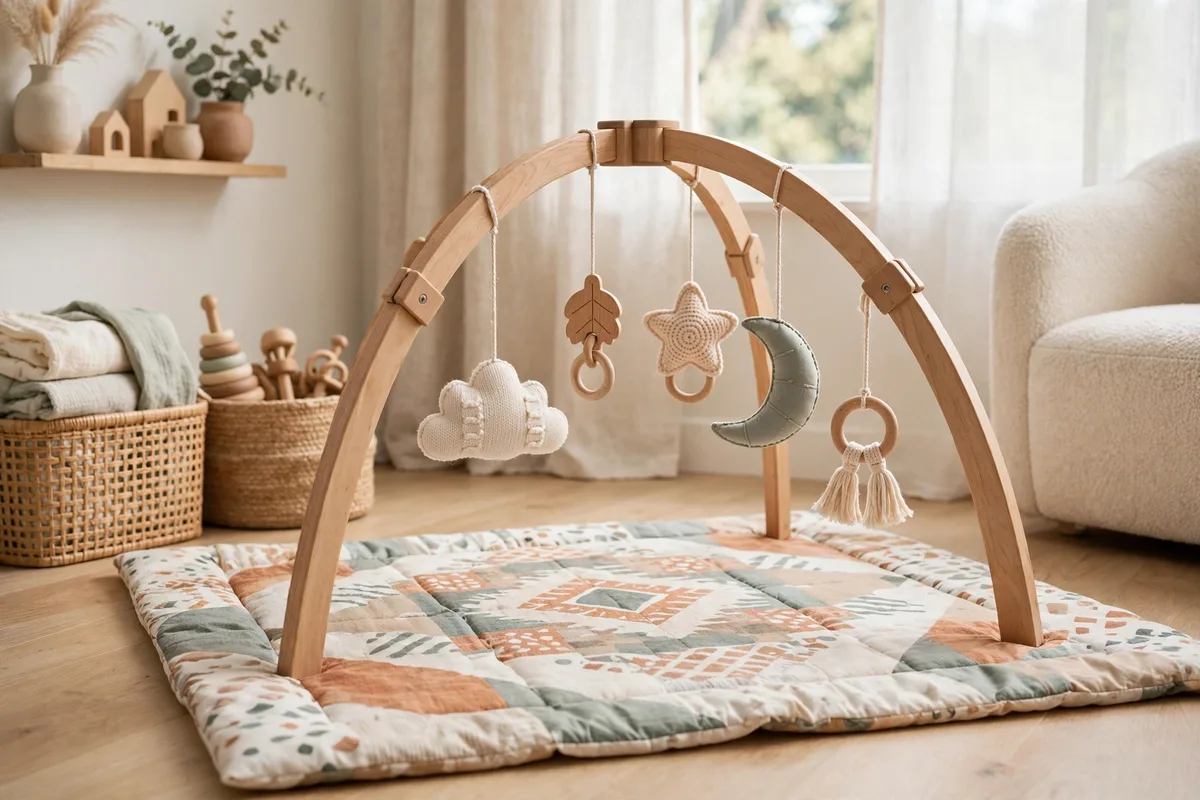
The best play mat is a tummy-time tool first and a cushion second — a firm, flat surface a newborn can push up from, with high-contrast toys at the 8-to-12-inch distance newborn eyes actually focus at — and the Lovevery Play Gym leads this guide because its whole design is sequenced around how babies develop, month by month. A mat that is too soft is the category’s commonest failure: the baby’s face sinks, the push-up frustrates, and tummy time ends in tears.
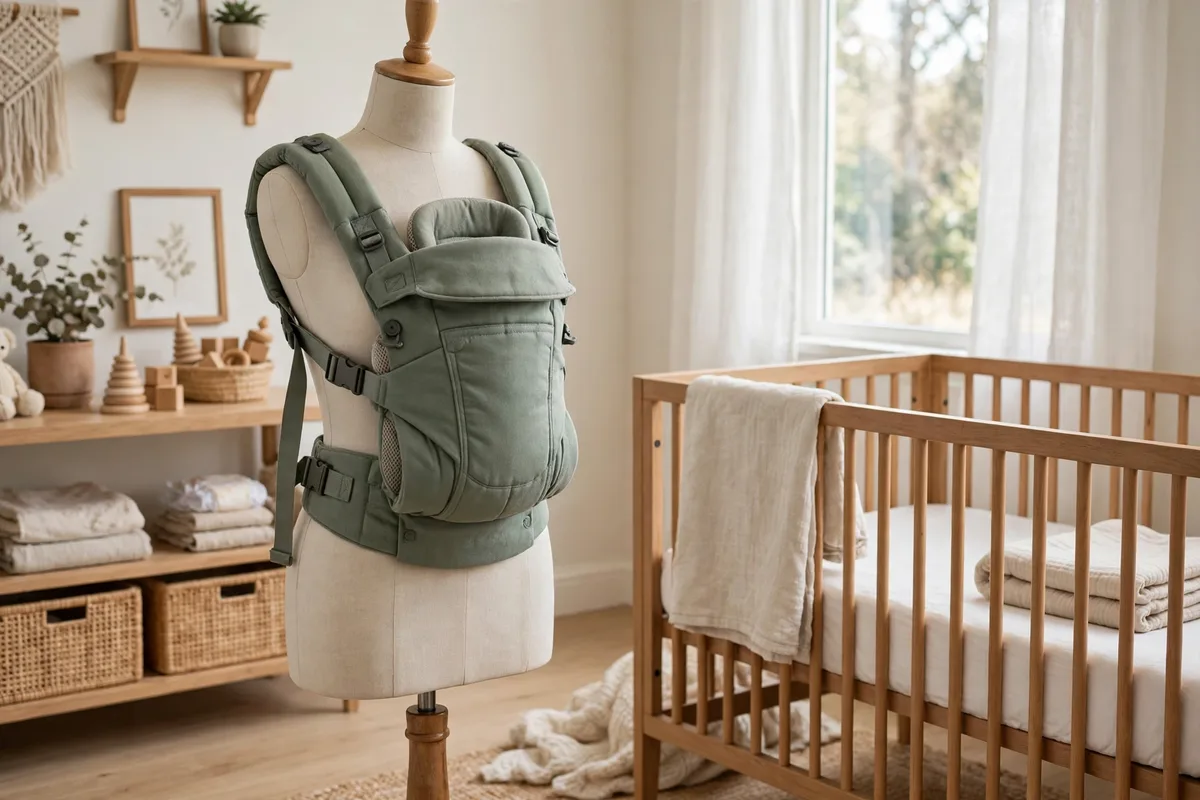
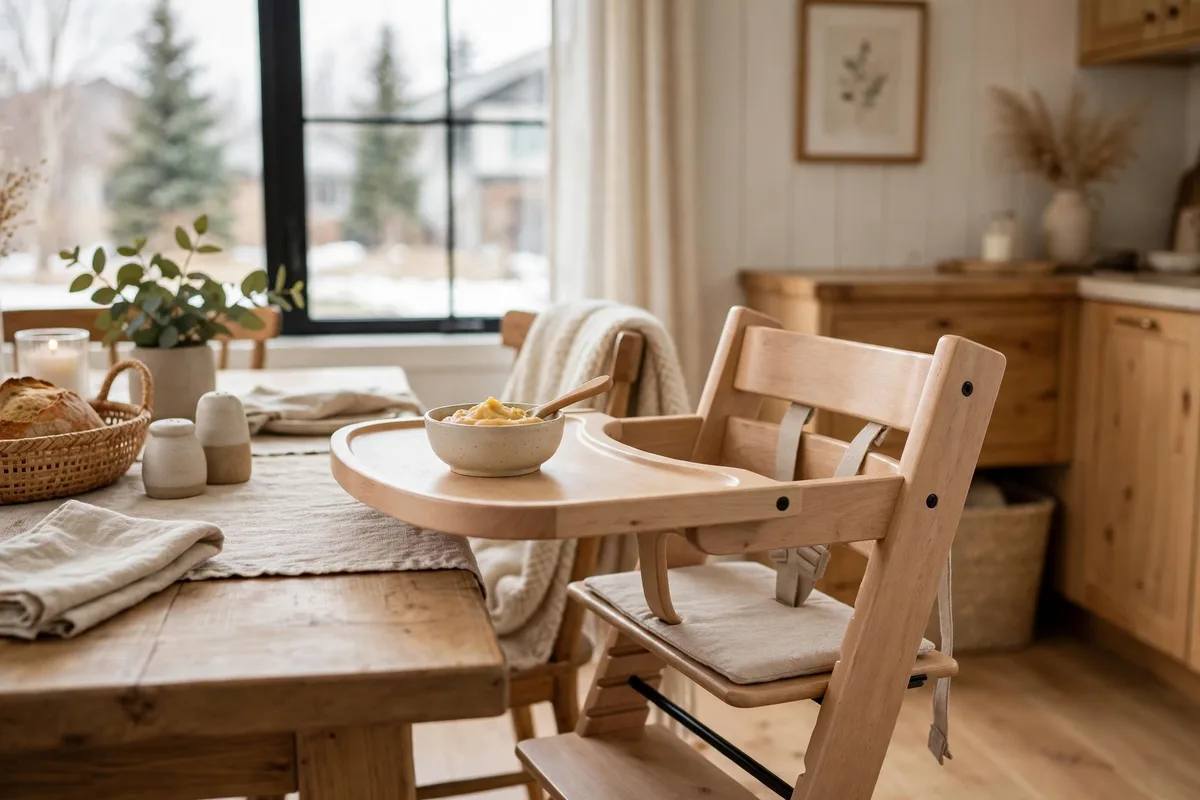
The five picks divide by stage and floor: a developmental system gym, a musical first gym, a washable design gym, a premium fabric mat, and expandable foam tiles. Each entry states its surface, cleaning and second life in the open. The mat anchors the floor hours between the best baby carriers in Canada and the USA guide’s carries, sits under the best high chairs in Canada and the USA once the baby sits at the table, and pairs with the best baby monitors in Canada and the USA for the parents’ peace of mind.
Disclosure: CookSmartPicks is reader-supported. When you buy through links on this page, we may earn an Amazon commission at no extra cost to you. Prices and availability change often — check the current price on Amazon before you decide.
How we chose these baby play mats and activity gyms
The shortlist was built on developmental design first: every pick had to give tummy time a firm, flat working surface (plush mats that swallow a newborn’s forearms were cut), with stimulus — high-contrast cards, mirrors, crinkle and sound toys — placed at the distances newborns actually focus. Activity gyms were judged on whether their toys reward reaching and batting in the sequence babies develop those skills.
Materials claims were read for specifics rather than slogans: formamide-free foam, stated fabric fills, and whole-mat washability where the design allows, because a play mat’s hygiene is a weekly reality, not a feature list. Longevity closed the ranking — every pick needed a second act (toddler play surface, tent, reading corner) beyond the arch months. All five are available through normal Canadian baby retail.
The lineup at a glance
| Product | Best for | Why it stands out |
|---|---|---|
| Lovevery The Play Gym | Best overall | The syllabus gym: a year of development, sequenced on one mat |
| Fisher-Price Kick & Play Piano Gym | Best budget gym | The kicking piano: first cause-and-effect, at a starter price |
| Skip Hop Activity Gym (Explore & More) | Best looking gym | The beautiful gym: a full curriculum that matches the nursery |
| Toki Mats Play Mat (Natural Latex) | Best premium mat | The furniture mat: natural latex, sized for years, not months |
| ProSource Puzzle Play Mat (EVA Foam Tiles) | Best expandable | The modular floor: tiles that grow from tummy square to playroom |
1. Lovevery The Play Gym — Best overall
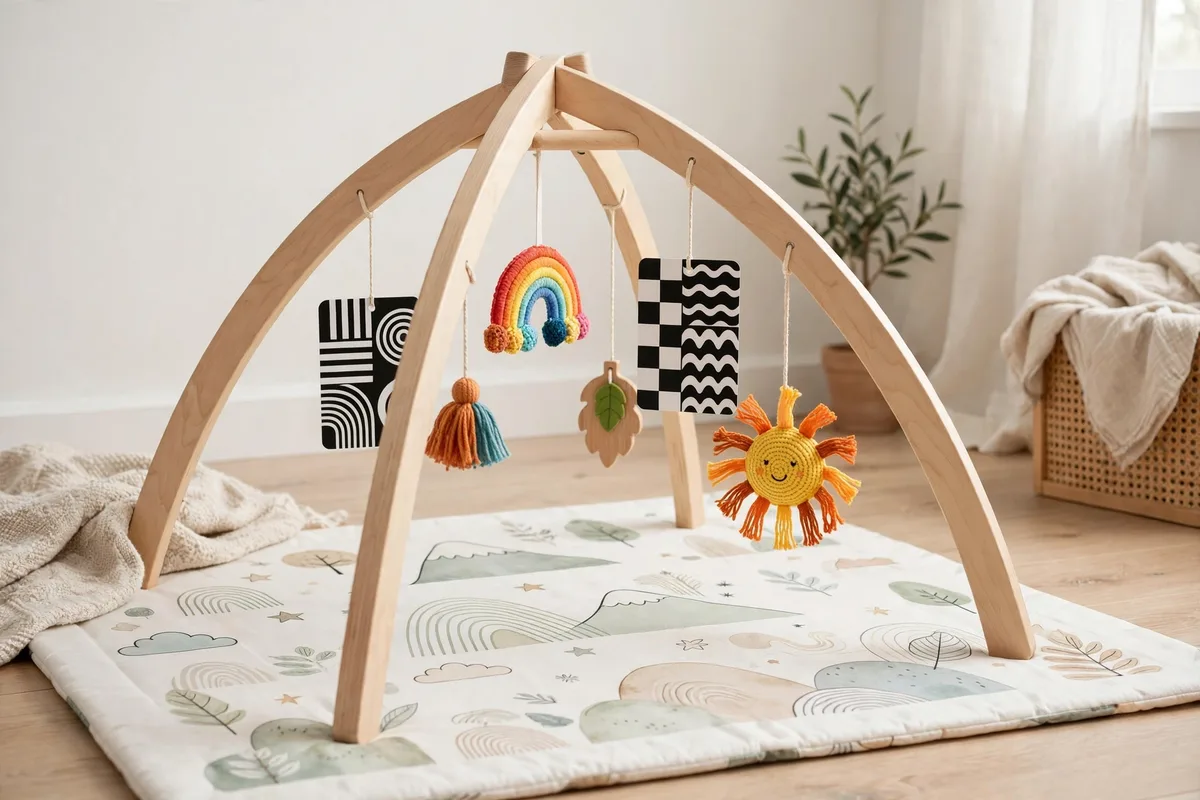
The Lovevery Play Gym is the category’s curriculum: a firm mat printed with developmental zones, a set of high-contrast and sensory cards that swap as the baby’s vision develops, toys sequenced for batting, kicking and grasping in the order babies acquire them, and a play guide that tells parents what to do at each stage — the rare baby product whose instructions are its best feature. The arches fold into a play tent for the toddler second act, and the mat’s cover is machine washable, because Lovevery’s designers have evidently met a baby.
The firmness is the professional detail: the mat gives a newborn’s forearms real purchase for the push-up, and the contrast cards sit at the focus distances the deep-dive describes. Parents report the gym’s signature result — tummy-time sessions that lengthen week by week instead of ending in protest — which is the outcome the entire category promises and this design most reliably delivers.
Canadian availability runs through the maker and major retailers at the guide’s premium price. For the household buying one floor-play system for the first year and beyond, the Lovevery is the considered default — the mat as a syllabus, taught on the living-room floor.
Ownership’s arc is the conversion: the gym becomes the tent, the tent becomes the reading nook, and the Lovevery is still in the house when the foam tiles of lesser systems have been donated — longevity by design, not by accident.
The play guide deserves its reputation used properly: read one stage ahead, not the whole book — the gym’s toys reward being introduced in the guide’s sequence, and the parent who deploys everything on day one has spent the curriculum’s surprises in a single afternoon.
Yay · Pros
- Stage-sequenced toys and a real play guide
- Firm tummy-time surface; washable cover
- Converts to a play tent for toddlers
Hmm · Cons
- Premium price
- Generous footprint needs its floor space
- The system’s guidance can feel like homework
Best for: The full first year — a developmental system Skip if: Your budget is foam-tile sized — the ProSource below covers the floor for years, cheaper
2. Fisher-Price Kick & Play Piano Gym — Best budget gym
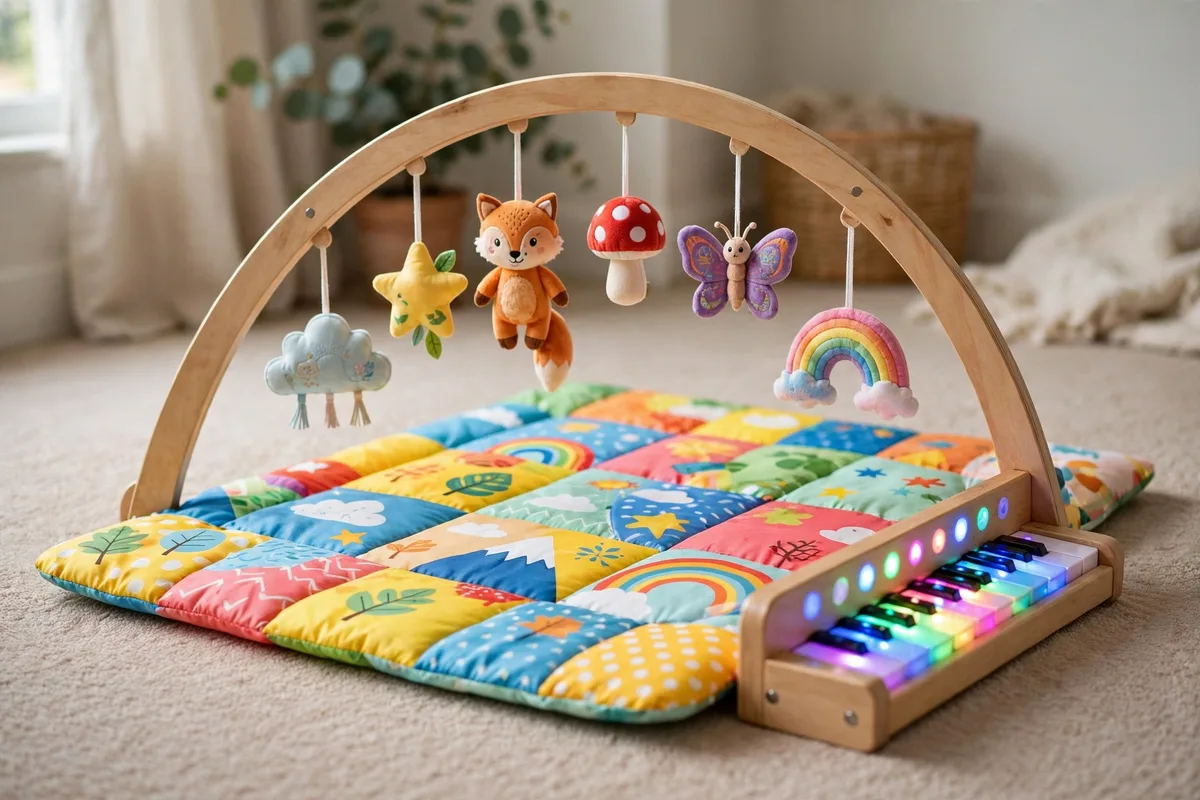
The Kick & Play Piano Gym is the first gym generations of babies have met: a mat, an arch of dangling toys, and at the baby’s feet a light-up piano whose keys reward kicking with music — the cause-and-effect lesson that makes this gym’s tummy and back time unusually productive. The piano detaches for sit-up play and toddlerhood, the mat machine washes, and the price is the friendliest in this guide by a distance that matters to new parents.
The design’s genius is motivational: babies kick the piano on purpose within weeks, building the leg strength and the discovery that their actions run the world — developmental gold delivered as a toy. The mat’s padding is thinner than the premium picks’ (on a carpet, irrelevant; on hardwood, add a rug), and the electronic soundscape is a household taste — there is a volume setting, and it will be used.
Canadian availability is universal at a budget price. As the starter gym — the baby-shower gift, the grandparents’ house unit, the first six months’ floor — the Piano Gym is the category’s best-value institution, and its presence in this guide needs no apology to the premium picks.
Ownership is measured in photographs: the kicking stage is brief and this gym is its stage set, after which the piano alone survives into the toddler band — a two-act life at a one-act price.
The piano’s second life is the highchair footrest band and the toddler’s first instrument, in owner folklore — but its documented trick is simpler: the keys’ lights hold a rolling baby’s attention through the frustrated phase, buying the extra minute of tummy time that the day’s total is built from.
Yay · Pros
- Kick piano teaches cause and effect
- Mat machine washes; piano detaches for later play
- The guide’s friendliest price
Hmm · Cons
- The mat is thinner than premium gyms’
- Batteries and electronic sounds are a taste
- Outgrown fastest of the five
Best for: First gym on a budget — music that teaches cause and effect Skip if: You want a full first-year system — the Lovevery sequences further
3. Skip Hop Activity Gym (Explore & More) — Best looking gym
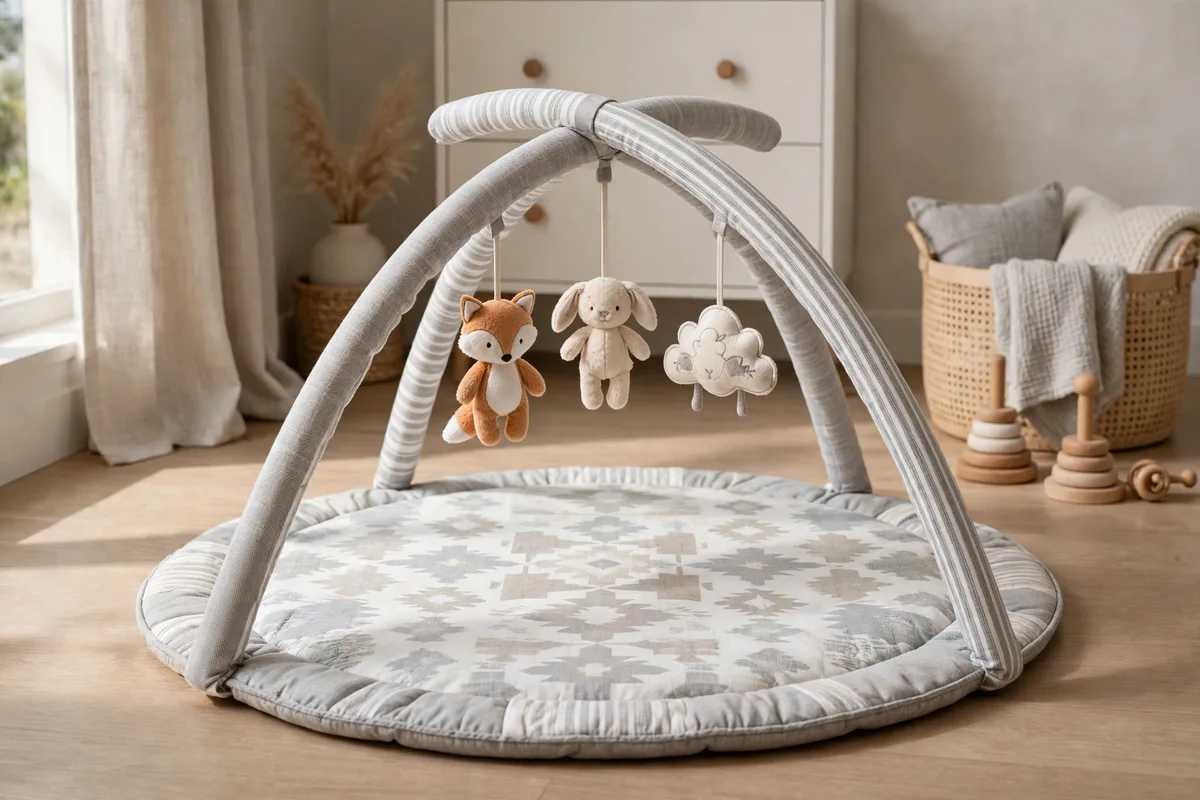
Skip Hop’s activity gyms (the Explore & More and Treetop Friends lines) are the design-conscious middle: proper arch gyms with a genuinely developmental toy set — crinkle, mirror, rattle, teether textures — dressed in the brand’s modern nursery aesthetic, on mats with the category’s nicer fabrics and a tummy-time pillow included in most configurations. The mats machine wash, the arches detach for the flat-mat phase, and the whole object photographs like the nursery in the brochure, which in the age of the shared nursery photo is a real feature.
The developmental kit is honestly complete — the toys hit the same sensory curriculum as the leaders’ — with the mat a touch plusher than the Lovevery’s, the trade the guide notes for tummy-time purists and most babies forgive. Where Skip Hop wins is the room: this is the gym that stays on the living-room floor without an apology, and a gym that stays out gets used, which is the usage argument again.
Canadian availability is broad at a mid-premium price. For the household balancing the developmental brief against a designed home, Skip Hop is the negotiated peace — both sides mostly win.
Ownership’s detail is the wash: the mats come out of the laundry looking new longer than rivals’, so the gym that lives in the shared living space keeps its showroom manners through the whole arch era.
Skip Hop’s tummy-time pillow earns a technique note: place it under the chest with the arms over its crest, not under the belly — the position that turns a protesting newborn into a pushing-up one, and the detail that decides whether the pillow is equipment or decor.
Yay · Pros
- Full developmental toy set, designed beautifully
- Machine-washable mat; tummy-time pillow
- Arches detach for the flat-mat phase
Hmm · Cons
- Softer mat than the tummy-time purists prefer
- Premium-mid pricing for a gym outgrown in a year
- Toy set is curated small
Best for: Design-led nurseries that still need a real gym Skip if: Tummy-time firmness is your top spec — the Lovevery’s mat is firmer
4. Toki Mats Play Mat (Natural Latex) — Best premium mat
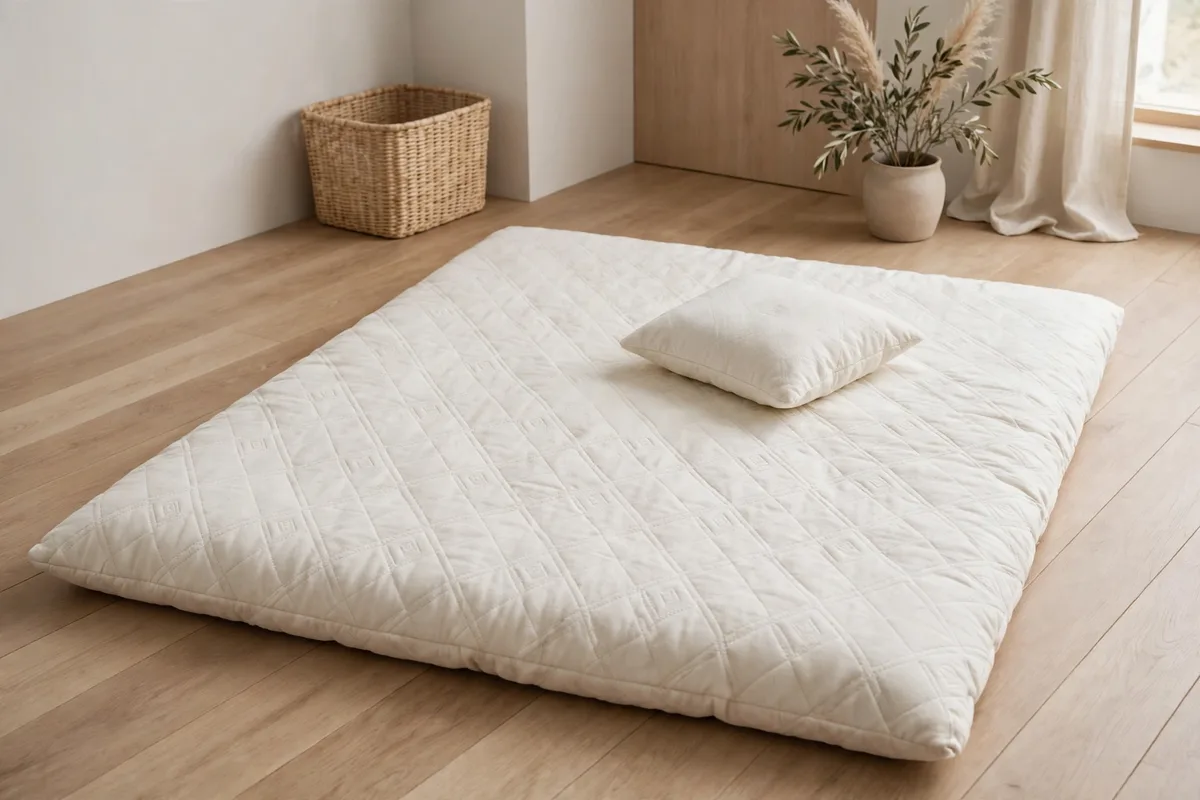
Toki Mats is the premium flat mat: a thick, supportive pad in natural latex foam (the maker’s material) covered in washable organic-cotton-class fabrics, sized generously — the mat as a piece of nursery furniture rather than a toy. It hosts tummy time on a firm-but-cushioned surface, becomes the crawling and first-steps floor, and continues as the toddler’s play and reading surface for years, in designs that belong in a considered home. For households that buy the gym toys separately (or receive them), the Toki is the floor itself, done at the highest standard in this guide.
The material story is the brand’s core: natural latex instead of EVA foam sidesteps the foam debate entirely, and the covers’ quality and washability meet the spit-up standard. The thickness cushions a sitting baby’s tumbles without the face-sinking softness that frustrates newborns — the balance struck at the premium end, with a price to match.
Canadian availability is online at the guide’s top per-object price. The buyer is the buy-once household: one mat, bought before the birth, still in daily service at the third birthday — the Toki’s ownership arc is the longest here, and its cost-per-year arithmetic quietly wins.
Ownership is heirloom-paced: Tokis pass between siblings and then between families, their covers rewashed and their latex unbowed — the mat as the nursery’s equivalent of the good rug.
The Toki’s covers reward a spare: with one cover in the wash the mat stays in service, and at this object’s price the spare cover is the accessory to buy with it — the premium mat’s only downtime is laundry, and it is optional.
Yay · Pros
- Natural latex — sidesteps the EVA debate
- Firm support with real cushioning
- Years of service: baby floor to toddler corner
Hmm · Cons
- No arches or toys — it is a mat, purely
- Premium price for a single object
- Large sizes are a storage commitment
Best for: A premium mat that outlasts the gym phase entirely Skip if: You want the toys and arches included — the gyms above bundle them
5. ProSource Puzzle Play Mat (EVA Foam Tiles) — Best expandable
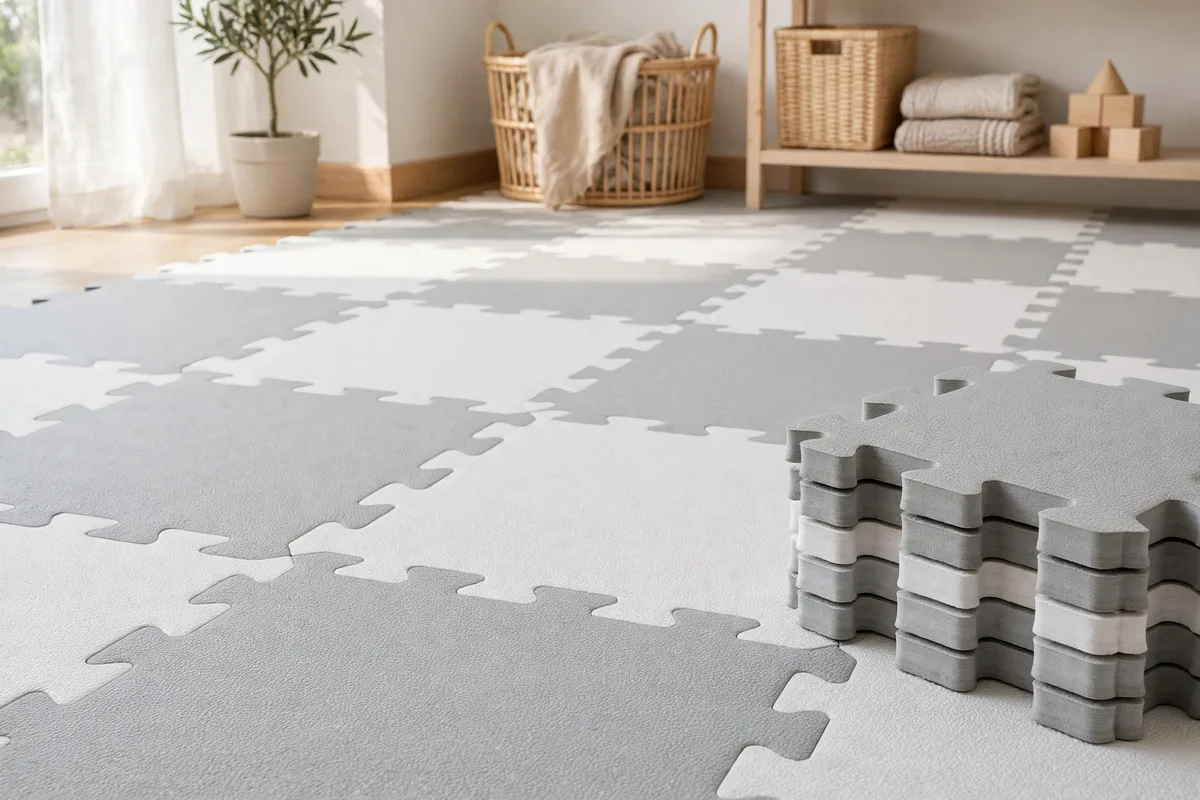
ProSource’s puzzle mats are the expandable floor: interlocking EVA foam tiles (formamide-free, per the maker) that start as a tummy-time square, grow into the crawling arena, and end as the playroom’s entire cushioned surface — coverage priced per square foot at the lowest rate in this guide. The tiles’ firmness is tummy-time correct, their wipe-clean surface handles the daily spills, and a damaged tile replaces singly instead of retiring a mat — the modular economy that makes foam the fleet choice for big floors and grandparents’ houses alike.
The honest notes are the seams and the style: crumbs migrate into the joints (a vacuum and an occasional lift-and-shake are the maintenance), and the foam-tile look is functional rather than decorative, though the wood-grain and muted-tone sets narrow the gap considerably. Thickness options let the household choose the cushion level — the thicker tiles for hardwood nurseries are the ones to buy.
Canadian availability is online and broad, in packs that scale from one room to a basement. For coverage per dollar across the crawling years, nothing else in this guide is close, and the ProSource floor under a Skip Hop gym is a combination this guide endorses outright.
Ownership is architectural: the tile floor grows with the child’s territory, migrates rooms, and finally retires to the workshop or garage as kneeling padding — the longest tail of usefulness in the nursery, full stop.
Tile layout is a design decision: border the play zone with the edge pieces finished (the bevelled edges exist precisely for this), and the foam floor reads as a rug rather than a gym — the difference between a playroom corner and a living-room compromise.
Yay · Pros
- Lowest cost per square foot; infinitely expandable
- Firm tummy-time surface; wipe-clean
- Single tiles replace — nothing retires early
Hmm · Cons
- Seams trap crumbs — occasional detailing needed
- The foam look is a gym, not a nursery portrait
- Letters/patterns on some sets are a taste
Best for: Expandable floor coverage, room by room Skip if: You want a single beautiful object — the Toki is the mat as furniture
Materials honesty: what ‘non-toxic’ can and cannot promise
Every play mat in this category claims to be non-toxic, and the claim means less than parents hope: there is no single certification behind the words, so the guide reads for specifics instead — EVA foam mats should be formamide-free (the compound that got foam mats regulated in Europe), fabric mats should state their fill and be washable (a mat that cannot be washed will be dirty, which is its own exposure), and any mat’s smell on opening is information: strong chemical odour means airing it out for days before the baby goes on it, whatever the box promised.
The developmental design matters more than the material debate past that baseline: tummy time — the activity every paediatric body in both countries prescribes in daily, increasing doses — succeeds or fails on the mat’s surface and stimulus design. A mat that is too soft lets a young baby’s face sink and frustrates the push-up; the right firmness (all five picks qualify) gives the forearms purchase, and the high-contrast patterns, mirrors and crinkle textures are not decoration — they are the visual curriculum of the first six months, placed at the distances newborn eyes actually focus at (roughly 8 to 12 inches).
Washability is the ownership divide: fabric gyms that machine wash whole (the Lovevery and Skip Hop class) reset to clean in a cycle, while foam tiles wipe down in place but harbour crumbs and spills in their seams — a toothbrush’s occasional attention. Spit-up is not an edge case in this category; it is the operating environment, and the mat whose cleaning matches your household’s laundry reality is the mat that stays hygienic rather than theoretical.
Size and second life close the decision: a mat that fits the room’s actual floor (measure — the Lovevery gym’s footprint is generous) gets used daily, while the foam tiles’ expandability is their quiet superpower, growing from tummy-time square to toddler play surface to the under-gym padding of the preschool years. The mats in this guide were chosen to have a year-two job — play tent, reading corner, puzzle surface — because the nursery’s most expensive objects should not retire at the first birthday.
And the safety frame that outranks all of it: a play mat is a floor toy, used awake and supervised, and it is never a sleep surface — babies who fall asleep on the mat move to the crib, the gym’s arches and toys are for waking hours, and loose accessories follow the maker’s age labels. Within that frame, the daily floor hours these mats host are among the best-evidenced investments in the baby’s motor development a household can buy — the mat is where the rolling, reaching and crawling curriculum physically happens.
Play mat questions, answered
How much tummy time should a baby get on a play mat?
Daily, in short sessions that grow with the baby: start with a few minutes several times a day for a newborn and build toward the commonly recommended total of about 60–90 minutes spread across the day by 3–4 months (follow your paediatrician’s guidance for your baby). A firm mat with high-contrast toys at newborn focus distance (8–12 inches) makes babies last longer per session — the mat’s design is a tummy-time tool, not just padding.
Is a firmer mat better for tummy time?
For young babies, yes — a mat that is too plush lets the face sink and makes pushing up harder, which shortens tummy time. The fabric gyms here use firm, flat mats under their padding for exactly this reason, and foam tiles are naturally firm. Save the deep-soft surfaces for supervised lounging once the baby is rolling and sitting, and always keep floor play awake and watched.
What does ‘non-toxic’ actually mean on a play mat?
Read for specifics, not the slogan: formamide-free EVA for foam mats, stated fills and washable construction for fabric ones, and no strong chemical smell on opening (air any new mat out before first use regardless). There is no single ‘non-toxic’ certification behind the marketing words — the brands in this guide state their materials plainly, which is the version of the claim worth trusting.
How do I clean a play mat?
Fabric gyms (Lovevery, Skip Hop, Fisher-Price) generally machine wash cold and air dry — check the label, and remove electronic toys first. Foam tiles wipe with a damp cloth and mild soap, with occasional seam attention. The washable-whole gyms are the hygiene winners for the spit-up months; whichever you own, a weekly clean is the realistic rhythm.
Activity gym or foam tiles — which do I need?
Each shines at a stage: an activity gym’s arches, dangling toys and mirror drive the reaching and tummy-time curriculum of the first six months; a large flat mat (foam tiles or a big fabric mat) serves rolling, crawling and toddler play for years. Many households start with the gym and add tiles as the baby outgrows the arches — the two are phases of one floor-play system, and this guide’s picks are chosen to hand off to each other.
Where should a play mat be used?
On any flat, firm floor away from hazards, at the room’s comfortable temperature — never on a bed, sofa or raised surface, and never as a sleep space. Babies who fall asleep on the mat should be moved to their crib or bassinet. Keep the play area clear of cords and small objects, and treat the mat as supervised, awake floor time only.
The floor itself is the last specification: hardwood and tile ask for the mat’s full cushioning and a non-slip reality check (a mat that migrates across a polished floor mid-roll is a hazard wearing a nursery’s colours — rug pads and corner weights exist for exactly this), while carpeted rooms forgive thinner mats entirely. Match the mat to the floor it will live on, and the daily sessions this guide is built around happen on a surface that is safe, firm and still.
The short version
Buy the Lovevery for the full developmental system, the Fisher-Price for the budget first gym, the Skip Hop for design with a real curriculum, the Toki for a premium mat that serves for years, and the ProSource tiles for expandable coverage. Whatever you choose: firm surface, washable plan, awake and supervised — and move sleepers to the crib.
Last updated: November 18, 2026. We refresh this guide each season and whenever a pick is replaced by a better one.