The best electric fireplace is not the one with the tallest flame in the product photo — it is the one whose heat you understand before it arrives. Here is the number the whole category is built on: a standard plug-in electric fireplace runs a 1,500-watt heater, and 1,500 watts makes about 5,118 BTU of heat per hour, no more, whatever the cabinet, the crystal bed or the brochure’s square-foot claim says. That is real, useful warmth for the room you are sitting in. It is not a furnace, and no pick here will be allowed to pretend otherwise.
What separates the five models below is everything around that shared heater: how real the flame looks, and how the unit joins your room. One is a built-in firebox that recreates a wood fire inside a brick interior — and can more than double its heat on a 240-volt circuit. Two are slim linear wall units, one is a freestanding stove you simply place and plug in, and one is a premium built-in only four inches deep for shallow walls. Installation class is the first decision; flame taste is the second; the heater, on 120 volts, is the same size in all of them.
Every figure below is the manufacturer’s published specification, with the source named where a claim needs one — including Natural Resources Canada’s plain statement of what electric resistance heat can and cannot do. Where a maker’s coverage claim outruns the physics, the review says so in words. If you only need heat without the hearth, our best space heaters in Canada and the USA guide is the cheaper honest route; this guide is for buyers who want the flame and are willing to pay for how well it is done.
Disclosure: CookSmartPicks is reader-supported. When you buy through links on this page, we may earn an Amazon commission at no extra cost to you. Prices and availability change often — check the current price on Amazon before you decide.
The short answer
For the most realistic fire, the Dimplex Revillusion 36-inch firebox is the benchmark — and the only pick that out-heats the class, on a 240-volt circuit. The Napoleon Alluravision 50 is the slim wall-mount to buy, and the Touchstone Sideline 50 delivers the recessed look with app control.
How we chose these electric fireplaces
CookSmartPicks is a research-based guide; we do not claim hands-on testing we have not done. For this list we compared manufacturer specifications and owner’s manuals — heater wattage and the voltage behind it, installation class, framing dimensions and depth, flame system, controls and safety listing — against independent roundups and verified owner reports from Canada and the USA. The first filter was arithmetic, not aesthetics: every pick’s heat claim was converted back to watts before it was allowed into the guide, because a watt is a watt whatever the cabinet around it claims.
The second filter was installation honesty. An insert, a wall-mount, a built-in and a stove are four different projects, so each pick is labelled with its class, its true depth, and whether it plugs in, hardwires, or needs an electrician. The third filter was certification: every pick carries a North American safety listing (CSA, UL or ETL) named in its documentation. Models whose heat claims could not be reconciled with their wattage were cut, however good their flame photographs looked.
The lineup at a glance
| Product | Best for | Why it stands out |
|---|---|---|
| Dimplex Revillusion 36-inch Built-In Firebox RBF36 | Best realistic flame | A full-depth brick firebox you see through the flames — the realism benchmark, with 240 V heat headroom |
| Napoleon Alluravision 50 Slimline NEFL50CHS | Best wall-mount slim | A nearly frameless 50-inch fire only 4-1/4 inches deep — the wall barely notices it |
| Touchstone Sideline 50 Recessed Electric Fireplace 80004 | Best value wall-mount | The recessed linear look with app control at a mid price — logs and crystals both in the box |
| Duraflame 3D Infrared Quartz Electric Stove DFI-5010 | Best freestanding stove | A plug-in stove with a real digital thermostat — full 1,500 W heat with zero installation |
| Amantii Panorama BI-50-XTRASLIM Electric Fireplace | Best premium built-in | A clean-face built-in only 4 inches deep, rated indoors or out, with the widest flame palette here |
1. Dimplex Revillusion 36-inch Built-In Firebox RBF36 — Best realistic flame
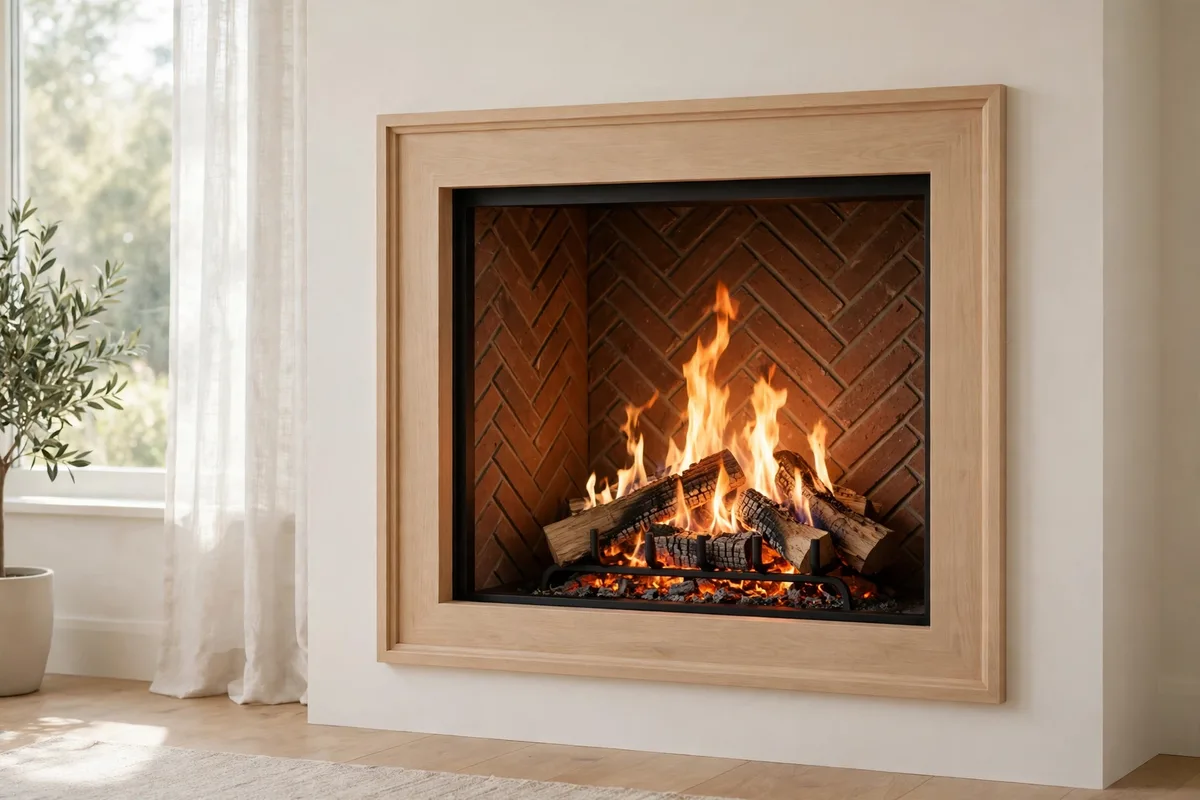
The Revillusion is the flame-realism benchmark here, and the reason is architectural: Dimplex’s ThruView design lets you see through the flames to a full-depth firebox interior — herringbone brick or weathered concrete — with a grate of life-size logs that pulse and glow. Independent fireplace retailers who sell across brands consistently rank it the most convincing log fire they carry, and an ambient light sensor that adjusts the firebox lighting to the room keeps the illusion working at noon as well as midnight. This is the pick for an existing masonry opening or a framed niche.
The electrical story is in the manual: the RBF36 is designed to be direct-wired to a 120, 208 or 240-volt circuit. On 120 volts the manual rates it at 1,300 watts and 4,400 BTU — honest figures, and less heat than the plug-in picks below. On 240 volts it rises to 2,575 watts and 8,794 BTU, output Dimplex positions as part of a primary heating plan. An optional plug kit exists for 120-volt installations only. So the Revillusion is two products: a plug-in flame showcase, or — with an electrician — the only genuinely high-heat unit here.
Plan the project properly: the firebox measures 37-1/8 inches wide, 26-5/8 inches high and 12-1/8 inches deep per the manual, needs a framed opening (roughly 36-5/8 by 26-3/16 inches for this size) and is zero-clearance except at the top. The flame runs without heat for summer use, and Dimplex backs the firebox with a 2-year limited warranty per its series documentation. It is the most expensive route here and the only one involving construction — and owners consistently say the flame was worth the framing.
Yay · Pros
- The most realistic flame here — full-depth view through the fire to a brick interior
- Scales with voltage: 8,794 BTU on a 240 V circuit per the manual
- Flame-only mode, ambient light sensor and heater that runs without flame
- 2-year limited warranty per Dimplex series documentation
Hmm · Cons
- A build project: framing, finishing and (for full heat) an electrician
- On 120 V it produces less heat than the plug-in stove in this guide
- Traditional log look only — no linear or crystal-bed styling
Best for: traditional rooms, existing fireplace openings and renovation builds where flame realism outranks every other feature. Skip if: you want the fire on the wall this weekend with no framing; the wall-mount picks below exist for exactly that.
2. Napoleon Alluravision 50 Slimline NEFL50CHS — Best wall-mount slim
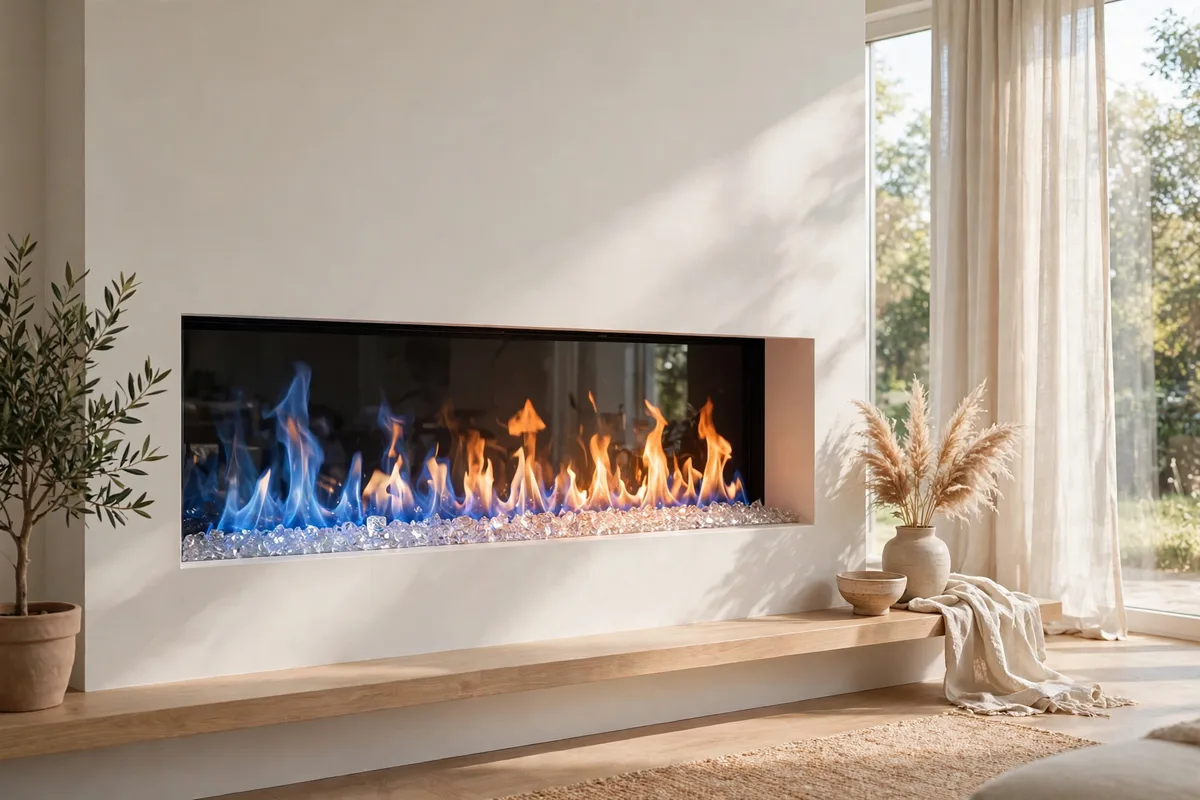
Napoleon’s design brief is in its series slogan: see the fireplace, not the frame. The Alluravision 50 Slimline is a nearly frameless sheet of glass 50-5/16 inches wide and only 4-1/4 inches deep. It can also be fully recessed for a flush finish, and it plugs into a standard outlet or hardwires to 120 volts. For condos and bedrooms — where construction is limited and floor space is precious — that combination of width and shallowness is the whole case.
The heater is the standard honest size: up to 5,000 BTU and 1,500 watts per Napoleon, warming — per the maker — up to about 400 square feet as supplemental heat, which is one of the more restrained coverage claims in this category. The flame system offers four colours, five speeds and four brightness levels over a crystal cube ember bed, with a NIGHT LIGHT mode that glows without flame. Napoleon rates its blower Whisper Quiet at 39 dB in the series brochure — a maker figure, but a plausible one for a slim fan unit. Flame and heat run independently, so the fire works in July.
The honest limit is the picture’s shape: the viewing area is about 48-1/2 inches wide but only about 11 inches tall, so the flame is a wide, low ribbon rather than a tall fire. Rooms wanting hearth-like height should look at the Revillusion or the stove. Installation is genuinely simple — hang it on its bracket, plug in, done — and the slim depth means recessing fits walls the deeper units cannot use.
Yay · Pros
- Only 4-1/4 inches deep — hangs almost flat, or recesses fully flush
- Four flame colours, five speeds, plus a flame-free NIGHT LIGHT mode
- Restrained, credible maker heat claim: 5,000 BTU for supplemental zone heat
- Plug-in or 120 V hardwire — no electrician required for the standard install
Hmm · Cons
- Viewing window is letterbox-short — flame height is modest
- Slimline model is 120 V only; the higher-heat Deep versions are different models
- Crystal media look only in the box; driftwood media is an added extra
Best for: condos, bedrooms and modern living rooms that want a wide fire on the wall this weekend, with nothing cut into the room. Skip if: you want a tall, hearth-like flame picture; this window is wide and deliberately low.
3. Touchstone Sideline 50 Recessed Electric Fireplace 80004 — Best value wall-mount
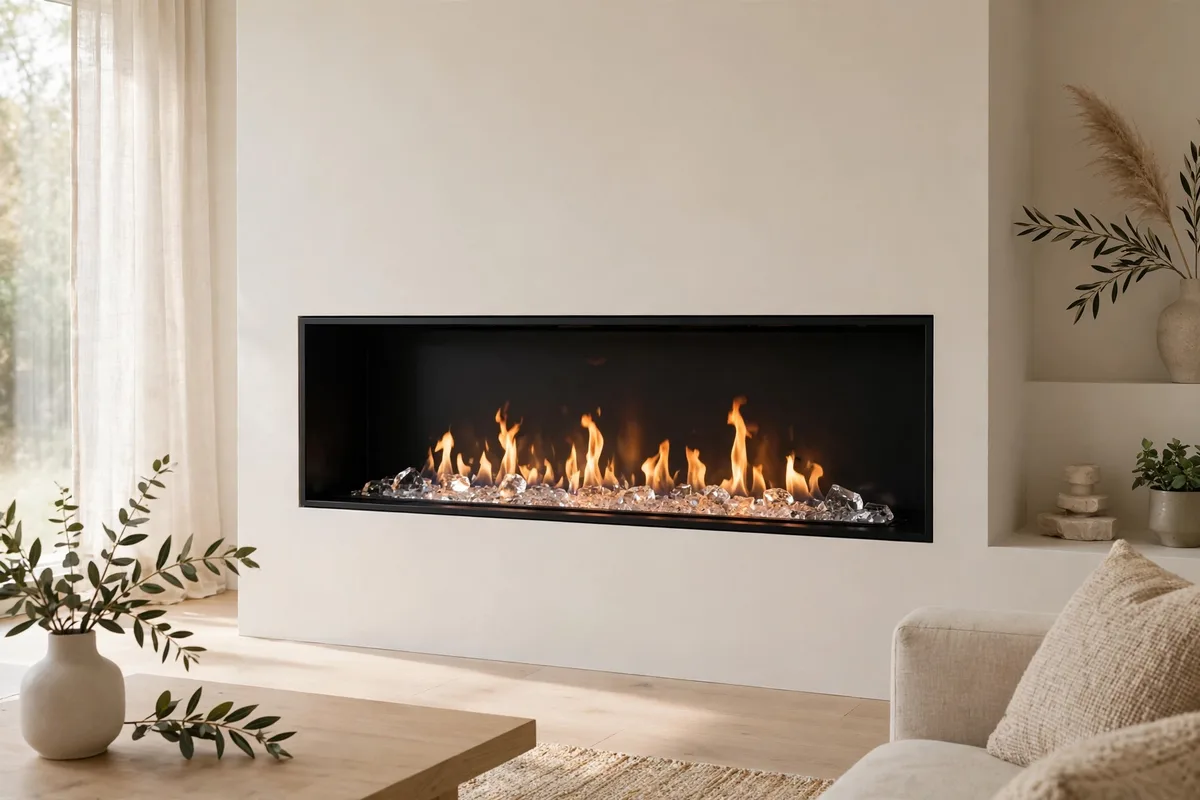
The Sideline 50 is the value centre of the linear market: a 50-3/8-inch-wide unit, 21-1/2 inches high and 5-1/2 inches deep, designed to recess into a framed opening or hang on the wall surface. Touchstone publishes the rough opening — about 47-1/8 inches wide, 20-1/2 inches high and 5-3/4 inches deep — the dimension that decides the project: a 2x6 wall swallows it, a 2x4 wall means surface-mounting or building the wall out. It plugs in or hardwires at 120 volts, and unusually for its tier it includes both ember styles in the box — faux logs and crystal media — so the hearth look is a choice you make at home.
The heater is a 1,500-watt coil with blower, rated by Touchstone at 5,000 BTU and about 400 square feet of supplemental coverage — the same wattage as every plug-in here, with a claim at the restrained end of the category’s range. Controls are the Sideline’s quiet strength: a thermostat rather than just high and low, overheat auto-off, a timer from 30 minutes to 7.5 hours, a remote, and WiFi app control with Alexa and Google compatibility. The flame runs with or without the heater, across multiple colour combinations — five flame settings and a ten-colour ember bed in the current documentation.
Certification is documented properly: Touchstone’s manual records testing to CSA standards for the United States and Canada, and requires wiring to the applicable national electric code. The watch-outs are the warranty — one year on electronic parts — and placement: at least 8 inches below a mounted TV or ceiling and 6 inches above the floor, per Touchstone’s guidance. For a recessed feature wall on a sane budget, this is the pick the premium brands have to argue against.
Yay · Pros
- Recesses flush or surface-mounts; plugs in or hardwires at 120 V
- Logs and crystal media both included — choose the look at home
- Thermostat, timer, remote and WiFi app with Alexa and Google
- CSA-standard testing documented in the owner’s manual
Hmm · Cons
- Needs a 5-3/4-inch-deep rough opening to recess — too deep for a standard 2x4 wall
- 1-year warranty on electronic parts is the shortest cover here
- The 400 sq ft maker figure is supplemental top-up heat, not sole heating
Best for: living rooms and media walls that want the recessed linear look, both media styles in the box, and app control without premium pricing. Skip if: your wall is a shallow 2x4 build and you will not surface-mount; the Napoleon above is the shallower answer.
4. Duraflame 3D Infrared Quartz Electric Stove DFI-5010 — Best freestanding stove
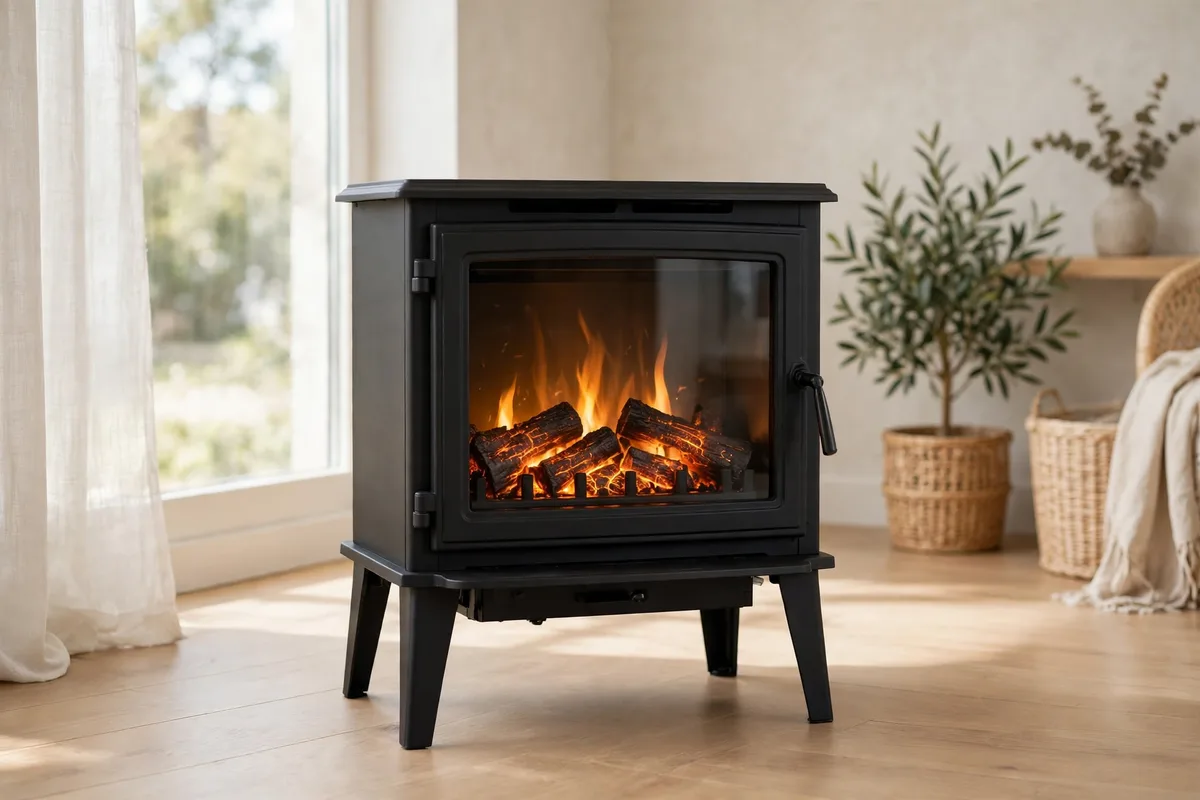
The DFI-5010 is the anti-project: a freestanding stove with a big glass front, glowing logs and a 3D flame effect, which you place on the floor, plug into an ordinary 120-volt outlet, and use the same evening. No framing, no bracket, no electrician — and when you move, it moves with you, making it the natural pick for renters, cabins and spare rooms. The stove format does one more thing the wall units cannot: it reads as furniture — a hearth object in the corner rather than a screen on the wall.
Inside is an infrared quartz heater rated by Duraflame at 1,500 watts and 5,200 BTU — the maker’s figure for what is physically the standard 5,118 BTU of any 1,500-watt heater, a rounding this guide notes rather than repeats as an advantage. One claim needs direct correction: the maker’s “supplemental zone heating for up to 1,000 square feet” is not a promise 1,500 watts can keep as a room’s main warmth; treat it as strong top-up heat for the room you are in. The infrared element warms objects and people in its line of sight, which can feel faster in a draughty room, but it produces the same heat per watt as a fan-forced coil — choose the stove for its form and controls, not for a heating advantage physics does not provide.
The controls justify the pick: an adjustable digital thermostat — the feature that separates real room heaters from high/low novelties — five flame brightness levels, a timer, a remote, overheat shutoff, and a flame that runs without heat. Respect the manual’s clearances: at least 3 feet from furniture, bedding and curtains at the front, and never leave it running unattended. Duraflame backs it with a 1-year limited warranty.
Yay · Pros
- Zero installation — place it, plug it in, use it tonight; fully portable
- Adjustable digital thermostat, not just high and low settings
- 3D flame with five brightness levels, runs with or without heat
- Overheat shutoff and a remote, in a stove that reads as furniture
Hmm · Cons
- Maker’s up-to-1,000 sq ft claim outruns the physics — treat it as room-scale top-up heat
- Needs 3 feet of clearance in front per the manual — not a tuck-anywhere unit
- Infrared branding aside, it delivers the same heat per watt as every 1,500 W pick
Best for: renters, cabins, spare rooms and stove lovers who want the fire today, movable tomorrow, with a real thermostat. Skip if: you want the fire built into the wall; this is deliberately a piece of furniture, not a fixture.
5. Amantii Panorama BI-50-XTRASLIM Electric Fireplace — Best premium built-in
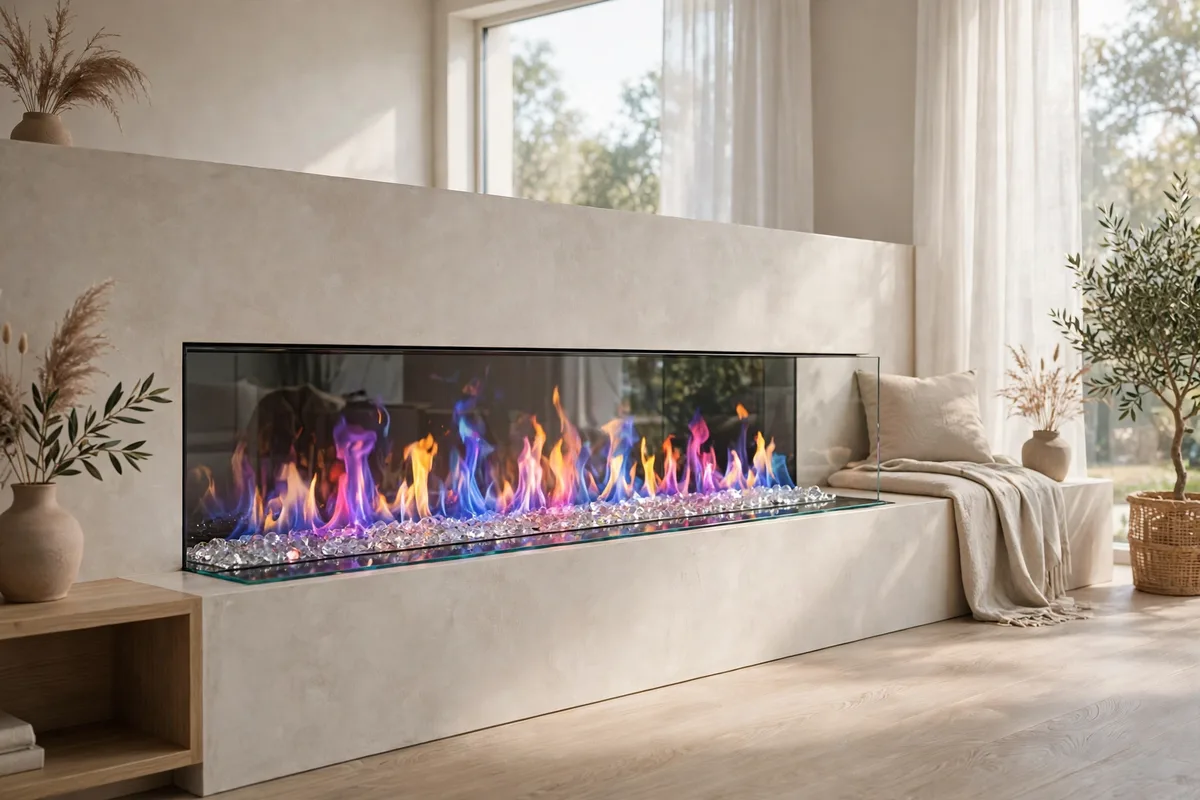
The Panorama BI-50-XTRASLIM exists for the wall that defeats other built-ins: at just 4 inches deep, it recesses into shallow framing where a 5-1/2 or 6-3/4-inch unit does not fit, and its full-frame design lets finishing material run right to the glass for a clean-face, trimless look — or you can fit the included black steel surround. It measures 49-1/8 inches wide by 19-7/8 inches high, with a 45-1/4 by 11-7/8-inch viewing area, and Amantii rates the series for indoor and outdoor installation, with a weather cover required outdoors.
Amantii’s flame system, which the maker calls FIRE & ICE, runs three light strips through yellow, orange, blue, violet and rose, with canopy and ember-bed lighting in 11 colours, two flame styles and a three-speed flame motor — the most adjustable picture here. Controls run to a thermostatic remote, touchpad and WiFi app. The heater is a two-stage 1,500-watt-maximum unit (1,500 high, 750 low); Amantii’s BTU figures appear as 4,800 in the specification sheets and 5,000 in retail documentation — both describing the same standard heater — and its roughly 400–500 square foot guidance is supplemental, like every 120-volt pick here.
The practical details are handled: hardwire-ready, a left-side plug with a roughly 71-inch cord if you plug in instead, flame that operates without heat, and certification the maker states as ETL or CSA marks, with a 2-year warranty. The honest framing: the premium buys architecture — the shallowest clean-face built-in, the widest flame palette, the indoor-outdoor rating — not extra heat.
Yay · Pros
- Only 4 inches deep — the built-in for shallow walls, with trimless clean-face finishing
- Widest flame palette here: five flame colours plus 11 canopy and ember colours
- Rated for indoor and outdoor installation (weather cover required outdoors)
- WiFi app, thermostatic remote, hardwire-ready, 2-year warranty
Hmm · Cons
- A built-in: framing and finishing are part of the purchase
- Outdoor use requires the maker’s weather cover, sold for that purpose
- At 120 V its heat is the standard 1,500 W — the premium buys design, not warmth
Best for: renovations and new builds with shallow walls, design-led rooms, and anyone wanting one unit rated for indoors or a covered outdoor space. Skip if: you are renting or avoiding construction; the stove and the wall-hung Napoleon give you a fire without opening a wall.
The honest heat math: what 1,500 watts can and cannot do
Start with the physics every listing hopes you will skip. Electric resistance heat converts electricity to heat at a fixed rate: one watt produces 3.412 BTU per hour, so a 1,500-watt heater — the maximum a standard 120-volt circuit comfortably supplies — makes about 5,118 BTU per hour. That is why the figures in this guide cluster where they do: 5,000 from Napoleon and Touchstone, 5,200 as the Duraflame’s maker figure, 4,800–5,000 on the Amantii. They are the same heater, rounded differently. Natural Resources Canada makes the companion point plainly: electric space heaters produce one unit of heat per unit of electricity — 100 percent efficient at the point of use — while a heat pump can deliver around three, which is why resistance heat is a comfort tool, not the cheapest way to heat a whole home.
The square-foot claims are where honesty goes to die, so compare them directly: for the same 1,500 watts, Touchstone states about 400 square feet of supplemental coverage and the Duraflame’s maker figure claims up to 1,000. A common sizing rule is roughly 10 watts per square foot as a room’s only heat source, putting 1,500 watts at about 150 square feet of primary heating in an ordinarily insulated room. Both maker claims use the word supplemental, and that word is doing the work: in a larger room with the central system running lower, a fireplace tops up the corner you actually sit in. Zone heating is the honest case for every pick here, alongside smaller plug-in options like the best space heaters in Canada and the USA for rooms that do not need a flame at all.
Circuit math is the other number to run before you buy. A 1,500-watt heater draws about 12.5 amps — most of a 15-amp household circuit — so a vacuum or hair dryer on the same circuit will trip the breaker, and manuals across this category say to plug directly into a wall outlet, never a power strip or extension cord. Running cost follows the wattage: on high, the heater uses 1.5 kilowatt-hours per hour, and a thermostat that cycles it off at temperature uses meaningfully less. Flame-only mode runs on LED lighting — the Amantii rates its no-heater draw at roughly 22–25 watts — which is why summer ambience costs almost nothing.
Getting more heat than 5,118 BTU requires more than 120 volts, full stop. The Revillusion is the demonstration: on a hardwired 240-volt circuit its manual rates it at 2,575 watts and 8,794 BTU, while the same firebox on 120 volts produces less heat than the freestanding stove in this guide. Decide the installation class first, then check the heat matches the job — and treat any 120-volt product, however dressed, as a 1,500-watt zone heater with a beautiful flame attached.
Four ways an electric fireplace joins a room: insert, wall-mount, built-in and stove
Installation class is the decision everything else hangs on, because it sets the project’s cost in time and tradespeople before the flame is ever lit. The freestanding stove is the zero-project class: place it, respect its clearances — the Duraflame’s manual wants 3 feet in front — and plug in. The wall-mount class hangs on a bracket like a heavy television — an afternoon’s work with a stud finder, reversible when you move. These two classes are where renters and first-time buyers belong — the flame and heater are the same quality the built classes offer.
The recessed and built-in classes trade that ease for architecture. A recessed linear unit like the Touchstone or the Amantii sits inside a framed opening so its face lands flush with the finished wall; a built-in firebox like the Revillusion goes further, becoming part of a surround, mantel or media wall. The governing measurement is depth, and it is unforgiving: a standard 2x4 wall cavity is about 3-1/2 inches deep, a 2x6 cavity about 5-1/2. The Napoleon’s 4-1/4-inch body and the Amantii’s 4-inch body exist precisely because of that arithmetic, while the Touchstone’s 5-3/4-inch rough-opening depth needs the deeper wall or a built-out section. Measure the wall before you fall for the picture, and check the stud bay for wiring and plumbing before anything is cut.
The insert use-case sits inside the built-in class: reviving an existing fireplace opening. Measure a masonry firebox twice — front and back wall, because fireboxes taper — plus the depth; the unit must fit the smallest number, and the Revillusion’s 12-1/8-inch depth is the figure to test. Two practical points: most masonry fireplaces have no outlet inside the opening, so plan the cord route or an electrician’s visit; and close the chimney damper first, because an open flue pulls warmed air up the chimney all winter.
Whichever class you choose, finish with the certification and clearance checks. Confirm a CSA, UL or ETL listing on the rating plate — the Touchstone manual records CSA-standard testing for the USA and Canada, and Amantii states ETL or CSA marks across its range. Keep the manual’s clearances, plug plug-in models straight into a wall outlet rather than a strip, and let the room’s other layers share the work: the best blackout curtains in Canada and the USA hold the warmth the fireplace makes, and the best heated blankets in Canada and the USA covers nights you want heat without a hearth.
Electric fireplace questions, answered
Can an electric fireplace heat a whole house?
No 120-volt plug-in model can. A 1,500-watt heater produces about 5,118 BTU per hour — roughly 150 square feet as a room’s only heat by the common 10-watts-per-square-foot rule, and comfortable supplemental warmth in a larger room. The one pick that goes further is the Dimplex Revillusion on a hardwired 240-volt circuit, rated by its manual at 2,575 watts and 8,794 BTU.
How much does an electric fireplace cost to run?
The heater’s draw is fixed by its wattage: a 1,500-watt unit uses 1.5 kilowatt-hours per hour on high, and less once a thermostat starts cycling it. Multiply that by your local per-kilowatt-hour rate for your exact figure. Flame-only mode is a different world — LED lighting drawing roughly 20–50 watts depending on the model — so the ambience runs for a small fraction of the heating cost.
Can I mount a TV above an electric fireplace?
Often yes, but only within the manufacturer’s stated clearances — read them for the specific model rather than assuming. Front-venting linear units like the Touchstone are designed with TV mounting in mind, and Touchstone recommends at least 8 inches between the unit and a mounted TV or ceiling. The manual’s clearance table — not a product photo — is the document to follow.
Plug-in or hardwired — which should I choose?
Choose plug-in for anything wall-mounted, freestanding or rented: it is an afternoon’s work and fully reversible. Choose hardwired when the unit is being built into a finished wall and you want no visible cord, or when you need the higher heat a 240-volt circuit unlocks, as on the Revillusion. Hardwired connections belong to a licensed electrician in both Canada and the USA — the framing around them can still be your own work.
What safety certification should I check for?
Look for a CSA, UL or Intertek ETL mark on the unit’s rating plate — the listing that matches your country. The Touchstone manual records testing to CSA standards for fixed and location-dedicated electric room appliances in the USA and Canada, and Amantii states its fireplaces carry ETL or CSA marks. A model with no North American listing, however attractive the photos, is the one to walk past.
Can I run the flame without heat in summer?
Yes — every pick in this guide runs its flame with the heater off, which is one of the category’s genuine pleasures. The flame system is LED lighting drawing a few dozen watts at most, so a summer evening’s ambience costs very little to run. It is also the mode for shoulder seasons, when a room wants the look of a fire before it wants the heat.
The short version
Short on time? Buy the Dimplex Revillusion for the most realistic fire and the only 240-volt heat upgrade in the class. Buy the Napoleon Alluravision 50 for a slim wall-hung fire, the Touchstone Sideline 50 for the recessed look with app control at a mid price, the Duraflame DFI-5010 stove for full heat with zero installation, and the Amantii Panorama BI-50-XTRASLIM for a premium clean-face built-in in a shallow wall. For evenings that need warmth without a hearth at all, pair the room with the best heated blankets in Canada and the USA and the best blackout curtains in Canada and the USA.
Sources
This guide is research-based: we compared manufacturer specifications with the independent testing and reporting below, cross-checked against verified owner reports in Canada and the USA. Specs are the manufacturers’ published figures; where testers disagree with a maker’s claim, the review says so.
- Natural Resources Canada — Electric heaters — Federal guidance: electric heaters produce one unit of heat per unit of electricity, while heat pumps can deliver about three.
- Dimplex — Revillusion Built-in Electric Firebox owner’s manual (RBF36) — Maker’s manual: 1,300 W / 1,975 W / 2,575 W at 120 / 208 / 240 V, framing dimensions, hardwire specification and optional 120 V plug kit.
- The Home Depot Canada — Napoleon Alluravision 50 Slimline NEFL50CHS — Canadian retailer record: 1,500 W, up to 5,000 BTU, 4.25-inch assembled depth, four flame colours and flame-without-heat operation.
- Electric Fireplaces Direct (Canada) — Best Electric Fireplaces of 2026 — Specialist retailer roundup cross-checking flame realism and installation classes, ranking the Dimplex Revillusion best for log realism.
- HVAC Compared — Best Electric Fireplace Heaters — Independent analysis from makers’ manuals: the 3.412 BTU-per-watt conversion, Duraflame and Touchstone specifications, clearances and certification.
- Electric Fireplace Guys — Amantii Panorama BI-50-XTRASLIM specifications — Full specification record: 4-inch depth, 1,500 W maximum, viewing dimensions, rough opening, WiFi control and 2-year warranty.
Last updated: November 20, 2026. We refresh this guide each season and whenever a pick is replaced by a better one.