The best pet gate is not the tallest or the widest one on the page — it is the one whose mounting type matches the spot it has to guard. A pressure-mounted gate wedged at the top of a staircase is the single most common, and most dangerous, mistake in this category: safety authorities in both Canada and the USA are blunt that only a gate screwed into the wall belongs there. Get the mount right first, and the rest — height, bar spacing, walk-through door — falls into place.
This guide compares five gates that cover the five jobs Canadian and American homes actually ask for: an everyday doorway gate with a cat door, a value walk-through, a hardware-mounted stair gate, a portable panel, and an ultra-budget barrier for small, calm pets. Every width, height and mounting claim below is the manufacturer’s published figure, and where a fit chart has a gap in the middle of its range — two of these do — we say so before you order, not after.
One framing note before the picks: a pet gate is a boundary, not a vault. A determined large dog that launches itself at any barrier can defeat most of them, which is why this guide pairs each gate with the dog it genuinely suits — and why households training a new puppy may want to read it alongside our guide to the best dog crates in Canada and the USA, so the gate works inside a bigger plan rather than as the whole plan.
Disclosure: CookSmartPicks is reader-supported. When you buy through links on this page, we may earn an Amazon commission at no extra cost to you. Prices and availability change often — check the current price on Amazon before you decide.
The short answer
For most doorways, buy the Carlson Extra Wide Walk Through — all-steel, one-hand latch, and a small pet door so the cat keeps its freedom. On a tighter budget the Regalo Easy Step covers the same ground, and for the top of any staircase the hardware-mounted Cardinal Gates Stairway Special is the only style of gate that belongs there.
How we chose these pet gates
CookSmartPicks is a research-based guide; we do not claim hands-on testing we have not done. For this list we compared manufacturer specifications — mounting type, fitted width ranges, gate height, bar spacing and door design — against independent gate testing and safety guidance, then cross-checked them against verified owner reports from Canada and the USA. Mounting claims were read literally: a gate rated for doorways only is never recommended here for the top of stairs.
Three filters shaped the final five: the mount rule itself (each gate labelled only for the locations it is approved for), honest sizing from each maker’s fit chart rather than the headline ‘fits up to’ number, and daily life with animals — one-hand latches, chew-resistant steel, bar spacing a small dog cannot slip through, and whether a cat can still get where it needs to go.
The lineup at a glance
| Product | Best for | Why it stands out |
|---|---|---|
| Carlson Extra Wide Walk Through Pet Gate | Best overall | All-steel walk-through with a 10 x 7 inch pet door — the dog stays put, the cat does not |
| Regalo Easy Step Walk Thru Gate | Best value | The category’s default doorway gate: steel, certified, and a one-touch lever at a value price point |
| Cardinal Gates Stairway Special SS30 | Best for top of stairs | Hardware-mounted aluminum with a one-way stop bracket — the gate childproofing professionals reach for |
| MYPET Paws Portable Pet Gate | Best portable pressure-mount | A 5-pound panel that expands, locks and moves room to room — no tools, no door, no fuss |
| Evenflo Position & Lock Baby Gate | Best ultra-budget for small pets | The classic wood-and-mesh panel at the lowest tier — Evenflo itself lists pet use among its use cases |
1. Carlson Extra Wide Walk Through Pet Gate — Best overall
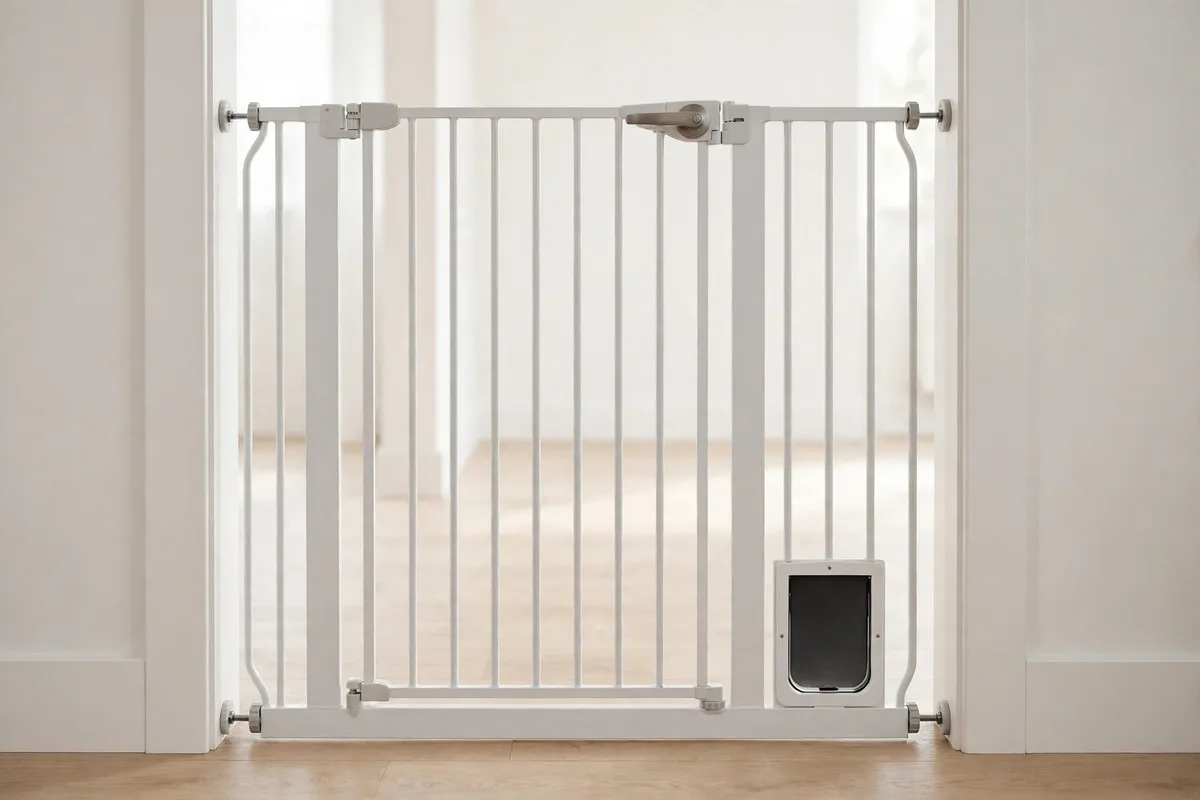
The Carlson Extra Wide is the gate most multi-pet households end up keeping, because it solves the problem the other gates ignore: the animals do not all need the same rule. The main door is a full walk-through panel with a lever-style handle and a one-touch release safety lock, worked with one hand while you carry laundry or a coffee. Set into the bottom is Carlson’s patented small pet door — 10 by 7 inches per the manufacturer — which a cat or very small dog can use freely while the dog you are containing stays on its side of the line.
The frame is all steel, which matters: Carlson rates it as chew-proof, and steel does not flex and squeak the way plastic panels do when a 60-pound dog leans into the middle. It pressure-mounts with four adjustable tension points, so it goes up without drilling, and stands 30 inches tall — enough for most small and medium dogs and for large dogs that are not committed jumpers. Per Carlson’s listings it fits openings from 29 to 38.5 inches with the included extension; further kits are sold separately.
Two honest caveats. First, the fit is not continuous: retailer fit charts for this model describe coverage of roughly 29 to 31 inches bare and 35.5 to 38.5 inches with the extension fitted, so some mid-30s openings need an extra extension piece — measure your doorway and check the chart before ordering. Second, like every pressure-mount gate here, it is a doorway and bottom-of-stairs gate only; friction is not a fastening. Owners praise the latch action and the cat door; the recurring complaint is that the latch needs a firm push to seat fully, so check for the click.
Yay · Pros
- Built-in 10 x 7 inch pet door lets cats pass while the dog stays contained
- All-steel frame is chew-resistant and does not flex under a leaning dog
- One-touch lever handle opens with one hand, full arms or not
- Pressure-mounts in minutes with no holes in the walls
- Fits openings from 29 to 38.5 inches with the included extension (manufacturer figure)
Hmm · Cons
- Fit chart has a gap in the mid-30-inch range that can require an extra extension
- Latch needs a deliberate push to engage — owners advise checking for the click
- Pressure mount only: never for the top of stairs
Best for: households with a dog to contain and a cat to keep free, gating a standard doorway or hallway. Skip if: your opening is at the top of a staircase — you need the hardware-mounted Cardinal below, full stop.
2. Regalo Easy Step Walk Thru Gate — Best value
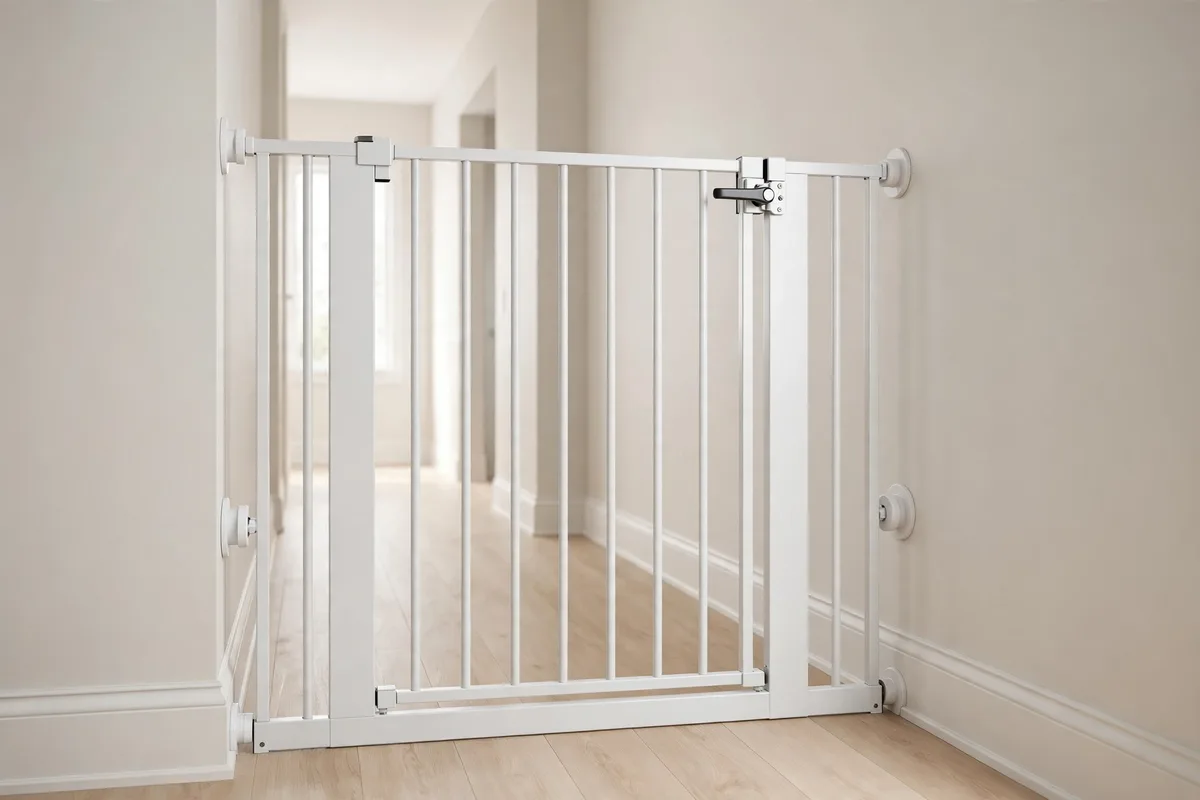
The Easy Step is the gate that defined this category’s value tier, and it stays here because the fundamentals are right. It is all steel, stands 30 inches tall per Regalo’s current listing, and opens with a 16-inch walk-through door worked by a one-touch release lever — no stepping over a panel ten times a day. The bars sit 2 inches apart per the manufacturer, tight enough that small dogs cannot work a head through, and the gate is certified to JPMA and ASTM standards — it began life as a child-safety gate, which is exactly the standard a pet gate should be held to.
Fit is where you need to read Regalo’s own chart rather than the headline. The gate covers openings from 29 to 32 inches on its own, and 35.5 to 38.5 inches with the 6-inch extension in the box; openings between roughly 32 and 35 inches need an additional extension piece sold separately. That gap surprises buyers every year, and it is why this guide keeps repeating one instruction: measure the opening at its narrowest point, then buy to the chart, not to the box’s biggest number.
Regalo includes wall cups and is unusually direct about them: the cups must be used — screwed in for a secure install — or a strong push can walk the gate out of the frame, and the company states plainly that the gate must never be used at the top of stairs. Treat those instructions as part of the product. Installed with its cups in a doorway, hallway or at the bottom of stairs, owners report years of daily use; the common gripes are the narrow 16-inch passage — you will turn slightly sideways with a laundry basket — and the low threshold bar at floor level.
Yay · Pros
- All-steel build certified to JPMA and ASTM safety standards
- One-touch lever and a real walk-through door — no stepping over
- 2-inch bar spacing keeps small dogs from slipping a head through
- Wall cups included for a properly secure pressure install
- Covers 29 to 38.5 inches with the in-box extension (manufacturer figure)
Hmm · Cons
- Openings between about 32 and 35 inches need an extra extension sold separately
- 16-inch walk-through is narrow with arms full; low threshold bar to step over
- Regalo states it must never be used at the top of stairs
Best for: a first gate for a doorway, hallway or bottom of stairs, where certified steel at a value tier matters more than extras. Skip if: your opening falls in the 32 to 35 inch gap and you do not want to buy the extra extension piece.
3. Cardinal Gates Stairway Special SS30 — Best for top of stairs
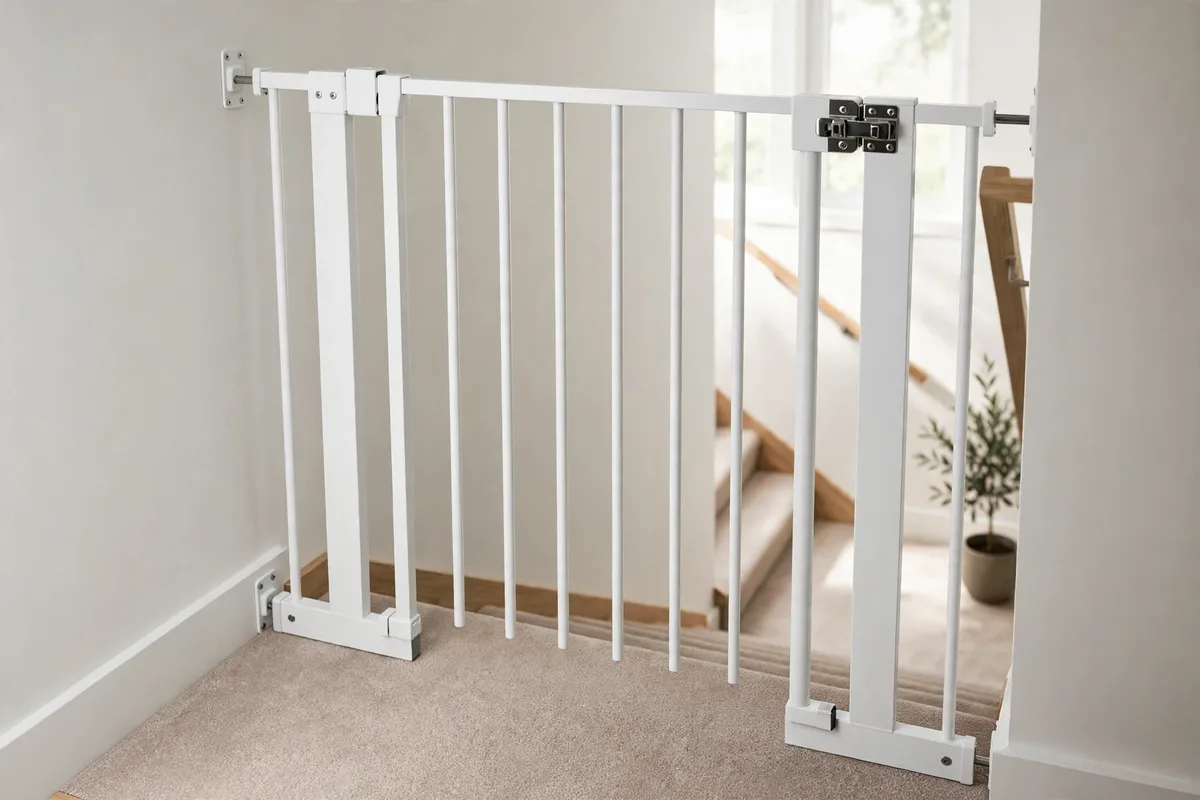
Everything about the Stairway Special starts from one fact: it screws into the wall. Cardinal designed the SS30 as its maximum-safety gate for the top of a stairway, and the hardware mount is the whole point — a gate fastened to studs cannot be pushed out of its opening by a falling body, a charging dog or a toddler hanging off the latch. Independent testers who fit gates for a living single this model out: The Bump’s testing panel chose it as their best gate for stairs, and childproofing professionals quoted there call Cardinal the choice of most pros.
The details reward a careful install. The frame is aluminum — lighter than steel, rustproof, and happy in a humid bathroom doorway or at a cottage — and it fits openings from 27 to 42.5 inches at 29.5 inches tall, with 2.5-inch bar spacing, per Cardinal. The latch baffles small hands while opening one-handed for adults, and there is no bottom threshold bar to trip over at the top of a flight. Two tricks set it apart: it mounts at angles up to 30 degrees, so offset studs and angled banisters stop being deal-breakers, and the included one-way stop bracket prevents the gate swinging out over the stairs.
The trade-offs are the honest cost of doing this properly. Installation is real work — measuring, finding studs, drilling — and testers found it the fiddliest install in its class; banister clamps and width extensions are separate purchases, and it costs more than any pressure-mount gate here. None of that changes the verdict: at the top of stairs the comparison is screwed-in versus friction, and only one of those is a fastening.
Yay · Pros
- Hardware-mounted into studs — the only mount type approved for the top of stairs
- One-way stop bracket stops the gate swinging out over the stairwell
- Mounts at angles up to 30 degrees for offset studs and awkward banisters
- No threshold bar to trip on; aluminum frame is light and rustproof
- Fits 27 to 42.5 inches, JPMA certified (manufacturer figures)
Hmm · Cons
- Slowest, most involved install in this guide — drilling into studs required
- Banister clamps and width extensions are separate purchases
- Premium price tier; overkill for a simple room-to-room doorway
Best for: the top of any staircase, and any doorway where a determined large dog makes friction mounting a gamble. Skip if: you rent and cannot drill, and the spot is an ordinary doorway — a pressure-mount pick above will serve you there.
4. MYPET Paws Portable Pet Gate — Best portable pressure-mount
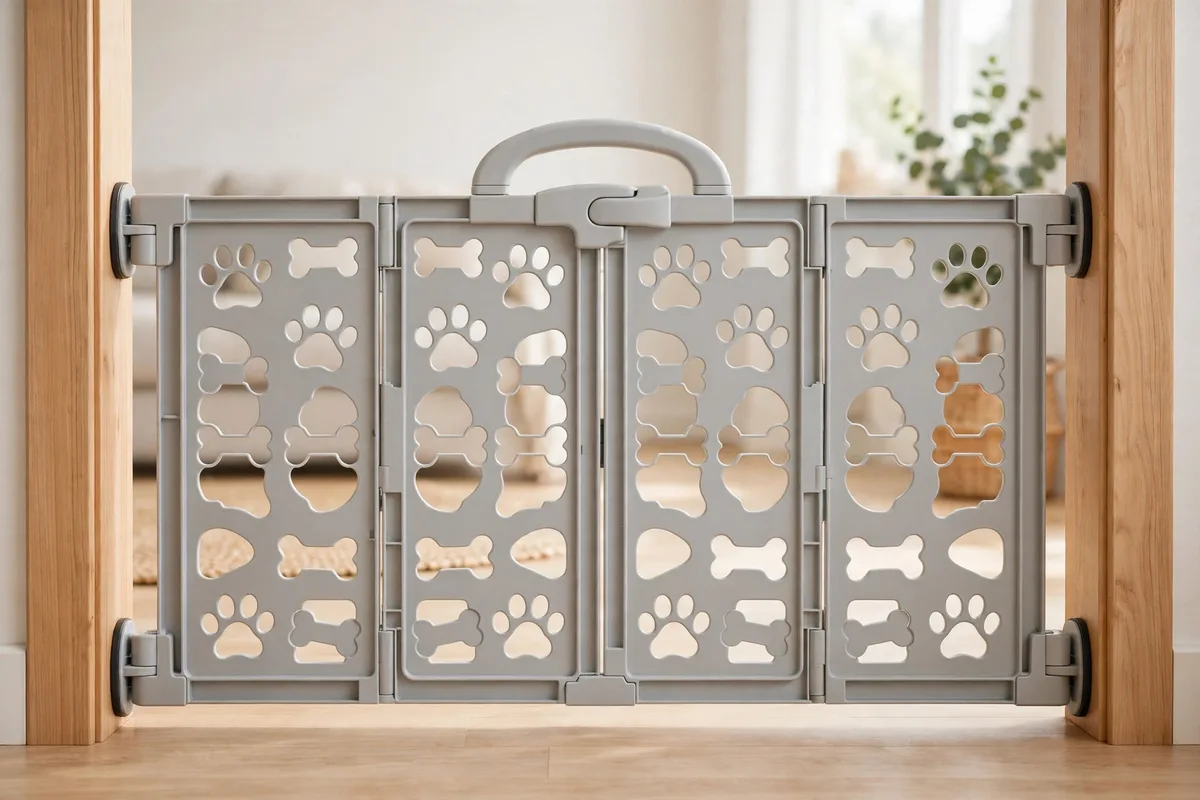
Not every barrier needs to live in one doorway forever. The Paws Portable, from North States’ MYPET line, is a single expanding panel: set it in the opening, slide the two panels along what North States calls the EZ Track until they meet the frame, and push the curved handle down to lock the tension. That is the entire installation. It fits openings from 26 to 40 inches, stands 23 inches tall, weighs about 5 pounds, and when the visit is over it lifts out and leans in a closet.
The small engineering touches suit real houses. The rubber bumpers sit higher than on most panels, positioned to clear baseboard moulding up to 4 inches tall per North States, so the gate grips the wall instead of rocking on the trim — the quiet reason many cheap panels never feel secure. The fieldstone-grey plastic carries a paw-print pattern and rounded edges, with no bars at all: a kind visual barrier for puppies and small dogs learning boundaries. North States makes it in the USA and sells replacement slides and parts by model number if the mechanism ever wears.
Be clear about what it is not. At 23 inches it is a step-over or lift-out panel with no walk-through door, and that height suits small to medium dogs that respect a visual boundary — an athletic jumper will treat it as a hurdle, and a big dog leaning hard is asking a lot of a plastic pressure panel. North States is explicit that pressure-mounted gates do not belong at the top of stairs. Used as intended — a movable, occasional barrier for a small pet, a puppy room, a rental or a grandparent’s house — it is the most convenient gate in this guide, and for senior dogs it pairs naturally with the best pet stairs and ramps in Canada and the USA when the real problem is mobility rather than mischief.
Yay · Pros
- Installs in seconds with no tools and moves between rooms just as fast
- Bumpers are raised to clear baseboards up to 4 inches high (manufacturer figure)
- Light at about 5 pounds; stores flat against a wall or in a closet
- Solid panel has no bars for a small head or paw to get caught in
- Made in the USA, with replacement parts sold by model number
Hmm · Cons
- 23-inch height will not stop a jumper or a tall, determined dog
- No walk-through door — you step over it or lift it out
- Plastic panel flexes more than the steel gates under a heavy lean
Best for: temporary, movable barriers for small dogs and puppies — rentals, visitors, cleaning days and multi-room use. Skip if: you cross this doorway twenty times a day; a walk-through gate will save your temper within a week.
5. Evenflo Position & Lock Baby Gate — Best ultra-budget for small pets
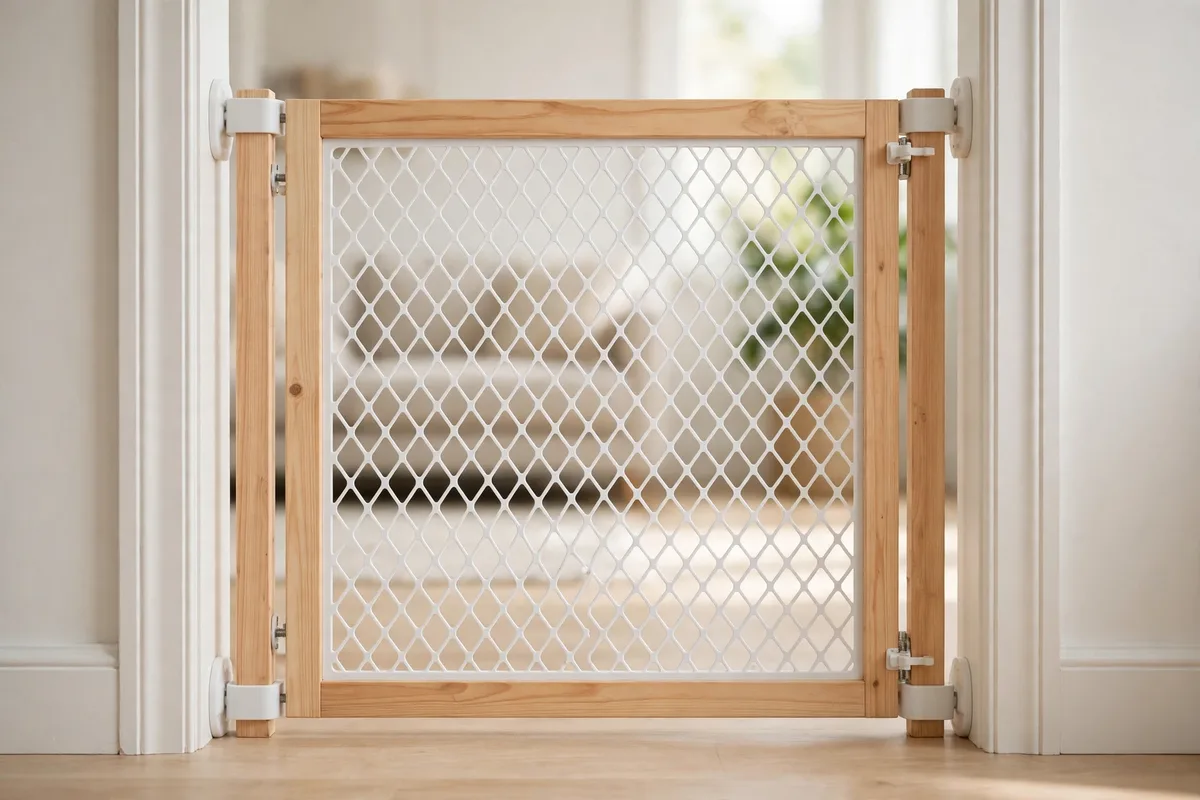
A fairness note first: this is a baby gate, included deliberately and labelled honestly. Evenflo’s own product page lists ‘Pet’ among the Position & Lock’s use cases, and for one specific job — keeping a small, calm dog or a cat out of one room, cheaply and temporarily — it remains the ultra-budget benchmark. The design has barely changed in decades: a wood frame, a lightweight plastic mesh panel, and a notched locking bar you lift, slide to width and press down to tension the gate into the opening.
The published figures: it fits openings from 26 to 42 inches — the widest base range in this guide — stands 23 inches tall, and weighs just 3 pounds, the lightest gate here. The locking bar is marked and notched, so reinstalling it in the same doorway lands on the same notch every time, and the mesh wipes clean. There is no walk-through door and no steel anywhere; you lift the whole panel out or step over it, and the mesh is a visual barrier, not a chew barrier.
So the boundaries of this pick matter. It suits small, settled pets in low-traffic doorways — a senior dog that should not do the basement stairs, a cat kept out of one room, a puppy behind a bathroom door for an afternoon. It does not suit a chewer, a jumper, a strong dog that tests barriers, or any spot above stairs. Owners split the way ultra-budget products always split people: many use one for years without drama, others find the locking tab stiff and the fit finicky in uneven frames. At this tier that is a reasonable trade — as long as the pet behind it is the easygoing kind, ideally one that spends its gated hours settled on one of the best dog beds in Canada and the USA.
Yay · Pros
- Lowest price tier in this guide by a wide margin
- Widest base fit range here: 26 to 42 inches (manufacturer figure)
- Featherweight 3-pound panel; notched bar makes reinstallation repeatable
- Wood frame and mesh look softer in a living space than steel bars
- Evenflo lists pet containment among its intended uses
Hmm · Cons
- No walk-through door — lift it out or step over, every time
- Plastic mesh is not chew-proof and the panel is only 23 inches tall
- Locking tab can feel stiff; fit is finicky in out-of-square frames
Best for: small, calm pets in a low-traffic doorway, where the barrier is a polite suggestion rather than a security measure. Skip if: your dog chews, jumps, or leans on barriers — step up to the steel Carlson or Regalo instead.
Pressure-mount vs hardware-mount: the one rule that is not negotiable
Every gate in this guide holds itself in place one of two ways. A pressure-mounted gate is a spring fight: rubber bumpers press outward against the door frame, and friction does all the work. A hardware-mounted gate is screwed into studs or solid framing, and the fasteners do the work. At the top of a staircase that difference is the difference between a barrier and a suggestion, because a pressure gate hit by a falling body — a toddler, a person carrying laundry, a large dog at speed — can pop out of its opening exactly when it is needed most.
This is not reviewer opinion; it is the settled position of the safety authorities on both sides of the border. The US Consumer Product Safety Commission’s childproofing guidance says to use only gates that screw to the wall at the top of stairs, and the federal standard for gates and enclosures builds on the ASTM F1004 specification. Canadian guidance says the same in plainer language: Child Safety Link, the Nova Scotia children’s hospital safety programme, instructs families to use a hardware-mounted gate at the top of stairs, never a pressure-mounted one, swinging open over the floor, not out over the steps.
The rule has a second half that gets less attention: pressure-mount gates are genuinely fine where a failure is an inconvenience rather than a fall. Between rooms on the same floor, in a kitchen doorway, at the bottom of a staircase — here friction mounting is a rational choice, and it is why three of our five picks use it. Location, not price, should pick your mount.
Hardware mounting done badly is its own hazard, so three details matter. First, screws must land in a stud or solid wood — a gate anchored only in drywall is a pressure gate with extra steps. Second, at the top of stairs the gate must not swing out over the drop; use the one-way stop bracket hardware gates include, as the Cardinal does. Third, banisters and angled walls need the maker’s clamp kits rather than improvisation — the Cardinal’s 30-degree angled mounting exists because real staircases are rarely square.
A final distinction: pet gates and child gates are not interchangeable in the eyes of the CPSC, which says a pet gate should never be used as a child safety gate. Several picks here — the Regalo, the Cardinal, the Evenflo — are JPMA-certified child gates that also serve pets, the strongest combination. If a toddler also lives in the house, gate child-critical spots — especially stairs — with a certified hardware-mounted child gate.
Height, bar spacing and the tape measure: sizing a gate to your dog
Gate shopping goes wrong at the tape measure more often than at the checkout. Measure the opening at its narrowest point — usually at the baseboards, not at eye level — and write the number down before you look at a single product. Then read fit ranges the way manufacturers actually build them: many gates cover two separate bands, one bare and one with an extension, with a dead zone between them. ‘Fits up to 38.5 inches’ on a box tells you nothing about a 34-inch doorway — both the Carlson and the Regalo here have exactly that dead zone.
Height is a question about your dog’s ambitions, not its size. A gate contains a dog that accepts barriers; it merely slows a dog that tests them. As a working rule, a gate should stand at least a few inches above the dog’s shoulder for a calm adult, and committed jumpers need a different conversation entirely — extra-tall gates exist at 36 inches and beyond. The 30-inch steel gates here suit most small and medium dogs and non-jumping large breeds; the 23-inch panels are for small, settled pets only, and every seller of them says so.
Bar spacing is the quiet spec that decides whether a gate works for small animals. Vertical bars 2 to 2.5 inches apart — the range across this guide’s steel gates — keep small dogs from pushing a head through and getting stuck; horizontal rails, by contrast, are a ladder for climbers. Mesh and solid panels remove the question entirely, at the cost of chew resistance. Cats rewrite the whole calculation: most clear 30 inches without effort, so a standard gate contains the dog and inconveniences the cat only if there is a pet door in it — the Carlson’s 10 by 7 inch door is the one built-in answer here.
Finally, think about the humans. A walk-through door with a one-hand latch is not a luxury on a doorway you cross thirty times a day; within a month, a lift-out panel in a busy doorway becomes a panel leaning against the wall, guarding nothing. Match the gate to the traffic: walk-through steel for the kitchen door, a movable panel for the guest room, screwed-in aluminum for the stairs.
Pet gate questions, answered
Can I put a pressure-mounted gate at the top of the stairs?
No — the one non-negotiable rule in the category. US CPSC guidance and Canadian hospital safety guidance both say only a gate that screws into the wall belongs at the top of stairs, because a pressure gate can be knocked out of its opening by a fall against it. Use a hardware-mounted gate there, with its one-way stop fitted so it cannot swing out over the steps.
How tall should a pet gate be for my dog?
Tall enough that your dog treats it as a wall rather than a hurdle: for a calm adult dog, a gate standing a few inches above shoulder height — typically the 30-inch steel gates in this guide — is enough. Committed jumpers need extra-tall models or a different plan altogether, and the 23-inch panels here are only for small, settled pets that respect a visual boundary.
How do I measure my doorway for a pet gate?
Measure the opening at its narrowest point, usually down at the baseboards, and buy to the manufacturer’s fit chart rather than the headline maximum. Many gates fit two separate width bands — bare, and with an extension — with a gap between them; both the Carlson and Regalo picks have a dead zone in the mid-30-inch range that needs an extra extension piece.
Will a pet gate keep my cat in — or out?
Mostly, it will not: a healthy cat can clear a 30-inch gate, so gates manage dogs far better than cats. If the goal is the opposite — dog contained, cat free — choose a gate with a built-in pet door like the Carlson’s 10 by 7 inch panel, which lets the cat keep its routes while the dog stays put.
Are pet gates safe to use as baby gates?
Not automatically, and the CPSC says a pet gate should never be substituted for a child safety gate. If children are part of the picture, choose gates certified to JPMA/ASTM child standards — the Regalo, Cardinal and Evenflo picks here are child gates that also work for pets — and use hardware mounting wherever a fall is possible.
What if my doorway has baseboards or a banister in the way?
Baseboards are the common one: look for gates whose bumpers sit high enough to clear the trim, like the MYPET panel rated for moulding up to 4 inches, or use the maker’s spacer kits. For banisters, hardware gates such as the Cardinal offer clamp kits that fasten to the post without drilling into it — use the manufacturer’s kit rather than improvising.
The short version
Buy the Carlson Extra Wide for an everyday doorway — steel, one-hand latch, and a pet door that keeps the cat free — or the Regalo Easy Step for the same job at a value tier. At the top of stairs, only the hardware-mounted Cardinal Stairway Special belongs. The MYPET Paws Portable is the movable panel for temporary barriers, and the Evenflo Position & Lock covers small, calm pets at the lowest tier. Pair the gate with the best dog crates in Canada and the USA and the best dog beds in Canada and the USA for the rest of the routine.
Sources
This guide is research-based: we compared manufacturer specifications with the independent testing and reporting below, cross-checked against verified owner reports in Canada and the USA. Specs are the manufacturers’ published figures; where testers disagree with a maker’s claim, the review says so.
- Child Safety Link — The Do’s and Don’ts of Baby Gates — Canadian hospital safety guidance: hardware-mounted gates only at the top of stairs.
- The Bump — Best Baby Gates for Stairs and Doorways, Tested — Hands-on testing with child-safety experts; chose the Cardinal SS30 as best for stairs.
- ReviewsByPeople — Best Baby Gates 2026 specification comparison — Side-by-side maker specs for the Regalo Easy Step and Cardinal Stairway Special.
- North States — MYPET Paws Portable Petgate (manufacturer) — Maker’s page: 26 to 40 inch fit, 23 inch height, bumpers for moulding up to 4 inches.
- Evenflo — Position & Lock Baby Gate (manufacturer) — Maker’s specs and use cases, which explicitly include pets: 26 to 42 inch fit, 23 inches tall.
- Petco — Carlson Extra Wide Walk-Thru Pet Gate listing — Manufacturer-supplied Carlson specs: 29 to 38.5 inch fit, 30 inches tall, 10 x 7 inch pet door.
Last updated: November 20, 2026. We refresh this guide each season and whenever a pick is replaced by a better one.