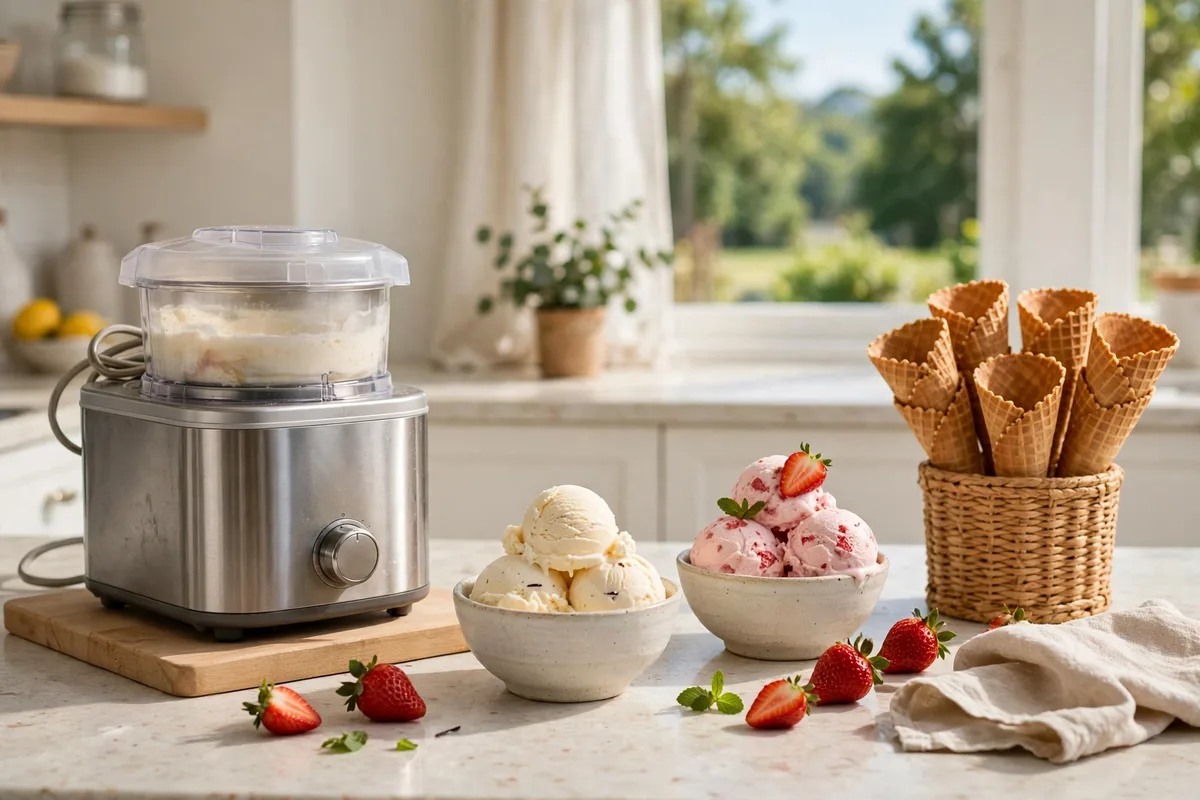
The best ice cream maker for most households is a choice between two rhythms: a compressor machine like the Cuisinart ICE-100, which freezes on demand with no pre-frozen bowl, or a freezer-bowl classic like the Cuisinart ICE-21, which costs a fraction as much and asks only for 24 hours of freezer patience. Both make ice cream better than the mid-tier grocery tub; they differ in spontaneity, not in ceiling. This guide ranks both classes, plus the attachment that turns a stand mixer into the third answer.
Texture is the whole game — small ice crystals, the right amount of whipped air, a clean scrape from the bowl wall — and each pick was judged on the dasher and freezing engineering that decides it, with batch sizes in honest quarts. If your frozen-treat life runs through the pint-and-mix-in style instead, our the Ninja Creami guide for Canada and the USA guide covers that processor class; for the blended frozen drinks of summer, the best frozen drink makers in Canada and the USA guide is the one; and the best stand mixer attachments in Canada and the USA guide supplies the mixer the attachment pick bolts onto.
Disclosure: CookSmartPicks is reader-supported. When you buy through links on this page, we may earn an Amazon commission at no extra cost to you. Prices and availability change often — check the current price on Amazon before you decide.
How we chose these ice cream makers
The shortlist was built by class, because the classes serve different households: compressor machines (no pre-freezing, back-to-back batches), freezer-bowl machines (value, one freeze per session), and the stand-mixer attachment (no new appliance). Within each class we compared batch capacity in quarts, churn time from maker specifications, and the dasher design — a scraper that rides the bowl wall closely freezes smoother ice cream than one that leaves a shell — because that unglamorous detail decides texture more than any feature list.
Ownership screens followed: bowl and canister dishwasher behaviour, the freezer footprint a bowl demands permanently, noise (a 40-minute churn is a roommate), and Canadian availability with warranty channels. Two novelty countertop machines with toy-grade dashers were cut; ice cream is a texture product, and a weak dasher cannot be reviewed around. Every pick below makes genuinely good ice cream — the guide’s job is matching the class to your rhythm.
The lineup at a glance
| Product | Best for | Why it stands out |
|---|---|---|
| Cuisinart ICE-100 Compressor Ice Cream & Gelato Maker (1.5-Qt) | Best overall (compressor) | The on-demand machine: 1.5 quarts, gelato mode, no freezer bowl to plan around |
| Whynter ICM-200LS Compressor Ice Cream Maker (2-Qt, Stainless) | Best large capacity | The big-batch compressor: 2 full quarts with a removable stainless canister |
| Cuisinart ICE-21 Frozen Yogurt, Sorbet & Ice Cream Maker (1.5-Qt) | Best value (freezer bowl) | The value legend: 1.5 quarts in 20 minutes from a pre-frozen bowl |
| KitchenAid Ice Cream Maker Attachment (2-Qt Freezer Bowl) | Best for mixer owners | The attachment answer: 2-quart churns powered by the mixer you own |
| Breville Smart Scoop Compressor Ice Cream Maker (1.5-Qt) | Best premium | The smart flagship: it feels the ice cream set, then holds it at serving texture |
1. Cuisinart ICE-100 Compressor Ice Cream & Gelato Maker (1.5-Qt) — Best overall (compressor)
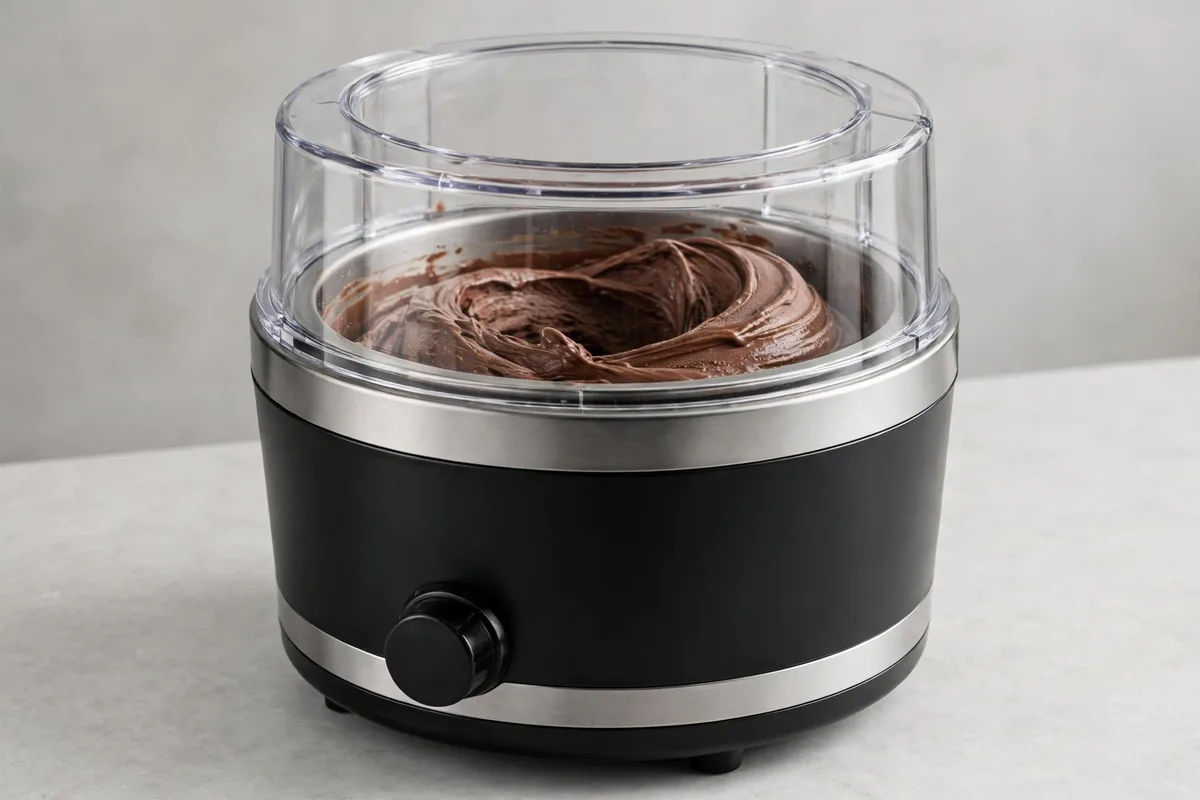
The ICE-100 is the compressor class distilled: a self-freezing unit with a 1.5-quart capacity that takes a chilled base to soft-serve in about 40 minutes and to firm ice cream shortly after, with no bowl to pre-freeze and nothing stopping a second batch for the sorbet course. A dedicated gelato paddle and speed are included — gelato wants slower churning and less air — which makes this the rare home machine that does both styles deliberately rather than accidentally. The transparent lid lets you watch the set and time mix-ins properly.
In use, its virtues are rhythm and repeatability: the same base produces the same result on Tuesday as on Saturday, the countdown is honest, and the canister and paddles wash easily. Cuisinart rates the compressor for continuous back-to-back use, and owner reports from years of service describe exactly the appliance this guide wants to recommend — the one that turns ice cream from a project into a habit. It is not silent (a compressor hums), and it earns permanent counter space or a low shelf, because nobody hauls it from a high cupboard weekly.
Canadian availability and service run through Cuisinart’s normal channels. Priced as a real appliance, it justifies itself the way the guide measures everything: cost per use across years of summers. For the household that will genuinely churn monthly, this is the correct first purchase and likely the last.
The ICE-100’s see-through lid teaches timing better than any manual: watching the base climb the dasher and pull away from the walls is how owners learn the exact minute mix-ins belong, a skill that transfers to every machine they will ever own.
Yay · Pros
- No pre-freezing — ice cream on demand
- Dedicated gelato paddle and speed
- Back-to-back batches; repeatable results
Hmm · Cons
- Counter footprint and price of a real appliance
- Compressor hum during the cycle
- Heavier than bowl machines — it lives where it lands
Best for: Most households that will actually make ice cream monthly or more Skip if: Ice cream is a twice-a-summer event — the ICE-21 below serves it for far less
2. Whynter ICM-200LS Compressor Ice Cream Maker (2-Qt, Stainless) — Best large capacity
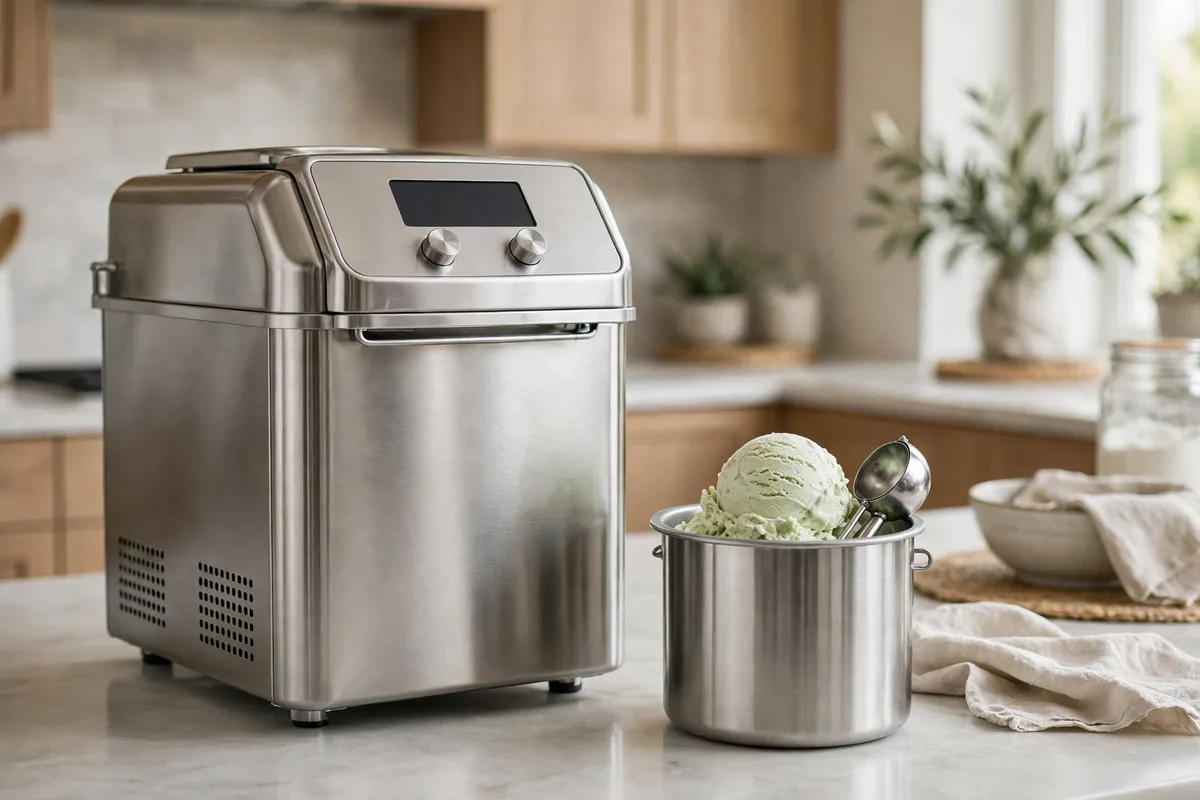
The Whynter ICM-200LS is the compressor class scaled up: a 2-quart stainless unit with a built-in freezer, an LCD timer, and a motor strong enough to churn dense, low-overrun bases without straining — the batch size that covers a birthday party in one run instead of two. Its removable stainless canister and churn blade lift out for washing and serving, a design detail owners praise because the alternative (washing inside a compressor cabinet) is nobody’s favourite chore.
Performance is the point: the Whynter’s compressor freezes a full 2-quart load evenly, where lesser compressors leave the centre soft, and the timer’s reliability means the machine can be trusted unattended through its cycle. It also carries a yogurt function in its feature set — a genuine second job most rivals lack. The footprint and weight are the honest costs: this is a counter-resident appliance, sized like a bread machine and twice as dense.
In Canada it sells through appliance and online retail at a premium over the Cuisinart. For the household that churns for gatherings, or the enthusiast who wants the largest home batches without a commercial machine, the Whynter is the class leader — the pick whose capacity number is the whole argument.
The Whynter’s removable canister changes the serving ritual: the whole batch travels to the table in its own chilled vessel, which keeps second helpings at texture while the conversation runs — a small theatre with a real thermal argument.
Yay · Pros
- Full 2-quart batches — party scale
- Strong motor for dense, low-overrun bases
- Removable canister washes at the sink
Hmm · Cons
- Largest and heaviest pick here
- Premium price
- Stainless exterior shows fingerprints
Best for: Big families and batch-makers who churn for a crowd Skip if: Counter space is scarce — this is the biggest machine here
3. Cuisinart ICE-21 Frozen Yogurt, Sorbet & Ice Cream Maker (1.5-Qt) — Best value (freezer bowl)
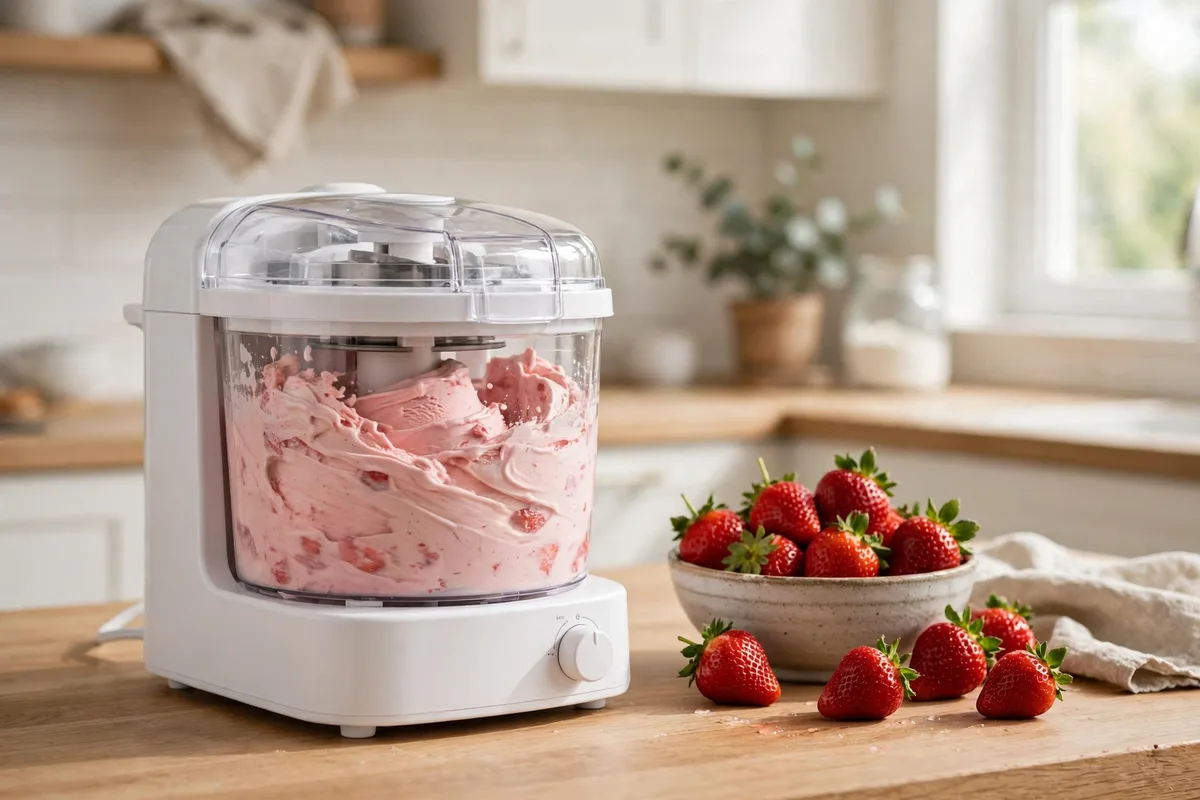
The ICE-21 is the freezer-bowl machine that defined the class for a generation: a compact unit whose double-insulated bowl freezes solid in the freezer, then churns 1.5 quarts in about 20 minutes with a dasher that scrapes honestly and a wide ingredient spout that takes mix-ins without dismantling anything. The results, from a properly frozen bowl and a properly chilled base, are genuinely excellent — smooth, dense enough, and indistinguishable in blind tasting from machines several times its price, which is why it remains the value benchmark of the entire category.
The terms are the class’s terms, stated plainly: the bowl lives in your freezer permanently (about the footprint of a large mixing bowl), each session needs the full freeze first, and a second batch waits for tomorrow. Households with freezer space and a weekly rhythm — freeze the bowl Sunday, churn Monday — never feel the constraint; spontaneous households feel it exactly once and then understand the compressor’s price.
Canadian availability is universal and the price is routinely the cost of a few premium grocery tubs. As a first ice cream maker — the experiment that decides whether your household is an ice-cream household — nothing else in the guide makes the case this cheaply or this well.
The ICE-21’s bowl has an afterlife in summer kitchens as the coldest mixing bowl in the house — pasta salads and whipped cream both benefit from a vessel that spent the night in the freezer, whether or not ice cream is on the day’s plan.
Yay · Pros
- Excellent texture at a fraction of compressor prices
- Compact; simple; huge owner base
- Wide spout for mix-ins mid-churn
Hmm · Cons
- One batch per 24-hour freeze
- Bowl claims permanent freezer space
- Lighter dasher than the compressor class
Best for: Budget households and first-time ice cream makers Skip if: Your freezer has no spare bowl-sized space, permanently
4. KitchenAid Ice Cream Maker Attachment (2-Qt Freezer Bowl) — Best for mixer owners
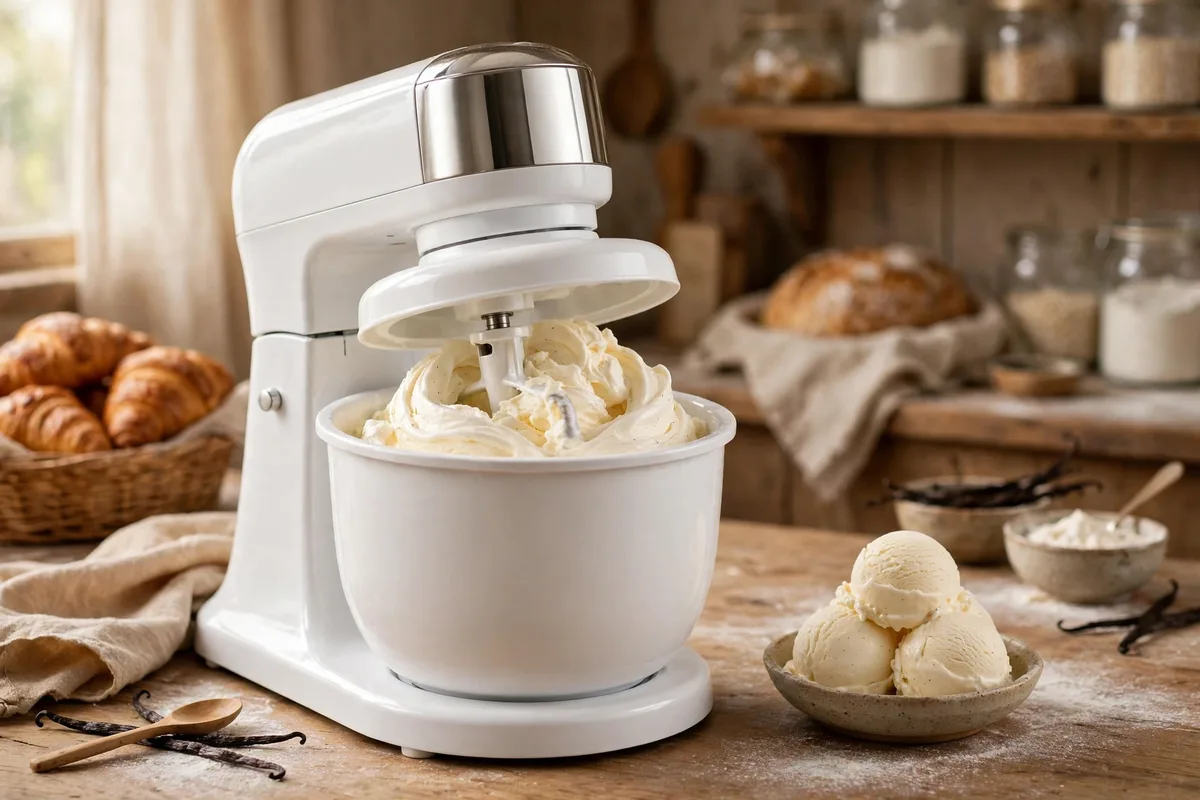
The KitchenAid attachment is the no-new-appliance answer: a 2-quart freezer bowl and dasher that lock onto the mixer’s hub and bowl-lift or tilt-head stand, using the motor already on your counter to churn. For mixer households it is the most storage-efficient route to real ice cream — the bowl lives in the freezer, the dasher in a drawer, and no third appliance ever asks for counter rent. KitchenAid rates it for up to 2 quarts of soft ice cream per batch, firmed afterwards in the freezer as with all home churns.
Performance follows the class physics: from a fully frozen bowl (the full 24 hours — the attachment’s bowl is not exempt from the rule), it produces smooth, well-scraped results, with the mixer’s low speeds suiting gelato-style bases nicely. The fit caveat is real and stated in our mixer-attachments guide as well: confirm compatibility with your exact model, particularly older and smaller tilt-heads, before ordering — the drive adapter differs across generations.
Canadian availability runs through KitchenAid’s normal channels. For the household whose mixer already anchors the counter — the same household our [[3]] guide serves — this attachment completes the frozen-dessert picture at the lowest total footprint in the guide.
The KitchenAid bowl’s 2-quart rating assumes soft-serve consistency at the dasher’s stop; owners who like a firmer scoop churn, then give the batch an hour in the freezer in a shallow pan — the two-stage finish every home class quietly relies on.
Yay · Pros
- No new appliance — uses your mixer’s motor
- 2-quart batches; stores in freezer and drawer
- Lowest total footprint in the guide
Hmm · Cons
- Bowl needs the same 24-hour freeze
- Fit check required for smaller tilt-head models
- Dasher drive fit varies by mixer generation
Best for: Stand-mixer households that refuse a new appliance Skip if: You do not own a compatible KitchenAid mixer
5. Breville Smart Scoop Compressor Ice Cream Maker (1.5-Qt) — Best premium
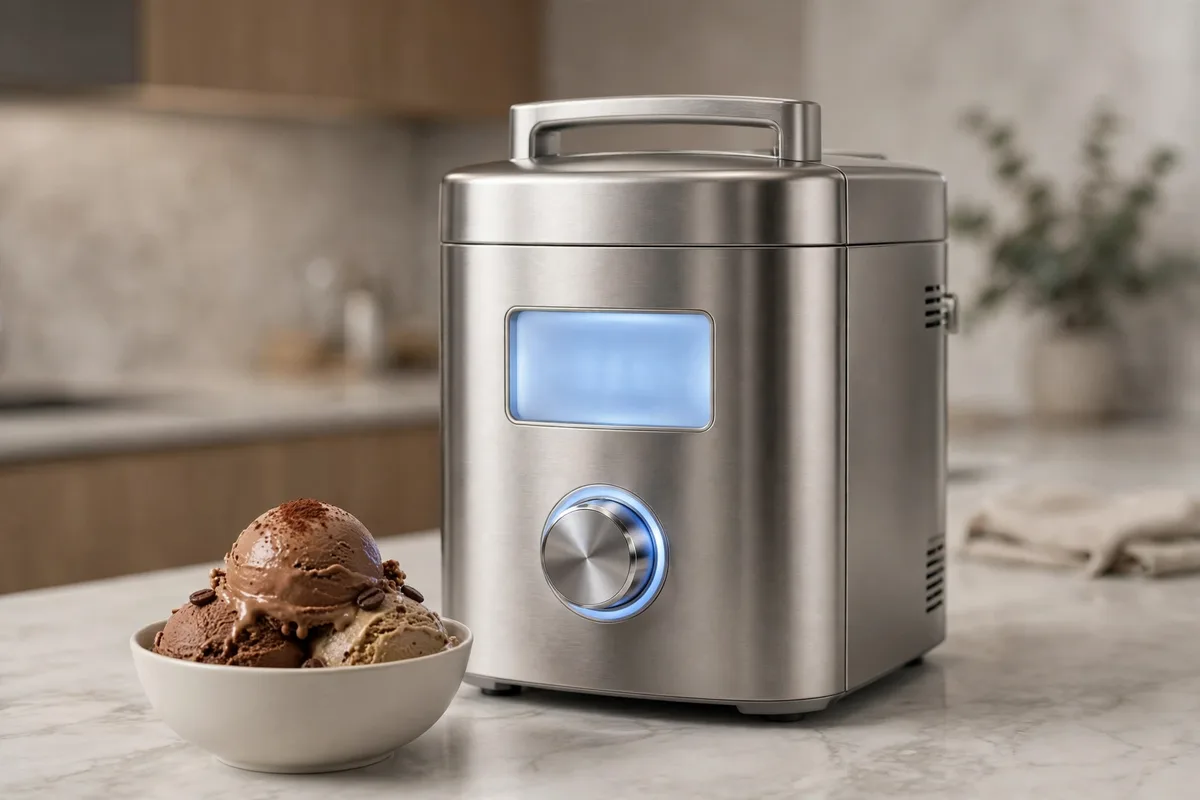
The Smart Scoop is the enthusiast’s compressor: a 1.5-quart self-freezing machine that senses the mixture’s hardness as it churns and adjusts accordingly, with settings from sorbet through gelato to frozen yogurt and ice cream, and a keep-cool function that holds the finished batch at serving texture for up to three hours — the feature hosts did not know they needed until a dinner party’s dessert waited, perfectly, through the main course. It even plays music when the batch is done, a whimsy owners either adore or mute forever.
Beneath the theatre, the engineering is serious: the compressor is strong, the churn consistent, and the hardness sensing produces repeatable textures across bases of different sugar and fat content, where timer-only machines drift. The pre-cool function chills the bowl before the base goes in, shaving minutes and crystal size. Everything about it is the category’s ceiling — including, honestly, the price and the counter footprint.
Breville’s Canadian presence (the Sage brand’s sibling) makes it a supported purchase. For the household that makes ice cream as a hobby — tweaking bases, comparing overruns, serving courses — the Smart Scoop is the machine that participates in the hobby with you, and the guide’s unapologetic flagship.
The Smart Scoop’s keep-cool hold has a second audience: households with staggered dessert times — children at seven, adults at ten — where one batch held at texture replaces the freezer-tempering dance entirely.
Yay · Pros
- Hardness sensing for repeatable texture
- Keep-cool holds dessert up to 3 hours
- Pre-cool function; sorbet-to-gelato settings
Hmm · Cons
- Highest price in the guide
- Large footprint; premium in every dimension
- Features outnumber most households’ needs
Best for: Enthusiasts who want hardness control and a keep-cool hold Skip if: Your needs end at good vanilla monthly — the ICE-100 covers them for less
Overrun, dasher speed and the 24-hour freeze: what actually makes ice cream good
Ice cream texture is decided by three variables, and only one of them is the recipe. The first is freezing speed: the faster the base freezes, the smaller the ice crystals, and the smoother the result — which is why compressor machines and fully-frozen bowls (a full 24 hours in a 0°F / −18°C freezer, not the overnight minimum the box suggests) outperform impatient ones. The second is overrun — the air the dasher whips in. Commercial premium ice cream runs low overrun (dense, rich); cheap machines whip more air (light, fluffy, faster-melting). Neither is wrong, but the style you love decides the machine class that makes it.
The third variable is the dasher’s scrape: a blade that rides close to the bowl’s wall keeps the freezing layer moving into the mix, while a lazy gap leaves a hard shell building on the wall and a soupy centre. This is the unglamorous engineering difference between the picks above and the bargain bin — in the hand, it reads as ‘this one just works better,’ and it is why the same base recipe produces different ice cream in different machines.
Base temperature discipline beats recipe tweaking: a base chilled overnight (and ideally aged — the proteins hydrate and the texture improves measurably) freezes faster and smoother than a warm one in any machine. Cook custard bases to 170–175°F, chill them fully, and add mix-ins in the last five minutes of churning. Alcohol, the home maker’s secret weapon, lowers the freezing point for scoopable-from-the-freezer results — a tablespoon of vodka per quart is flavourless insurance; liqueurs pull double duty.
Storage is the final texture battleground: homemade ice cream hardens brick-like in a home freezer because it lacks commercial stabilizers. The fixes are a shallow container (more surface, faster tempering), a press of parchment on the surface against ice crystals, and ten minutes on the counter before scooping. Eat it within two weeks — homemade ice cream is a fresh food pretending to be a frozen one, and its peak is days, not months.
And the honest class summary: buy the compressor if ice cream is a weekly practice or a household of enthusiasts; buy the freezer bowl if it is a monthly pleasure and your freezer has the space; buy the attachment if the mixer already anchors your counter. All three classes make ice cream genuinely better than the mid-tier grocery tub — the difference is rhythm, not ceiling.
A note on sugar, because it is the home maker’s texture lever: sugar depresses the freezing point, so a base’s sweetness literally sets how hard the finished ice cream freezes — too little and it sets brick-hard, too much and it never firms. When a batch disappoints, adjust the sugar by a tablespoon per quart before blaming the machine; the machine is almost never the variable that changed.
Ice cream maker questions, answered
What is the difference between compressor and freezer-bowl ice cream makers?
Compressor machines have a built-in freezer: no pre-freezing, back-to-back batches, ice cream in about an hour from a chilled base. Freezer-bowl machines cost far less but need the bowl frozen solid — a full 24 hours at 0°F (−18°C) — before each session, and one batch per freeze. Choose the compressor for frequency and spontrums; the bowl for value and occasional use.
How much ice cream does each machine make per batch?
The ICE-100 and Smart Scoop make about 1.5 quarts per batch; the Whynter makes 2 quarts; the ICE-21 and the KitchenAid attachment make about 1.5 to 2 quarts depending on the base’s expansion. A quart serves four modest scoops, so a 1.5-quart batch covers a family dessert with a little left to freeze.
How long does a freezer bowl really need to freeze?
A full 24 hours in a freezer set to 0°F (−18°C) is the honest answer — the 12-to-16-hour figures in some manuals assume a very cold, stable freezer. The bowl is ready when you cannot hear liquid sloshing when you shake it. Warm kitchens and frequently opened freezers stretch the time; a dedicated spot at the back of the freezer is the reliable setup.
Can these machines make sorbet and frozen yogurt too?
Yes — all five picks churn sorbet (often their best trick, since sorbet’s texture loves a fast freeze), frozen yogurt, and gelato-style bases; the compressor models add dedicated gelato modes or slower dasher speeds for denser results. Non-dairy bases work in every class; coconut-milk bases freeze slightly softer and benefit from the counter-tempering tip in our deep-dive.
Is the Ninja Creami a real ice cream maker?
It makes a different product: soft-frozen desserts from frozen ingredients, with a distinctive dense-chewy texture, but it does not churn a liquid base into traditional ice cream. Households that want classic custard ice cream, sorbet from fresh fruit juice, or gelato need a churner from this guide; households that love the Creami’s protein pints and mix-in style are already served — the two are complements in many kitchens.
Why does homemade ice cream get so hard in the freezer?
Homemade ice cream lacks commercial stabilizers, so it freezes harder and forms crystals over time. Store it in a shallow container with parchment pressed on the surface, eat within about two weeks, and temper it on the counter for ten minutes before scooping. A tablespoon of alcohol per quart of base keeps it noticeably more scoopable straight from the freezer.
One more class of honesty belongs in this guide: the cost per pint. A compressor machine amortized across five summers of weekly churning produces ice cream at ingredient cost — cream, eggs, sugar, flavour — which undercuts premium grocery pints decisively and merely matches the mid-tier tubs. The freezer-bowl class reaches the same ingredient maths almost immediately. What neither class can match is the supermarket’s convenience at 9 p.m. in February, which is why the honest recommendation remains rhythm-based: buy the class your household’s actual summer will use, and the economics — like the texture — take care of themselves.
A word for the second-hand market, where this category quietly shines: compressor machines and quality bowl units appear regularly at estate sales and marketplace listings at a third of retail, because they are bought aspirationally and used seasonally. Inspect a used compressor the way you would a fridge — it should run cold and quiet within minutes — and a used freezer bowl for cracks at the rim. Bought well, the enthusiast tier becomes a value-tier purchase.
The short version
Buy the Cuisinart ICE-100 for on-demand ice cream without the freezer-bowl ritual, or the Whynter if your batches feed a crowd. The ICE-21 is the unbeatable value if your freezer can house its bowl, the KitchenAid attachment is the answer for mixer households, and the Breville Smart Scoop is the enthusiast flagship. Whichever class you choose: chill the base overnight and freeze the bowl a full 24 hours — technique beats machinery.
Last updated: November 18, 2026. We refresh this guide each season and whenever a pick is replaced by a better one.