A stand mixer’s most underused feature is the round cap on its nose. Behind it sits a power hub that turns one motor into a pasta maker, a meat grinder, an ice cream churn and a precision scale — and the best stand mixer attachments are how a mixer bought for birthday cakes becomes the hardest-working tool in the kitchen. Our guide to the best stand mixers in Canada and the USA covers the mixers themselves; this one assumes you own one (most likely a KitchenAid — the ecosystem this guide covers, because its hub is the industry’s de facto standard) and asks what deserves to plug into it.
The five picks below are ordered the way households actually expand: pasta first, because fresh pasta is the attachment miracle people write home about; grinding second; then the specialty tools. Each review separates the metal from the plastic honestly — in attachments, construction material is not a detail, it is the difference between a decade of service and a cracked housing — and each is labelled with who should skip it, because an attachment in a drawer is worse than no attachment at all.
Disclosure: CookSmartPicks is reader-supported. When you buy through links on this page, we may earn an Amazon commission at no extra cost to you. Prices and availability change often — check the current price on Amazon before you decide.
How we chose these stand mixer attachments
CookSmartPicks is a research-based guide; we never claim hands-on testing we have not done. For this list we compared manufacturer specifications — materials, die and blade sets, stated capacities and hub compatibility — with independent roundups and long-term owner reports from verified buyers in Canada and the USA, paying particular attention to the durability split between metal and plastic versions that dominates attachment ownership. Compatibility statements are KitchenAid’s own claims, flagged as such.
Compatibility was verified model by model, not assumed from the brand name: every pick was checked against the current tilt-head and bowl-lift ranges and against the older K45-era hubs still common in Canadian kitchens, and the two picks with known exceptions — the freezer bowl’s fit under smaller tilt-heads — carry the warning in their sections rather than a footnote. We also priced the attachment against the standalone appliance it replaces in both countries’ retail, because an attachment that costs like the standalone and performs worse is a novelty, not a pick.
The lineup at a glance
| Product | Best for | Why it stands out |
|---|---|---|
| KitchenAid Gourmet Pasta Press (KSMPEXTA) | Best for extruded pasta | Six metal-die pasta shapes extruded by the mixer’s hub — the ecosystem’s showpiece |
| KitchenAid 3-Piece Pasta Roller & Cutter Set (KSMPRA) | Best for sheets & noodles | Stainless rollers and two cutters — the pasta attachment most owners actually use weekly |
| KitchenAid Metal Food Grinder Attachment (KSMMGA) | Best for grinding | The all-metal grinder: three plates, sausage tubes and none of the plastic version’s worries |
| KitchenAid Ice Cream Maker Attachment (KICA0WH) | Best for ice cream | A freezer-bowl churn driven by the mixer: two quarts of real ice cream per batch |
| KitchenAid Sifter + Scale Attachment (KSMSFTA) | Best for baking precision | Sifts and weighs dry ingredients straight into the bowl — precision as an attachment |
1. KitchenAid Gourmet Pasta Press (KSMPEXTA) — Best for extruded pasta
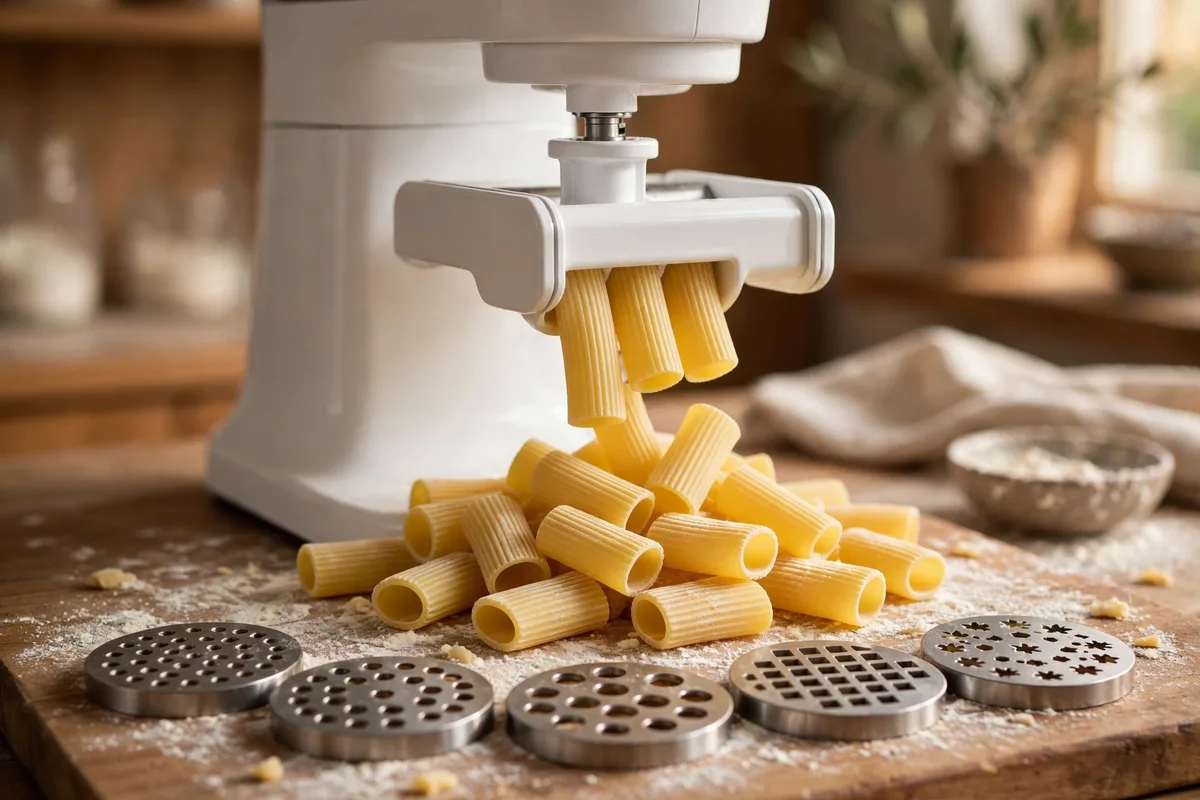
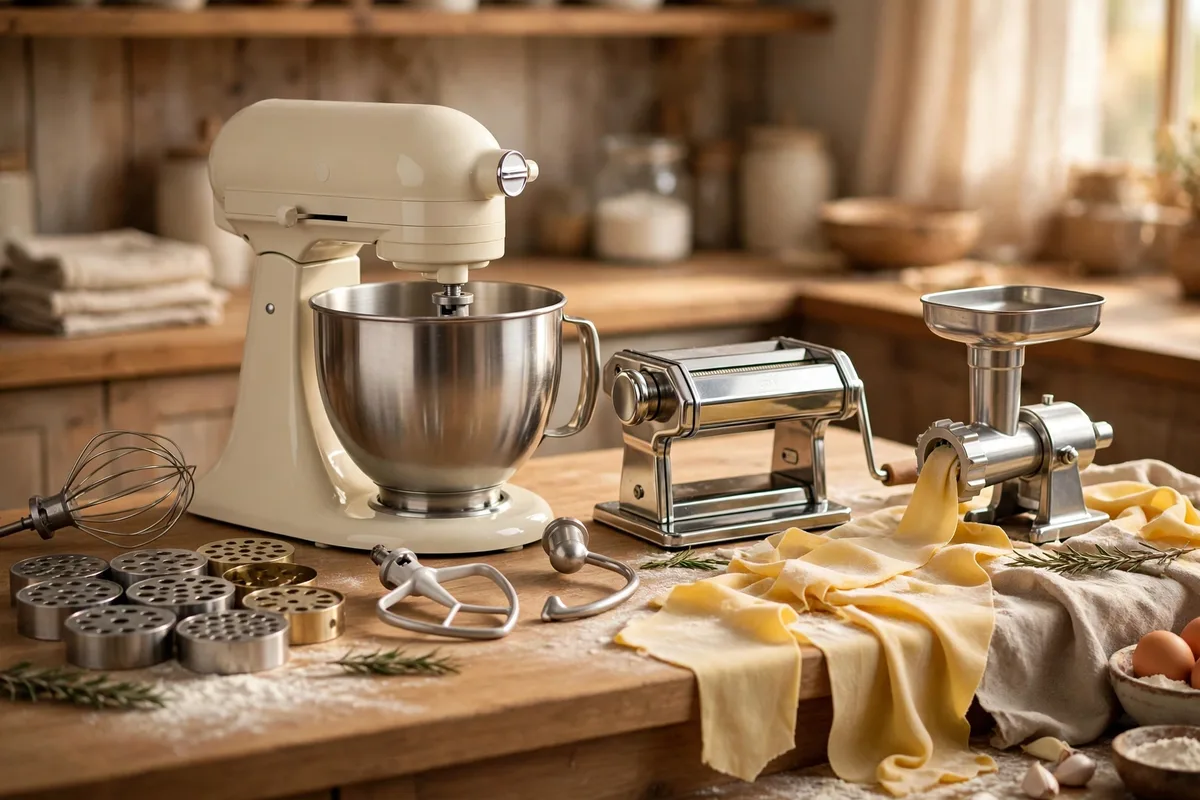
The Gourmet Pasta Press is the attachment that turns a mixer into an Italian deli: per KitchenAid it extrudes six shapes — including rigatoni, bucatini, fusilli and spaghetti — by driving dough through metal dies with the mixer’s hub power. Fresh extruded pasta is a different food from rolled pasta: thicker-walled, sauce-gripping, and impossible to buy fresh in most Canadian and American towns. The press is the ecosystem’s showpiece, and owners who use it describe the same ritual satisfaction as hand-crank machines, without the hand cranking.
The honest work notes: dough hydration for extrusion is drier and crumblier than rolled-pasta dough — the learning curve is one or two batches — and the dies want cleaning with the included tool before residue dries, a five-minute job that becomes a thirty-minute one if postponed. Construction is the mixed picture typical of the line: a sturdy housing with the dies doing the metal work where it matters. For households that will make extruded pasta monthly or more, it justifies its flagship status; for twice-a-year curiosity, the roller set below is the wiser first buy.
The pasta press’s ownership rhythm is the dough’s, not the machine’s: ten minutes of kneading by hand or hook, a half-hour rest, then extrusion at a pace that suits a Sunday. The dies store in the press body, the casing rinses clean if you let the dough dry in it first — the counterintuitive trick every owner learns — and brass-die results improve as the press seasons. Kept for households that make pasta monthly or more, it earns its cupboard; bought for a yearly experiment, it becomes the most interesting clutter in the kitchen.
Yay · Pros
- Six extruded shapes from one attachment — rigatoni to bucatini
- Mixer power replaces hand-cranking entirely
- The shapes fresh pasta shops sell, made at home
Hmm · Cons
- The premium attachment in this guide
- Dies want a thorough brush-out before dough dries
- Slower than a dedicated extruder at party volumes
Best for: committed pasta households who want the full shape library from one hub. Skip if: you only ever make flat noodles — the roller set is cheaper and faster for sheets.
2. KitchenAid 3-Piece Pasta Roller & Cutter Set (KSMPRA) — Best for sheets & noodles
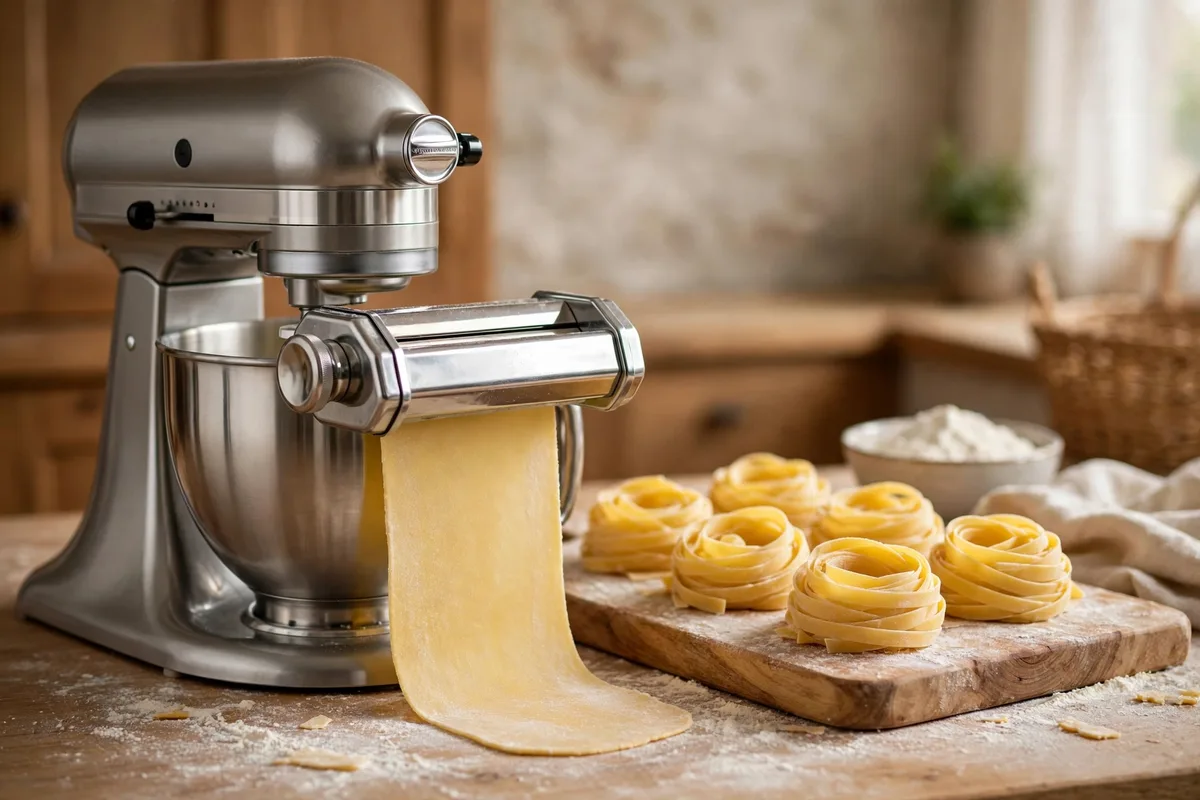
If the press is the showpiece, the 3-piece roller and cutter set is the workhorse — and for most households, the correct first pasta attachment. Per KitchenAid the set rolls dough to eight thickness settings and cuts spaghetti and fettuccine, which covers the overwhelming majority of home pasta: lasagna sheets, hand-cut pappardelle from rolled sheets, and the two classic cuts. The rollers are stainless steel, the build is the metal-where-it-matters philosophy done right, and the whole set stores in a box the size of a shoebox.
Owner reports are the strongest in this guide: consistent thickness (the thing hand-rolling cannot give a beginner), fast learning curve, and durability measured in years of weekly use. The limitations are the catalogue’s edges — no extruded shapes, and the cutter set covers two widths, with additional cutters sold separately for angel hair and wider ribbons. Paired with a drying rack and a free Sunday afternoon, this is the attachment that most reliably converts mixer owners into pasta people — and it is the ecosystem piece our [[2]] readers ask about most.
The roller set’s ownership pleasure is maintenance’s absence: a brush, a dry cloth, and never water — the rule that keeps the rollers true for decades. Sheets rest under a towel while you work, and the cutters handle the rest; the set also quietly becomes a cracker, wonton and fondant tool in households that bake broadly. It stores flat in its box at the back of a deep drawer, which is why owners keep it for twenty years while bulkier single-task tools get donated around it.
Yay · Pros
- Stainless rollers with eight thickness settings
- Spaghetti and fettuccine cutters included
- The strongest owner-report record in this guide
Hmm · Cons
- Cutters cover two widths — angel hair needs the wider set
- Noodles only: no extruded shapes
- Roller wants dough at the right hydration, like all pasta work
Best for: most pasta households: weekly sheets, fettuccine and lasagna, at the ecosystem’s value point. Skip if: extruded shapes are the dream — that is the press, above.
3. KitchenAid Metal Food Grinder Attachment (KSMMGA) — Best for grinding
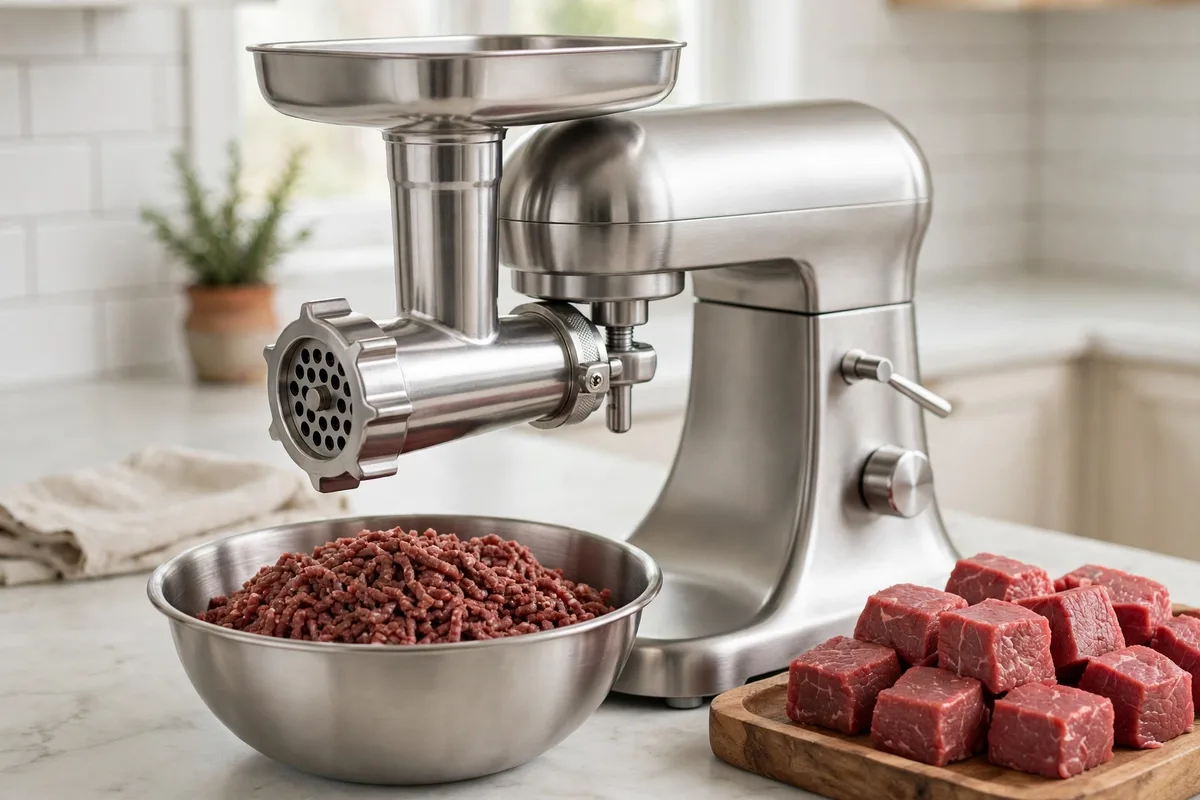
The Metal Food Grinder is the attachment where this guide’s material rule bites hardest: KitchenAid sells a plastic-bodied grinder too, and the metal version exists because grinding is a high-torque, high-resistance job where housings flex and gears wear. Per KitchenAid the metal grinder includes fine, medium and coarse plates plus sausage stuffer tubes, turning the mixer into a burger-blend station, a sausage maker and a raw pet-food prepper’s best friend. Chilled meat, steady feeding, clean results — the technique is the same as any grinder’s.
Owner reports draw the line clearly: the metal model is the one still grinding years later, and it handles household volumes — a few kilos at a time — with the patience the hub’s gearing implies. It is not a dedicated butcher’s grinder and does not claim to be; hunters processing a season’s game need a standalone machine. Within household scale, though, the value is real: grind quality you control (your cuts, your fat ratio, ground once and fresh) at attachment price and drawer size. The prep discipline — everything cold, including the grinder parts — is the whole learning curve.
The grinder’s ownership case is control that compounds: grind day becomes sausage day becomes stock day, because the same session that produces burgers produces the trim for the freezer. The metal body chills in the freezer before use — the ten-minute habit that separates clean cuts from smearing — and every part washes without the rust anxiety of carbon steel. For a household that buys whole cuts on sale, the attachment returns its cost in a season of grocery maths, then keeps returning it for years.
Yay · Pros
- All-metal housing and drive — the durability pick
- Three plates plus sausage stuffer tubes included
- Grind your own blends: cuts and fat ratio under your control
Hmm · Cons
- Feed pace is household, not butcher-shop
- Parts want prompt washing — raw meat rules apply
- Plastic pusher and trays are the wear points to watch
Best for: burger blends, sausage makers and raw pet-food households who grind weekly. Skip if: you process game at volume — buy a dedicated grinder instead.
4. KitchenAid Ice Cream Maker Attachment (KICA0WH) — Best for ice cream
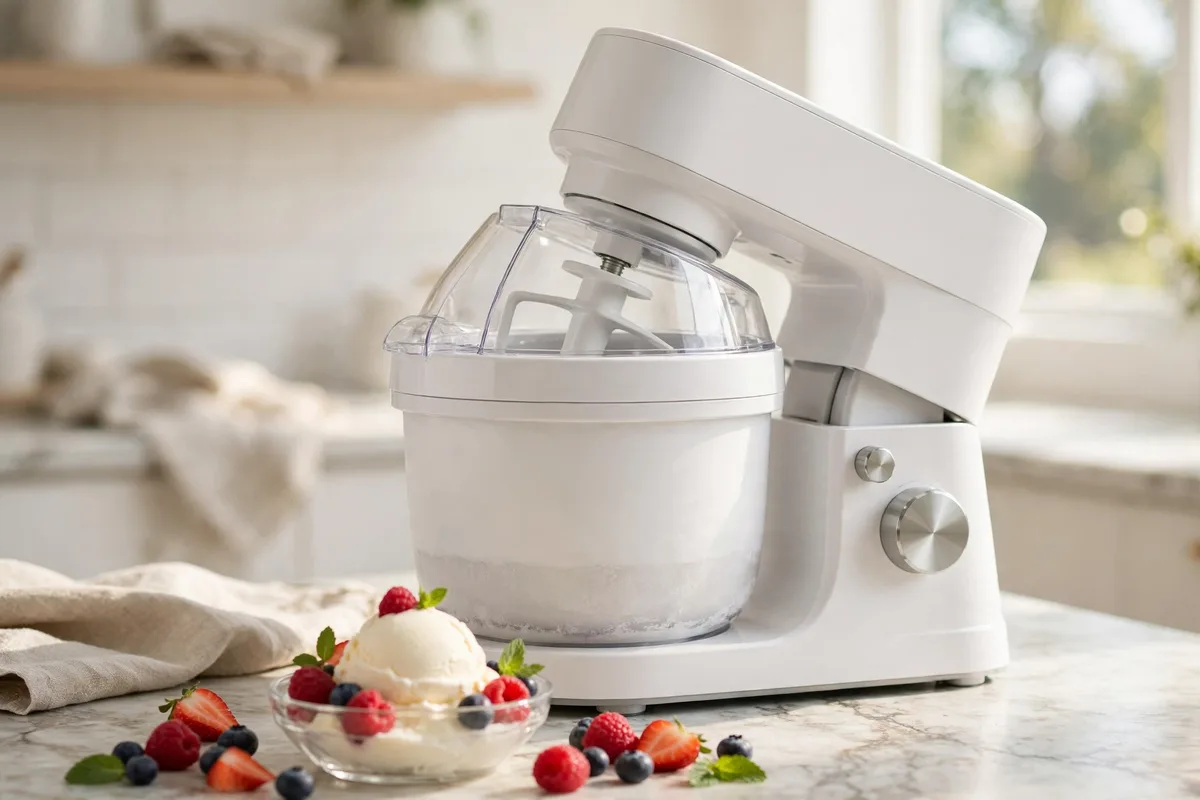
The Ice Cream Maker is the ecosystem’s most conditional attachment: a freeze-first bowl (KitchenAid specifies at least 15 hours in the freezer) that the mixer’s hub drives with a dasher, churning roughly two quarts per batch per the manufacturer. When the bowl is properly frozen and the mix properly chilled, owners get genuinely good ice cream, gelato and sorbet with the peculiar satisfaction of having made it on the same machine that made the cake it accompanies.
The conditional part is real, and this guide states it plainly: every disappointed review of this attachment traces to an under-frozen bowl — a freezer running warm, a bowl pulled at ten hours, a warm mix. Households with a deep freeze and a summer rhythm (bowl lives in the freezer, churn on Saturdays) rate it highly; households with a cramped freezer-over-fridge rate it as a cupboard tenant. Buy it as a summer ritual with storage already solved, and it is a delight; buy it as an impulse, and it is the ecosystem’s most expensive drawer resident.
The ice cream maker’s ownership term is freezer geography: the bowl needs a level, permanent-ish freezer home, and in exchange it produces a litre of ice cream whenever the base is ready — owners keep a custard base in the fridge the way others keep sourdough starter. The dasher and drive parts are simple and replaceable, and the bowl doubles as a chilled serving and dough-proofing bowl in winter. It is the most seasonal pick here and, in July, the most beloved object in the kitchen.
Yay · Pros
- Real churned ice cream, gelato and sorbet from the mixer you own
- Two-quart batches — right-sized for families
- No separate countertop machine to store
Hmm · Cons
- Bowl must be frozen hard — at least 15 hours per the maker
- Two-quart batches only
- Results depend entirely on freeze discipline
Best for: families who will genuinely churn a batch most summer weekends. Skip if: your freezer has no room for a resident bowl — it will never get used.
5. KitchenAid Sifter + Scale Attachment (KSMSFTA) — Best for baking precision
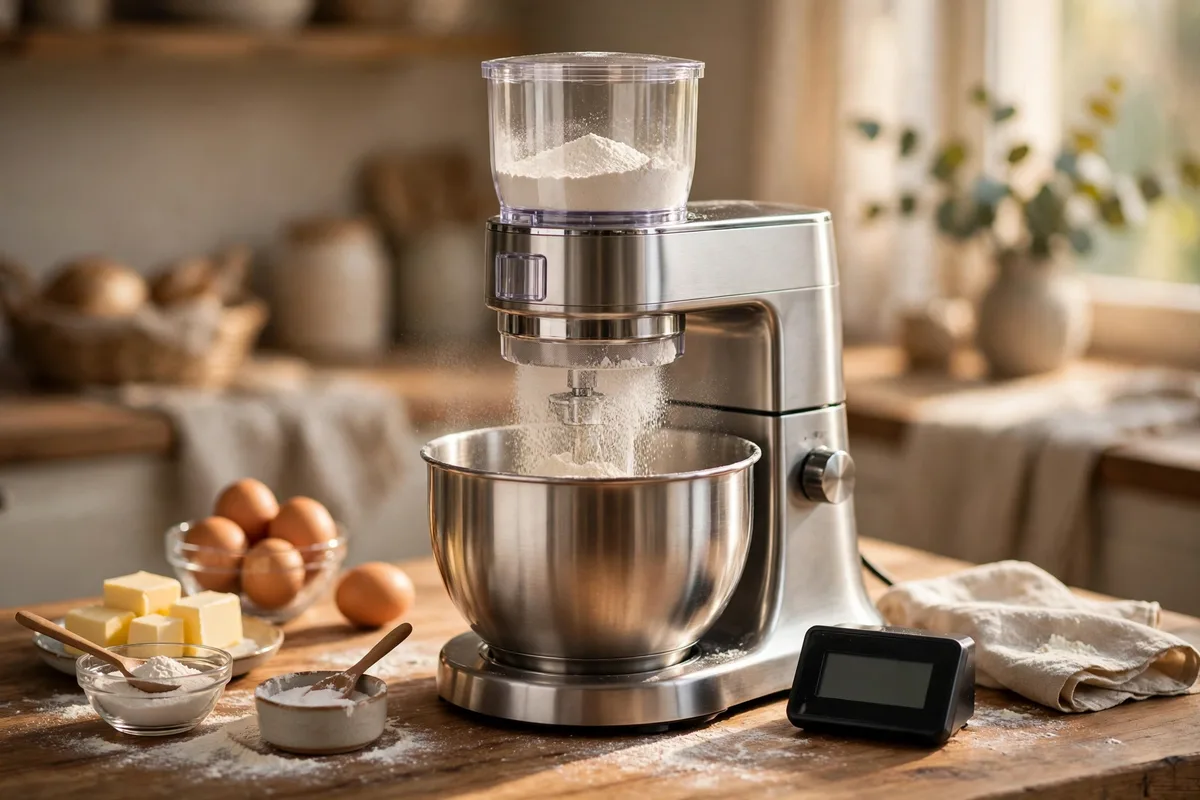
The Sifter + Scale is the attachment for the baker the rest of the ecosystem ignores: it sifts dry ingredients directly into the bowl while weighing them, per KitchenAid’s design, replacing the scoop-guess-and-level routine with gram-accurate, aerated flour delivered hands-free. Baking is chemistry measured by weight, and this is the only attachment here that improves the mixer’s original job rather than adding a new one. The digital scale detaches for standalone use, which owners report makes it the most borrowed tool in the set.
The trade-offs are pace and price: sifting-while-weighing is slower than scooping for a casual batch of muffins, and the attachment costs real money for a single-purpose gain. The audience that values it — bakers working through bread and pastry repertoires where 20 grams is a texture — values it exactly because it removes the two largest error sources in home baking at once. For everyone else it is a luxury; for them it is infrastructure. Either way, it is the attachment that most changes what the mixer itself does.
The sifter and scale’s ownership gift is the disappearance of two chores: flour stops dusting the counter, and the gram scale stops living in the drawer. Bakers who weigh ingredients — the habit that most improves home baking — find the attachment removes the last friction from doing it every time. The scale unit wants gentle handling and dry storage, and the sifter’s screen rinses in seconds. For the mixer that already anchors a baking household, it is the attachment that changes daily practice rather than adding an occasion.
Yay · Pros
- Sifts and weighs in one hands-free pass into the bowl
- Removes home baking’s two biggest error sources
- Scale detaches for standalone weighing
Hmm · Cons
- A precision tool with a precision-tool price
- Slower than scoop-and-level for casual baking
- One more thing to wash after flour work
Best for: serious home bakers chasing repeatable, gram-accurate results. Skip if: you bake casually — a standalone scale does 90% of this for a tenth of the price.
The hub, the generations and the metal question: buying attachments that fit and last
Every KitchenAid stand mixer — bowl-lift or tilt-head, new or decades old — carries the same front power hub, and KitchenAid states its hub attachments fit every model since the hub’s introduction. That universality is the ecosystem’s real value: an attachment bought for a Classic today fits the Professional you upgrade to in ten years. The practical check before ordering is not the mixer but the attachment generation: KitchenAid has revised several attachments over the years, and current listings’ compatibility notes are the authority for any specific pairing.
The metal question runs through owner reports on every attachment in this guide. Where a tool meets resistance — grinding meat, pressing pasta dough — metal housings and gears are the durability story, and plastic versions of the same tool are the false economy owners warn about. This is why the grinder pick below is specifically the metal model and why the pasta press’s die construction is part of its review: in attachments, you are buying a drivetrain as much as a tool.
Storage is the last honest consideration. Five attachments is five boxes in a cupboard, and the owners who use theirs weekly are the ones who store them assembled-adjacent to the mixer, not archived in a basement. Buy in the order your cooking actually runs — for most households pasta first, grinding second, ice cream in summer — and the ecosystem grows the way the best stand mixers in Canada and the USA guide’s mixers earned their place: one useful tool at a time. And when the attachments have done their work, the best quiet blenders in Canada and the USA machines are how the leftovers become tomorrow’s smoothie.
A note on the second-hand market, because these attachments dominate it: estate sales and marketplace listings are full of barely used pasta sets and grinders, and the metal-bodied ones are usually excellent buys — the failure points to inspect are the plastic drive gears on older grinder bodies, cracks around the freezer bowl’s rim, and pasta dies with bent pins. A used metal attachment at half price, inspected for those three things, is often the smartest purchase in this whole category, and the new-price picks above remain the reference for what ‘complete’ should include.
Finally, match the attachment to the mixer’s motor honestly: the hub delivers a fraction of the bowl motor’s drama, and dense work — stiff pasta dough extrusion, heavy grinding — suits the larger bowl-lift machines best. A small tilt-head will run every pick here, but it will run the press and grinder at a pace that tests patience. Owners of the smaller mixers consistently rate the roller set and sifter highest, which is less about the attachments than about honest pairing — the theme of this entire guide.
Stand mixer attachment questions, answered
Do KitchenAid attachments fit every stand mixer model?
Per KitchenAid, the front power hub is universal: hub attachments fit all KitchenAid stand mixer models, bowl-lift and tilt-head alike, across decades of production. Two checks still apply — confirm the specific attachment’s listing compatibility notes (a few specialty items have exceptions), and remember that bowl-fitting tools like the ice cream maker depend on your bowl style rather than the hub. For the five picks here, hub compatibility is the brand’s standing claim.
Are metal attachments worth it over plastic ones?
Wherever the tool meets real resistance. Metal housings and gears survive the torque of meat grinding and stiff pasta dough for years; plastic-bodied versions of the same tools are the ones in owner reports with cracked housings and worn gears. For low-resistance jobs — sifting, spiralizing — quality plastic is perfectly serviceable. The rule this guide applies: pay for metal where force is involved, and save the money where it is not.
Can the food grinder attachment really handle meat well?
At home volumes, yes — with one technique condition. The grinder performs best with meat cut in strips and chilled almost to freezing, fed steadily rather than forced; treated that way, owner reports describe clean grinds for burgers, sausages and pet food at a pace a household actually needs. It will not match a dedicated half-horsepower grinder for a hunting season’s worth of game — that is a different tool class, and high-volume hunters should buy it instead.
What makes the ice cream attachment succeed or fail?
Chilling discipline. The freezer bowl needs a long, full freeze (KitchenAid specifies at least 15 hours) in a freezer cold enough to do it — a bowl that is merely cold makes soup, not ice cream. Batches are about two quarts per the maker, mixes should be chilled before churning, and add-ins go in during the last minutes. Owners who master the freeze-first routine rate the attachment highly; owners who shortcut it write the disappointed reviews.
Should I buy the pasta press or the pasta roller set first?
For pasta households, yes: the roller-and-cutter set handles the sheet work most home cooks actually do weekly — rolling to consistent thickness and cutting fettuccine and spaghetti — and the press earns its keep only if extruded shapes (rigatoni, bucatini, fusilli) are genuinely on your menu. Many owners buy the roller set first and add the press a year later. Buying both at once makes sense mainly as a bundle-priced gift or for committed pasta makers.
Do attachments fit mixers from other brands?
Generally no: the hub’s shaft and locking geometry are KitchenAid’s own, and other brands use their own systems — Ankarsrum, Bosch and Kenwood each run proprietary attachment families, some of them excellent. A small market of third-party attachments is made to fit the KitchenAid hub specifically, with quality ranging from fine to flimsy; the metal-bodied third-party grinders get the best owner reports. If you own a different brand’s mixer, shop its own catalogue first — the fit, gearing and warranty all assume it.
The short version
Start with the Pasta Roller & Cutter Set — it is the attachment most owners use weekly — and add the Gourmet Pasta Press when extruded shapes call. The Metal Food Grinder is the only grinder version worth buying, the Ice Cream Maker is a summer ritual that rewards freezer space, and the Sifter + Scale is precision infrastructure for serious bakers. Buy in your cooking’s order, metal where force is involved, and the mixer on your counter quietly becomes five tools — the full mixer story is in our best stand mixers in Canada and the USA, and the hub’s quiet cousins live in our best quiet blenders in Canada and the USA.
Last updated: November 18, 2026. We refresh this guide each season and whenever a pick is replaced by a better one.