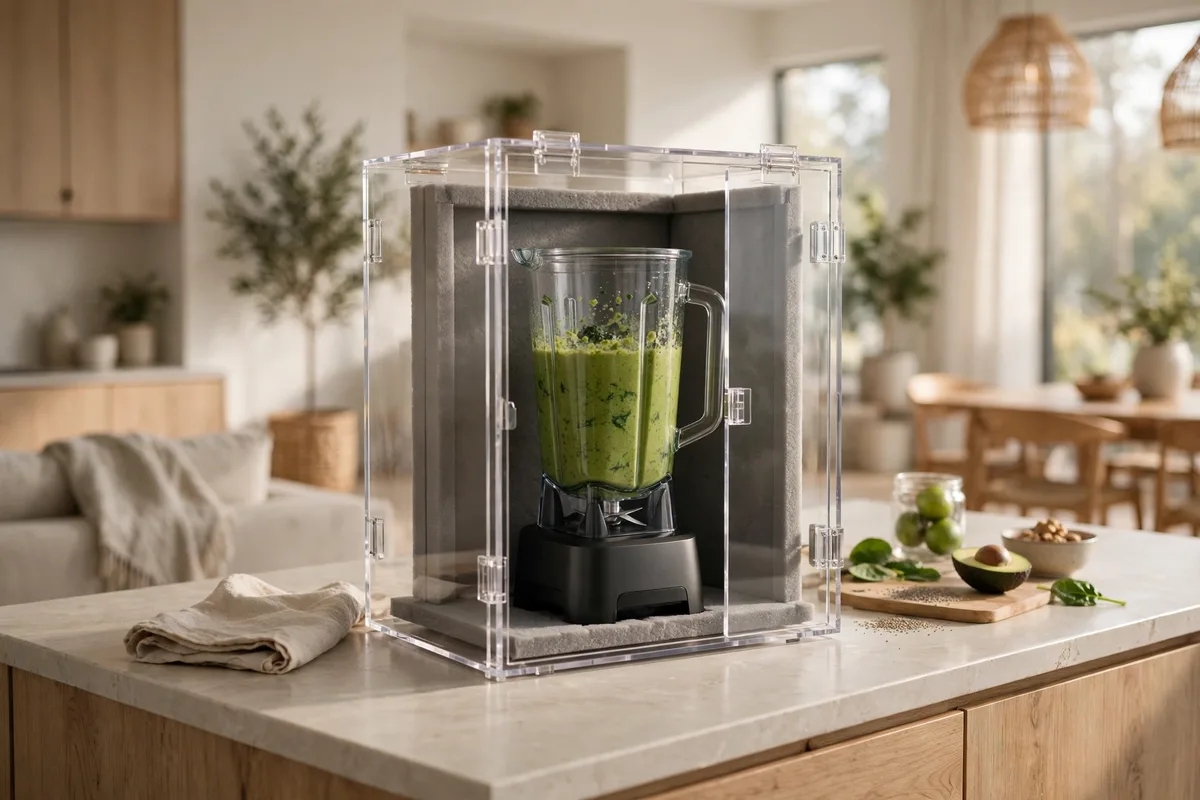
A standard blender at full speed is one of the loudest appliances in the house — loud enough to end conversations, wake babies and make 7 a.m. smoothies an act of household diplomacy. The best quiet blenders attack that problem with engineering rather than apologies: sealed sound enclosures borrowed from café counters, removable shields, and designs that muffle the shrill top end that makes blender noise so grating. Our main roundup of the best blenders and mixers in Canada and the USA covers the high-speed class in full; this guide is the subset built for open-plan homes, light sleepers and early risers.
The honest framing first, because this category invites exaggeration: no blender is silent. Ice cracking and a powerful motor make noise, and any decibel figure on a box is a manufacturer claim under that maker’s own test conditions. What the five machines below genuinely deliver ranges from café-grade hush (the two enclosure models) to a meaningful softening (the shield and vacuum designs) — and each pick is labelled with which promise it actually keeps. If your mixer is the loud one instead, the best stand mixer attachments in Canada and the USA guide is its quiet companion read.
Disclosure: CookSmartPicks is reader-supported. When you buy through links on this page, we may earn an Amazon commission at no extra cost to you. Prices and availability change often — check the current price on Amazon before you decide.
How we chose these quiet blenders
CookSmartPicks is a research-based guide; we never claim hands-on testing we have not done. For this list we compared manufacturer specifications — motor ratings, enclosure and shield designs, jar sizes and published noise figures where makers provide them — with independent roundups and long-term owner reports from verified buyers in Canada and the USA. Noise claims get special handling: decibel figures are manufacturer claims measured under each maker’s own conditions, and we say so, because no cross-brand noise standard exists for blenders.
The shortlist also had to survive a parts-and-service check, because a quiet blender is a decade purchase: we confirmed each brand sells replacement jars, lids and enclosure parts through normal channels, and noted where Canadian service runs through a depot rather than a local counter. Two enclosure models were cut at this stage — their covers were integral and non-replaceable, so one cracked hood would have ended the quiet the buyer paid for. A quiet blender whose silence can be repaired is a different product from one whose silence can only be replaced.
The lineup at a glance
| Product | Best for | Why it stands out |
|---|---|---|
| Blendtec Professional 800 with Stealth Enclosure | Best overall | A sealed Stealth enclosure over a full-power Blendtec — café quiet, home format |
| Vitamix The Quiet One | Best splurge | The café standard: commercial Vitamix power inside a full sound enclosure |
| Hamilton Beach Professional Quiet Blender with Sound Shield | Best value | A removable sound shield over a 1500W home blender — quiet on a budget |
| Kuvings Power Blender with Soundproof Cover | Best alternative enclosure | A sound-cover power blender from the slow-juicer specialist — check the box contents |
| Tribest Dynapro Vacuum Blender | Best for smoothie quality | Vacuum blending for texture and colour, with a calmer, less shrill blend as the bonus |
1. Blendtec Professional 800 with Stealth Enclosure — Best overall
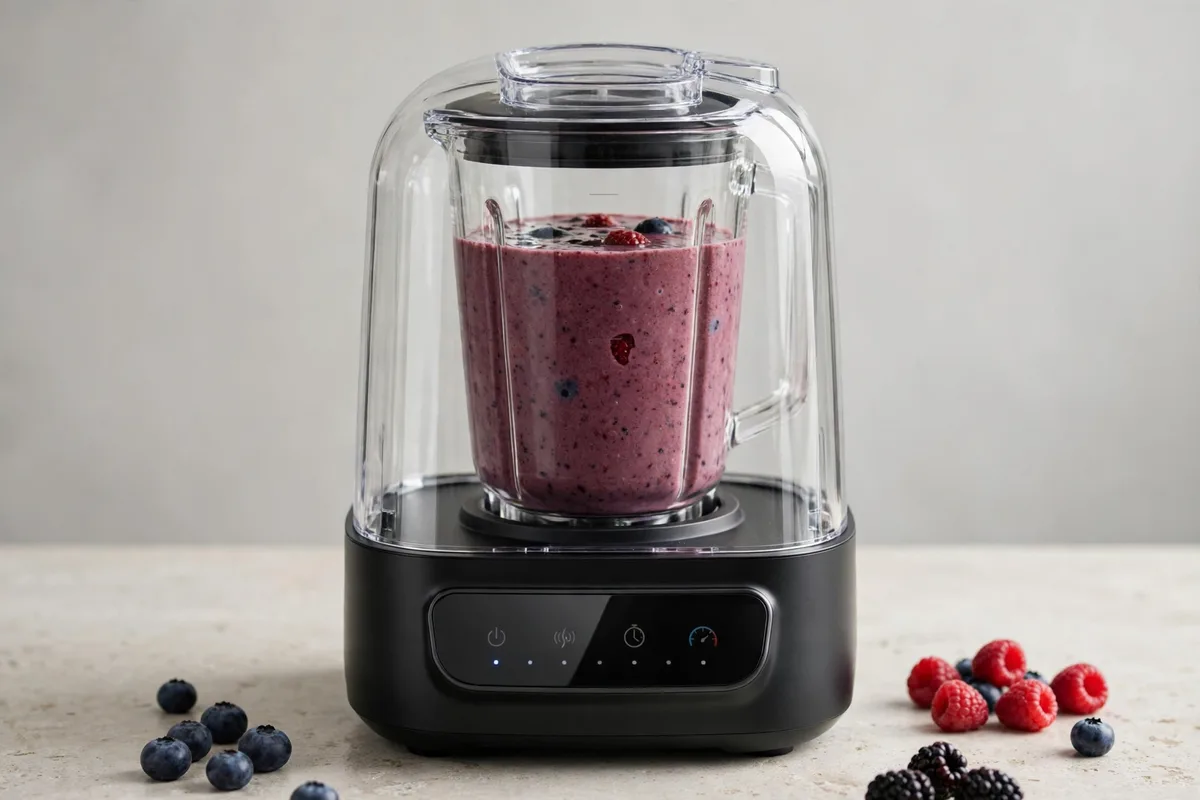
The Professional 800 is Blendtec’s home flagship built around its Stealth sound enclosure — a sealed box that closes over the jar and, per Blendtec, makes this the quietest residential blender in its line, a claim independent reviewers and owners consistently describe as a dramatic difference rather than a subtle one. Under the enclosure sits a full-power Blendtec motor (the maker rates it at 3.8 peak horsepower) with capacitive-touch controls and pre-programmed cycles, so nothing about performance is traded away for quiet.
Owner reports describe the lived difference plainly: blending at full speed while a conversation continues in the same room, and morning smoothies that no longer announce themselves to the whole house. The costs are size and price — the enclosure makes this a tall, present appliance that wants a permanent counter spot and under-cabinet clearance, and Blendtec jars are a premium replacement part. For daily blenders in open-plan homes, it is the reference quiet machine: commercial idea, home format, no performance apology.
Ownership of the Professional 800 settles into a routine owners describe with unusual affection: the enclosure opens with one hand, the jar rinses clean because the blade is fixed, and the whole machine wipes down like a countertop appliance rather than a project. Blendtec’s jar is the consumable — expect to replace it every few years of daily use, at a fraction of the machine’s cost, through either country’s retail. Kept in an open-plan kitchen, it is the rare high-power blender that never has to apologize to the room.
Yay · Pros
- Full sound enclosure — the real café fix, at home scale
- Full-power motor and programmes: nothing detuned for quiet
- Owners report conversation-level blending at full speed
Hmm · Cons
- Enclosure adds height — check under-cabinet clearance
- Jar replacements carry Blendtec pricing
- The box is a presence; this is not a hide-away appliance
Best for: daily blenders in open-plan homes who want café quiet without café pricing logic. Skip if: your budget is mid-range — the Hamilton Beach shield is the honest step down.
2. Vitamix The Quiet One — Best splurge
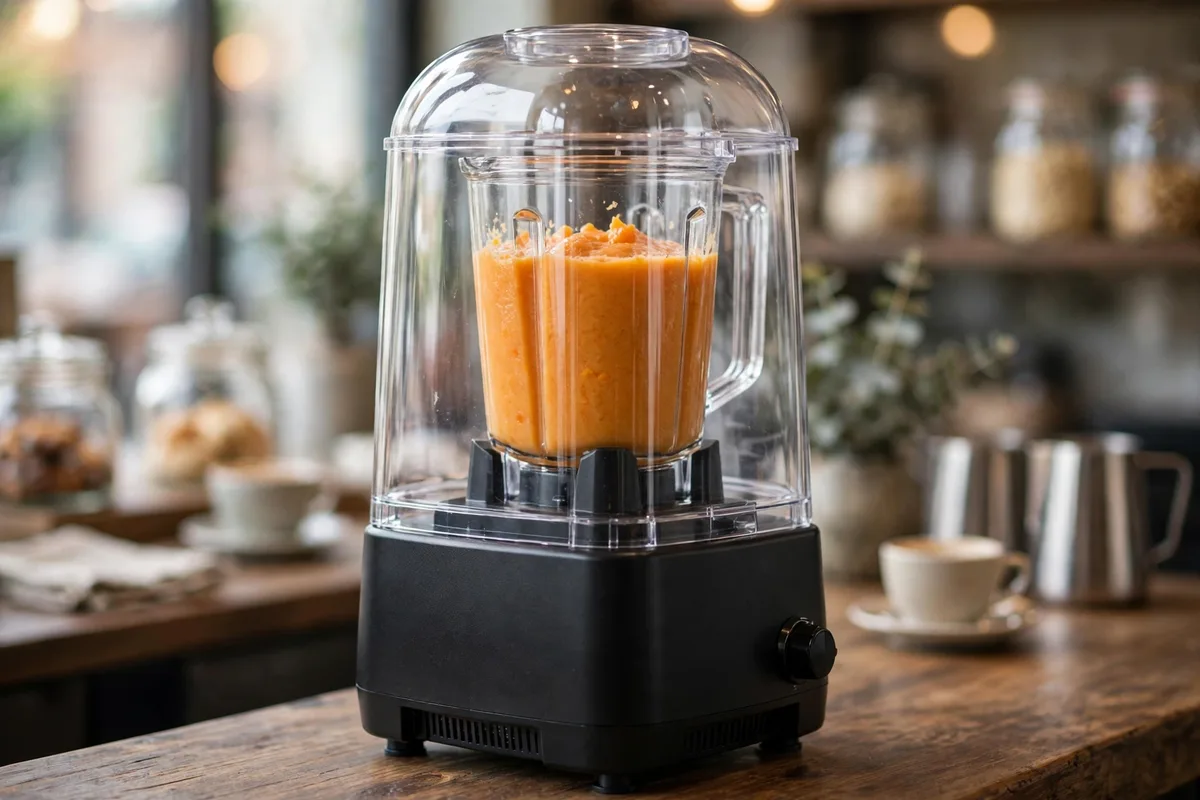
The Quiet One is the machine cafés buy when the blender must not be heard over the counter, and it is exactly what its name claims: a commercial Vitamix with a full sound enclosure, a 3-peak-horsepower motor per the manufacturer, and dozens of optimised programmes tuned for drinks made all day, every day. Vitamix builds it for commercial duty cycles — which, translated for a home buyer, means the durability question is simply settled: this class of machine is rated for hundreds of blends a week.
Why would a household buy it? Two honest reasons: the quietest blending Vitamix knows how to make, in the brand many buyers already trust, and a buy-once horizon measured in decades of daily use. The counterarguments are equally plain: it is the most expensive machine in this guide by a distance, it is big, and its talents are wasted on twice-a-week smoothies. Owner reports from juice-bar and home users alike praise the enclosure’s real-world effect and the set-and-forget programmes. If blending is a daily ritual and noise is the last obstacle, this is the end of the search.
The Quiet One’s ownership story is written in cafes: advance containers swap in seconds, the enclosure’s front removes for washing, and Vitamix Commercial’s service network treats downtime as the emergency it is for a business. At home, that translates to parts that simply exist — gaskets, drive sockets, spare jars — a decade after purchase. It is more machine than a household needs, and that is precisely its appeal for the buyer who has already replaced two lesser blenders and intends this to be the last purchase in the category.
Yay · Pros
- Commercial sound enclosure — the quietest Vitamix made
- Built for café duty cycles: durability is the point
- Deep programme library tuned for all-day drink making
Hmm · Cons
- Commercial pricing — the highest in this guide
- Large footprint that assumes a permanent station
- Over-specified for occasional blending
Best for: heavy daily users and smoothie businesses at home who buy appliances by the decade. Skip if: you blend occasionally — its talents and price both assume daily work.
3. Hamilton Beach Professional Quiet Blender with Sound Shield — Best value
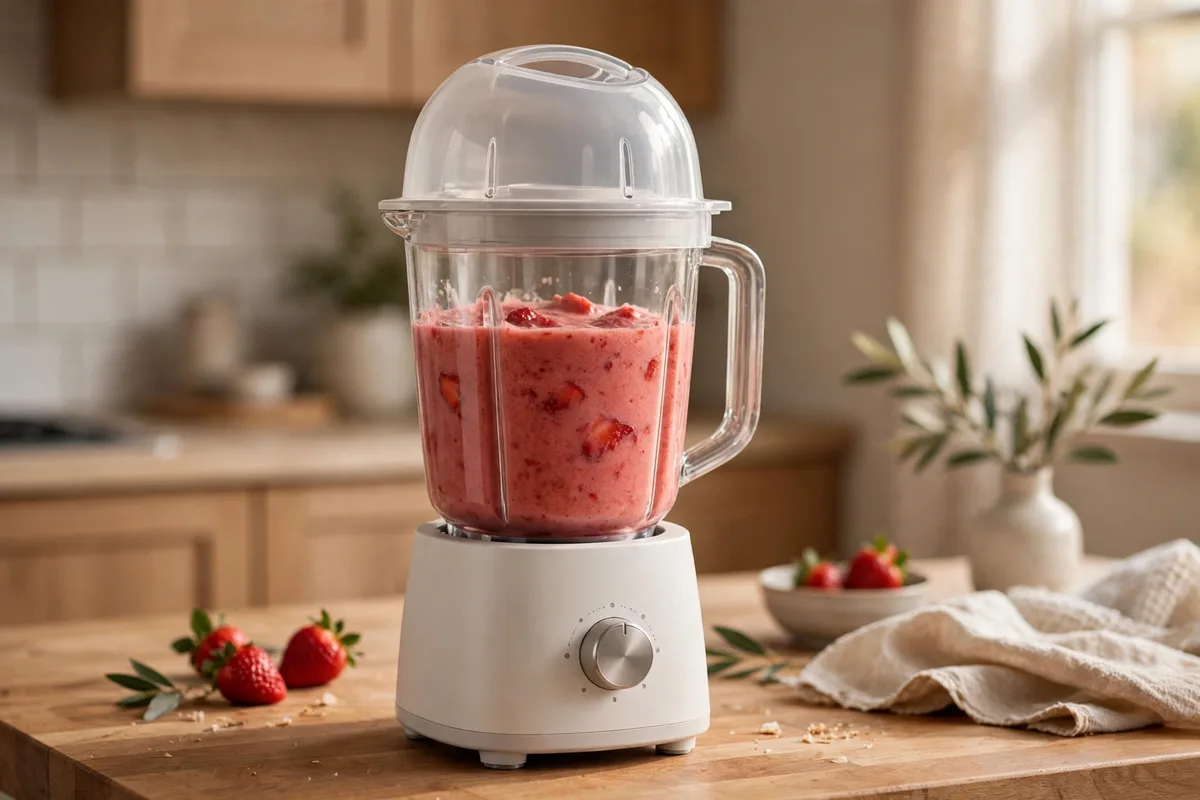
Hamilton Beach’s answer to blender noise is the honest budget one: a removable sound shield that fits over the jar of a full-power home blender, damping the shrill frequencies that make blending feel louder than it measures. The maker rates the motor at 1500 watts peak, the jar handles family smoothies, and the shield lifts off for washing and storage — a genuinely practical design for kitchens where the enclosure flagships simply cannot be justified.
Owner reports calibrate expectations correctly: this is a softening, not a silencing. The shield takes the edge off — early-morning blending becomes inconsiderate rather than impossible — and reviewers who expected café quiet from a shield price were the disappointed ones. Judged on what it is (the cheapest meaningful noise reduction in blending, wrapped around a competent everyday blender) it is an easy recommendation, and it anchors this guide’s honesty scale: if your need is ‘less annoying’ rather than ‘barely audible’, this is your tier and the enclosure money stays in your pocket.
The Hamilton Beach asks for the least commitment of any pick: the shield lifts off for the sink, the jar and lid are ordinary dishwasher citizens, and the whole machine stores at normal blender height with the shield nested. Its ownership limit is ambition — daily green smoothies for a family will work it near its ceiling, and the warranty is a home warranty, not a commercial one. For the apartment brief it was chosen for — real blending, civilized volume, sane price — those limits rarely bind, which is what a correct pick looks like.
Yay · Pros
- Removable sound shield at a fraction of enclosure prices
- Full-power home motor — no performance detune
- Shield stores separately; the blender stays compact
Hmm · Cons
- A shield softens; it does not silence — set expectations
- Jar capacity suits smoothies for two, not crowds
- Fit and finish are budget-class
Best for: occasional-to-weekly blenders who want calmer mornings without enclosure money. Skip if: a sleeping baby is in the next room — that is enclosure territory, above.
4. Kuvings Power Blender with Soundproof Cover — Best alternative enclosure
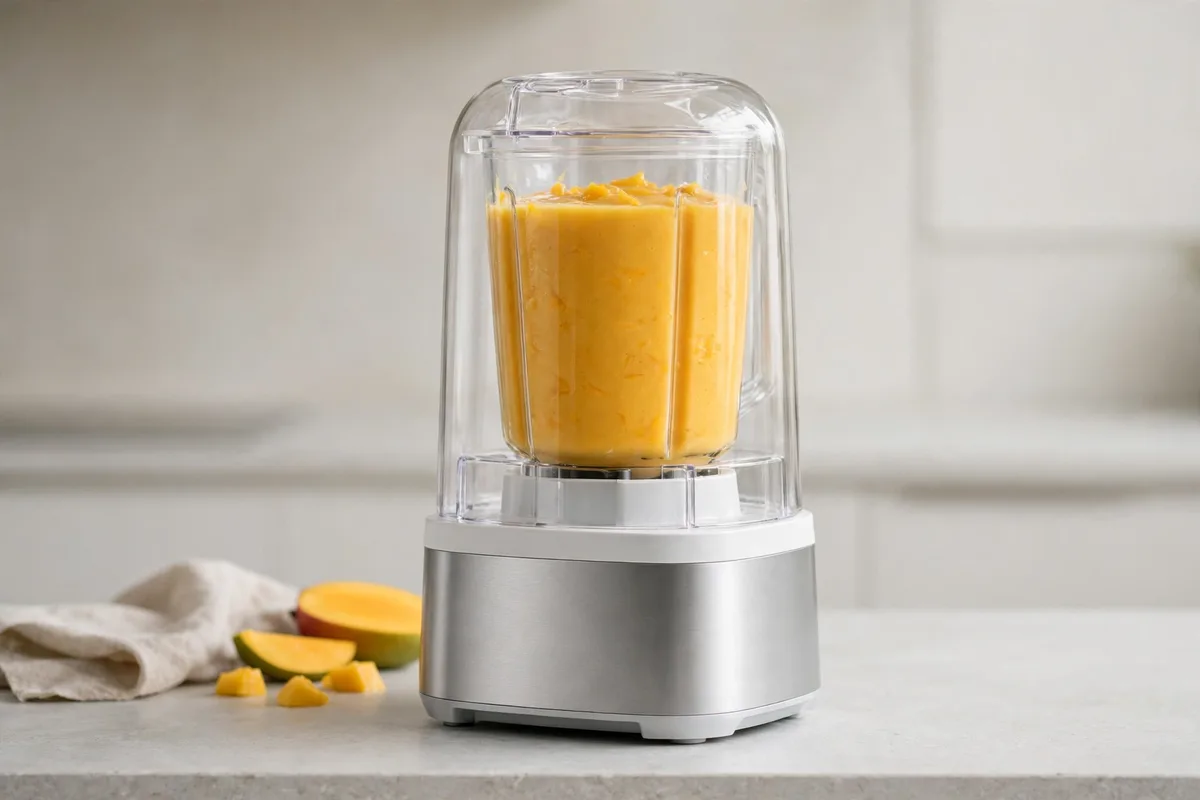
Kuvings markets its power blender line in several markets with a sound-dampening cover over the jar — the same enclosure idea as the flagships, from the Korean brand better known in North America for its slow juicers. Where stocked with the cover included, it is a legitimate third route into enclosed blending, with a high-speed motor and the solid build Kuvings’ juicer reputation rests on. The manufacturer’s noise positioning is the cover; without it, this is a standard loud power blender, which is why the listing check matters more here than anywhere in this guide.
The cautions are practical rather than technical: availability in Canada and the USA is spottier than Blendtec or Vitamix, the included accessories vary by market and production run, and the North American owner-report record is thinner. Buyers should confirm — in the specific listing, before ordering — that the sound cover is included and that warranty service is reachable from their country. With those two boxes ticked, it is a credible enclosure alternative; without them, the Blendtec above is the safer spend.
The Kuvings’ ownership terms deserve the caution the pick label carries: buy it where the return window is long and the warranty registration is documented, because the brand’s North American blending support is thinner than the two commercial names above it. What owners get in exchange is the gentlest full-size blending here — vacuum and quiet in one machine — and a design that looks like kitchen equipment rather than laboratory gear. If your retailer relationship is solid, the combination is genuinely unavailable anywhere else in this guide.
Yay · Pros
- Enclosure approach from an established juicing brand
- High-speed power with the cover doing the noise work
- A genuine third option beyond the big two
Hmm · Cons
- Availability varies by market — confirm the cover is in the box
- Smaller service network in Canada and the USA than Blendtec or Vitamix
- Fewer long-term owner reports in North America
Best for: noise-aware buyers outside North America’s big two brands, where the model is stocked. Skip if: you cannot confirm the cover and local warranty in the listing — choose the Blendtec instead.
5. Tribest Dynapro Vacuum Blender — Best for smoothie quality
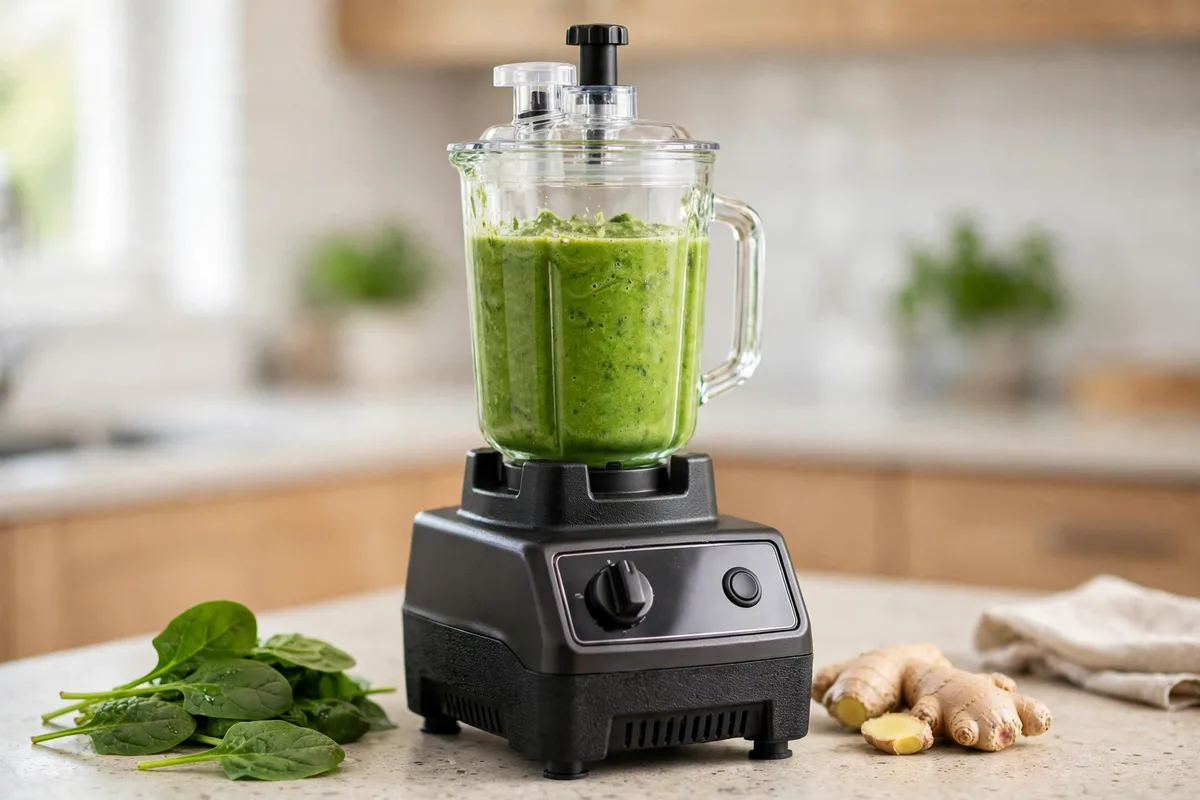
The Dynapro earns its place in a quiet-blender guide honestly, but by a different mechanism: it vacuum-seals the jar before blending, pulling out the air whose expansion and collapse contributes to a blend’s harshness — and, as Tribest positions it, reducing the oxidation that browns and separates green smoothies. Owners describe the sound as less shrill and the texture as noticeably finer; nobody describes it as silent, and neither does this guide. Think of it as the quality-first machine whose side effect is a calmer blend.
The vacuum system is the real headline for the right buyer: juices and smoothies that hold colour and flavour longer, commercial-style throughput per the manufacturer’s ratings, and a build aimed at heavy home or light commercial use. The trade-offs are the extra vacuum step in every routine, premium pricing, and the partial nature of the noise benefit. If your problem is brown smoothies, this is arguably the best machine in the guide; if your problem is purely a sleeping household, the enclosures above solve it more directly — and our [[3]] roundup covers the compact end if space is also tight.
The Dynapro’s ownership is enthusiast-shaped: the vacuum pump is one more part to rinse and seat correctly, and in exchange smoothies keep their colour and bite for hours — the meal-prep household blends Sunday for Monday without the usual brown apology. Tribest’s parts support is long-standing in the juicing world, and the commercial-rated motor is built for the duty cycle a shield-only machine would resent. It is the pick for the household that has already decided blending is a daily practice, not an experiment.
Yay · Pros
- Vacuum blending: smoother texture, slower browning
- Takes the shrill edge off blending as a side effect
- Commercial-leaning build for heavy home use
Hmm · Cons
- Not an enclosure — the noise gain is real but partial
- Vacuum step adds a minute to the routine
- Premium pricing for a quality feature, not a quiet feature
Best for: green-smoothie devotees who want better texture and colour, with calmer blending as the bonus. Skip if: noise is the whole brief — an enclosure fixes it directly; vacuum only softens it.
Decibels, honestly: what the numbers on the box leave out
Blender noise is quoted badly everywhere. Manufacturers who publish a decibel figure choose their own test distance, load and speed, so two blenders both ‘rated’ in the 60s can sound completely different across a kitchen. What owners actually experience has three ingredients: raw loudness, pitch (the high-speed whine reads as louder than it measures), and duration — a blender that finishes in 40 seconds disturbs a household less than a quieter one grinding for three minutes. That is why this guide talks about enclosures and shields as engineering, and raw numbers only as manufacturer claims.
The enclosure approach attacks the problem at the source: sound is energy, a sealed box traps much of it, and commercial cafés adopted enclosures because staff must hear orders over the machine. Shields and vacuum designs are partial versions of the same physics. What no blender can do is silence the two remaining noises — the crack of ice and frozen fruit in the first five seconds, and motor cooling fans — so ‘quiet blender’ honestly means ‘conversationally tolerable’, and anyone promising silence is selling something.
Set against the standard class in our best blenders and mixers in Canada and the USA roundup — machines that make no noise concessions at all — even the budget shield here is a different household experience. Choose your tier by who is sleeping, how open your kitchen is, and how often you blend; then let the enclosure do the work.
Placement is the free decibel reduction nobody lists: a blender on a stone counter against a tiled backsplash is measurably louder than the same machine on a wooden board in the room’s middle, because hard surfaces return the sound the enclosure cannot catch. A folded silicone mat under the base, and six inches off the wall, routinely buys the equivalent of a product tier. Try placement before purchase if volume is your only complaint about a blender you otherwise like — the cheapest quiet blender is sometimes the one already in the kitchen, moved.
And a note on hearing the room, not the number: two blenders at the same measured volume can feel very different, because high-pitched blade whine carries annoyance out of proportion to its decibels. Enclosures help exactly there — they muffle the whine more than the rumble — which is why owners describe enclosed machines as “calmer” beyond what the numbers promise. If a household member is sound-sensitive, weight the enclosure picks above their raw figures; the lived difference is larger than the laboratory one.
Quiet blender questions, answered
Do sound enclosures on blenders actually work?
For the enclosure models, measurably and obviously — putting the jar inside a sealed sound box removes a large share of the noise, which is why cafés pay commercial prices for them. Shield models are a middle step: they tame the shrill top end rather than silencing the machine. No blender is silent — ice cracking and the motor fan remain — but the difference between an open high-speed blender and an enclosed one is the difference between leaving the room and staying in the conversation.
What decibel level counts as quiet for a blender?
Treat any single decibel figure as a manufacturer claim measured under that maker’s own conditions — distance, load and speed all move the number, and there is no cross-brand standard. A figure in the high 60s under load is genuinely quiet for a blender; figures in the 80s are standard-class loud. When a listing gives no number at all, assume standard-class noise. Enclosure or shield presence is a more reliable signal than any printed decibel.
Can a quiet blender still crush ice and frozen fruit properly?
Yes — the enclosure and shield models here use full-power motors (the Blendtec and Vitamix are commercial-class machines), and power is what frozen blends need. The thing to check is jar size and programme logic, not wattage compromises: quiet models are not detuned, they are boxed. The budget shield gives up some jar capacity and refinement, not the fundamental ability to crush ice and frozen fruit.
Are commercial quiet blenders worth it at home?
They are built for cafés, which means two things for a home buyer: genuinely better noise engineering and durability ratings — and a price and footprint that assume a business is paying. If you blend daily for years and the budget exists, the Quiet One is a decade-scale purchase. If you blend a few times a week, the Blendtec Pro 800 brings the same enclosure idea in a home format, and the Hamilton Beach shield covers occasional blending for far less.
Does vacuum blending make a blender quieter?
A little, but not by itself. Removing air before blending reduces the foamy, aerated texture and the oxidation that browns green smoothies, and a sealed vacuum jar does muffle the harshest frequencies somewhat. Owners describe the result as less shrill rather than quiet. If morning noise is your core problem, an enclosure is the real fix; if smoothie quality is the problem, vacuum is — the Dynapro’s place in this guide is honestly the overlap of the two.
Can I put a sound enclosure on the blender I already own?
Sometimes: universal aftermarket covers exist, and Vitamix sells enclosure housings for some of its commercial bases, but fit is the whole game — a cover must clear the jar, lid and controls while sealing at the base, and a poor fit rattles, which can make the result louder at some frequencies. Measure your machine’s full footprint and height with the jar on, check the cover’s internal dimensions rather than its marketing, and buy where returns are easy. If your blender is due for replacement anyway, a designed-as-a-system quiet model is the surer spend.
The short version
Buy the Blendtec Professional 800 for genuine enclosure quiet at home scale, or the Vitamix The Quiet One if café-grade durability justifies café-grade money. The Hamilton Beach Quiet Shield is the honest budget softening, the Kuvings is the enclosure alternative where its cover and warranty check out, and the Tribest Dynapro is the smoothie-quality pick with calmer blending as a bonus. Set the expectation once: quiet means conversational, not silent — and if you are outfitting the whole counter, our best blenders and mixers in Canada and the USA shows what these machines give up against the loud flagships (very little).
Last updated: November 18, 2026. We refresh this guide each season and whenever a pick is replaced by a better one.