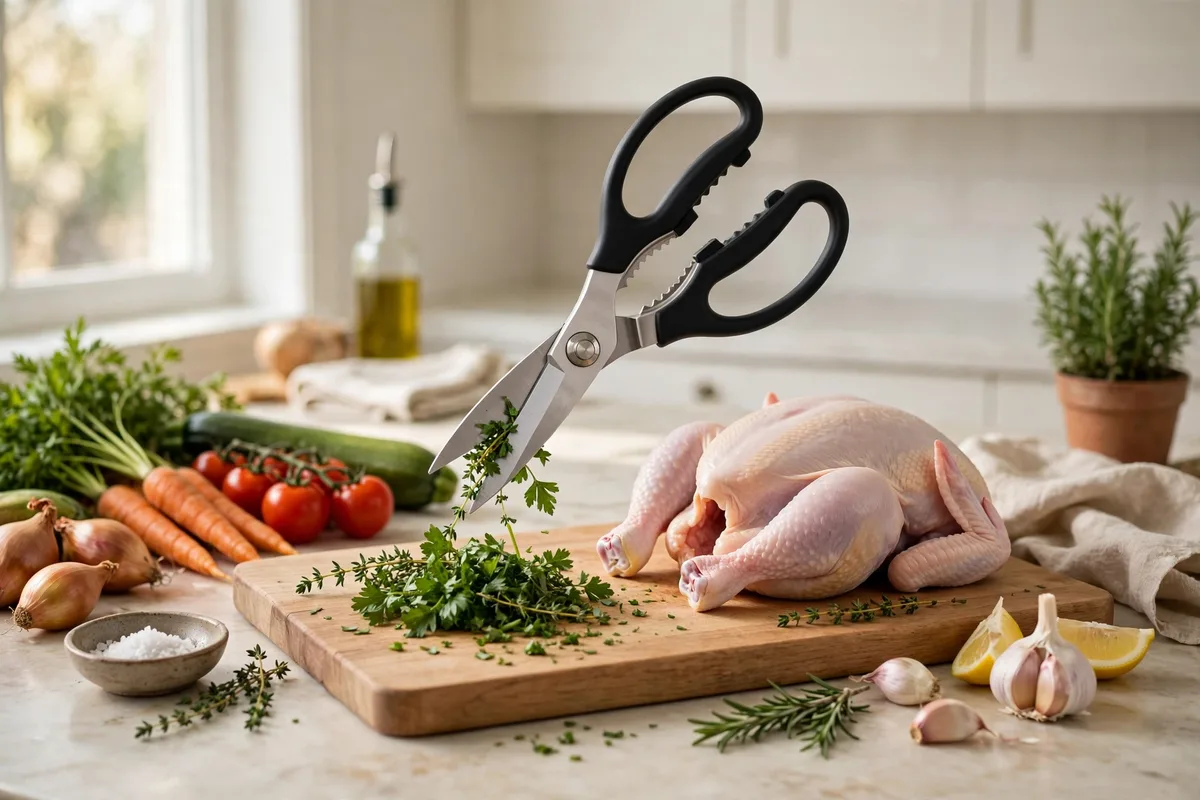
The best kitchen shears for most households are a take-apart pair with one micro-serrated blade: they come apart so the pivot can be washed completely — the hygiene detail that matters after raw chicken — and the Shun Premium and Messermeister picks below are the strongest versions of that design. Shears are the most under-researched tool in the drawer, bought by colour and replaced yearly, when a good pair is a decade purchase that spatchcocks chickens, snips herbs, and opens everything else in the kitchen.
The five picks divide by philosophy: Japanese forged precision, the American household standard, a Japanese value blade, the take-apart specialist, and the soft-grip budget classic. Each was judged on pivot design, blade steel and geometry, and handle comfort under real force. Keep them sharp alongside the best knife sets in Canada and the USA from our knife guide, store them with the best knife sharpeners in Canada and the USA kit, and cut on the best cutting boards in Canada and the USA that anchors the counter.
Disclosure: CookSmartPicks is reader-supported. When you buy through links on this page, we may earn an Amazon commission at no extra cost to you. Prices and availability change often — check the current price on Amazon before you decide.
How we chose these kitchen shears
The pivot was the first screen, because it decides hygiene and lifespan together: we prioritized take-apart designs whose hinges separate for a complete wash yet close with zero lateral play, and cut two popular models whose take-apart joints rattled in hand — a loose pivot only gets looser. Blade specification came second: one micro-serrated blade to grip slippery food, one smooth blade to cut, in steel hard enough to hold an edge through poultry work, checked against maker specifications rather than listing adjectives.
Handle ergonomics under load was the third filter — spatchcocking is a force task, and loops that bruise a palm fail it — followed by the honest extras (bone notch, spring assist, bottle and jar grips) weighted as conveniences, never as substitutes for cutting. Canadian availability was confirmed for every pick, including the Japanese imports, whose North American distribution runs through proper kitchen retailers rather than grey-market listings.
The lineup at a glance
| Product | Best for | Why it stands out |
|---|---|---|
| Shun Premium Kitchen Shears (Take-Apart) | Best overall | The cutlery-grade shear: forged steel, a perfect take-apart hinge, decade manners |
| KitchenAid All Purpose Kitchen Shears | Best household standard | The drawer standard: balanced, comfortable, sharp enough for everything |
| Tojiro Kitchen Shears FK-843 (Take-Apart) | Best for knife people | The knife-lover’s shear: Tojiro steel, take-apart precision, no decoration |
| Messermeister Take-Apart Kitchen Scissors (8-Inch) | Best take-apart value | The hygiene specialist: a pivot that comes fully apart, at a working price |
| Fiskars Softgrip Kitchen Shears | Best budget & comfort | The comfort pick: a grip kind to sore hands, priced for the two-pair system |
1. Shun Premium Kitchen Shears (Take-Apart) — Best overall
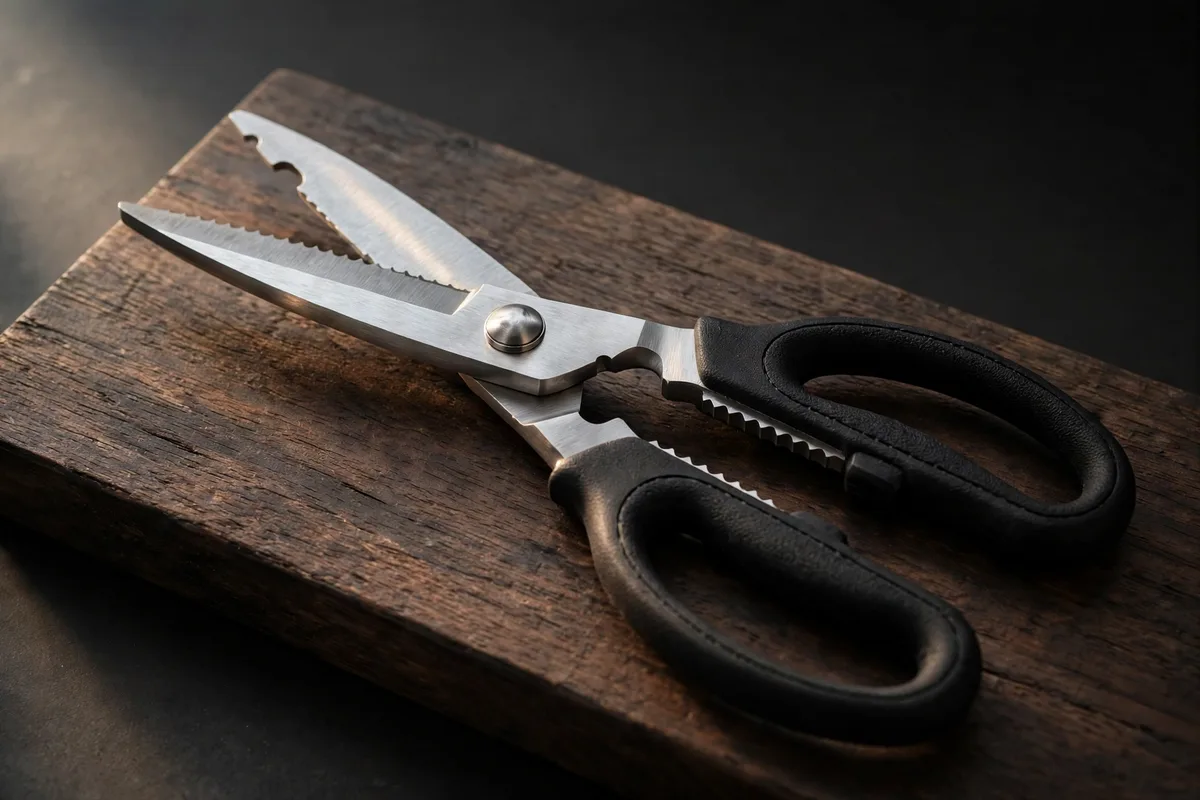
The Shun Premium shears are what happens when a Japanese blade house treats scissors as cutlery: forged high-carbon stainless blades with the brand’s characteristic edge geometry — one micro-serrated blade that grips poultry skin and fish without skating, one smooth blade that does the cutting — joined by a take-apart pivot that separates for a complete wash and closes with the wobble-free precision the category’s cheaper hinges promise and rarely deliver. The handles are elastomer-padded, sized for a full power grip, and balanced like a tool meant to be used for an hour, not a minute.
In work, they are the strongest all-rounders here: a chicken spatchcocks without the hand fatigue that ends lesser shears’ attempts, herbs snip cleanly rather than crushing, and the bone notch near the pivot gives leverage exactly where joints resist. Kai’s steel holds its edge through the kind of year that sends soft-stainless shears to the sharpener twice, and the brand’s sharpening ecosystem supports the blades for their life.
Canadian availability runs through proper kitchen retailers, at a price that buys the pair once. For the cook who has replaced three disappointing shears in five years, the arithmetic is familiar and decisive: this is the pair that ends the cycle, and the guide’s benchmark for what shears can be.
The Shun’s take-apart joint has a discipline worth copying at any tier: it separates with a deliberate quarter-turn that cannot happen by accident mid-cut, so the hygiene benefit never trades against the fear of the blades parting in your hand — the design detail that makes the feature trustworthy.
Yay · Pros
- Forged Japanese steel; superb edge retention
- Take-apart pivot with zero-play precision
- Full power-grip handles; bone notch leverage
Hmm · Cons
- Premium price
- Hand-wash discipline, like all fine edges
- Too precious for junk-drawer abuse
Best for: Serious cooks who want the decade pair Skip if: Your shears open boxes daily — protect this edge; buy the Fiskars as the beater pair
2. KitchenAid All Purpose Kitchen Shears — Best household standard
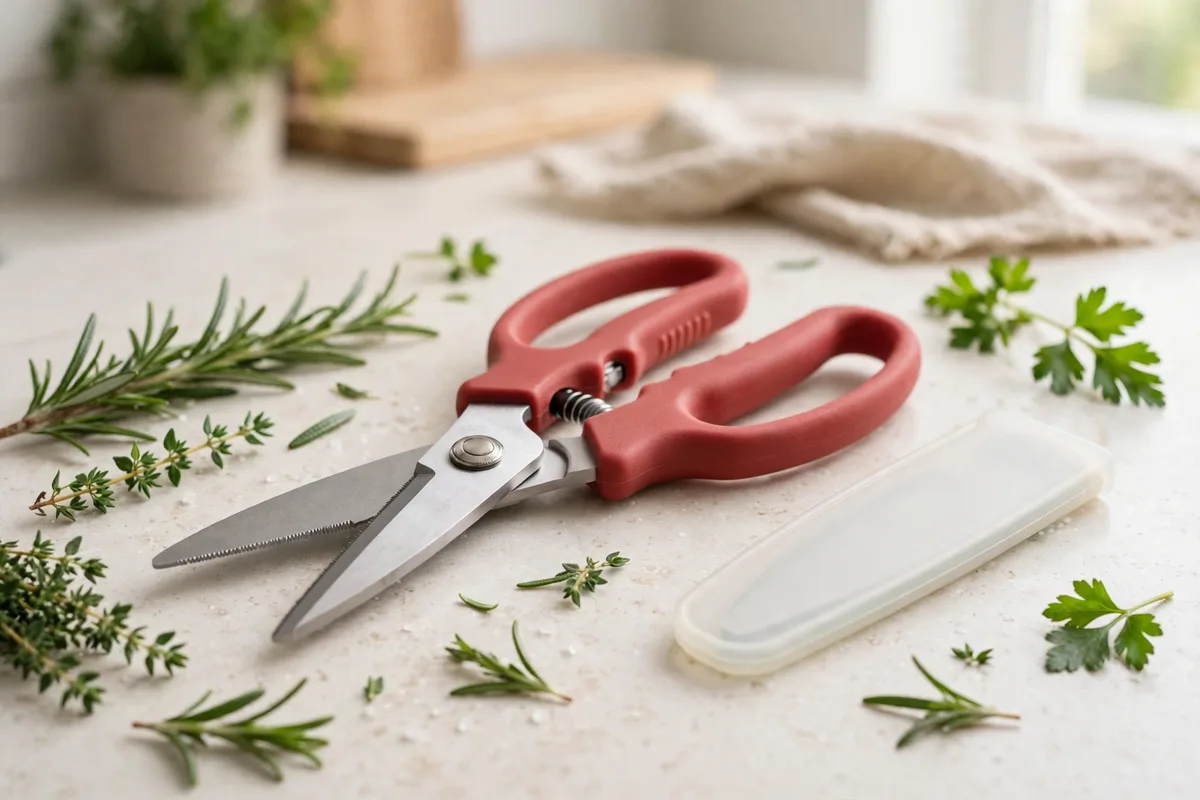
KitchenAid’s All Purpose shears are the pair already in half the continent’s drawers, and the design earns the ubiquity: micro-serrated stainless blades that grip what they cut, a soft comfort-grip handle that survives long sessions, and a protective sheath that keeps the edge (and your fingers, in the drawer) safe. They are the balanced middle of the category — sharp enough for herbs and chickens, cheap enough to replace without grief, sturdy enough that replacement is rarely needed.
The honest compromises are the fixed pivot — the joint cannot be separated for the full wash the take-apart picks allow, so poultry sessions end with extra care around the hinge — and a steel that wants a touch-up sooner than the Japanese blades. Against that, the KitchenAid’s ergonomics are the friendliest here for average hands, and its cutting action has the smooth, single-resistance feel that separates real shears from stamped ones at any price.
Canadian availability is total, and the price routinely dips into impulse territory on sale. For the household buying one pair to do everything reasonably well — and keeping a beater for the boxes — this is the standard recommendation, outsold by nothing in this guide for good reason.
KitchenAid’s sheath deserves its sentence: shears stored sheathed keep their edge off the drawer’s metal traffic and their points out of reaching fingers, and the number of drawer injuries the humble sheath prevents across a decade is the quietest safety statistic in the kitchen.
Yay · Pros
- Balanced cutting; comfort grip; sheath included
- Micro-serrated grip blade
- Everywhere in Canada; frequent sale prices
Hmm · Cons
- Fixed pivot — wash carefully around the joint
- Steel is softer than the Japanese picks
- Handles snug for very large hands
Best for: Most households — the reliable standard Skip if: Raw-chicken hygiene is your top concern — a take-apart pivot washes completely
3. Tojiro Kitchen Shears FK-843 (Take-Apart) — Best for knife people
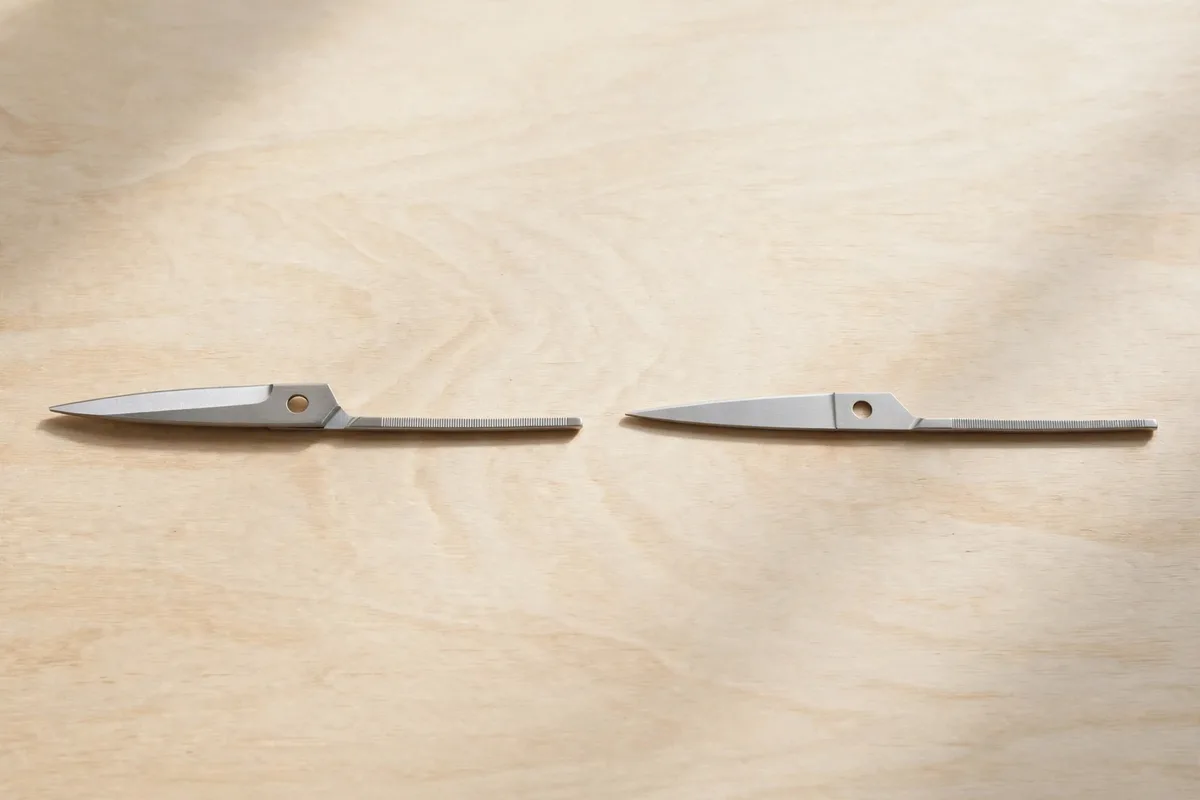
Tojiro’s FK-843 is the knife person’s shear: a Japanese take-apart design in the maker’s stainless, with slim, hard blades that cut with the crisp, exact feel of the brand’s gyutos, and a pivot that separates for washing with machined precision. Where the Shun adds padding and polish, the Tojiro is the tool in its working clothes — lighter in the hand, quicker in herb work, and possessed of an edge that glides through poultry skin and fish with the least effort in this guide.
The trade-offs are the enthusiast’s usual ones: no elastomer padding for marathon sessions, a finish that prioritizes the cut over the photograph, and Canadian availability through specialty Japanese-knife retailers rather than every kitchen aisle — order it where knife people order, and the warranty conversation is a knowledgeable one. The steel’s hardness rewards the whetstone-literate owner with years between sharpenings.
For the cook whose knife roll already speaks Japanese, this is the shear that matches it — precision first, decoration never — at a price well below the Shun’s flagship tier. It is the connoisseur’s value pick, and the sharpest object in this guide.
The Tojiro’s slim profile earns it a second station in many kitchens: it is the shear that lives in the knife roll and travels — to the cottage, the rental, the friend’s under-equipped kitchen — because great cutting in a flat, light package is portable in a way the padded flagships are not.
Yay · Pros
- Hard Japanese steel; the keenest cut here
- Precise take-apart pivot
- Light, quick handling for herb work
Hmm · Cons
- Utilitarian finish; no comfort padding
- Availability varies in Canada — specialty import
- Hand-wash only, like all fine steel
Best for: Knife enthusiasts who value Japanese steel at a working price Skip if: You want padded comfort for long, forceful sessions
4. Messermeister Take-Apart Kitchen Scissors (8-Inch) — Best take-apart value
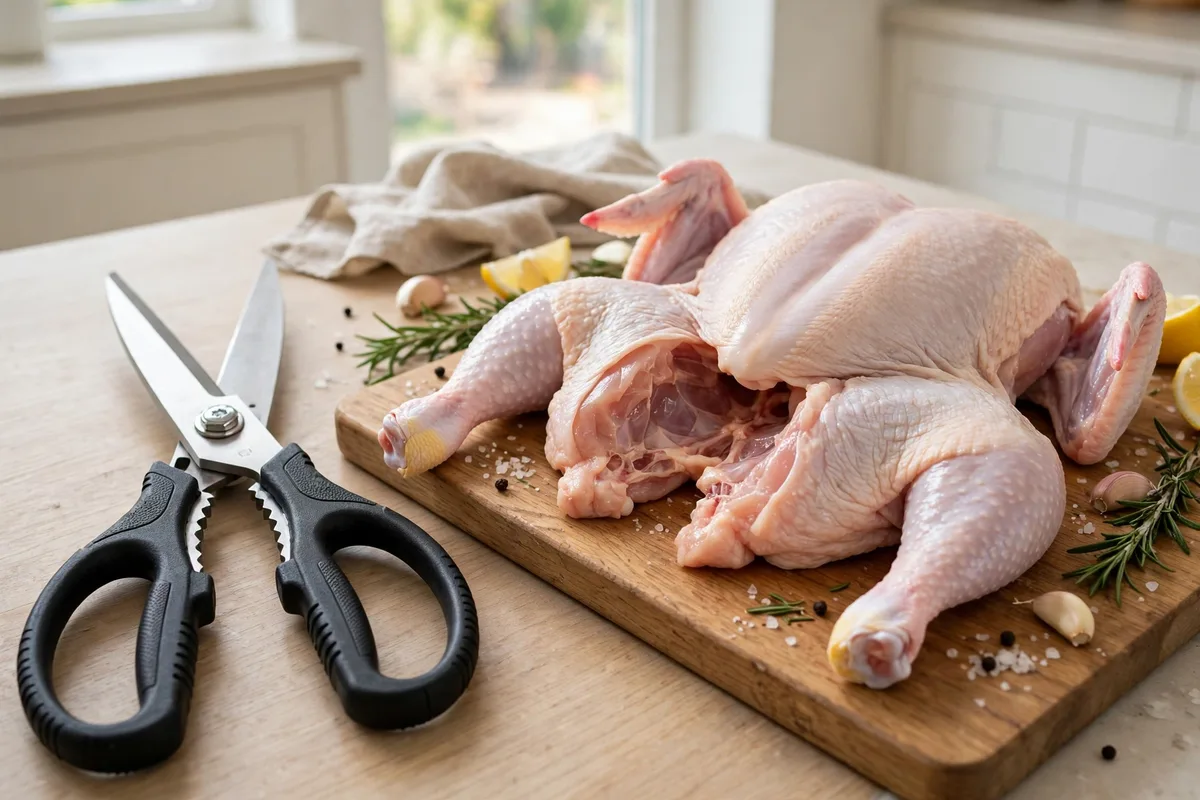
Messermeister’s take-apart shears are the hygiene-first design executed at a working price: the blades separate completely — the pivot is the brand’s signature mechanism — so every surface that touched the raw chicken can be washed, dried and inspected, with no residue retiring to the joint. The blades pair a micro-serrated grip edge with a smooth cutter, add the category’s useful extras (a bone notch, jar and bottle grips in the handles), and cut with a sturdiness that handles weekly spatchcocking without complaint.
Comfort is the honest compromise: the handles are slimmer than the Shun’s padded loops, so marathon sessions favour bigger, softer grips — for the household whose shear work is bursty (a chicken, a bunch of herbs, the packaging), the difference rarely binds. The steel is a mid-hardness stainless that sharpens easily and needs it more often than the Japanese picks; the take-apart design at least makes that maintenance pleasant.
Canadian availability is good through kitchen retailers, and the price sits in the sensible middle. For the household whose first question is ‘can I get it truly clean?’ — a question this guide respects as the correct first question for poultry tools — Messermeister is the answer with the strongest mechanism per dollar.
Messermeister’s handle grips — the little bottle and jar openers moulded into the loops — sound like gimmickry until the first stuck lid at a campsite or the first crown cap with no opener in the drawer; working tools earn their extras by being present, and these always are.
Yay · Pros
- Fully separating pivot — the complete wash
- Bone notch and handle grips included
- Mid price; sturdy working build
Hmm · Cons
- Slimmer handles than the Shun for big jobs
- Steel wants regular touch-ups
- Less refined finish than the leaders
Best for: Poultry-heavy households prioritizing washable hygiene Skip if: You want the keenest edge — the Japanese picks cut finer
5. Fiskars Softgrip Kitchen Shears — Best budget & comfort
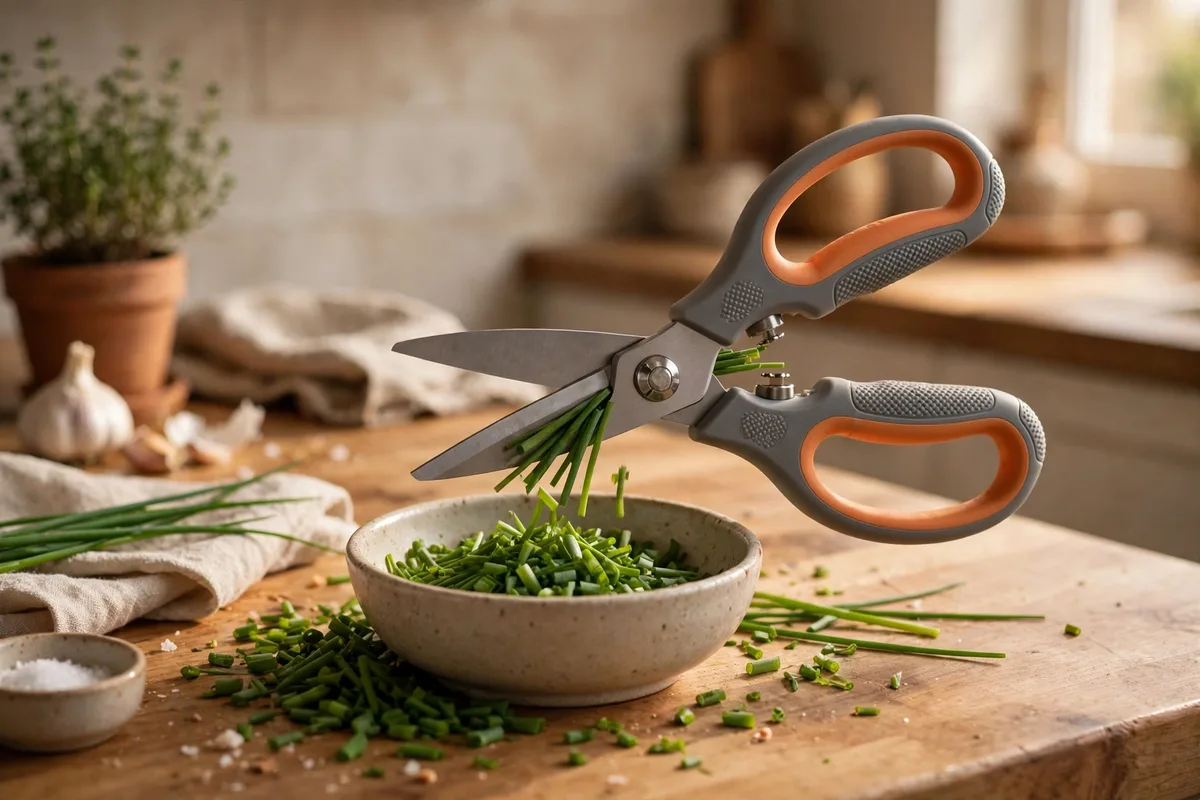
Fiskars’ Softgrip shears are the comfort-and-price pick: the Finnish brand’s ergonomic handle — cushioned, contoured, and genuinely kind to arthritic or tired hands — paired with serrated stainless blades that handle the kitchen’s daily cutting (herbs, packaging, pizza, salad snipping) without drama. The Softgrip loop design is the reason occupational therapists recommend the brand, and for light-duty households it may be the only specification that matters.
The limits are the budget tier’s limits: a fixed pivot that cannot be fully washed inside, a softer steel that dulls sooner — fastest if the shears moonlight on cardboard — and a cutting force that stops short of confident poultry work. Within its brief, none of that is a flaw; the guide places it as the light-duty and second-pair champion, the beater that protects your good shears’ edges from the junk drawer’s demands, per the two-pair system in the deep-dive.
Canadian availability is universal and the price is the lowest here by a wide margin. Buy two: one for the kitchen’s light work, one for everywhere else, and let the premium picks above stay sharp for food.
The Fiskars’ orange grip is a findability feature as much as a comfort one: in a cluttered drawer or a dim pantry it is the tool the eye lands on first, which is why so many households report it is, in practice, the most-used shear they own.
Yay · Pros
- Best-in-class ergonomic comfort grip
- Lowest price in the guide
- Perfect second/beater pair
Hmm · Cons
- Fixed pivot; basic steel dulls fastest
- Not a poultry-power tool
- Plastic-forward build
Best for: Budget buyers, sore hands, and the beater-pair role Skip if: You need poultry power or a washable pivot
Take-apart or not: the hinge decision that decides a shear’s life
A kitchen shear’s blades harbour what its work creates: raw chicken residue, herb oils, and the moisture of a hundred rinses, all migrating to the one place a cloth cannot reach — the pivot. That is the entire case for take-apart designs: a hinge that separates lets both blades and the joint itself be washed completely, dried fully, and inspected honestly, which is why food-safety-minded reviewers and poultry-heavy households treat separability as the category’s first specification. A fixed pivot can be washed well; it cannot be washed completely, and the difference compounds over years.
The counter-argument is mechanical: a take-apart hinge must be engineered to separate on purpose but never in use, and the cheap versions fail exactly there — blades that wobble, joints that loosen, a screw that backs out mid-chicken. The good designs in this guide solve it with interlocking or precisely toleranced pivots that feel like fixed shears until the moment you twist them apart. Judge any take-apart shear by its closed feel: zero lateral play, a smooth single resistance through the cut. If it rattles in the store, it will disgust you in the sink.
Cutting performance itself is blade geometry: a micro-serrated edge on one blade grips slippery food (poultry skin, fish, twine-wrapped roasts) while the smooth blade does the cutting, and a curved blade profile keeps the food from squirting forward out of the cut — the ‘walking’ frustration of straight, cheap shears. Steel hardness decides how long that performance lasts: Japanese shears at the guide’s top hold their edges through years of bone-adjacent work, while soft stainless needs the sharpener’s regular attention. Shears can be sharpened — the smooth blade like a knife, the serrated one only by a professional — which is why the steel matters.
Handles are the third life-decider: spatchcocking a chicken is a force task, and a handle that fits only fingertips will bruise a palm long before the bird is flat. Look for loops that admit a full grip, a lower loop sized for two or three fingers’ power, and a surface that stays grippy with wet, fatty hands. The spring-loaded poultry specialists trade all-day comfort for cutting force; the all-purpose picks trade a little force for a handle you can use for an hour of herb and packaging work without thinking about it.
And the drawer reality that ends the science: shears are the most borrowed tool in the kitchen — packages, twine, cardboard, the occasional zip-tie — and every non-food cut dulls them toward uselessness for food. Serious kitchens keep two pairs: the good shears for food only, and a beater pair for the junk drawer’s demands. That two-pair system, more than any single purchase, is what ‘sharp shears, always’ actually looks like.
One test separates good shears from great ones in ten seconds, in any store: cut a single sheet of paper towel — or better, a piece of raw chicken skin stretched lightly — with the tips of the blades, the weakest point of the cut. Shears that bite cleanly at the tip, without folding the material, have the blade alignment and tension that the whole category promises; shears that chew at the tip will chew at everything, forever, whatever their handle feels like. It is the only audition that matters, and it cannot be faked by packaging.
Kitchen shears questions, answered
Are take-apart kitchen shears really better?
For most households, yes: take-apart (come-apart) shears let you wash the pivot completely — the spot where raw chicken residue hides in fixed shears — and dry it fully, which is the strongest hygiene argument in the category. The condition is build quality: a good take-apart hinge has zero wobble when closed. If a model rattles or feels loose in hand, choose a fixed pair instead.
Can kitchen shears be sharpened?
Yes, the smooth blade sharpens like a knife on a whetstone or with a pull-through sharpener’s fine stage. The micro-serrated blade should not be sharpened at home — its teeth need professional equipment to restore. In practice, sharpening the smooth blade restores most of the cutting feel, and quality steels (like the Japanese picks in this guide) need it rarely.
What is the difference between poultry shears and all-purpose shears?
Poultry shears add a curved blade that cradles the bird, a spring that reopens the blades against resistance, and usually a bone notch near the pivot for leverage through joints. All-purpose shears can spatchcock a chicken — the top picks here do it well — but a household that breaks down birds weekly will feel the specialist’s advantages in force and comfort. Occasional spatchcockers are fine with the best all-purpose pairs.
Can I use kitchen shears instead of a knife for herbs and vegetables?
Quality shears cut herbs, pizza, bacon, and soft vegetables beautifully, and they are the fastest tool for snipping chives, trimming green beans, and portioning a quesadilla. They do not replace a chef’s knife for board work — dicing, mincing, and anything needing a flat surface — because the food has nowhere to rest. Think of shears as the knife’s partner for in-hand and in-pan cutting.
How should I wash and store kitchen shears?
Hand-wash and dry immediately, especially take-apart models: separate the blades, wash the pivot faces, dry fully, and reassemble. Dishwashers dull edges and trap moisture in pivots, and carbon-rich steels can spot. A drop of food-safe mineral oil on the pivot a few times a year keeps the action smooth for decades.
Why do my kitchen shears keep going dull?
Keep two pairs: your good shears for food only, and an inexpensive pair for the junk-drawer work — packages, cardboard, twine, zip-ties — that dulls edges fastest. It is the system professional kitchens use, and it costs less than replacing one premium pair whose edge died opening boxes.
A closing note on left-handed households, because shears are quietly handed tools: most kitchen shears are ground and handled for right hands, and a left-handed user forcing them gets a cut that pushes material apart instead of shearing it — the blades’ overlap works against them. True left-handed models exist from several makers (Fiskars among them), and ambidextrous designs with symmetrical handles and reversible blade orientation serve mixed households best. If the shears in your drawer have always felt slightly wrong in one partner’s hand, this is why, and the fix is a specification, not a technique. Check the handedness before you buy; the picks above are right-hand standard unless a left-hand variant is listed by the maker.
Storage is the last small discipline: shears belong in a knife block’s scissor slot, on a magnetic strip, or sheathed in the drawer — never loose among the metal utensils, where every rummage dings the edges against spoons and openers. The take-apart pairs store best assembled and dry; a separated pair in a damp drawer is a rust appointment. Thirty seconds of storage sense preserves the edge that everything else in this guide worked to choose.
The short version
Buy the Shun Premium for the decade pair, or the Messermeister if the fully washable pivot leads your list at a mid price. The KitchenAid is the household standard, the Tojiro is the knife-lover’s blade, and the Fiskars Softgrip is the comfort and beater-pair champion. Whatever you choose, keep a second cheap pair for boxes and cardboard — your good shears’ edge will thank you at every chicken.
Last updated: November 18, 2026. We refresh this guide each season and whenever a pick is replaced by a better one.