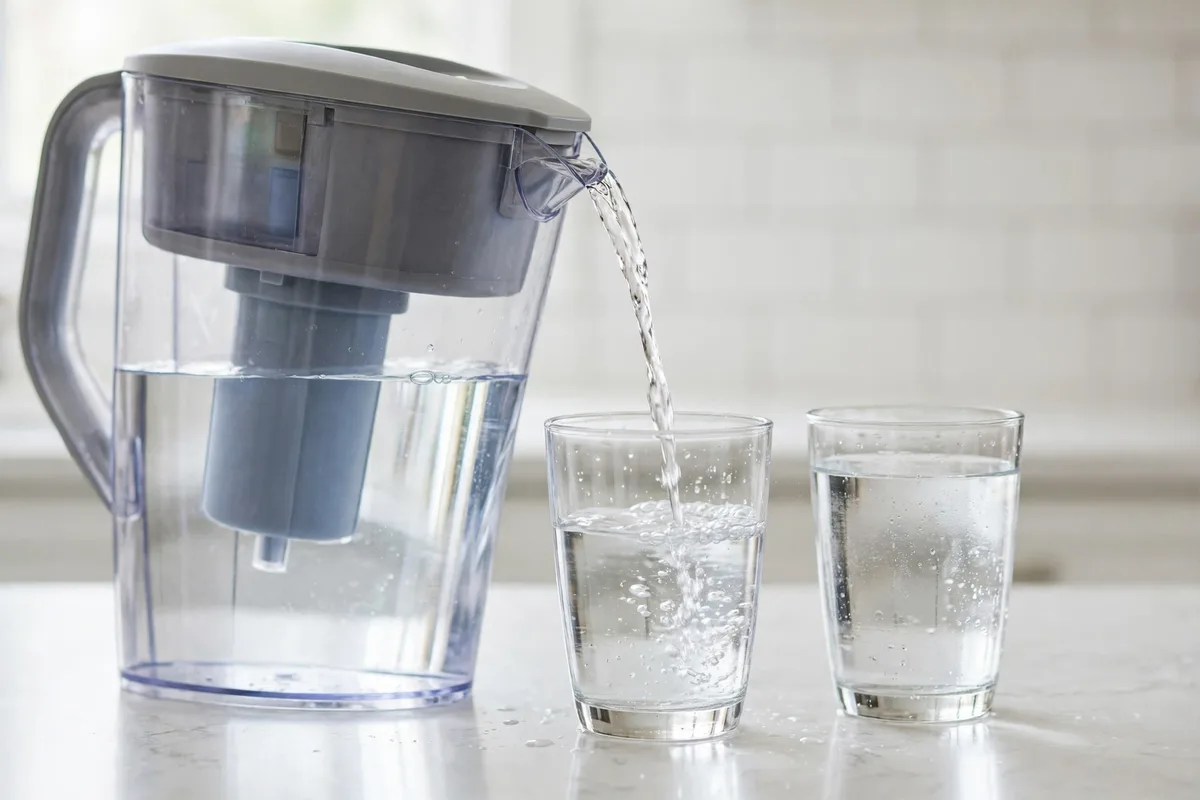
A water filter pitcher is the simplest step between tap water and better water: no plumbing, no installation, nothing under the sink — fill it, wait a few minutes, pour. What makes choosing one harder than it should be is the marketing. Nearly every box in the aisle claims to reduce 99% of something, and the claims are not lying so much as they are incomplete: the honest differences between pitchers are which contaminants the filter is certified — not merely tested — to reduce, how many gallons a cartridge lasts before that certification runs out, and how much of the pitcher is actually filtered water at any given moment. This guide compares the five pitchers that matter in Canada and the USA on exactly those terms: certifications first, filter life second, capacity and running costs after that. It also says plainly where a pitcher is the wrong tool and a countertop reverse osmosis system is the right one.
How to use this page: we do not print prices here. Pitcher prices and bundle deals move constantly, and unevenly between the Canadian and US stores, so a number printed on a webpage would be stale within days. Every button below opens the live price on Amazon Canada or Amazon USA, so the price you see is the true one at the moment you tap. Shopping the late-November sales? Our Black Friday kitchen deals watchlist tracks which kitchen categories are genuinely discounted this season — and how to spot the fake discounts.
Disclosure: CookSmartPicks is reader-supported. When you buy through links on this page, we may earn an Amazon commission at no extra cost to you. Prices and availability change often — check the current price on Amazon before you decide.
How we chose these water filter pitchers
CookSmartPicks is a research-based guide. We do not run a test lab, and we never claim hands-on testing we have not done. For this list we worked from the documents that actually govern this category: each manufacturer’s published performance data sheet, the certification listings of the three accredited bodies that certify drinking-water filters (NSF International, the Water Quality Association and IAPMO), and independent coverage and laboratory testing from Wirecutter and TechGearLab. Three filters of our own decided the lineup. First, a pitcher had to carry a certified reduction claim for lead, or a distinctive verified capability no mainstream pitcher has — taste-only filters did not make the page. Second, it had to be sold properly in both Canada and the USA, with local warranty and returns. Third, its filter life had to be stated in gallons by the manufacturer, because that number — not the sticker price — decides what a pitcher costs to own.
One boundary, stated up front. A pitcher is the no-install segment of water filtration: it lives in the fridge door and asks nothing of your plumbing. It is not the strongest filtration you can buy. If your concern list is long — fluoride and PFAS and lead and everything else — the countertop systems in our guide to the best countertop reverse osmosis water filters reduce more, and reduce more of it under certification. This page is for the much larger group of readers whose water needs one or two specific things fixed, without a plumbing project.
What the certifications actually mean
Three NSF/ANSI standards do nearly all the work in this category. Standard 42 covers taste and odour — chlorine, mainly. Every filter here holds it; it is table stakes, not a reason to buy. Standard 53 is the health-effects standard: lead, mercury, cadmium, volatile organic compounds — and it is where PFAS claims live. A pitcher certified under 53 for lead has been independently verified to reduce lead to the standard’s limit across its whole rated filter life. Standard 401 covers emerging contaminants: microplastics and a list of pharmaceuticals and pesticides. When this guide says a filter is “certified for” something, it means one of the accredited bodies — NSF, WQA or IAPMO — tested it against the named standard and keeps it under audit.
Two phrases deserve a reader’s suspicion, because the category trades on both. “Tested to NSF standards” is not certification. It means a laboratory ran the standard’s protocol, usually once, usually paid for by the brand. The data can be perfectly real — one pick below publishes exactly this kind of testing, and publishes it in full — but it is a test report, not a certification, and this guide keeps the two in separate columns. And “PFAS” is not one claim. The older certified claim covers two compounds, PFOA and PFOS. The newer Total PFAS claim covers seven. A box that says “reduces PFAS” may mean either; the performance data sheet says which. A related honesty note: NSF’s own contaminant guide lists no pitcher certification for fluoride at all — fluoride reduction is certified for reverse osmosis systems — so any pitcher’s fluoride claim rests on the maker’s data sheet or lab tests, and is labelled that way below.
The lineup at a glance
| Pitcher | Best for | Why it stands out |
|---|---|---|
| Brita (with the Elite filter) | Most people | 120-gallon filter life, NSF/ANSI 42/53/401 certification including lead — the lowest running cost here |
| PUR PLUS 11-Cup | Certified lead reduction on a budget | WQA-certified for lead, NSF-certified for microplastics; independent lab tests measured 100% lead removal |
| ZeroWater 10-Cup Ready-Pour | Maximum reduction | 5-stage ion exchange to 000 TDS; certified for lead, chromium-6, mercury and PFOA/PFOS — but a 15-gallon rated filter life |
| LifeStraw Home | Bacteria, parasites and microplastics | The only pitcher here with a membrane microfilter, plus a glass option; two filters on two schedules |
| Clearly Filtered | The broadest tested list, fluoride included | 365+ contaminants in published independent lab testing; formal certifications are narrower — the page explains both |
1. Brita with the Elite filter — Best for most people
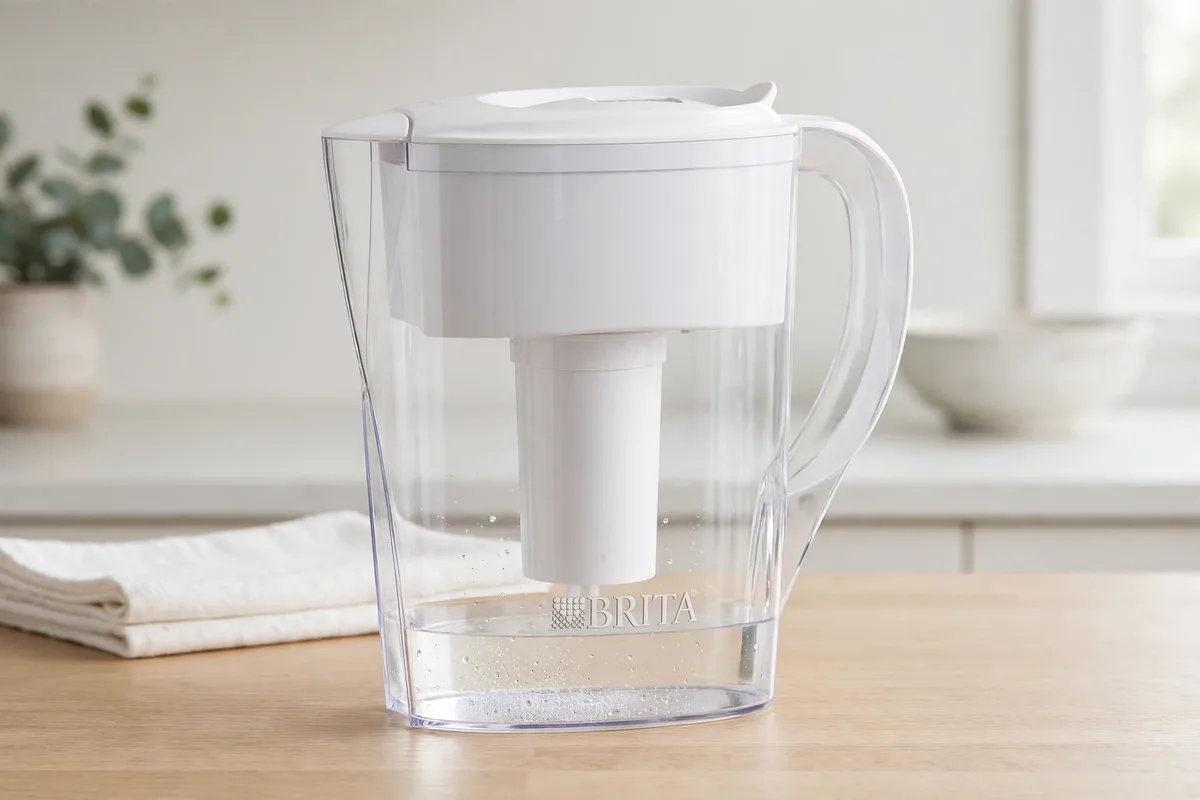
Brita is the default name in this category, but “a Brita” is really two different filters, and the difference is the single most important fact on this page. The Standard cartridge bundled with many pitchers (white, 40 gallons, about two months) is certified for chlorine taste and odour and a short list of metals — and it is not certified to reduce lead. The Elite cartridge (grey, formerly sold as Longlast) is the one this recommendation rests on: Brita’s data sheet lists it as certified to NSF/ANSI 42, 53 and 401, with certified reductions including lead, mercury and microplastics, and Wirecutter calls it “the most comprehensively certified pitcher-type filter we have tested,” listing PFOA and PFOS among its certified reductions. It also lasts 120 gallons — roughly six months — three times the Standard’s life. Buy whichever Brita body suits your fridge (the 10-cup class is the family size; the little 6-cup Metro suits one person; the 27-cup UltraMax dispenser takes the same cartridges), but budget for Elite refills: the pitcher is the cheap part of this purchase, in every sense.
The honest limits are about scope, not quality. Even the Elite’s certified list is a list — specific named contaminants, verified one by one — not a promise about everything in your water, and its PFAS coverage sits at the PFOA/PFOS level rather than the broader Total PFAS claim described above; check the current performance data sheet for the exact certified list before you buy, because certifications are per-contaminant and sheets are revised. Against that, the ownership experience is the easiest here by a distance: filtration is fast, the cartridges are sold in every grocery and drug store in both countries, and at 120 gallons per cartridge the Elite’s cost per gallon is the lowest on this page by a wide margin. For the mainstream worry — lead, taste, and a general tightening-up of municipal water — it is the pick to beat.
Yay · Pros
- The longest filter life here — 120 gallons (about 6 months) per Elite cartridge, and the lowest running cost
- The broadest mainstream certification set: NSF/ANSI 42, 53 and 401, including certified lead and microplastic reduction
- Fast filtration, and refills sold everywhere in Canada and the USA
Hmm · Cons
- The bundled Standard filter is NOT the lead-certified cartridge — the certified performance requires buying Elite refills
- PFAS coverage is at the PFOA/PFOS level, not the broader Total PFAS claim
- The certified list is a specific list — it does not cover fluoride, bacteria or every contaminant a reader might assume
Best for: most households on municipal water — certified lead reduction with the least fuss, the fewest filter changes and the lowest cost per gallon. Skip if: PFAS breadth or fluoride is your main concern — that is ZeroWater and Clearly Filtered territory, below.
2. PUR PLUS 11-Cup — Best certified lead reduction on a budget
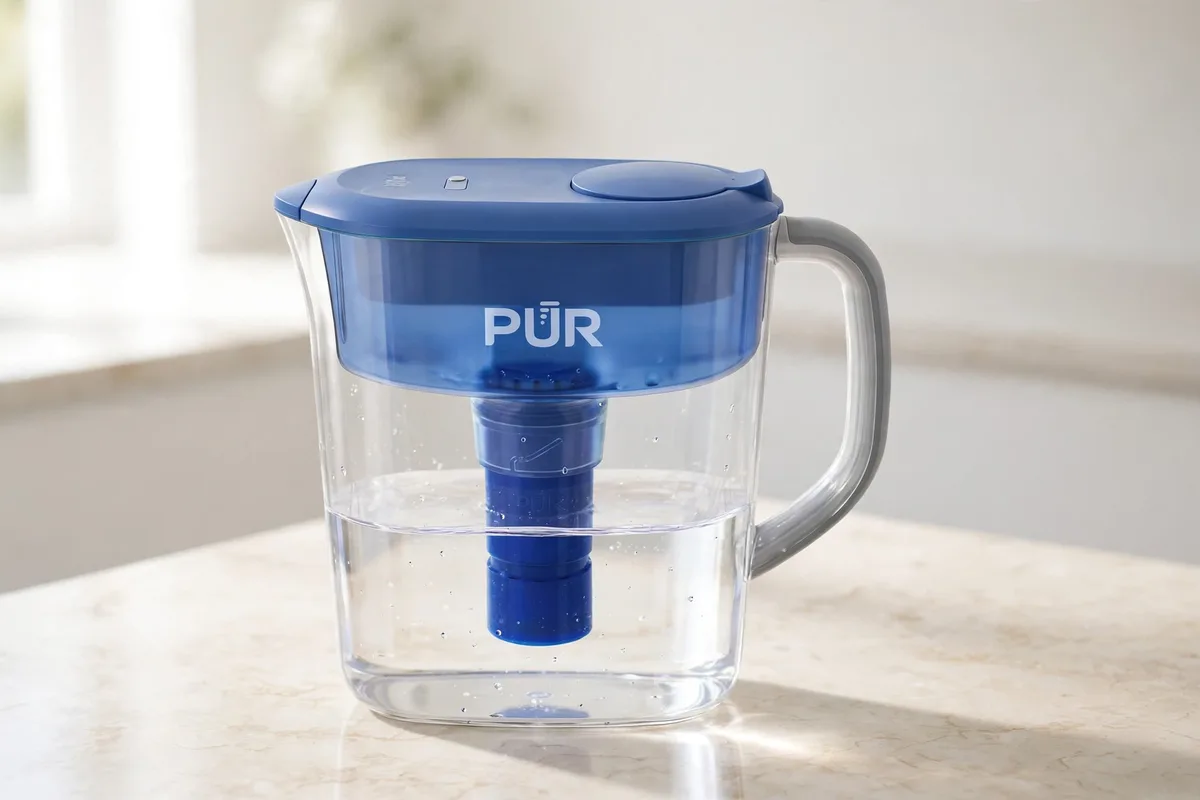
PUR is Brita’s shelf rival, and the PLUS filter is its argument. Per PUR’s performance data sheet, the PLUS cartridge (CRF-950Z) is WQA-certified to reduce lead and NSF-certified to reduce microplastics, chlorine and mercury, with NSF/ANSI 42, 53 and 401 listings behind it — and PUR’s current data sheet adds an IAPMO-certified Total PFAS claim for the PLUS filter. The independent evidence is unusually good for the price: TechGearLab’s laboratory testing of the 11-cup PLUS pitcher measured 100% removal of the lead in its test water (and of arsenic and uranium) and 97% removal of PFAS — test results rather than certifications, but from a lab, not a brochure. That combination — a certified lead claim at a mainstream price, backed by strong independent numbers — is why the PLUS earns the lead-first recommendation for buyers watching the budget.
The trade-offs are frequency and one word on the box. A PLUS cartridge lasts 40 gallons, about two months — you will change it three times as often as a Brita Elite, and over a year that arithmetic closes much of the price gap between the two brands. The denser filter also pours noticeably slower than Brita’s. And the word PLUS is load-bearing: standard PUR filters fit the same pitchers (the 11-cup here, and a 7-cup for smaller households) without carrying the same certifications, so the refill to buy is specifically the PLUS. Buy the right cartridge and this is the strongest certified-lead value in the aisle; buy the wrong one and you own a taste filter.
Yay · Pros
- WQA-certified lead reduction and NSF-certified microplastic reduction at a mainstream price
- Independent laboratory testing (TechGearLab) measured 100% lead and 97% PFAS removal
- Widely sold in both countries, with 7-cup and 11-cup pitcher sizes
Hmm · Cons
- 40-gallon filter life — three times the changes of a Brita Elite over a year
- Filtration runs slower than Brita’s — the price of the denser filter
- Standard (non-PLUS) PUR refills lack the certifications — an easy refill mistake to make
Best for: lead-first buyers on a budget — older homes, older plumbing, and anyone whose city has issued a lead-service-line notice. Skip if: you know a two-month filter rhythm will quietly lapse — the Brita Elite’s six-month cartridge forgives forgetfulness.
3. ZeroWater 10-Cup Ready-Pour — Strongest certified reduction
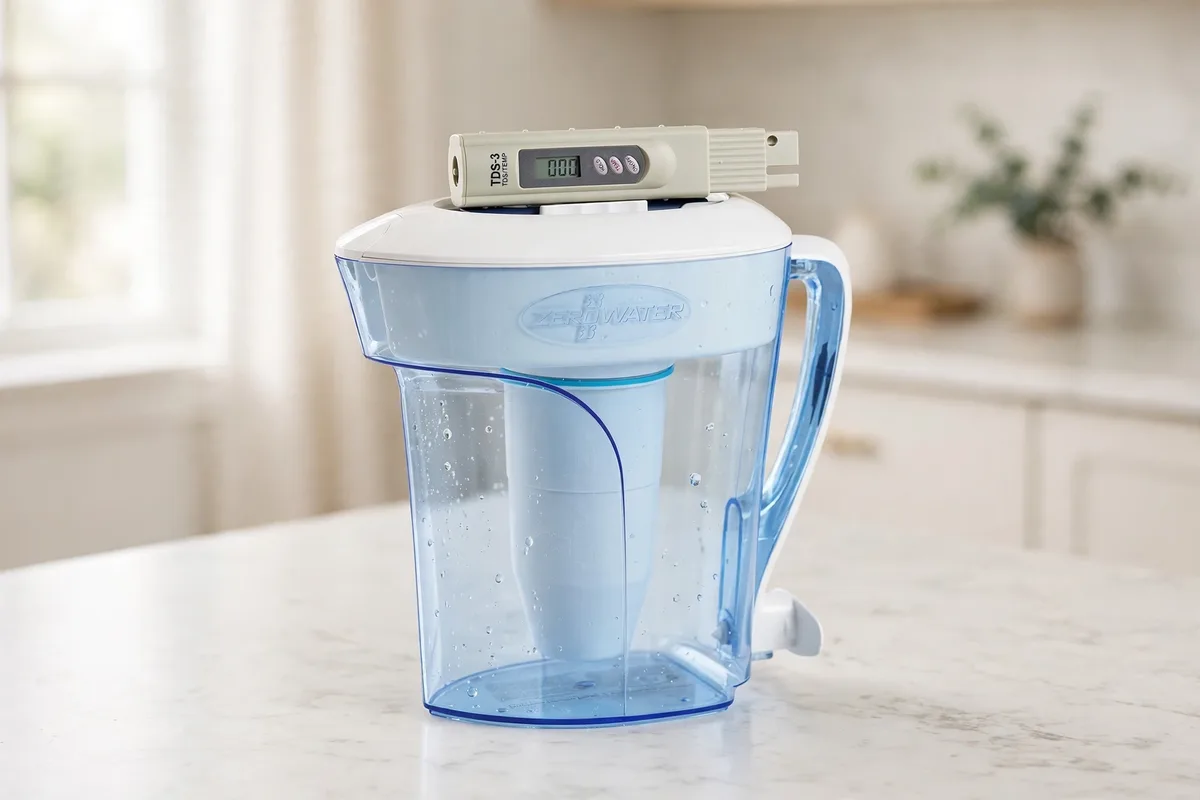
ZeroWater — now sold under the Culligan ZeroWater name — is built on different technology from everything above it. Where the others use carbon, its five-stage cartridge runs water through an ion-exchange bed that strips out dissolved solids almost entirely: the included meter reads 000 total dissolved solids (TDS) on freshly filtered water, against the 100–400 a tap typically shows. The certifications behind it are the strongest in this guide: IAPMO certifies the filter to NSF/ANSI 42 and 53 for lead, mercury, PFOA/PFOS and hexavalent chromium — 99.4% on the brand’s data sheet — a contaminant no other pitcher here is certified for. The current Culligan data sheet goes further, adding a Total PFAS claim (seven compounds), fluoride and nitrate to the certified list. If a specific, serious contaminant is the reason you are buying, this is the pitcher whose paperwork answers it.
Then comes the bill, and it is the honest reason this is not the first pick. Ion-exchange resin exhausts fast: the certified rated life is 15 gallons per cartridge. The brand rates up to about 40 gallons on soft, low-TDS water — and as little as 8 to 15 gallons where TDS runs high, which includes much of the US Southwest and, in Canada, the hard-water Prairie cities. The meter tells you when a cartridge is spent (006 is the change signal), and you should believe it: an exhausted cartridge is a cartridge no longer doing the certified work. Two smaller notes. The water tastes exceptionally clean to most people and flat to some, because the minerals that give water its taste are gone too. And this is a filter for treated municipal water — it is not a microbiological purifier, and it is not the tool for untreated well water or a boil-water advisory.
Yay · Pros
- The strongest certified reduction list in a pitcher — lead, chromium-6, mercury, PFOA/PFOS, with Total PFAS, fluoride and nitrate on the current data sheet
- A TDS meter is included — you can watch the filter work and know the week it stops working
- Ion exchange takes dissolved solids to 000 — the closest a pitcher comes to purified water
Hmm · Cons
- The shortest filter life here by far: a 15-gallon certified rating, and 8–15 gallons in hard water — the highest cost per gallon on this page
- Strips the minerals as well — some drinkers find the taste flat or empty
- Treated municipal water only — not a purifier, and not for wells or boil-water advisories
Best for: contaminant-first buyers who accept the refill cost — chromium-6, fluoride or broad PFAS coverage from a pitcher, with a meter to prove the filter is alive. Skip if: your water is hard and your household drinks a lot — the refill arithmetic will punish you, and the reverse osmosis guide is the better next read.
4. LifeStraw Home — Best for bacteria, parasites and microplastics
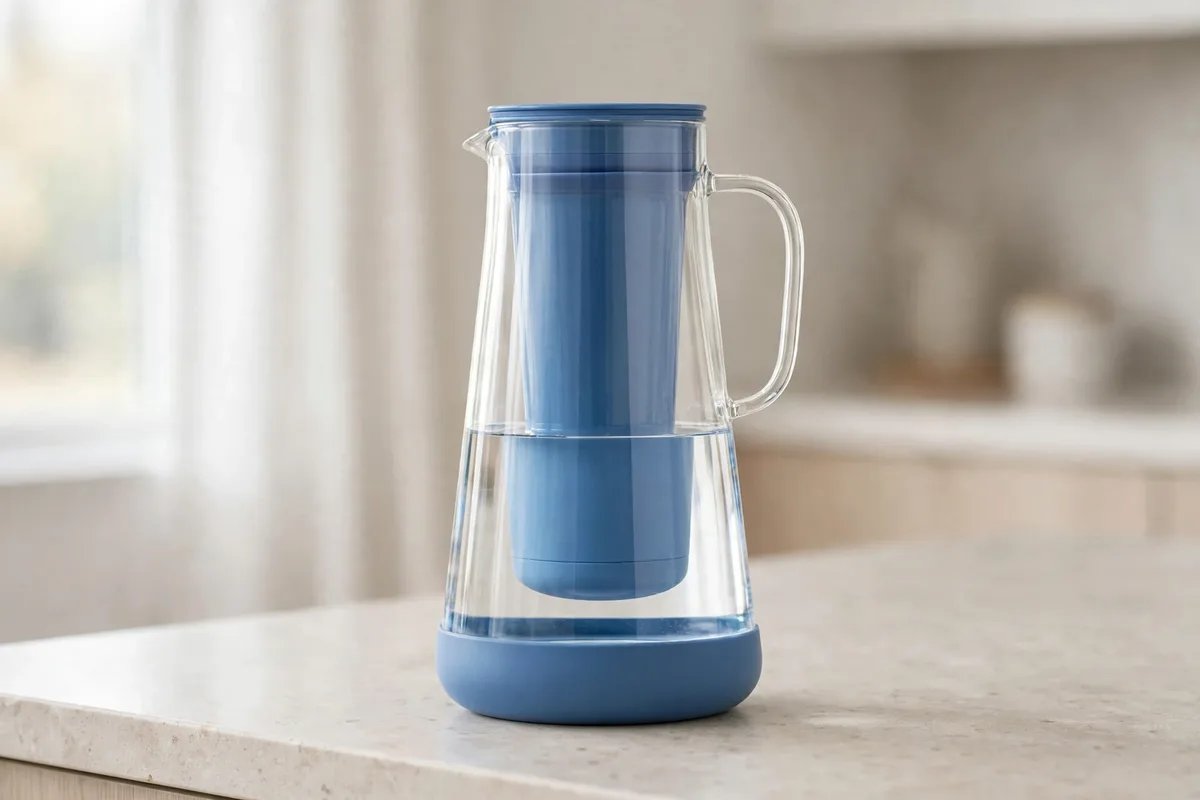
LifeStraw built its name on survival straws, and the Home pitcher is the only one here designed around a membrane. Its 0.2-micron membrane microfilter physically blocks what carbon cannot: per LifeStraw’s published testing, it removes 99.999999% of bacteria, 99.999% of parasites and 99.999% of microplastics, and it meets the US EPA and NSF P231 microbiological purifier protocols — a standard no other pitcher on this page claims. Behind the membrane, an activated-carbon and ion-exchange filter does the chemical work, reducing lead, mercury, chlorine, pesticides and PFAS (PFOA and PFOS); LifeStraw lists the system as WQA-certified to NSF/ANSI 42, 53 and 401. It comes as a 7-cup glass pitcher — the only glass body here — or a 10-cup plastic version, and unlike ZeroWater it keeps the minerals that make water taste like water.
Ownership is the trade. There are two filters on two clocks: the membrane lasts 264 gallons, up to a year, while the carbon filter behind it lasts 40 gallons, about two months — so the recurring purchase resembles the mainstream brands’, with a yearly membrane on top. The membrane also makes this the slowest pour in the guide, and the glass pitcher is the smallest capacity here. LifeStraw states plainly that the system does not reduce fluoride. Who is it for, then? Households whose supply occasionally lets them down — cottages, rural fringes, older buildings with tired plumbing — travellers filling from unfamiliar taps, and anyone whose specific worry is microplastics or microbes rather than metals. During an official boil-water advisory, follow the advisory; a pitcher is a layer, not an authority.
Yay · Pros
- The only pitcher here with a membrane tested to a microbiological purifier standard (US EPA / NSF P231) — bacteria, parasites and microplastics
- A certified chemical side as well: WQA-certified to NSF/ANSI 42, 53 and 401 per LifeStraw, including lead and PFAS reduction
- A glass pitcher option, and the membrane lasts a full year
Hmm · Cons
- Two filters on two replacement schedules — the carbon cartridge still changes every ~40 gallons
- The slowest filtration here, and the 7-cup glass pitcher is the smallest capacity
- Premium pricing, and no fluoride reduction (LifeStraw states this itself)
Best for: microbe- and microplastic-first buyers, cottage and rural-fringe households, and anyone who wants glass on the counter. Skip if: you want the set-and-forget simplicity and price of the mainstream pair — that is Brita and PUR.
5. Clearly Filtered — Broadest tested list, fluoride included
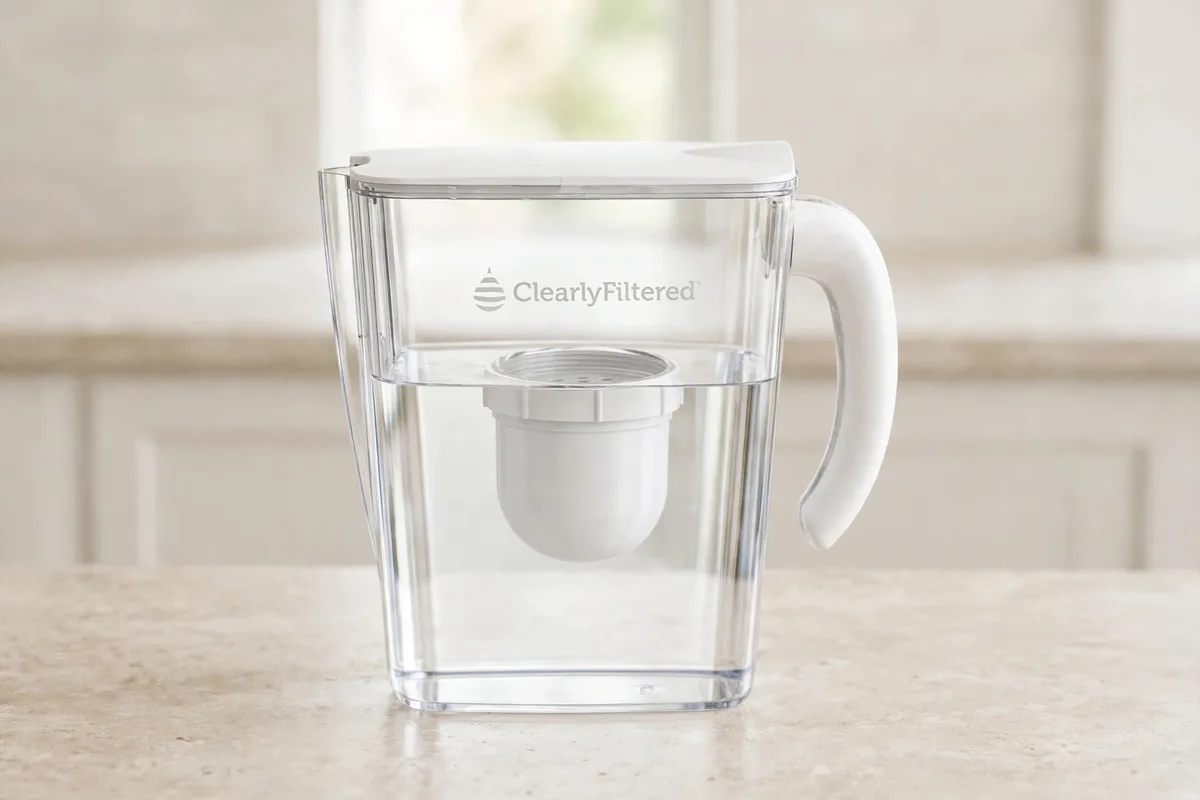
Clearly Filtered makes the boldest claim in the category — its pitcher targets 365+ contaminants — and the honest way to present it is in the two columns this guide has used throughout. In the certified column: the pitcher is certified to NSF/ANSI 42 (chlorine taste and odour) and 372 (lead-free materials), and WQA-certified for PFOA and PFOS reduction. In the tested column — which is where the 365+ list lives — the company publishes independent laboratory reports from an ISO 17025-accredited lab (IAPMO New Jersey) run to NSF/ANSI protocols, showing reductions across that long list, fluoride at over 99.5% among them. That tested column is genuinely the broadest evidence base any pitcher here offers, and the company deserves credit for publishing the underlying reports where most brands publish adjectives. The reader should simply know which column a given claim sits in — certification is audited and ongoing; a lab report is a result, once, under lab conditions.
The practical profile: a 10-cup pitcher whose filter is rated for 100 gallons — about four months in a typical household — which softens the premium price more than the sticker suggests. Filtration through the dense media is slow, closer to LifeStraw’s pace than Brita’s. And it is a smaller, US-centred brand: Canadians should check the Amazon.ca listing and the return terms before ordering, because support and refills do not have the grocery-store footprint of Brita or PUR. Buy it for the fluoride line and the published data, with your eyes open about the certification column, and it is a rational premium pick.
Yay · Pros
- The broadest independently tested contaminant list here — 365+ targets, fluoride over 99.5% in published lab testing
- The company publishes its underlying lab reports — a level of transparency the bigger brands do not match
- A 100-gallon filter life keeps the annual refill count reasonable despite the premium price
Hmm · Cons
- Most of the famous list is lab-tested, not certified — the formal certifications (NSF 42/372, WQA PFOA/PFOS) are narrower than the marketing
- Premium pricing, and slow filtration through dense media
- A smaller US-centred brand — Canadian buyers should confirm listing, refills and returns first
Best for: fluoride-first and breadth-first buyers who read data sheets and value published test evidence. Skip if: you want the breadth under certification rather than testing — that is ZeroWater — or the lowest running cost, which is Brita’s.
How to choose the right water filter pitcher
Start with your contaminant, not the brand. This category is five different answers wearing the same shape. Lead: the Brita Elite or the PUR PLUS, both certified. PFAS: ZeroWater carries the broadest certified claim (Total PFAS on its current sheet); Clearly Filtered carries the broadest tested one. Fluoride: ZeroWater’s current data sheet lists a certified claim, Clearly Filtered publishes test results, and no other pitcher here touches it. Bacteria, parasites, microplastics: LifeStraw’s membrane. Taste alone: honestly, any of them — including the cheap Brita Standard this page warned you about, which is a perfectly good taste filter as long as nobody mistakes it for a lead filter.
Do the refill arithmetic before you fall in love. Filter life is quoted in gallons, and a household’s year is easy to estimate: at two gallons a day of drinking and cooking water — a modest family figure — you will filter about 730 gallons a year. That is roughly 6 Brita Elite cartridges, 7 Clearly Filtered cartridges, 18 PUR PLUS or LifeStraw carbon cartridges, or somewhere between 18 and 45 ZeroWater cartridges depending on your water’s TDS. Divide any pitcher’s price advantage by those numbers before deciding it is cheaper. The pitcher is a down payment; the filters are the mortgage.
Read capacity honestly. A “10-cup pitcher” is 10 cups of pitcher — roughly half of it is the upper reservoir holding unfiltered water, so the filtered-and-ready amount at any moment is closer to five or six cups. For a couple, that is fine. For a family filling bottles and a kettle every morning, look at the dispenser formats (Brita’s 27-cup UltraMax, and the large dispensers ZeroWater and LifeStraw both sell on the same filter systems), or accept the twice-a-day refill as part of the routine.
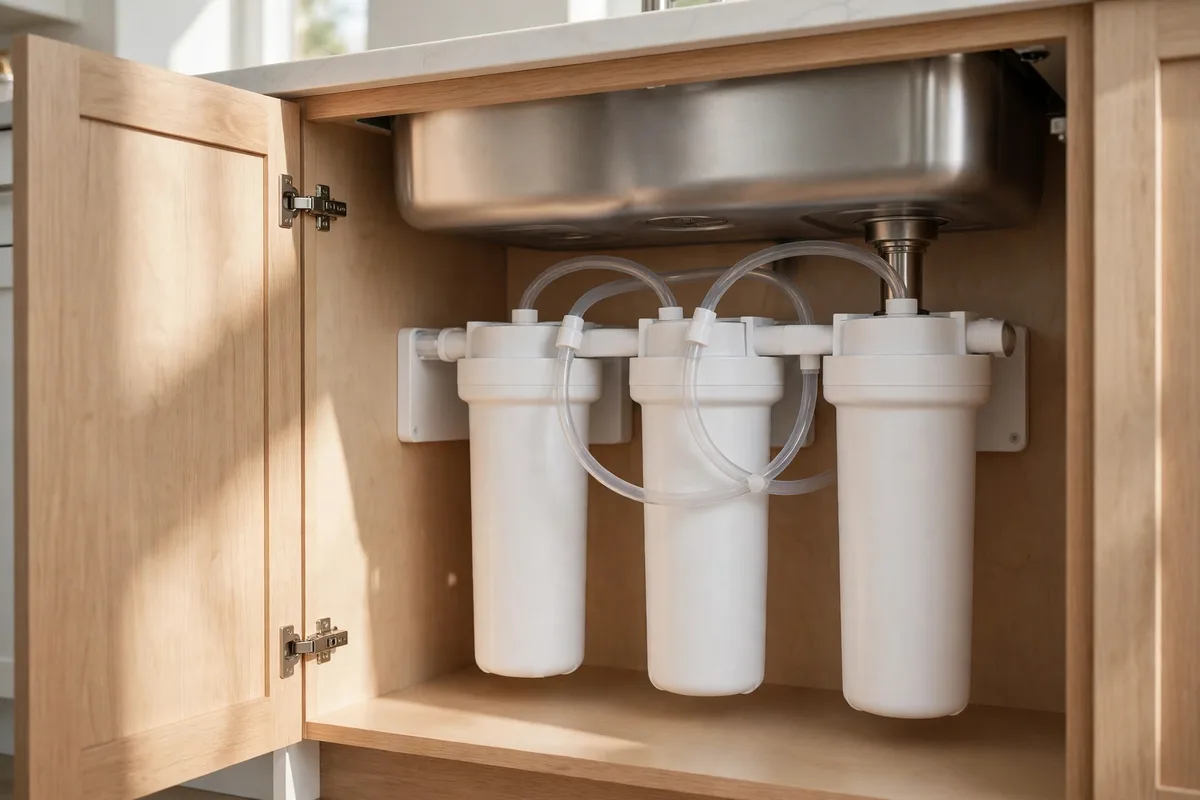
Know when a pitcher is the wrong tool. If your list reads fluoride and PFAS and lead and hard-water scale, or your household filters five gallons a day, the per-gallon economics flip: the countertop reverse osmosis systems in our countertop reverse osmosis guide reduce a broader list under certification — fluoride included — at a lower cost per gallon once the unit is on the counter. A pitcher wins on simplicity, renters’ rules and fridge-door convenience; it does not win on total reduction, and pretending otherwise is how readers end up owning both.
Canadians: buy it in Canada, and mind your water. Every pick here is sold on Amazon.ca, in Canadian dollars, with local warranty and returns — worth having for the brands whose refills you will reorder for years. One regional note with real money in it: Prairie tap water runs hard and high in dissolved solids, which is precisely the water that shortens a ZeroWater cartridge to its 8-to-15-gallon floor. In Calgary, Regina or Winnipeg, the ZeroWater math above gets worse and the Brita Elite’s gets relatively better; on the softer water of the coasts and the Great Lakes, the gap narrows.
Water filter pitcher questions, answered
Does a Brita filter remove lead?
Only one of them does. The Brita Elite cartridge is certified to NSF/ANSI 53 for lead reduction; the Standard cartridge bundled with many pitchers is certified for taste and odour and is not certified for lead. The two fit the same pitchers and sit side by side on the same shelf, which is why this confusion is so common. If lead is your reason for buying, the cartridge in the box — and every refill after it — has to say Elite.
Do water filter pitchers remove PFAS?
Some do, with fine print worth reading. Certified claims in this category name either PFOA and PFOS — the two best-known PFAS compounds — or the broader Total PFAS list of seven. On the picks above: Brita’s Elite carries a PFOA/PFOS-level claim (per Wirecutter’s certification check), PUR’s current data sheet lists an IAPMO-certified Total PFAS claim for the PLUS filter, ZeroWater’s current Culligan sheet claims Total PFAS under certification, LifeStraw lists PFOA/PFOS reduction, and Clearly Filtered is WQA-certified for PFOA/PFOS with a much longer PFAS list in its published lab testing. No pitcher can honestly promise “PFAS-free” water — the claims are reductions of named compounds, verified as described, and that is the most any filter marketing should say.
What does ZeroWater’s 000 reading actually prove?
Less than it appears to, and more than nothing. The meter measures total dissolved solids — the combined weight of everything dissolved in the water: calcium, magnesium, sodium, salts, and metals together. A 000 reading proves the ion-exchange bed stripped essentially all of it out, which is a real and unusual feat for a pitcher. What it cannot do is identify anything: the meter cannot see bacteria, cannot distinguish lead from calcium, and says nothing about PFAS. That is why the certifications matter more than the number — the meter’s best use is the one ZeroWater intends: telling you the week the cartridge is spent and the reading starts to climb.
Can a water filter pitcher remove fluoride?
It is the category’s hardest ask. NSF’s own guide lists fluoride reduction as certified for reverse osmosis systems, not pitchers — so there is no pitcher fluoride certification to look for. Two picks here address it on the evidence available: ZeroWater’s current Culligan data sheet lists fluoride among its IAPMO-certified NSF/ANSI 53 claims, and Clearly Filtered publishes independent lab testing showing fluoride reduction above 99.5%. Brita, PUR and LifeStraw do not claim fluoride reduction (LifeStraw says so explicitly). If fluoride is a non-negotiable, whole-household requirement, reverse osmosis remains the certified route.
How often do the filters really need changing?
On the manufacturer’s schedule — gallons or months, whichever arrives first — because the certifications on this page cover only the rated life. Past it, a filter does not usually fail dramatically; it fades: flow slows, taste creeps back, and the reductions the box promised are no longer the reductions being verified by anyone. The rated lives here are 120 gallons for the Brita Elite, 100 for Clearly Filtered, 40 for the PUR PLUS and the LifeStraw carbon cartridge (its membrane runs a year), and 15 rated gallons for ZeroWater, whose meter gives the clearest change signal in the category. Set the reminder when you install the cartridge, not when the water starts tasting like the tap again.
Why doesn’t this page list prices?
Because pitcher and filter prices move constantly — bundle deals, subscribe-and-save pricing and seasonal promotions, unevenly between the Canadian and US stores — and a printed price that no longer exists helps nobody. Every button on this page opens the live price on Amazon in your own country, so what you see at checkout is never a surprise, and you can compare the two stores in one tap each.
The short version
For most people, the Brita with the Elite filter is the water filter pitcher to buy — certified for lead and microplastics, with a 120-gallon cartridge that makes it the cheapest filtration here to live with; just never mistake the bundled Standard cartridge for it. Lead-first on a budget: the PUR PLUS, WQA-certified and independently lab-verified. Maximum reduction, cost be warned: ZeroWater, the only pitcher certified for chromium-6 and broad PFAS, on a 15-gallon filter leash. Bacteria, parasites and microplastics: LifeStraw Home and its membrane. The broadest tested list, fluoride included: Clearly Filtered, bought with the tested-vs-certified distinction understood. Whichever you choose, choose it by the contaminant you actually have — and once the water is filtered, it still has to travel with you, which is the job covered by our guide to the best water bottles in Canada and the USA.
Last updated: November 14, 2026. We refresh this guide each season and whenever a pick is replaced by a better one.