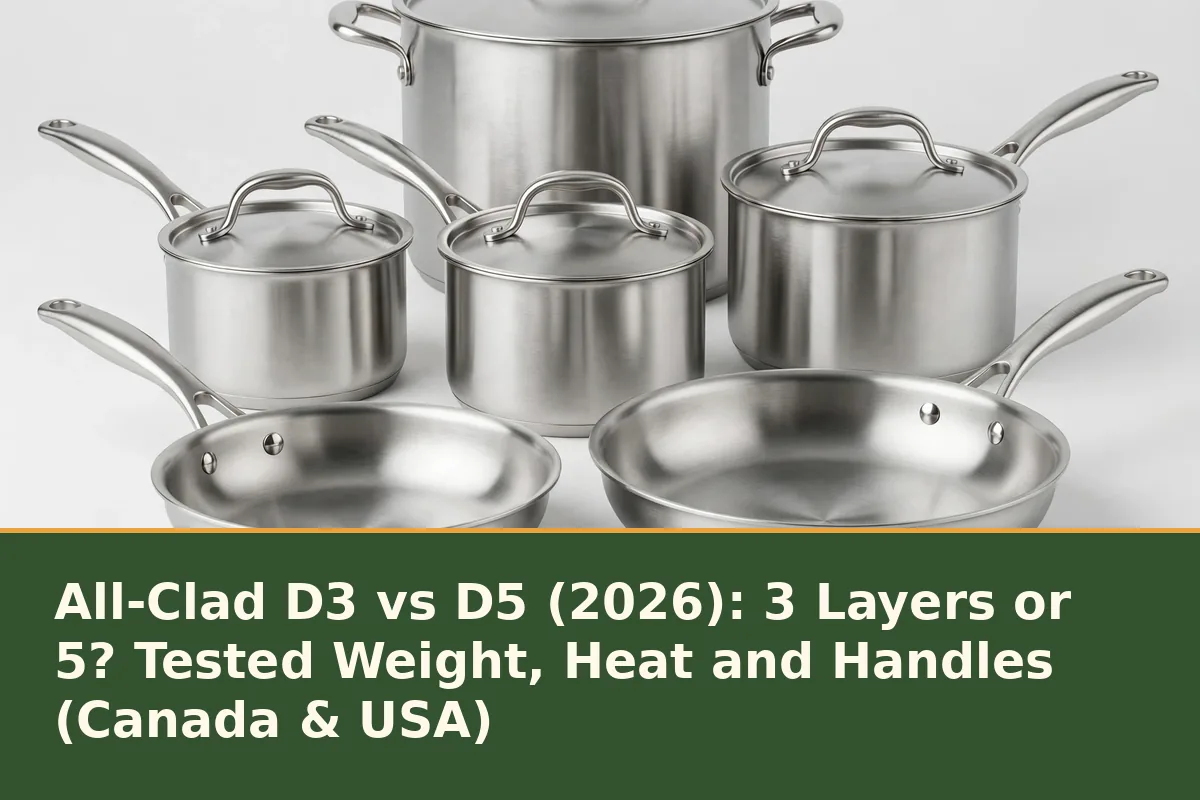
The All-Clad D3 Stainless is the most-searched question in stainless cookware, and it has a refreshingly honest answer: D3 bonds three layers (18/10 steel cooking surface, aluminium core, magnetic steel exterior) while D5 bonds five, adding a stainless diffusion core between two aluminium layers. Both are made in Canonsburg, Pennsylvania, fully clad, and rated to 600F.
Key takeaways: independent side-by-side testing (Prudent Reviews, own-money pans, surface thermometer) found both pans measure exactly 3.0 mm thick, D3 heats a bit faster, and D5 spreads heat slightly more evenly and holds it a little longer - a small gap, honestly reported.
What is new and why it matters
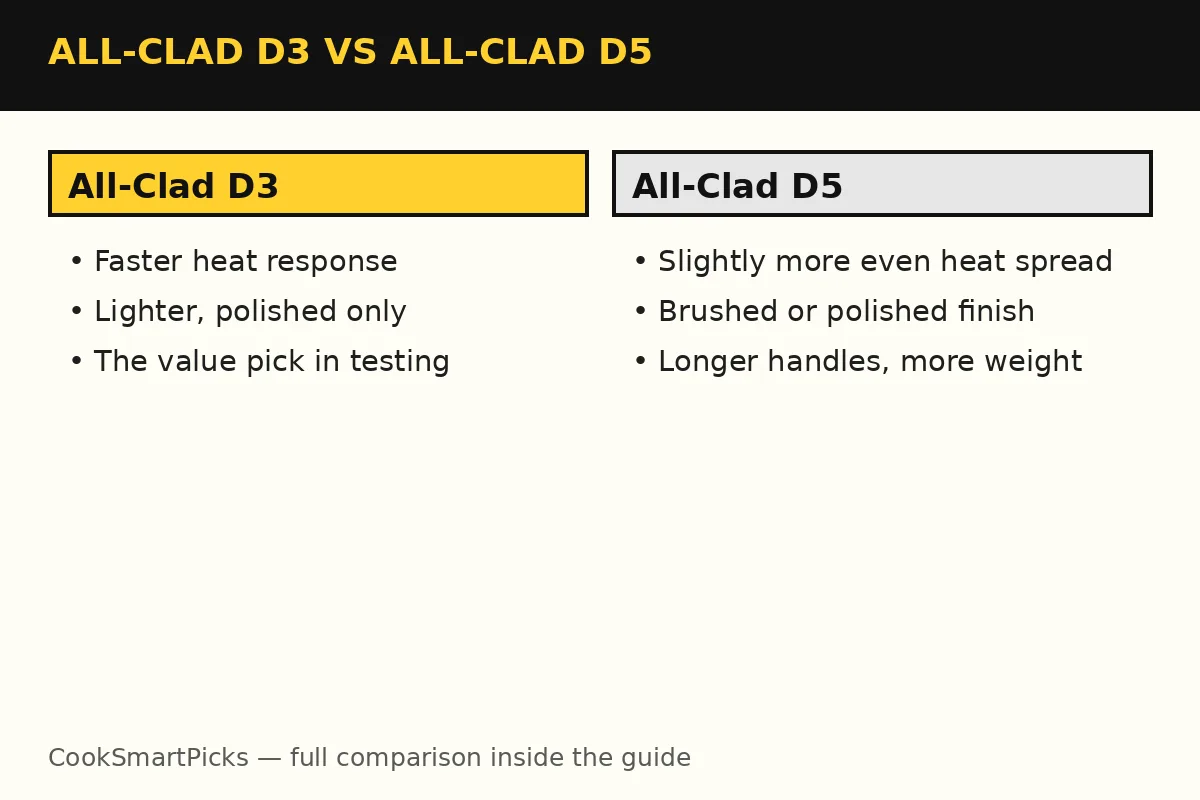
The differences that actually reach your hand are ergonomic: D5 handles run about an inch longer, D5 pans weigh about 0.4 lb more at 12 inches, and only D5 offers the brushed finish. All-Clads own October 2025 comparison frames D5 as the stability and warp-resistance upgrade.
A quotable way to put it: D3 and D5 pans are the same 3.0 mm thick - the D5 difference is layer order, not more metal. Related reading: our cookware set guide our Dutch oven guide our GreenPan Valencia Pro guide.
All-Clad D3 Stainless vs All-Clad D5 Stainless
| Feature | All-Clad D3 | All-Clad D5 |
|---|---|---|
| Construction | 3-ply: steel, aluminium, steel | 5-ply with stainless diffusion core |
| Thickness | 3.0 mm measured | 3.0 mm measured |
| Weight (12 in fry pan) | 2.8 lb | 3.2 lb |
| Handle length | 7.7 in measured | 8.7 in measured |
| Oven safe | 600F | 600F |
| Finish | Polished only | Polished or brushed |
Pros and cons
All-Clad D3 - Pros
- D3 responds fastest to burner changes - technique cooking loves it
- Both lines are fully clad rim to rim, induction-ready and lifetime-warranted
- D5 brushed finish hides fingerprints and everyday wear
Cons and watch-outs
- The real-world performance gap is small - testers say so plainly
- D5 costs roughly a quarter more for that small gap
- Neither line has sealed rims, per independent measurement
Best for: D3 for most home cooks and technique cooking. D5 for crowded-pan batch cooking, brushed-finish looks and maximum warp resistance.
The alternative: All-Clad D5 Stainless
Choose D5 if you cook large batches where edge-to-edge evenness matters most and you prefer the brushed look - accepting the extra weight and the roughly 25 percent premium testers measured.
FAQs
What is the difference between All-Clad D3 and D5?
Layers: D3 is 3-ply with an aluminium core; D5 is 5-ply with an added stainless diffusion core. Both are 3.0 mm thick, induction-ready and oven-safe to 600F.
Does D5 cook noticeably better than D3?
Independent testing found a small gap: D5 spreads heat slightly more evenly and retains it longer; D3 responds faster. Most home cooks will not taste a difference.
Which is lighter, D3 or D5?
D3. A 12-inch D3 fry pan measured 2.8 lb against 3.2 lb for D5, and D5 handles are about an inch longer.
D3 or D5: which is better value?
Testers land on D3 for most buyers. D5 earns its premium for batch cooking, brushed finish and warp resistance over decades of use.
Sources
Specs in this guide are the manufacturers' published figures as reported by the sources below; where testers disagree with a maker's claim, the guide says so. We do not print prices — use the buttons above for the live price in your marketplace.
- All-Clad Canada - D3 or D5? — Maker comparison (Oct 2025): layer construction, heat control, finishes and 600F rating.
- Prudent Reviews - All-Clad D3 vs D5 tested — Own-money testing: 3.0 mm thickness both, weights, handle lengths and performance gap.
- All-Clad - Compare collections — Official collection chart: ply counts, core materials, weights class and heat distribution ratings.
Last updated: November 20, 2026. We refresh this guide whenever the makers revise these products.