The best ceramic cookware set depends on a distinction most listings blur on purpose: is the ceramic a coating on a metal pan, or is the pan ceramic all the way through? Almost every set sold as “ceramic” is the first kind — an aluminum pan wearing a thin sol-gel ceramic finish. One pick in this guide, Xtrema, is the second kind: solid ceramic, no metal, no coating. They cook differently, age differently and fail differently, and this guide keeps them in separate mental boxes from the first paragraph to the last.
Here is the honest sentence the whole category turns on: a ceramic coating is a consumable surface with a lifespan measured in years, while solid ceramic has no surface to lose — it keeps its nature until the day it chips or cracks. Neither is “better” in the abstract. Coated pans are light, slick and affordable, and their release genuinely fades. Solid ceramic is heavy, slow and breakable, and never wears out chemically. Buy the trade you actually want.
The seven picks below are grouped by use case rather than ranked as twins: the best coated set overall, the best coated set for higher heat, the longest-wearing coating we found, the solid-ceramic option, the budget starter, the metal-utensil-tolerant outlier, and the single-pan minimalist route. Oven ratings and care rules are the manufacturers’ published figures, and where a coating’s marketing outruns its physics, the review says so. For the wider field, our general guide to the best cookware sets in Canada and the USA places ceramic among stainless, hybrid and hard-anodized rivals.
Disclosure: CookSmartPicks is reader-supported. When you buy through links on this page, we may earn an Amazon commission at no extra cost to you. Prices and availability change often — check the current price on Amazon before you decide.
The short answer
For most buyers, the Caraway 12-piece set is the coated pick to beat — with the understanding that its coating is a multi-year consumable. GreenPan Valencia Pro tolerates the most heat, Ninja’s Ceramic Pro is built to wear slowest, and Xtrema is the only solid-ceramic route: no coating at all, at the price of weight, slowness and no induction compatibility.
How we chose these ceramic cookware sets
CookSmartPicks is a research-based guide; we do not claim hands-on testing we have not done. For this list we compared manufacturer specifications — body material and thickness, coating system, oven ratings, cooktop compatibility and care rules — against independent roundups, coating-longevity reporting and long-term owner accounts from verified buyers in Canada and the USA. Coating life claims were read against the pattern every independent source agrees on: release performance declines with heat, metal utensils and dishwasher cycles, whatever the brand.
Three filters shaped the list. First, honesty of construction: a set had to state plainly whether it is coated or solid, and coated sets had to publish their body material and oven ceiling. Second, realistic lifespan value: a premium-priced coated set must justify itself in body thickness and heat tolerance, because its coating will not outlive a budget set’s by years. Third, care rules a household will actually follow — a set that demands hand-washing, low heat and wooden tools is scored on whether that bargain is worth it, not just on day-one slickness.
The lineup at a glance
| Product | Best for | Why it stands out |
|---|---|---|
| Caraway Ceramic Cookware Set (12-Piece) | Best coated overall | Thick aluminum body, 550°F oven rating and the category’s best storage system |
| GreenPan Valencia Pro 11-Piece Set | Best for higher heat | Thermolon coating on hard-anodized aluminum, pans rated to 600°F |
| Ninja Ceramic Pro 14-Piece Set | Best coating longevity pitch | A harder ceramic coating system built to resist scratching and staining longer |
| Xtrema Pure Ceramic Cookware | Best solid ceramic | No coating and no metal at all — nothing to wear through, ever |
| GreenLife Soft Grip 16-Piece Set | Best budget starter | The low-cost way in, with honest 350°F limits and soft-grip handles |
| Blue Diamond Cookware Set | Best for metal utensils | Diamond-infused coating the maker rates for metal utensils |
| Our Place Always Pan (with cookware companions) | Best minimalist route | One do-everything coated pan instead of a set, for tiny kitchens |
1. Caraway Ceramic Cookware Set (12-Piece) — Best coated overall
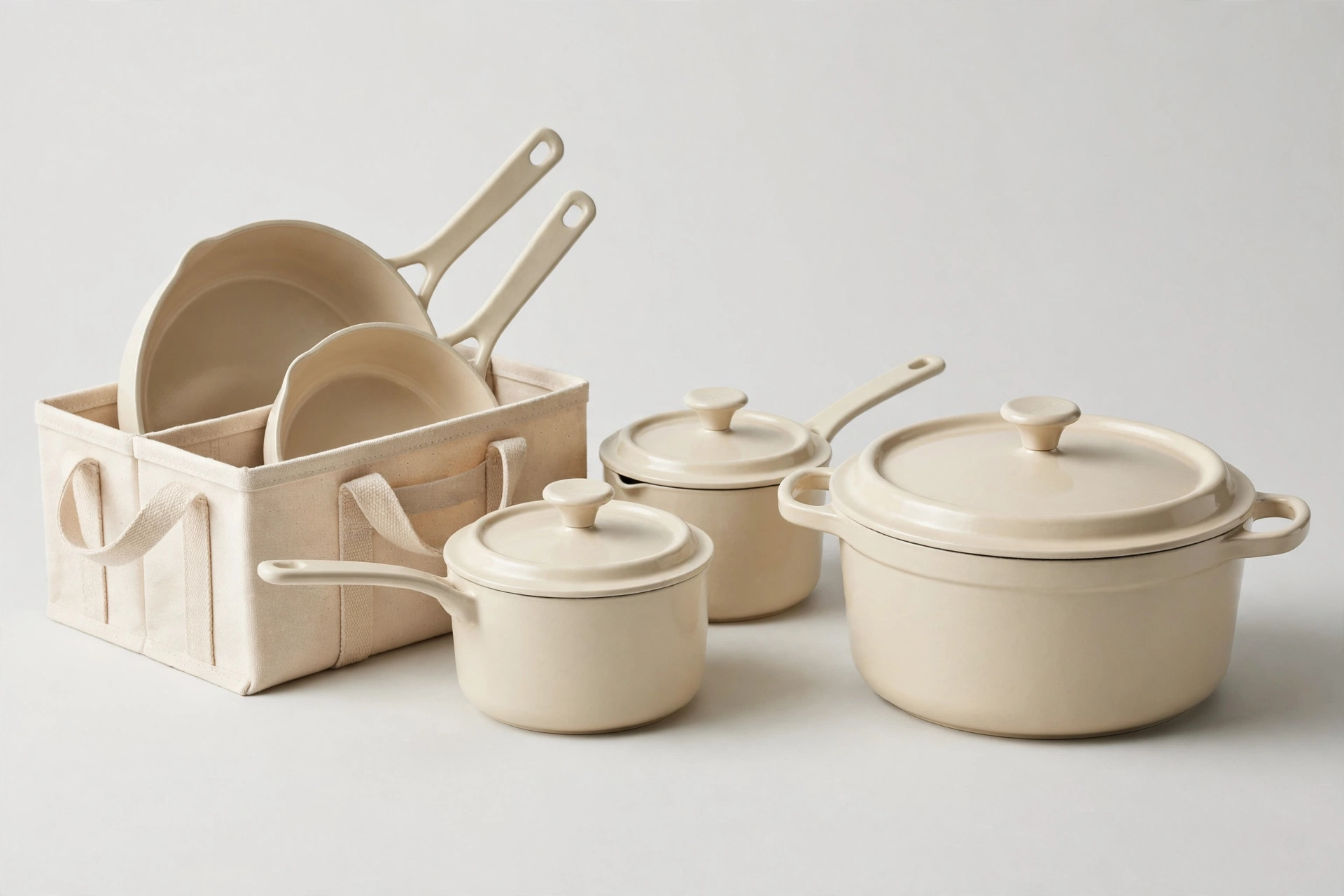
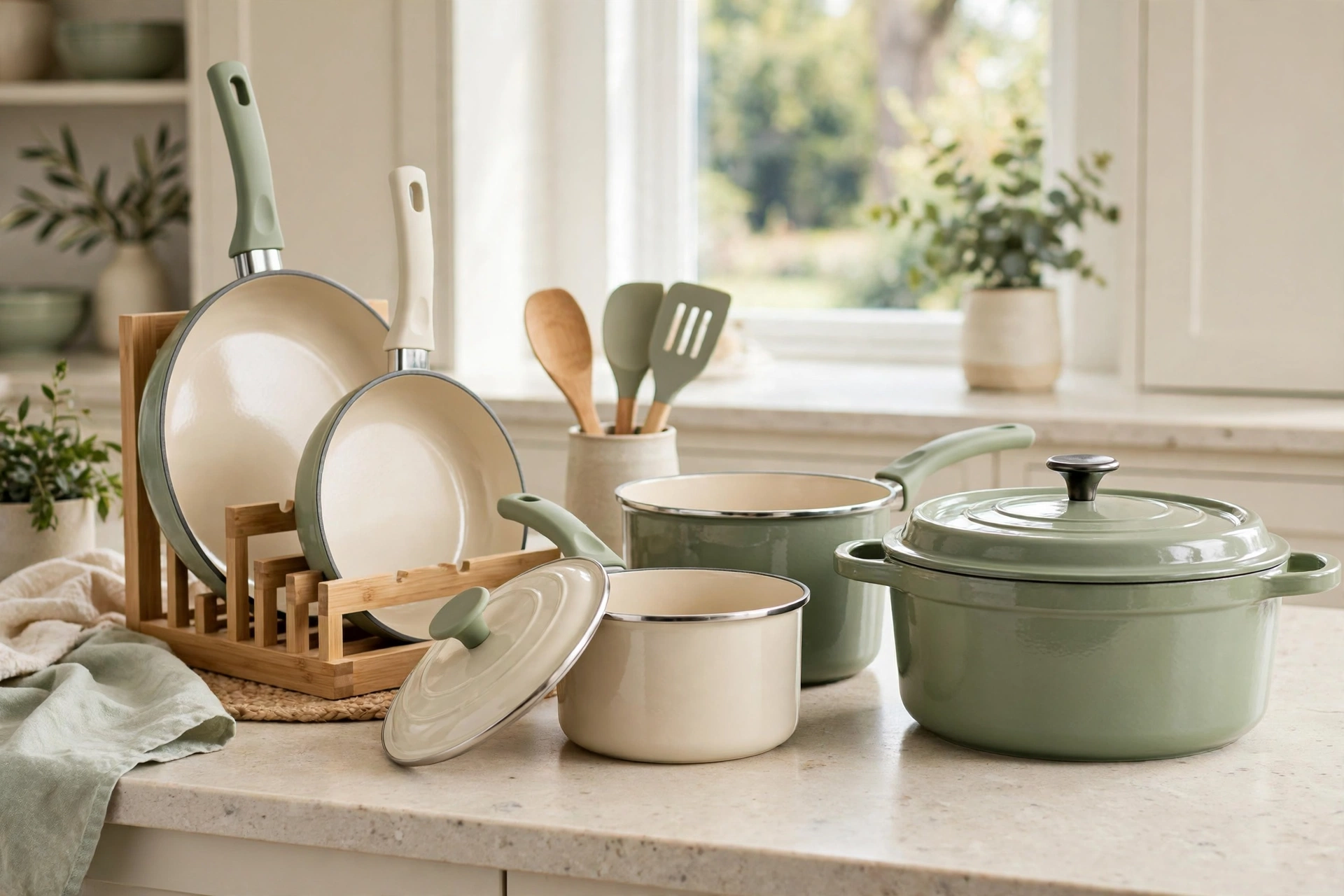
Caraway is the set that made ceramic-coated cookware a design object, and beneath the colours the specification is serious: a thick aluminum core with a stainless steel base plate for induction, a sol-gel ceramic coating free of PFAS and PTFE, and an oven rating of 550°F — high for this class. The 12-piece count covers a fry pan, saucepan, sauté pan and Dutch oven with lids, plus the magnetic pan racks and canvas lid holder that are genuinely the best storage system in the category.
Now the part Caraway’s own marketing underplays and this guide will not: the coating is a consumable. Independent longevity reporting on sol-gel coatings, Caraway’s included, converges on the same pattern — excellent release early, gradual decline over one to three years of regular use, fastest on the fry pan that sees daily high heat. Caraway’s care rules (low-to-medium heat, hand-wash, no aerosol sprays, wooden or silicone tools) are not fussiness; they are the difference between the short and long end of that range.
Buy Caraway as what it is: the best-made coated set, bought with open eyes about coating life, for cooks who cook gently and value the storage and the look. If a multi-year replacement cycle bothers you, the same money in clad stainless buys decades — and the solid-ceramic pick below removes the coating question entirely.
Yay · Pros
- Thick body and stainless base plate — induction compatible
- Oven-safe to 550°F, high for a coated set (manufacturer figure)
- Best-in-class included storage: pan racks and lid holder
- PFAS- and PTFE-free sol-gel coating
Hmm · Cons
- Coating release declines over 1–3 years of regular use, like all sol-gel
- Hand-wash and low-heat care rules are mandatory, not optional
- Premium price for a set whose fry pan is a consumable
Best for: design-conscious cooks who cook gently and accept the coating cycle. Skip if: you sear at high heat daily — the coating will fade fast; look at stainless instead.
2. GreenPan Valencia Pro 11-Piece Ceramic Nonstick Set — Best for higher heat
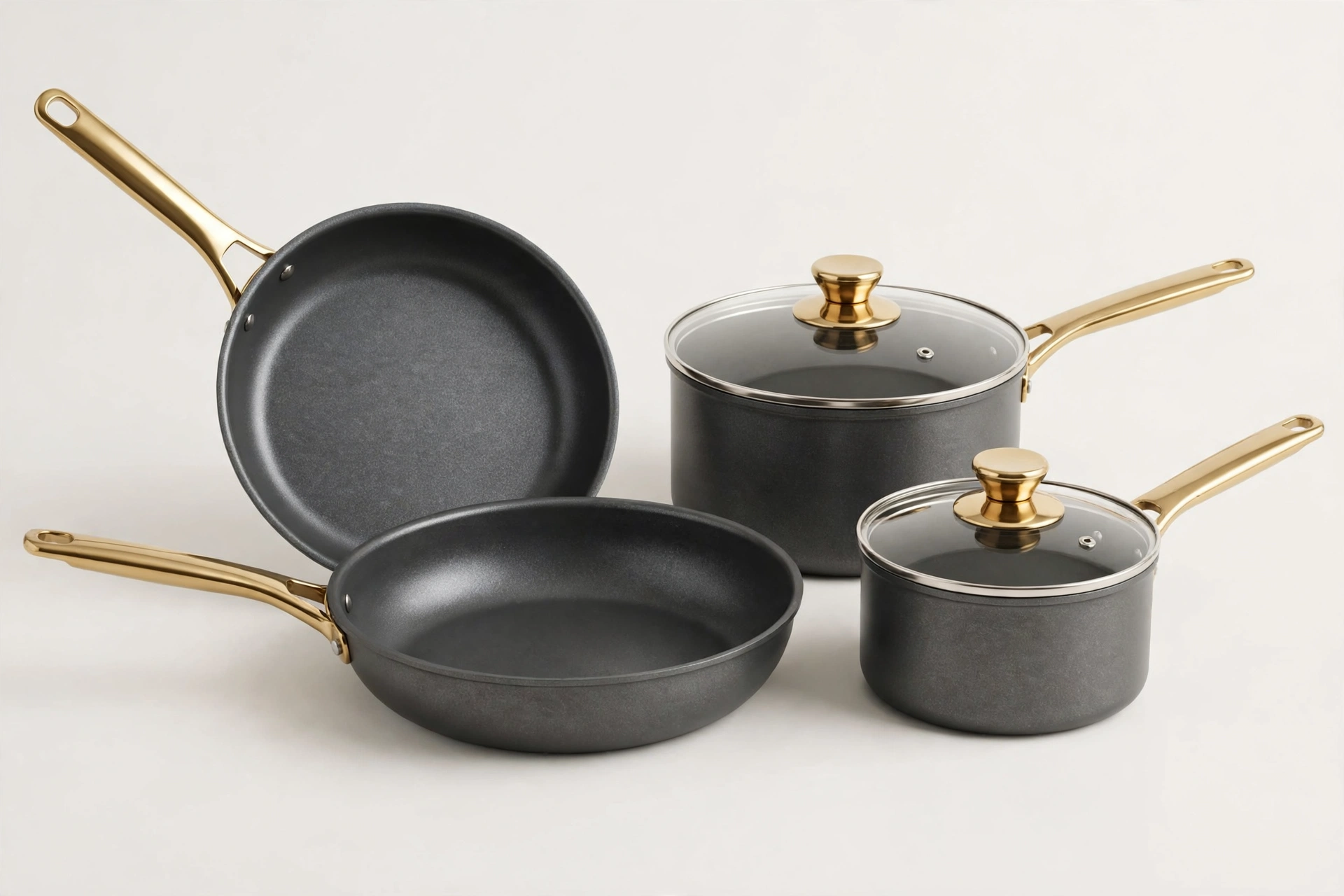
The Valencia Pro is the coated set for cooks who actually use heat. Its Thermolon ceramic coating sits on a hard-anodized aluminum body — harder and more warp-resistant than the plain aluminum under most coatings — with a bonded induction base, and GreenPan rates the pans oven-safe to 600°F, the highest ceiling among coated sets here, with glass lids to 425°F. The coating is reinforced for durability in GreenPan’s range, and the bodies carry a limited lifetime warranty against defects.
Heat tolerance is the spec that decides coating lifespan, because overheating is what kills sol-gel finishes fastest — a pan left empty on a high burner can pass 600°F in minutes. A set rated and built for higher temperatures forgives the occasional preheat overshoot that would age a 350°F set in a month. That, more than day-one slickness, is the Valencia Pro’s real advantage, and it is why the set also anchors our induction guide’s nonstick slot.
The honest limits remain the category’s: release fades with years, dishwasher cycles age the coating despite the “dishwasher safe” label, and the fry pans will need replacing before the saucepans do. Within those limits, this is the coated set that tolerates real cooking best.
Yay · Pros
- Pans oven-safe to 600°F — the highest coated ceiling here
- Hard-anodized body resists warping better than plain aluminum
- Bonded induction base, flat and full-diameter
- Thermolon coating is PFAS-free
Hmm · Cons
- Glass lids cap at 425°F, well below the pans
- Coating still fades over years — fry pans first
- Dishwasher use ages the coating despite the label allowing it
Best for: cooks who sear and finish in the oven and want a coating that tolerates heat. Skip if: you want the design and storage package — that is Caraway’s win.
3. Ninja Ceramic Pro 14-Piece Cookware Set — Best coating longevity pitch
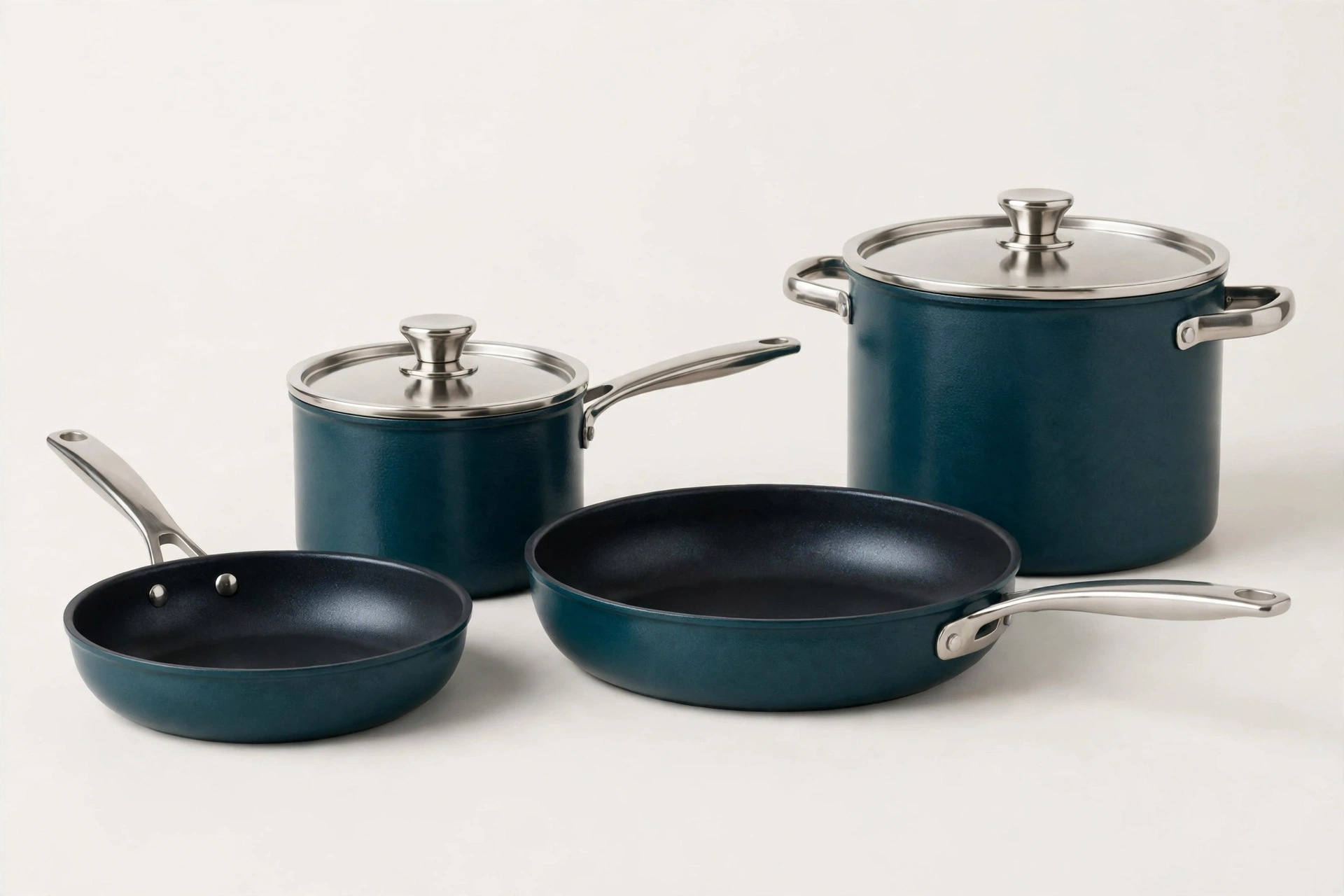
Ninja entered ceramic with a longevity argument: its Ceramic Pro line uses a harder ceramic coating system intended to resist the scratching, staining and wear that dull standard sol-gel finishes, on hard-anodized bodies with stainless handles. Ninja rates the set oven-safe to 550°F and induction compatible. The 14-piece count is the fullest in this guide — fry pans, saucepans, sauté pan, stockpots and lids enough for a household starting from zero.
Read the longevity claim the way this guide reads all of them: a harder coating can plausibly slow the fade, and Ninja’s coating does review as more abrasion-resistant than basic sol-gel in independent coverage — but no ceramic coating is permanent, and the set is new enough that five-year owner data does not exist yet. The honest position is “promising, unproven at decade scale,” which still makes it the coated pick for buyers whose top priority is stretching the replacement cycle.
The bodies are the safe part of the bet: hard-anodized aluminum with proper induction bases, even heating and handles that stay secure. If the coating wears to the category’s usual schedule, you still own good pans; if Ninja’s harder system delivers, you own the longest-lived coated set here.
Yay · Pros
- Harder coating system aimed squarely at wear and staining
- Oven-safe to 550°F and induction compatible (manufacturer figures)
- Fullest piece count here — a true from-zero set
- Hard-anodized bodies with stainless handles
Hmm · Cons
- Longevity claim is promising but lacks long-term owner data
- Heavier handles make the fry pans less nimble
- Coating is still a coating — not a lifetime surface
Best for: from-zero households that want the fullest set and the best shot at a long coating life. Skip if: you want a proven decade-scale record — choose clad stainless or solid ceramic.
4. Xtrema Pure Ceramic Cookware — Best solid ceramic
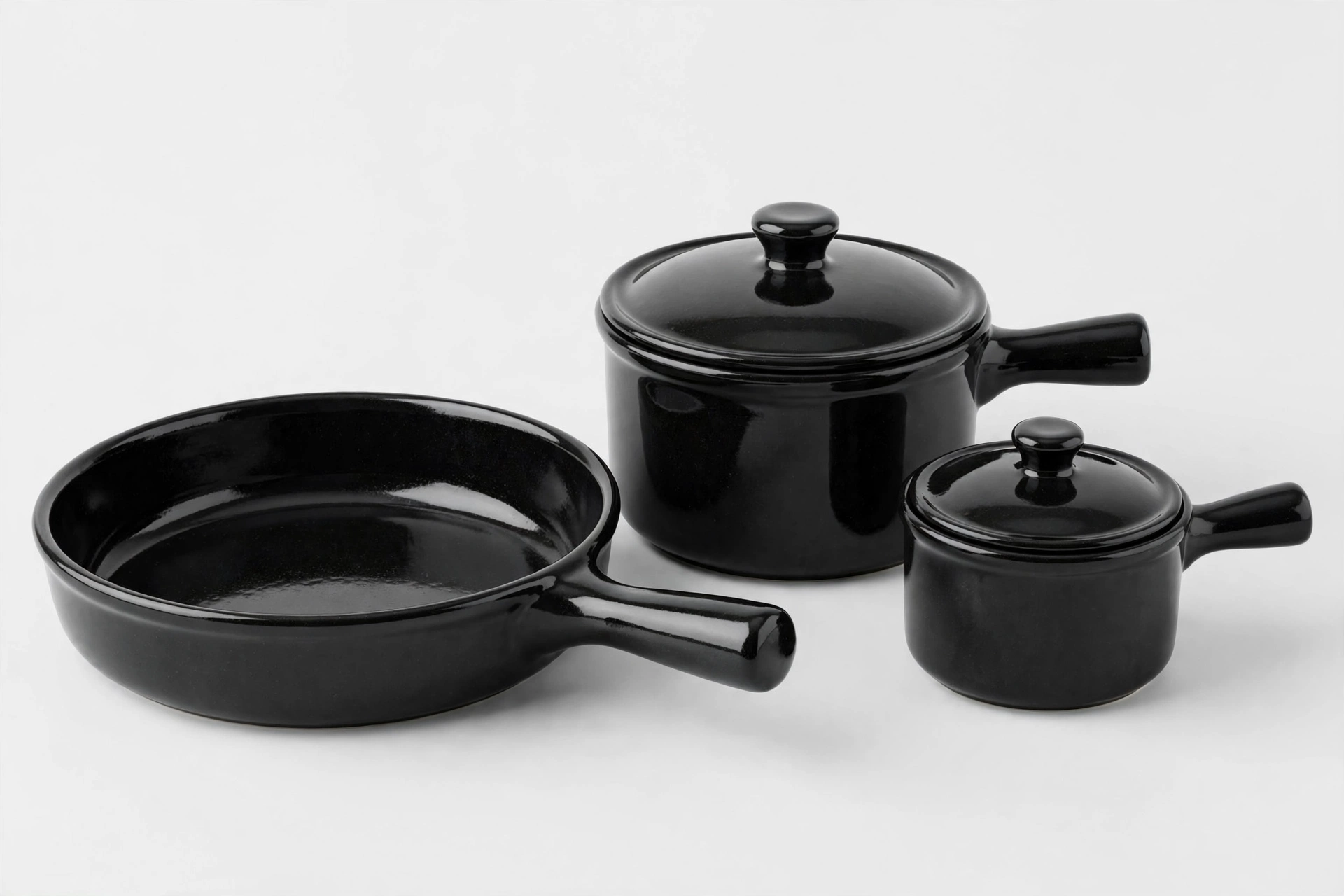
Xtrema is the only pick here that is ceramic in the literal sense: each piece is solid ceramic — clay and minerals, kiln-fired, glazed — with no metal core and no applied coating. There is nothing to chip off a surface layer, nothing to wear through, and the brand publishes third-party testing for extractable lead and cadmium. Xtrema rates the cookware for oven, broiler, grill and microwave use, and as dishwasher safe. It is the answer for buyers whose requirement is not “nonstick” but “no coating and no metal touching food.”
The trades are physical and non-negotiable. Solid ceramic heats slowly and holds heat long; it is heavy for its size; it is not nonstick in the coated sense — food release takes preheating and fat; and it can chip or crack if dropped or thermal-shocked with cold water on a hot pan. Xtrema’s own care guidance — warm up gradually on low for several minutes, then cook at modest heat — is the operating manual, not a suggestion.
And the disqualifier must be stated plainly: Xtrema does not work on induction at all, because ceramic contains no magnetic material. On gas, coil or radiant glass it is a lifetime material for patient, low-and-slow cooks. On induction, choose any other pick in this guide.
Yay · Pros
- Solid ceramic — no coating to wear out and no metal core
- Published third-party testing for lead and cadmium extraction
- Oven, broiler, grill and microwave safe per the manufacturer
- Can last indefinitely with careful handling
Hmm · Cons
- Not induction compatible — no workaround exists
- Heavy, slow to heat and slow to respond
- Chips or cracks if dropped or thermal-shocked; not truly nonstick
Best for: patient cooks on gas or electric who want zero coating and zero metal contact. Skip if: you cook on induction, or you want day-one nonstick release.
5. GreenLife Soft Grip 16-Piece Ceramic Nonstick Set — Best budget starter
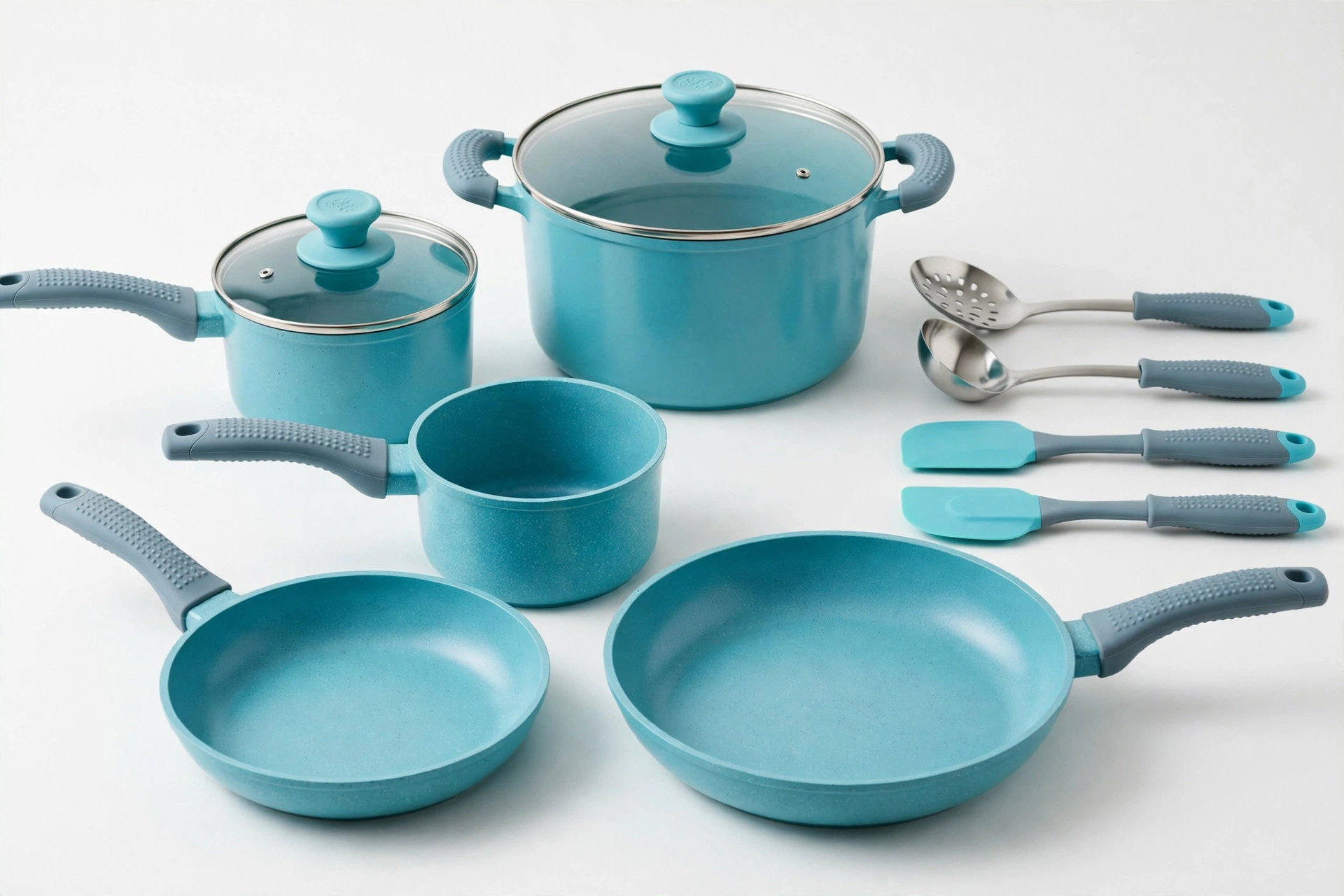
The GreenLife Soft Grip is the budget door into ceramic-coated cooking, and its honesty is in its limits: the set is rated oven-safe only to 350°F and is not induction compatible. Within those limits it is a cheerful, complete starter — fry pans, saucepans, a stockpot, a steamer insert and utensils, with stay-cool soft-grip handles and a PFAS-free ceramic coating over an aluminum body that heats quickly and evenly for everyday cooking.
A 350°F ceiling sounds modest until you map it to real meals: eggs, pancakes, sautés, sauces, reheating — the weekday repertoire lives below it. What the ceiling forbids is searing and oven finishing, which is exactly the high-heat work that destroys coatings fastest anyway. A budget set used within its limits can outlast an expensive set abused past them; that is the most useful sentence in this guide for a first-apartment cook.
Expect the category’s standard arc — strong early release, gradual fade, fry pan first — at a price where that arc is fair value. Buy it as a starter or a second set for a cottage or dorm kitchen, not as an heirloom.
Yay · Pros
- Lowest-cost complete ceramic set in this guide
- Soft-grip stay-cool handles suit new cooks
- Fast, even heating for everyday low-to-medium cooking
- PFAS-free coating; generous piece count with utensils
Hmm · Cons
- Oven-safe only to 350°F — no searing or oven finishing
- Not induction compatible
- Thin bodies warp if overheated on large burners
Best for: first kitchens, dorms and cottages that cook gently and want the full set at once. Skip if: you have induction, or you sear — step up to the Valencia Pro.
6. Blue Diamond Ceramic Nonstick Cookware Set — Best for metal utensils
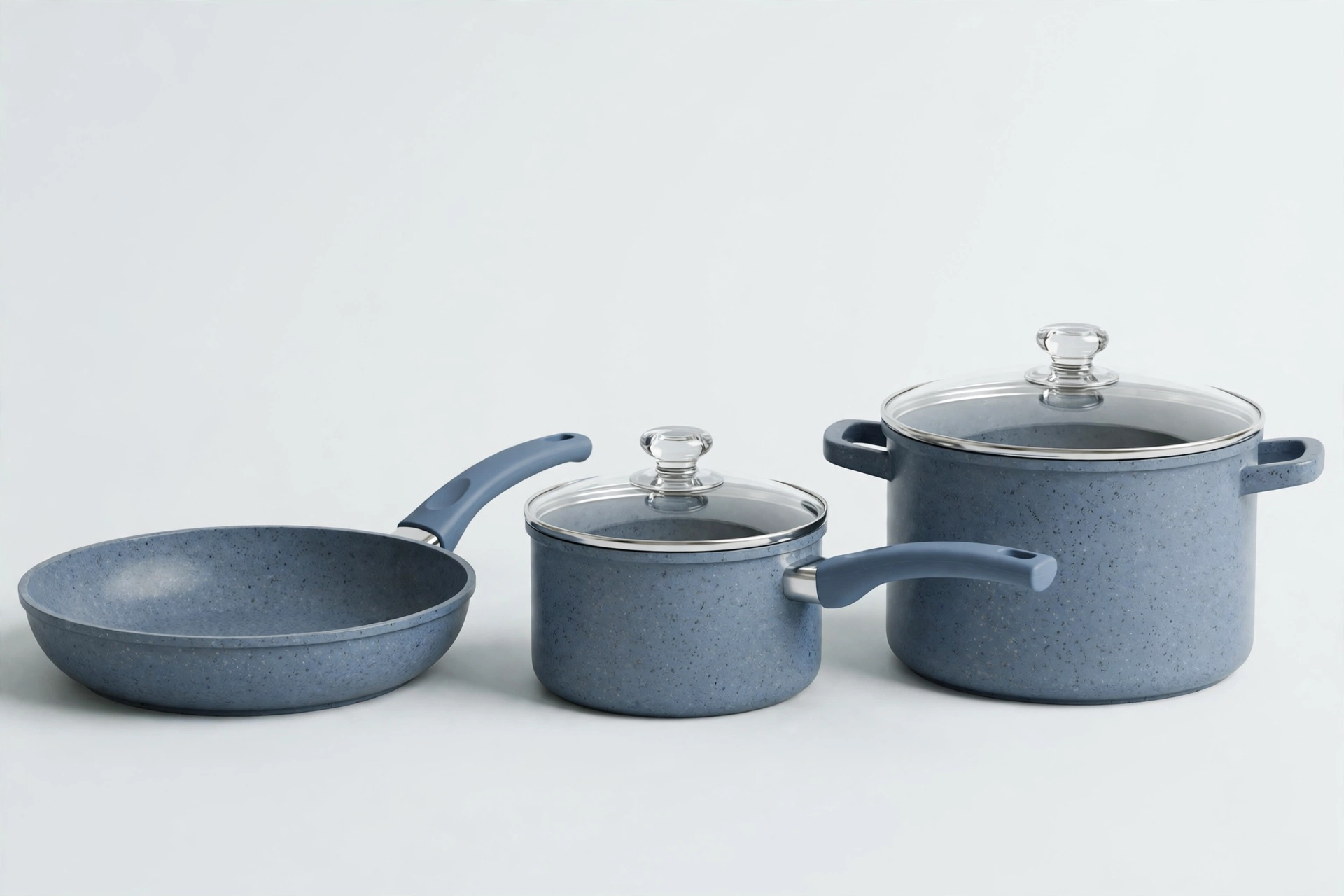
Blue Diamond’s pitch is in the name: its ceramic coating is infused with diamond particles, and the maker rates it for metal utensils and very high oven temperatures — the set is listed oven and broiler safe to 600°F. The bodies are forged aluminum, induction bases are included on the set, and the brand positions the coating as harder and more conductive than standard sol-gel. For households where metal spoons are a fact of life, that utensil tolerance is the deciding feature.
Read it with this guide’s standard caution: “metal utensil safe” means the coating survives them better, not that it is immortal, and independent longevity coverage of the brand still shows the familiar fade over years. Diamond infusion plausibly improves scratch resistance; it does not repeal the chemistry of sol-gel coatings. The warranty and price, though, are set for the real world — this is a mid-priced set that expects to be used hard.
Choose Blue Diamond if your kitchen’s utensil drawer is metal and staying that way, and you would rather have a coating built for that reality than a delicate one you must police. Gentle cooks get more total value from Caraway or GreenPan.
Yay · Pros
- Coating rated by the maker for metal utensils
- Oven and broiler safe to 600°F (manufacturer figure)
- Forged bodies with induction bases
- Mid-range price for a hard-used set
Hmm · Cons
- Release still fades over years despite the harder coating
- Aggressive marketing claims outrun the independent data
- Finish shows utensil marks cosmetically even when performing
Best for: busy households that cook with metal utensils and will not change. Skip if: you cook with silicone and wood anyway — Caraway and GreenPan age more gracefully.
7. Our Place Always Pan — Best minimalist route
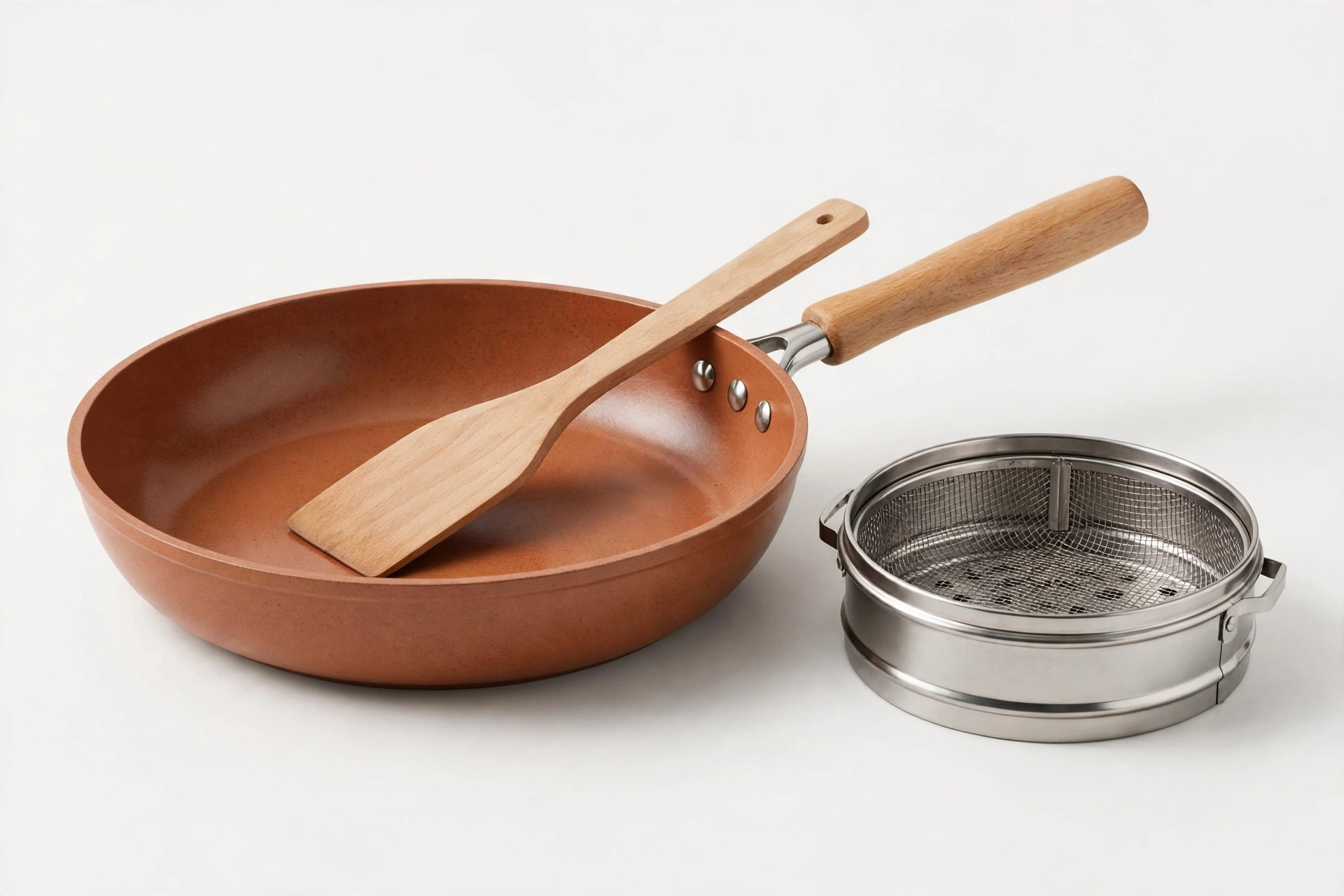
Not everyone needs a set. The Always Pan is the minimalist’s ceramic answer: one deep, lidded sauté-style pan with a ceramic-coated aluminum body, a nesting steamer basket and a beechwood spatula that rests on the handle, designed to stand in for a fry pan, sauté pan, steamer and saucepan in a small kitchen. Our Place rates it oven-safe to 450°F and induction compatible, and sells matching companions — a smaller Mini Always Pan and the Perfect Pot — for cooks building piece by piece.
As a single coated pan it lives or dies on the same physics as every pick above: the coating is slick early and fades with use, so the pan is best treated as a versatile medium-term tool rather than a lifetime one. Its design intelligence is real — the pour spouts, the spoon rest, the steamer that actually gets used — and for a one-pan kitchen it covers more recipes than any single skillet.
Buy it if your kitchen fits one pan and your cooking is varied but gentle. Buy a set if you routinely run two burners at once — no single pan, however clever, fries an egg while a sauce simmers.
Yay · Pros
- One pan covers frying, sautéing, steaming and saucing
- Induction compatible and oven-safe to 450°F (manufacturer figures)
- Nesting steamer basket and spatula rest included
- Ideal footprint for tiny kitchens and vans
Hmm · Cons
- A single pan cannot cook two things at once
- Coating fades on the category’s usual schedule
- Premium price for one piece
Best for: one-pan minimalists, small apartments and anyone equipping a tiny kitchen. Skip if: you cook multi-pan meals — a set serves you better.
Ceramic-coated vs solid ceramic: the difference that decides everything
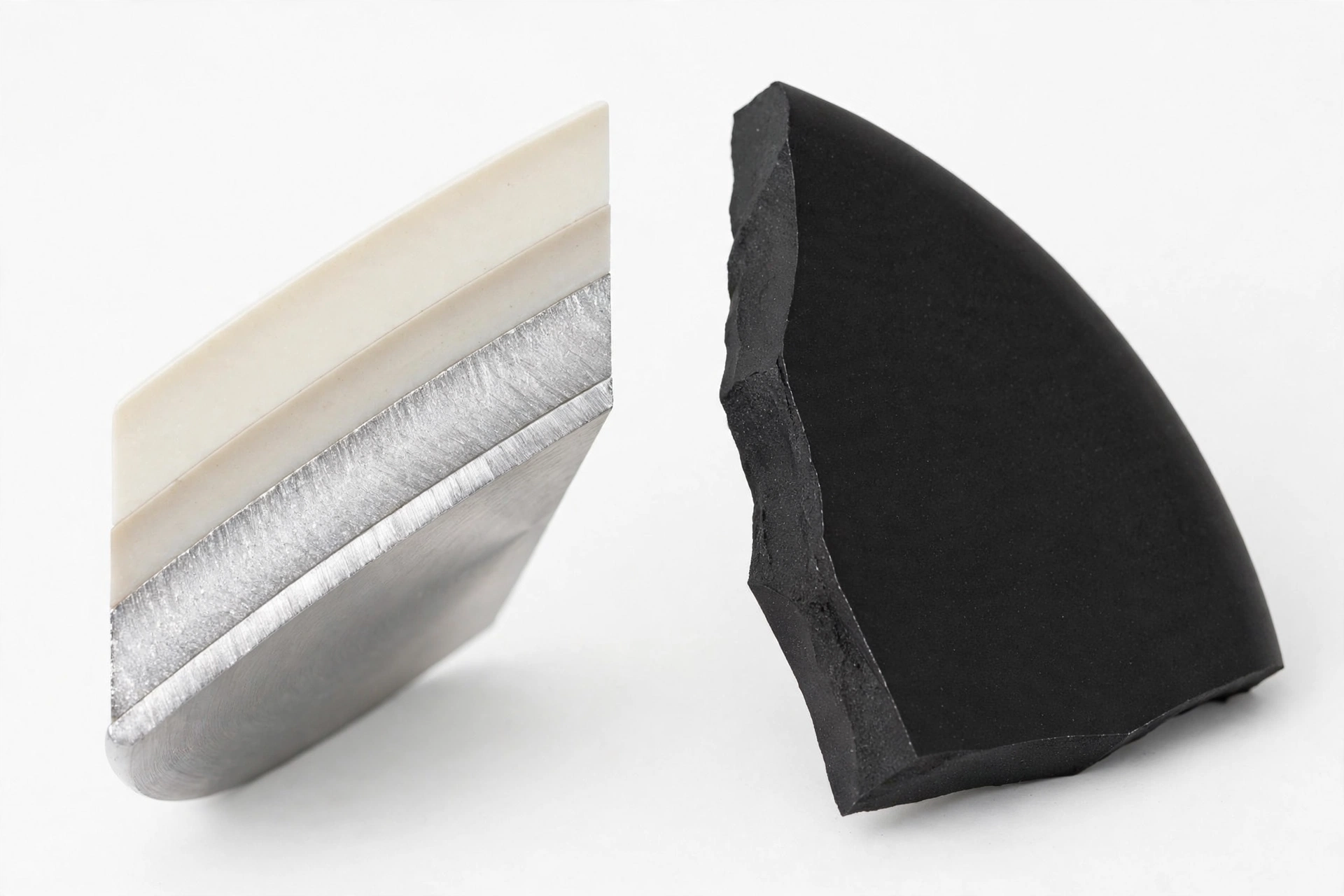
Hold the two constructions side by side and every other difference follows. A ceramic-coated pan is a metal pan — almost always aluminum, sometimes with a steel induction plate — sprayed with a sol-gel coating: silica-based, applied thin, cured into a glassy finish. The ceramic is a skin. It delivers genuine nonstick release without PFAS chemistry, and it wears the way skins do: micro-scratches accumulate, heat cycles fatigue it, and release declines until the pan beneath — still a good pan — behaves like plain aluminum.
A solid ceramic pan has no skin because it has no layers. The body is the material, fired hard, glazed for smoothness. It cannot lose a coating it does not have; its surface in year ten is its surface in year one, provided the piece survives. Survival is its condition: ceramic is brittle, so its enemies are impact and thermal shock, not abrasion and heat. Coated pans die by a thousand scratches; solid pans die in one drop. Choose your failure mode.
Cooking feel splits the same way. Coated pans are light, heat fast, respond quickly and release eggs from day one — the friendly choice for most households, honestly labelled as a multi-year purchase. Solid ceramic heats slowly, holds heat like a brick, needs fat and patience for release, and rewards low-and-slow cooking. Neither is the “healthy” winner marketing implies: reputable coated brands publish PFAS-free formulations, and solid ceramic’s glaze is exactly where a buyer should ask for extraction testing — which is why Xtrema’s published lead and cadmium reports matter.
How long does a ceramic coating actually last? Care rules that stretch it
Independent longevity reporting converges on a range, not a date: with daily use, a quality sol-gel coating typically releases beautifully for the first year, noticeably less by year two or three, and reaches “eggs stick without generous fat” somewhere in the two-to-five-year window depending on heat habits. Fry pans die first because they live hottest and emptiest; saucepans, which cook in liquid, keep their release far longer. A set does not expire all at once — it retires piece by piece.
Four habits decide where in that window you land. Keep heat at low-to-medium for coated pans and never preheat one empty on high — an empty pan on a full burner is the single most destructive act in this category. Skip aerosol cooking sprays, whose additives bake into a gummy film that owners mistake for coating failure. Hand-wash: dishwasher detergent and rack abrasion age the finish even on sets labelled dishwasher safe. And use wood or silicone tools, whatever the box permits — permission is not the same as wisdom.
When a fry pan’s release is gone, the sustainable move is replacing that one pan, not the set: the pots and saucepans still have years in them. Brands in this guide sell open-stock pieces in Canada and the USA, which is one more reason to buy a named set over a marketplace bundle whose replacement pan does not exist.
Ceramic and your cooktop: gas, electric, induction and oven notes
Ceramic-coated pans are happiest on gas and radiant electric, where heat arrives gently and evenly and the cook controls the ramp. Their enemy is not any particular burner but the empty preheat: a coated pan left dry on a high flame or a full-power element can pass the coating’s comfort zone before food ever lands in it. The working habit is pan, fat, food, then heat — or a short low preheat at most — and it doubles the useful life of any set in this guide.
Induction sorts the coated field cleanly. Sets with a bonded magnetic base — Caraway, GreenPan Valencia Pro, Ninja Ceramic Pro, Blue Diamond and the Always Pan — couple properly and heat evenly. Sets without one, like the GreenLife Soft Grip, simply do not register on an induction hob, whatever their other virtues. Solid ceramic is the mirror image: superb in the oven, on the grill and under the broiler, happy on gas and coil, and permanently excluded from induction because there is no metal in it to couple with the field.
The oven is where ceramic’s ratings need reading twice. A set’s headline figure belongs to its pans; glass lids typically cap 75 to 175 degrees lower, and handles set their own limits on budget sets. The honest table is in each review above: pans, lids and ceilings stated separately, because a 600°F pan under a 425°F lid is a 425°F system. Buy the ceiling your cooking actually uses — most households roast at 425°F and never test the rest — and spend the difference on the construction you touch every day.
What to cook first in a ceramic set (and what to cook elsewhere)
Match the first month of meals to the material and a ceramic set will feel like a revelation instead of a risk. Eggs, pancakes, crepes, fish fillets, grilled cheese, quesadillas and gentle sautés are coated ceramic’s home turf — the foods where release is the whole game and moderate heat is all they ask. Sauces and reheats live happily in the saucepans, and the Dutch oven shapes in this guide braise beautifully at oven temperatures inside their lids’ ratings. Cook this repertoire and the coating’s early years are pure pleasure.
Keep a second pan for the violent work. Hard sears on skin-on chicken, blackened spice crusts, dry-toasting spices and anything under a ripping broiler belong in cast iron or clad stainless, which shrug off the heat that ages sol-gel finishes. This is not a failure of ceramic; it is the division of labour every professional kitchen already practices, where nonstick pans are kept for delicate work precisely so they last. Solid ceramic plays the opposite schedule: slow braises, oven-to-table gratins and gentle stovetop simmers, warmed up gradually and never shocked.
The households that love their ceramic sets in year three are the ones that made this split without being told twice. The households that review them bitterly in month eight cooked everything in them, at maximum heat, from day one. The sets in this guide are the best of their kind — the cooking split is how you keep them that way.
Ceramic cookware questions, answered
Is ceramic cookware really non-toxic?
Reputable ceramic coatings are PFAS- and PTFE-free sol-gel finishes, and solid ceramic has no coating at all. The sensible check is published testing: brands like Xtrema publish lead and cadmium extraction reports. Unknown marketplace brands that publish nothing are the ones to avoid.
Why did my ceramic pan stop being nonstick?
Almost always heat and habit, not a defect: empty preheating on high, aerosol spray buildup, dishwasher cycles and metal utensils age sol-gel coatings. A sticky film that washes off with a baking-soda paste is spray residue; a pan that still sticks after gentle cleaning has a worn coating.
Can ceramic cookware go on induction?
Coated sets can, if they carry a magnetic base plate — Caraway, GreenPan Valencia Pro, Ninja Ceramic Pro, Blue Diamond and the Always Pan here do; GreenLife Soft Grip does not. Solid ceramic never works on induction, because ceramic is not magnetic.
Is solid ceramic better than ceramic-coated?
It is longer-lived and coating-free, but heavier, slower, breakable and not nonstick in the coated sense. Coated wins on convenience and price; solid wins on permanence. The right answer depends on your cooktop, your patience and how you feel about replacement cycles.
Can I use metal utensils on ceramic cookware?
Only where the maker rates the coating for it — Blue Diamond does; most others do not. Even on rated coatings, wood and silicone extend release life. Treat metal-utensil permission as insurance, not a lifestyle.
When should I replace a ceramic pan?
When eggs and fish stick despite correct preheating, moderate heat and enough fat — and a gentle deep-clean does not restore release. The body is still safe to cook on; it has simply become a plain pan, and most owners replace just the fry pan at that point.
The short version
Short on time? Buy Caraway for the best coated set with open eyes about coating life, the GreenPan Valencia Pro if you cook hot, or Xtrema if you want no coating at all and do not cook on induction. Compare ceramic against every other material in the best cookware sets in Canada and the USA, check induction behaviour in our best induction cookware sets guide, and see the coating-free alternative in the best stainless steel cookware sets.
Sources
This guide is research-based: we compared manufacturer specifications with the independent testing and reporting below, cross-checked against verified owner reports in Canada and the USA. Specs are the manufacturers’ published figures; where testers disagree with a maker’s claim, the review says so.
- PlasticFreeLab — Best Ceramic Cookware, Tested and Ranked — The clearest coated-versus-solid comparison we found, including the 12–24 month coating-degradation pattern for sol-gel finishes.
- The Kitchen Pot — Best Ceramic Cookware Sets and How Long They Last — Spec-first comparison of Caraway, GreenPan, Ninja, GreenLife and Xtrema with oven ratings and lifespan framing.
- The Kitchen Pot — Xtrema Cookware Review — Detailed account of solid ceramic’s trade-offs: slow heating, thermal-shock care and total induction incompatibility.
- Popular Science — The Best Induction Cookware — Independent confirmation of the Caraway and GreenPan Valencia Pro as the ceramic category’s leading sets.
Last updated: November 20, 2026. We refresh this guide each season and whenever a pick is replaced by a better one.