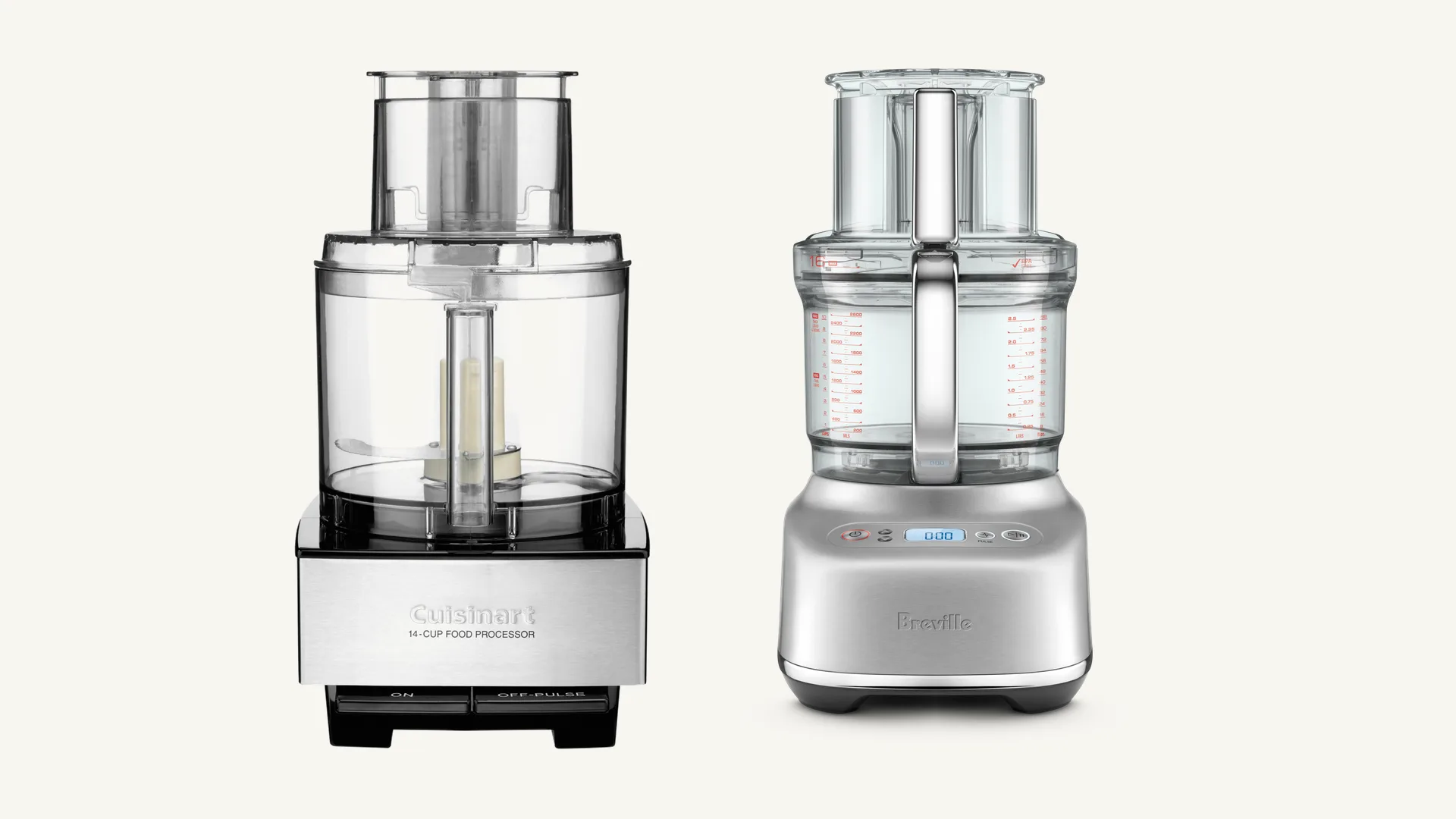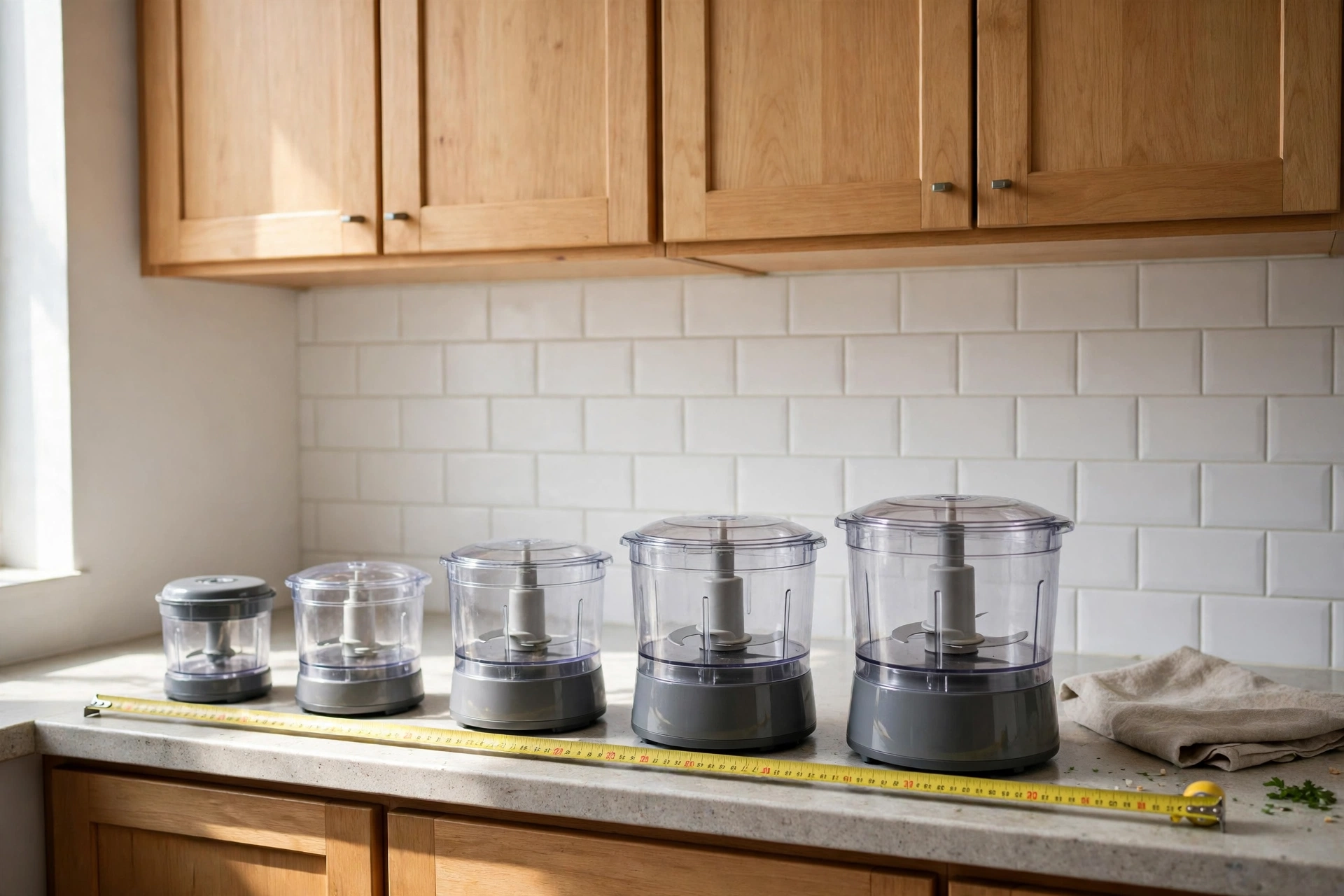
The best food processor for a small kitchen is not the smallest food processor — it is the one whose bowl is big enough for your cooking and whose base is small enough for your counter. Those two numbers pull in opposite directions, and most guides print only the flattering one. This guide prints both, side by side, for every pick: the counter footprint in inches and the bowl capacity in cups, so you can see the trade you are actually making. If counter space is not your constraint, our full-size roundup of the best food processors in Canada and the USA covers the 12-to-16-cup machines this guide deliberately leaves out.
The category splits into two honest families. Mini choppers — 2 to 5 cups — are blade-only machines: they chop, purée and emulsify brilliantly, store in a drawer’s worth of space, and cannot slice, shred or knead. Compact full-size processors — 7 to 8 cups — add slicing and shredding discs and dough capability on bases that still fit a small counter, at the price of real height and a cupboard shelf of their own. Neither family is better; they are answers to different kitchens, and the footprint table below is the fastest way to find yours.
Every dimension below is a manufacturer or major-retailer published figure, and where sources disagree — they do, especially on height — the review says so and uses the conservative number. A processor you must haul from a high shelf is a processor you will stop using, so storage height gets the same respect as counter width throughout.
Disclosure: CookSmartPicks is reader-supported. When you buy through links on this page, we may earn an Amazon commission at no extra cost to you. Prices and availability change often — check the current price on Amazon before you decide.
The short answer
For most small kitchens, the KitchenAid 5-Cup Food Chopper is the sweet spot: a real step up in bowl size on a base barely bigger than a mini. The Cuisinart Mini-Prep Plus is the classic 3-cup answer, and the Cuisinart Elemental 8 is the smallest machine that still slices, shreds and handles family batches.
How we chose these small-kitchen food processors
CookSmartPicks is a research-based guide; we do not claim hands-on testing we have not done. For this list we compared manufacturer and major-retailer specifications — bowl capacity, base width and depth, assembled height, motor wattage and included discs or blades — against independent small-kitchen roundups and verified owner reports in Canada and the USA, with special attention to the complaint that decides this category: machines bought for small kitchens and abandoned because they did not fit anywhere.
Three filters shaped the list. Footprint honesty came first: a pick had to publish real dimensions, and its base had to fit a standard small counter with room to work. Capacity realism came second — a bowl’s cup rating is its maximum, and its comfortable working capacity is roughly two-thirds of that, which is how the reviews talk about batch sizes. Third came storage: cord storage, in-bowl accessory storage and dishwasher-safe parts, because in a small kitchen the cleanup and the cupboard are part of the appliance.
The lineup at a glance
| Product | Best for | Why it stands out |
|---|---|---|
| KitchenAid 5-Cup Food Chopper (KFC0516) | Best overall for small kitchens | A 5-cup bowl on a roughly 7 × 6-inch base — the capacity-density sweet spot |
| Cuisinart Mini-Prep Plus (DLC-2A) | Best true mini | The 3-cup classic with an auto-reversing blade, about 7 × 5 inches |
| KitchenAid 3.5-Cup Food Chopper (KFC3516) | Best mini with a drizzle basin | 7 × 5.6 inches, 8.7 tall — and a lid that streams in oil for dressings |
| Ninja Express Chop (NJ110GR) | Best budget mini | A 2-cup chopper with a stacked blade, for garlic-and-herb jobs |
| KitchenAid 7-Cup Food Processor (KFP0718) | Best compact with storage | Discs and blade store inside the 7-cup bowl; about 9.7 × 7.9 inches |
| Cuisinart Elemental 8-Cup (FP-8) | Best compact full-size | 8 cups, 350 W, slicing and shredding discs, about 9.6 × 7.6 inches |
| Hamilton Beach Stack & Snap 8-Cup (70740) | Best easy-assembly 8-cup | A bowl that stacks and snaps — no twisting — with a big feed chute |
1. KitchenAid 5-Cup Food Chopper (KFC0516) — Best overall for small kitchens
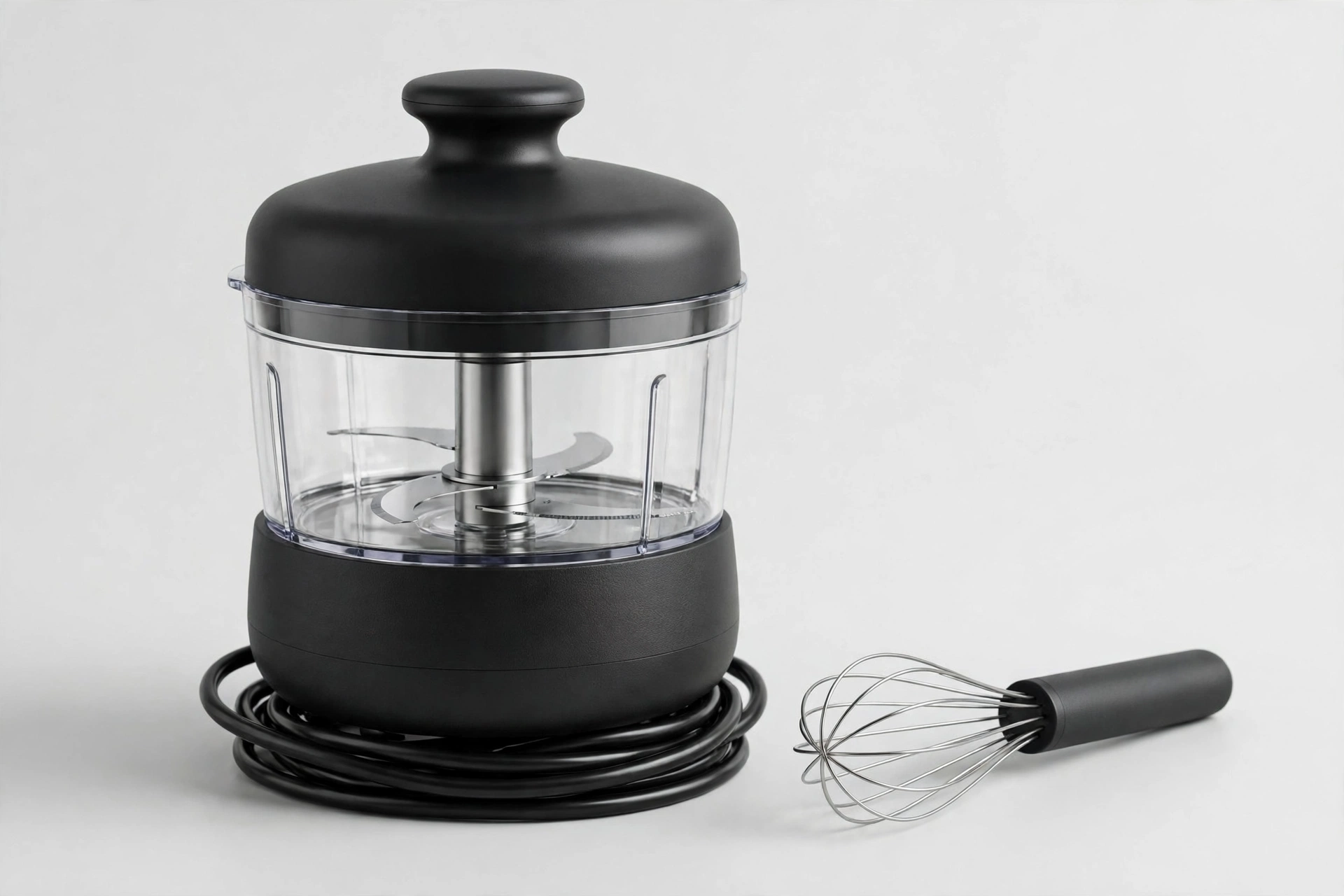
The 5-cup KitchenAid is the size the mini category was missing: two cups more than the classic minis — enough for a full batch of hummus, a family salsa or a double pesto — on a base published at roughly 7 inches wide by 5.95 inches deep and 10 inches tall. That is barely more counter than the 3.5-cup model below, which is why this machine wins the capacity-density contest this guide is built around. Two speeds plus pulse drive a locking stainless multipurpose blade, and the box adds a whisk accessory for cream and dressings.
KitchenAid’s small-chopper details are the ones owners praise a year in: the lid’s drizzle basin streams oil into a running emulsion, the bowl has a pour spout and handle, the blade locks so it stays put when you pour, and the cord wraps into the base for drawer or shelf storage. The bowl, lid and blade are dishwasher safe. Working capacity honesty applies as everywhere: five cups is the bowl’s maximum, and wet batches are happiest at three to four.
It cannot slice or shred — no blade-only chopper can — and it will not knead dough. Within the chopper’s honest job description, this is the most useful small-kitchen machine in the guide: big enough for dinner, small enough to live on the counter where it will actually be used.
Yay · Pros
- 5-cup bowl on a mini-class footprint — best capacity density here
- Whisk accessory included for cream and emulsions
- Drizzle basin, pour spout, locking blade and cord wrap
- Dishwasher-safe bowl, lid and blade
Hmm · Cons
- Chops and purées only — no slicing or shredding discs
- Comfortable wet-batch capacity is 3–4 cups, not the full 5
- Costs more than the 3.5-cup sibling it outsizes only slightly
Best for: small kitchens that cook for two to four and prep daily. Skip if: you need sliced onions and shredded cheese — jump to the 7 and 8-cup picks.
2. Cuisinart Mini-Prep Plus (DLC-2A) — Best true mini
The Mini-Prep Plus is the machine that defined the mini category and still defines its centre: a 3-cup work bowl, a 250-watt motor per Cuisinart, and the brand’s auto-reversing SmartPower blade — one direction’s edge chops, the reverse edge grinds — on a base of roughly 7 by 5 inches and under 10 inches tall. It is the processor for the jobs that happen daily: a cup of onions without tears, garlic and herbs in seconds, nuts, breadcrumbs, a single batch of pesto or salsa.
Three cups is the honest sweet spot of mini sizing — big enough for a recipe’s worth of salsa, small enough that a single onion does not just bounce around the walls, which is the failure mode of running small jobs in a big bowl. Controls are two touchpads, chop and grind, and the bowl and lid go in the dishwasher. The spatula and a small recipe book ride in the box.
Its limits are the category’s: no discs, no dough, and batches beyond about two comfortable cups belong to a bigger machine. But for the counter corner it occupies — less space than a kettle — nothing in this guide does more daily work per square inch except its own 5-cup rival above.
Yay · Pros
- The proven 3-cup size — right for daily small jobs
- Auto-reversing blade chops and grinds with one part
- About 7 × 5 inches and under 10 inches tall
- Dishwasher-safe bowl and lid; simple two-button control
Hmm · Cons
- No slicing, shredding or dough capability
- 250 W motor wants food cut to modest pieces first
- Touchpads can be finicky with wet fingers
Best for: daily small prep — onions, garlic, herbs, nuts, pesto, salsa — in the least space. Skip if: your typical batch is a family-size hummus — the 5-cup KitchenAid swallows it whole.
3. KitchenAid 3.5-Cup Food Chopper (KFC3516) — Best mini with a drizzle basin
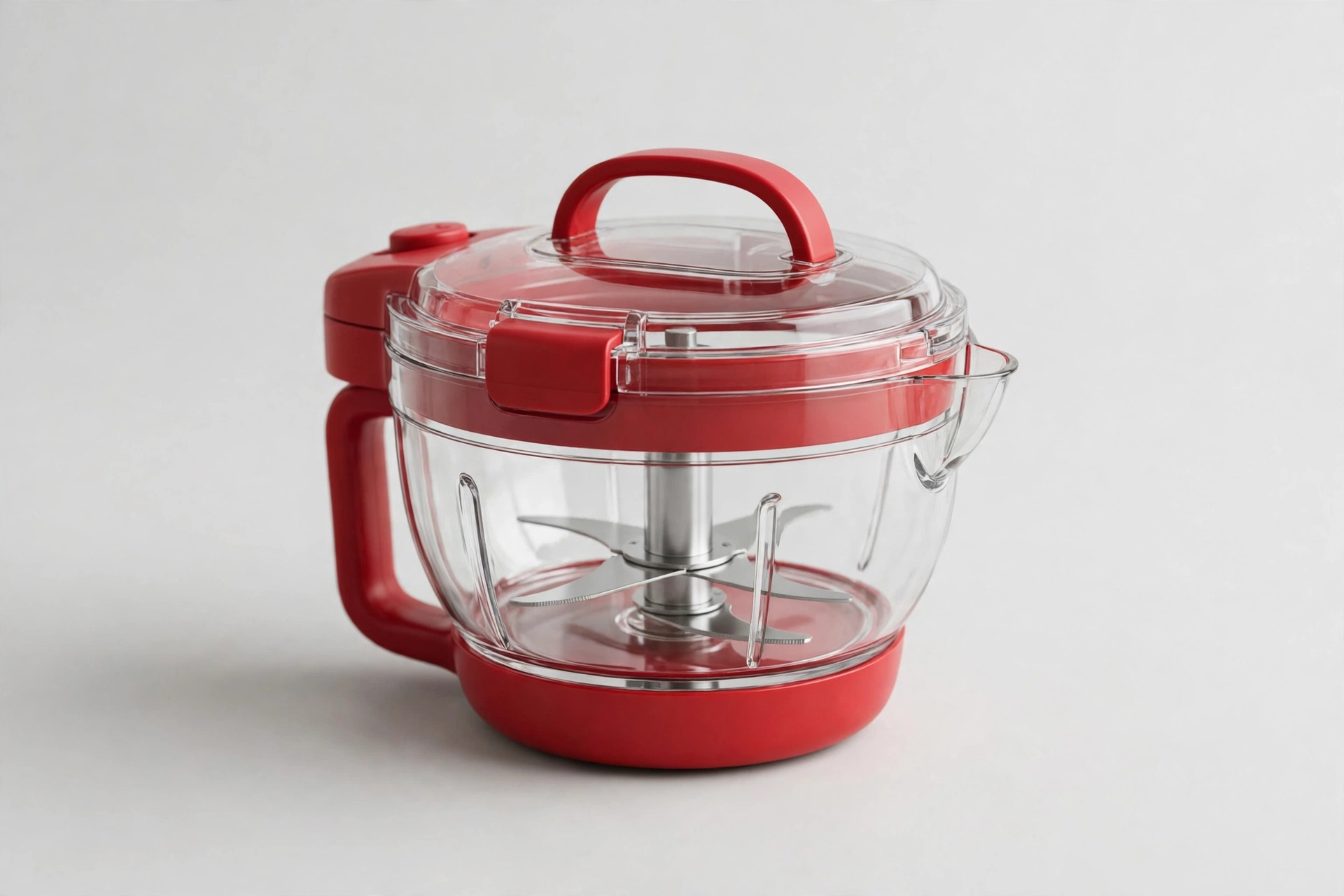
KitchenAid’s 3.5-cup chopper is the design-led mini: published dimensions of 7 inches wide, 5.6 deep and 8.7 tall — the shortest machine in this guide, and the one most likely to slide under a low cabinet or onto a shallow shelf. Inside is a locking stainless blade, two speeds and pulse, and the feature that separates it from every other mini: a drizzle basin in the lid that streams oil or vinegar into a running dressing or mayonnaise without stopping the motor.
That basin is why this chopper, and not a cheaper one, is the emulsion pick. Vinaigrettes and aioli fail when oil lands in a glug; streamed slowly through the basin, they come together glossy and stable, in a bowl that then pours from its own spout. The bowl, lid and blade are dishwasher safe, the cord wraps underneath, and the colour range — the widest in the category — means the one that lives on the counter can match the kitchen it lives in.
Against its 5-cup sibling, you trade a cup and a half of capacity for a shorter, prettier machine. If your batches are dressings, dips and one-onion jobs, that is the right trade. If you meal-prep, it is not.
Yay · Pros
- Shortest pick here at 8.7 inches tall — fits low shelves
- Drizzle basin makes dressings and mayo properly
- Locking blade, pour spout and cord wrap
- Widest colour range in the category
Hmm · Cons
- 3.5 cups fills fast on family batches
- No whisk accessory in this size
- Costs close to the 5-cup model that out-capacities it
Best for: dressing makers, small households and low-shelf storage. Skip if: you batch-cook — the 5-cup model is the same footprint family with real headroom.
4. Ninja Express Chop (NJ110GR) — Best budget mini
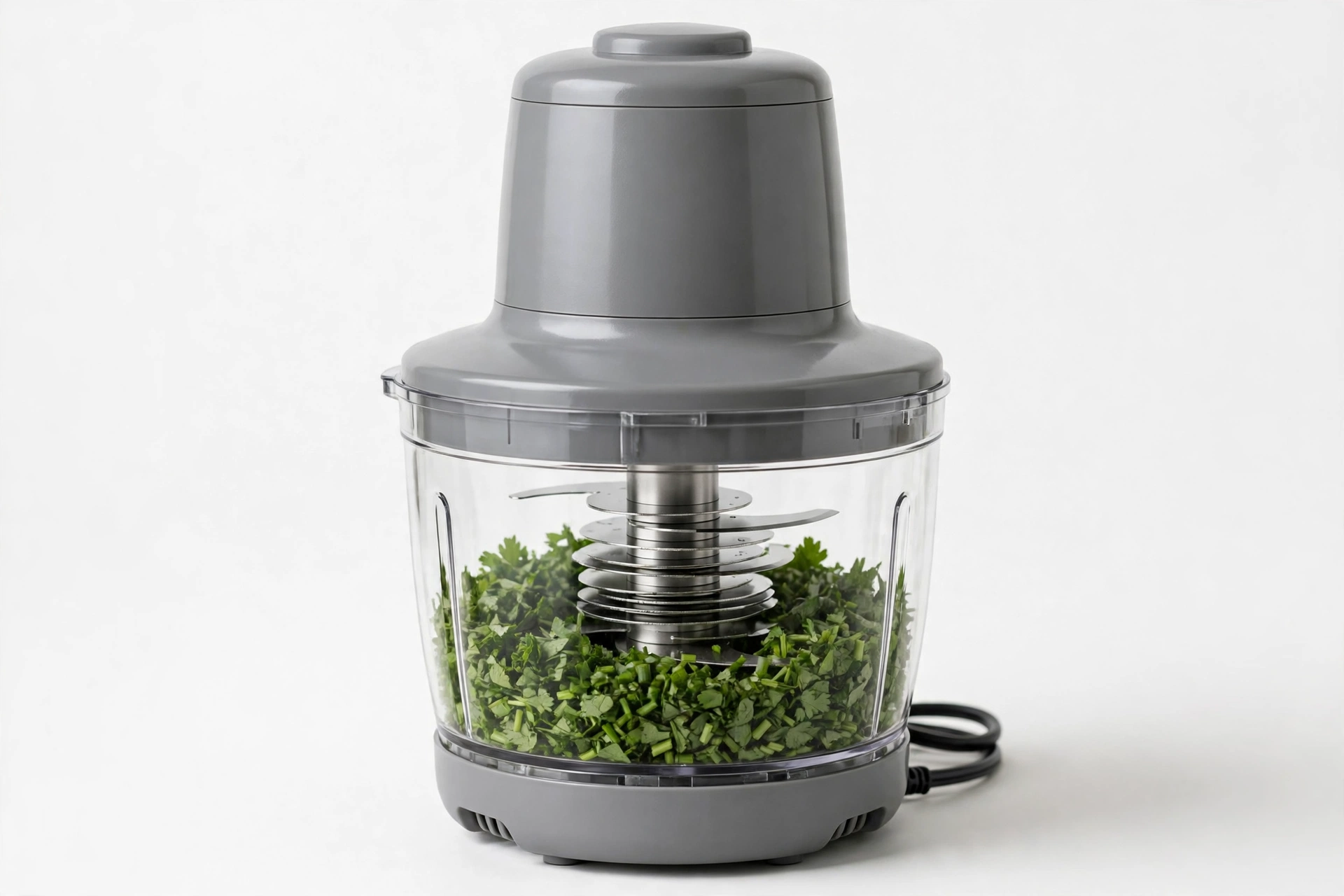
The Express Chop is the smallest honest machine in the guide: a 2-cup (16-ounce) bowl, a 200-watt motor pod that sits on top, and Ninja’s stacked blade assembly — blades at two heights — that pulls ingredients down instead of leaving a layer unchopped at the bottom. The footprint is roughly 5.75 inches square. You press the pod, it chops; that is the entire interface, and for garlic, herbs, nuts, onions for one, and baby-food purées, it is genuinely all the interface the jobs need.
Budget honesty applies in both directions. The pod-top design means no feed tube, no discs and no pouring while it runs, and 2 cups is a hard ceiling — a family salsa is two batches. The plastic bowl and splash guard are dishwasher safe, and the whole machine stores in a space a kettle would envy, which in a dorm, RV or first apartment is not a compromise but the entire point.
Buy it as the specialist for small, frequent jobs, priced so that its narrowness does not sting. Cooks who fall in love with chopping graduate to the 5-cup class and keep this one for garlic — a common and honourable career path.
Yay · Pros
- Smallest footprint here — about 5.75 inches square
- Stacked two-height blade chops evenly for its size
- One-press operation; nothing to learn
- Lowest price in the guide
Hmm · Cons
- 2-cup ceiling — family batches need two rounds
- 200 W motor is for soft and medium jobs, not ice or hard roots in volume
- No drizzle, discs or dough — a pure chopper
Best for: dorms, RVs, singles and garlic-and-herb specialists. Skip if: your smallest regular job is a full onion-and-pepper batch — start at 3 cups instead.
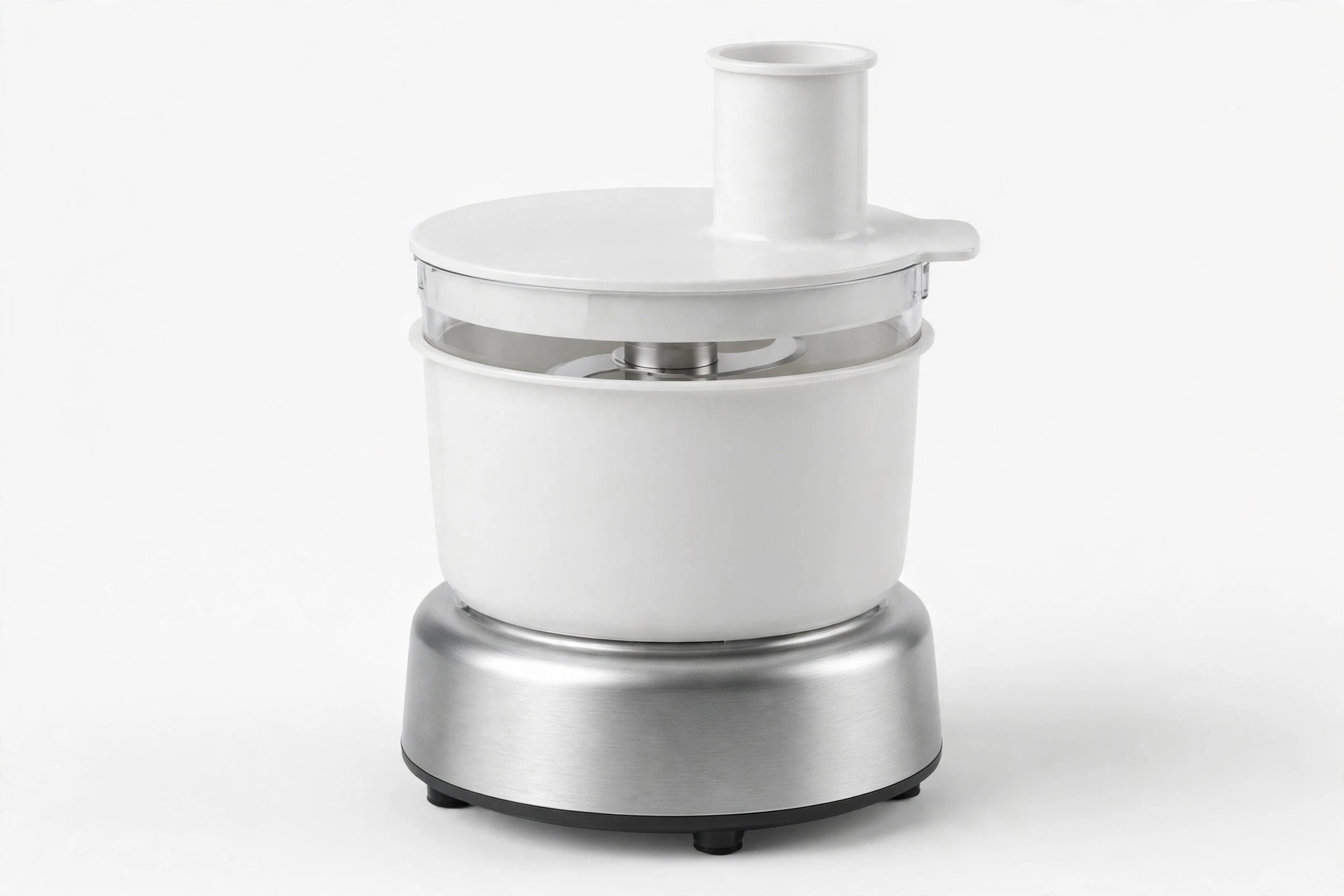
5. KitchenAid 7-Cup Food Processor (KFP0718) — Best compact with storage
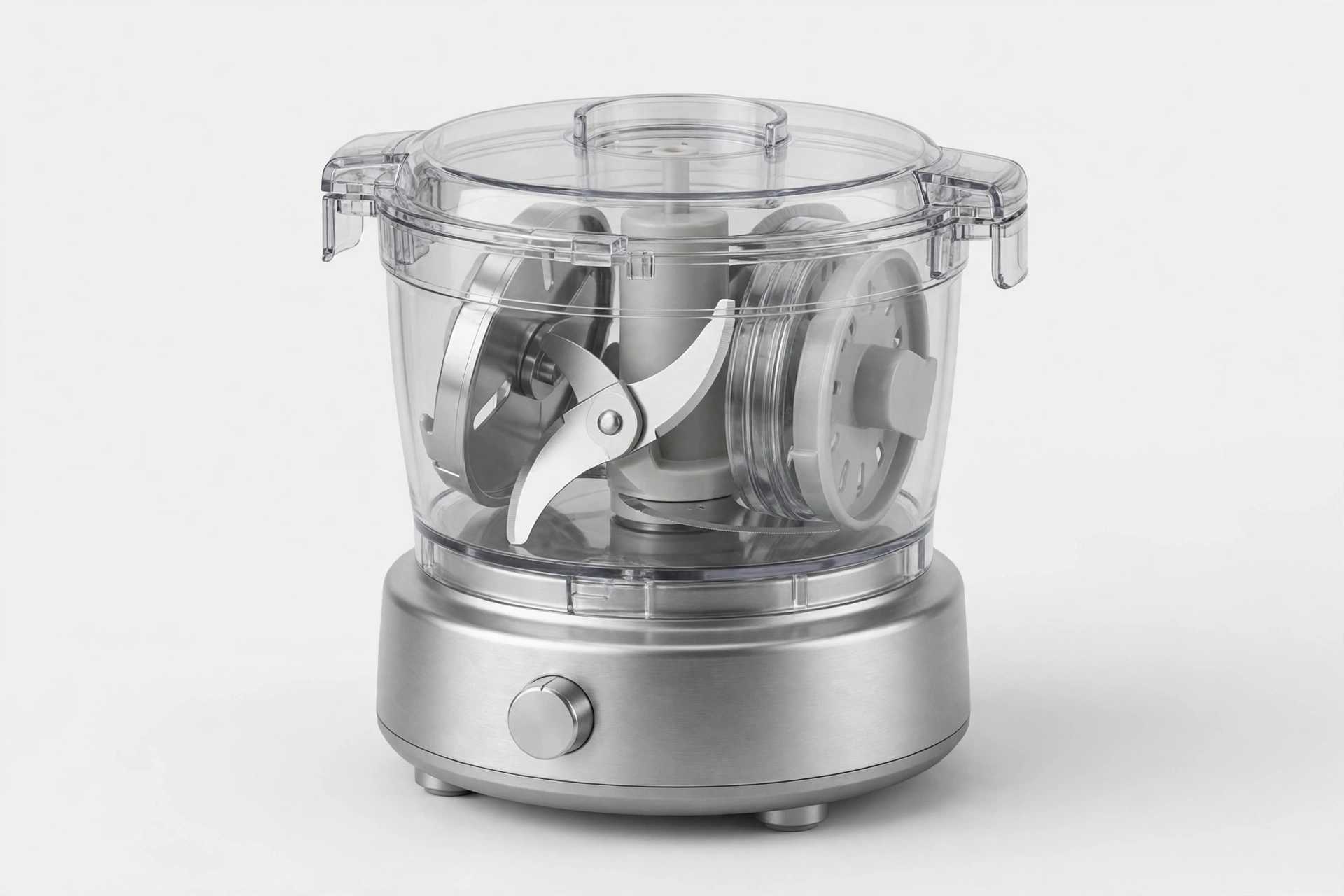
The 7-Cup is where compact stops meaning chopper: a true processor with a multipurpose blade and a reversible medium slicing/shredding disc, three speeds, and KitchenAid’s one-click, twist-free bowl assembly with a latched lid. Published dimensions vary by source — the manual lists about 7.87 inches deep, 9.65 wide and 15.35 tall, while some retailers list larger packaged figures — so plan around the manual’s numbers and a 16-inch shelf clearance. The design’s small-kitchen masterstroke is storage: the blade and disc store inside the bowl, so the machine’s footprint is its only footprint, with no accessory box colonising a drawer.
Seven cups is the compact-full-size sweet spot for households of two to four: a full cabbage slaw with the disc, a double batch of hummus with the blade, pastry dough in small batches. The sealed, leak-resistant bowl and the latched lid make wet jobs calmer than the twist-lock designs at this size, and every removable part is dishwasher safe.
It is taller than everything above it in this guide — measure your shelf before you fall for it. Kitchens with a 16-inch home for it get the smallest true processor experience KitchenAid makes.
Yay · Pros
- True slicing and shredding at a 7-cup compact size
- All accessories store inside the bowl — zero extra footprint
- One-click twist-free assembly; latched, sealed lid
- Three speeds; dishwasher-safe parts
Hmm · Cons
- About 15.4 inches tall — measure shelf clearance first
- Retailer dimension listings disagree; trust the manual
- Disc set is a single reversible medium — no fine or thick options in the box
Best for: households of two to four that want real discs without a full-size machine. Skip if: your shelves are under 16 inches — the choppers above are your category.
6. Cuisinart Elemental 8-Cup Food Processor (FP-8) — Best compact full-size
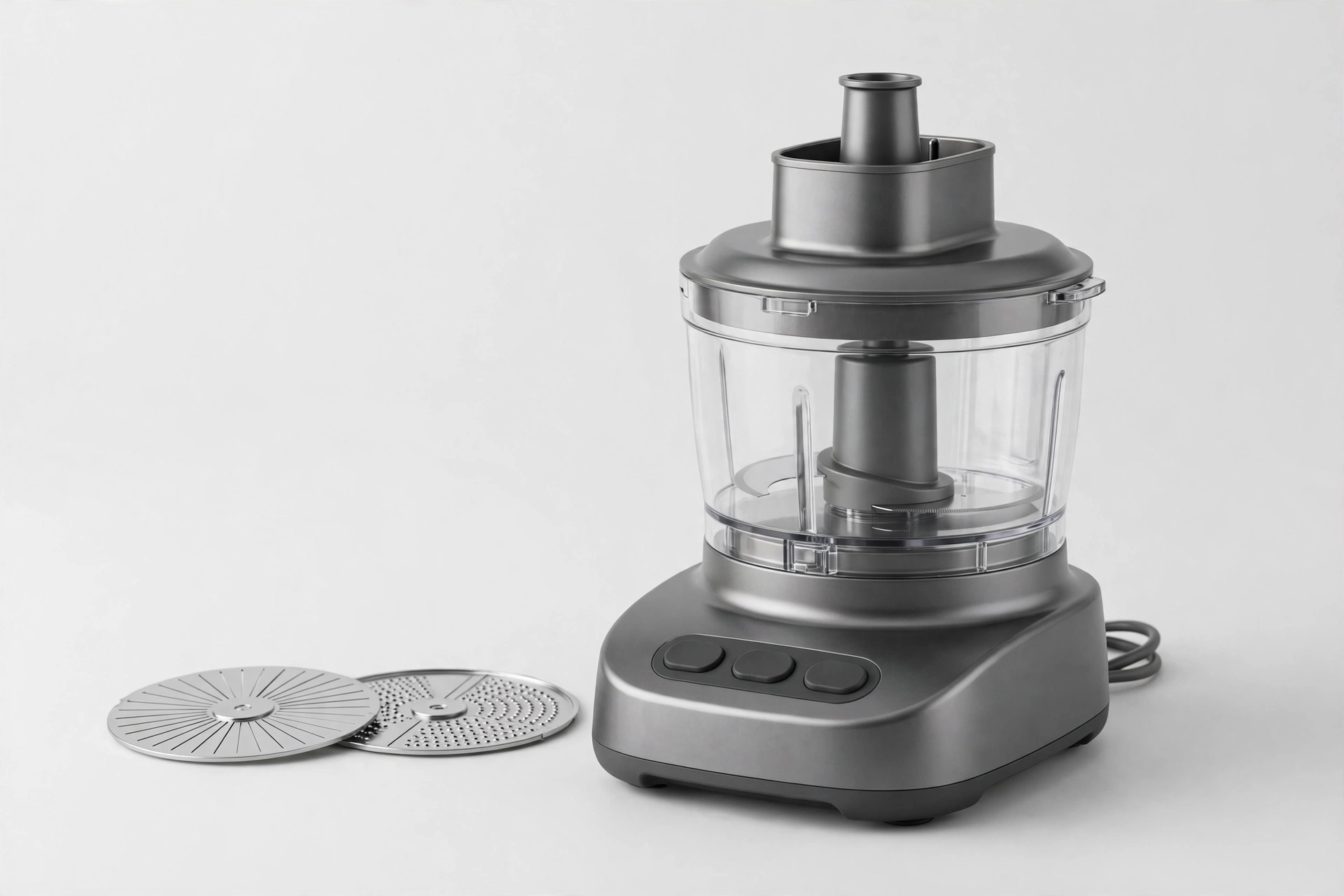
The Elemental 8 is the smallest machine in this guide that a family can mistake for a full-size processor: an 8-cup work bowl with measurement markings, a 350-watt motor, a stainless chopping/mixing/dough blade, and reversible slicing and shredding discs in fine and medium. Cuisinart’s published dimensions are 7.60 by 9.58 by 15.19 inches — a base under ten inches wide that fits the counter strip a 14-cup machine cannot, with the height every disc processor demands. Controls are a rubberised touch pad: high, low, pulse, off.
Eight cups is the threshold size for real family work: a whole head of cabbage, a kilo of cheese across a month of gratins, pizza dough for two pies. The integrated feed tube takes additions mid-process, and the bowl’s markings make scaling honest. Owner reports praise the disc work — even slices, clean shreds — as the reason to choose it over a chopper, which is exactly the dividing line this guide draws.
Like the KitchenAid 7-cup, it needs its 15-plus inches of vertical home. Given that home, it is the compact ceiling: the most processing per counter inch in the guide, and the natural upgrade path from the Mini-Prep made by the same house.
Yay · Pros
- 8 cups and 350 W — family batches on a sub-10-inch base
- Fine and medium reversible slicing/shredding discs included
- Dough blade included at this size
- Measurement-marked bowl and integrated feed tube
Hmm · Cons
- 15.19 inches tall — cabinet clearance is the gate
- Touch pad is less tactile than dials with wet hands
- Heavier than the choppers when shelf-storing
Best for: families in small kitchens who slice, shred and knead weekly. Skip if: you only chop — a chopper does your jobs in half the space.
7. Hamilton Beach Stack & Snap 8-Cup Food Processor (70740) — Best easy-assembly 8-cup
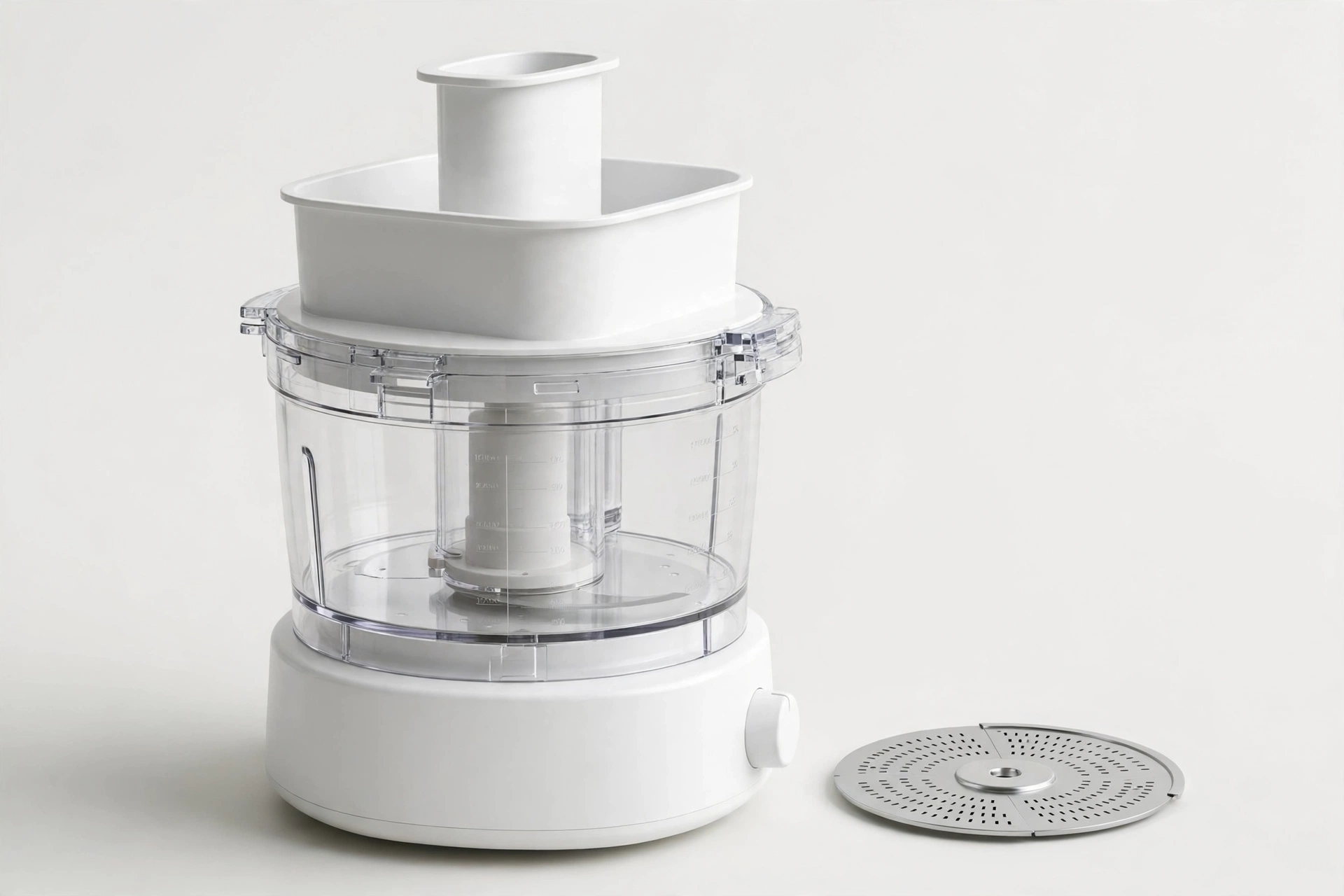
The Stack & Snap’s idea is assembly without the wrestling match: the bowl stacks onto the base and the lid snaps on — no twisting, no aligning tabs, no wondering whether it is locked, which is the daily friction that makes people leave processors in cupboards. The 8-cup bowl pairs with a 450-watt motor per Hamilton Beach, a chopping/mixing blade, a reversible slicing/shredding disc, and the Big Mouth feed chute that takes whole blocks of cheese and halved onions without pre-trimming theatre.
That chute is the feature owners cite: prep shrinks when the machine accepts food the size you cut it for dinner, not the size a narrow tube demands. Suction-cup feet hold the light body steady, the cord hides in the base, and the removable parts are dishwasher safe. Published footprints put it in the same compact class as the Elemental — roughly nine to ten inches across the base, with full processor height.
It trades the Cuisinart’s fit and finish for price and ease, and its plastic feels a class lighter. For a small kitchen that will actually use an 8-cup machine weekly because assembly stopped being annoying, that trade is the entire ballgame.
Yay · Pros
- Stack-and-snap assembly — no twist-lock wrestling
- Big Mouth chute takes whole cheese blocks and halved onions
- 450 W motor, the strongest in this guide (manufacturer figure)
- Suction feet and cord storage; dishwasher-safe parts
Hmm · Cons
- Fit and finish a class below Cuisinart and KitchenAid
- Full processor height, like all disc machines
- Disc range is the basics — no specialty cuts
Best for: cooks who abandoned a twist-lock processor and want back in, cheaply. Skip if: build feel matters as much as function — the Elemental is the finer object.
The footprint table: bowl capacity against counter space, all seven picks
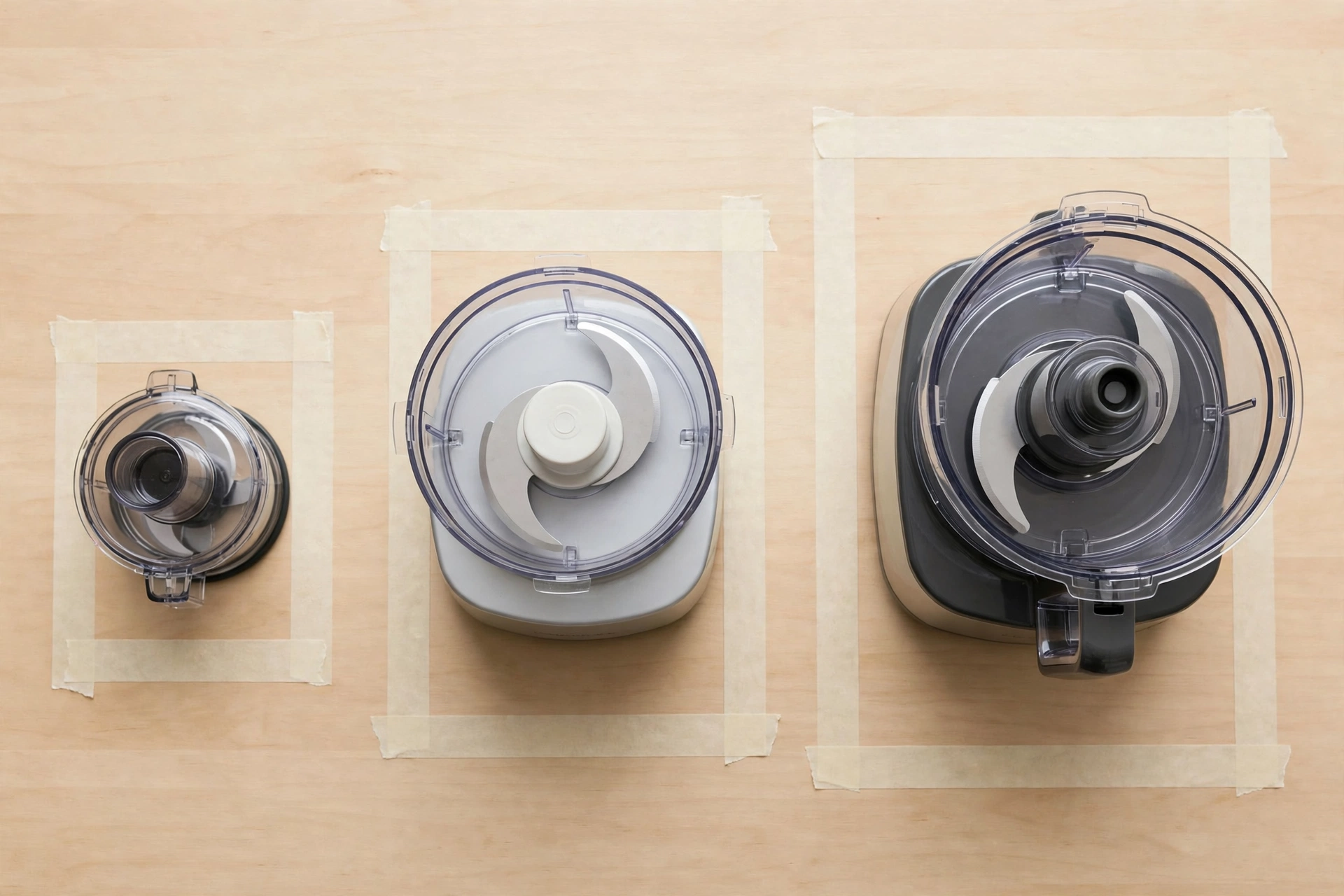
Read this table the way a small kitchen demands: the base dimensions are the rent you pay every day, the bowl is the work you get for it. Footprints use published width by depth; height decides whether the machine lives on the counter, a shelf, or in exile. Working capacity — what a bowl handles comfortably with liquid in motion — is roughly two-thirds of the headline cups, and the batch column uses that honest figure.
| Product | Bowl | Base (W × D) | Height | Comfortable batch | |||||||||||||||||||
|---|---|---|---|---|---|---|---|---|---|---|---|---|---|---|---|---|---|---|---|---|---|---|---|
| N | i | n | j | a | E | x | p | r | e | s | s | C | h | o | p | ||||||||
| 2 | c | u | p | s | |||||||||||||||||||
| ≈ | 5 | . | 7 | 5 | × | 5 | . | 7 | 5 | i | n | ||||||||||||
| ≈ | 9 | i | n | ||||||||||||||||||||
| G | a | r | l | i | c | , | h | e | r | b | s | , | o | n | e | o | n | i | o | n |
Mini chopper vs compact full-size: the dividing line is discs, not size
Shoppers frame this choice as small versus big. Cooks should frame it as blade versus discs. A mini chopper — everything up to the 5-cup class here — does one thing superbly: a blade spins in a bowl and reduces food to chopped, minced or smooth. If your processor jobs are onions, garlic, herbs, nuts, breadcrumbs, pesto, salsa, hummus and dressings, a chopper does all of them in a third of the space and washes in a minute. Buying a disc machine for those jobs buys height, parts and assembly friction you will never cash in.
A compact full-size processor adds the disc jobs — slicing cucumbers and onions evenly, shredding cheese and cabbage, cutting fries — plus dough blades and the feed tube that makes them practical. If you make slaw, gratins, scalloped potatoes or pizza dough weekly, no chopper substitutes, and the 7-to-8-cup class is the smallest honest way to get them. The tell is your last month of cooking, not your ambitions: count the times you sliced or shredded by hand and wished otherwise. Three or more a week means discs; fewer means a chopper and a sharp knife.
Height is the constraint that decides for many kitchens before preference gets a vote. Disc processors stand about 15 inches before the pusher; choppers stand under 10. Measure the shelf or the counter-to-cabinet gap first — standard cabinet clearance is about 18 inches, but older and smaller kitchens run tighter — and let the tape measure cast the first ballot.
Storage and care in a small kitchen: keeping a compact processor alive
A compact processor earns its place twice: once in the cooking and once in the cupboard. Storage is where small kitchens lose machines, so the habits matter. Store choppers with the blade locked in the bowl and the cord wrapped — every pick here supports it — and store disc processors with their discs inside the bowl where the design allows, as the KitchenAid 7-Cup does, rather than loose in a drawer where edges dull and fingers find them. A disc stored loose is a disc that will eventually be thrown away chipped, and a blade stored loose is a first-aid story.
Care is mostly one rule: the motor base never meets water. Wipe it, and put everything else — bowls, lids, blades, discs — in the dishwasher as their makers allow, or wash by hand when you want edges to stay keen longest. Processors die in small kitchens less from wear than from a lost pusher or a cracked bowl, so check that your brand sells replacement bowls and lids in Canada and the USA before you buy; every brand in this guide does, which is one of the quiet reasons marketplace no-name machines did not make the list.
Finally, let the machine live where it works. A chopper that fits the counter beside the board will be used daily; a processor exiled to a high shelf will be used monthly and resented both times. The footprint table above is therefore not just a buying tool — it is a placement plan. Measure the spot, buy the machine that fits the spot, and the small kitchen stops being a limitation and becomes the reason the right tool got bought.
What a compact processor cannot do (and the cheap tools that cover it)
Honesty about the gaps makes the compact choice stick. No machine in this guide extrudes pasta, juices, blends soup like a blender or grinds meat like a grinder — and the choppers cannot slice a cucumber into coins no matter how hopefully they are loaded. A mandoline or a sharp chef’s knife covers slicing for chopper owners at a fraction of a disc machine’s height; a box grater covers the occasional cheese shred; and a stand mixer or strong arms cover dough in households that bake monthly rather than weekly.
The second gap is batch rhythm. Compact bowls reward working in two calm batches over one violent overload: an overfilled bowl chops unevenly, leaks at the lid and strains the motor, while two half-batches finish faster and finer. This is the small-kitchen tax, and it is small. The third gap is noise and nerve — compact motors are loud for their size, and the first pulse always startles. Short pulses, a hand on the lid, and food cut to even pieces tame both.
None of these gaps argues for a bigger machine in a kitchen that cannot house one. They argue for buying the compact class with open eyes and a ten-dollar mandoline beside it — which is, in the end, the whole philosophy of this guide: the right small tool, honestly bounded, beats the aspirational large one in exile on a high shelf.
Small-kitchen food processor questions, answered
What size food processor is best for a small kitchen?
For chopping jobs, 3 to 5 cups is the sweet spot — the KitchenAid 5-Cup offers the most bowl per inch of counter. If you slice and shred, 7 to 8 cups is the compact full-size class. Below 3 cups is specialist territory for garlic-and-herb work.
Can a mini food processor replace a full-size one?
Only if your jobs are blade jobs: chopping, puréeing, emulsifying. Minis cannot slice, shred or knead. Households that make slaw, gratins or dough weekly need a compact full-size machine — the 7 and 8-cup picks here are built for exactly that gap.
How much counter space does a compact food processor need?
Choppers need roughly a 7 by 6-inch patch and under 10 inches of height. Compact disc processors need about a 10 by 8-inch patch and just over 15 inches of height. Measure your counter-to-cabinet gap before buying any disc model.
Why does my food processor bowl leak or overflow?
Headline capacity is the bowl’s maximum, not its working load. Liquids and wet batters behave best at about two-thirds of the rated cups — a 5-cup bowl wants roughly 3 to 3.5 cups of liquid in motion. Overfilling is the leak, nine times in ten.
Are compact processors dishwasher safe?
The bowls, lids, blades and discs of every pick here are dishwasher safe per their makers; bases wipe clean. Blades keep their edges longer with hand-washing, but at this size the parts wash fast either way.
Is a food chopper the same as a food processor?
Not quite. A chopper is blade-only; a processor adds discs, a feed tube and usually a dough blade. Retailers use the words loosely, so shop by included parts and dimensions — the table in this guide lists what each pick actually does.
The short version
Short on time? Buy the KitchenAid 5-Cup Chopper for the best bowl-per-inch in the guide, the Cuisinart Mini-Prep Plus for the classic mini, or the Cuisinart Elemental 8 if you need discs and dough in a compact body. When space stops being the constraint, step up to the full field in our best food processors in Canada and the USA — and for the tiniest jobs of all, the best electric mini food choppers guide goes smaller still.
Sources
This guide is research-based: we compared manufacturer specifications with the independent testing and reporting below, cross-checked against verified owner reports in Canada and the USA. Specs are the manufacturers’ published figures; where testers disagree with a maker’s claim, the review says so.
- Cooktry — 6 Best Food Processors for Small Kitchens (2026) — Independent small-kitchen comparison that publishes bowl, footprint and motor together — the method this guide adopts — including the KitchenAid 5-Cup and Cuisinart Mini-Prep Plus dimensions.
- Proven Pantry — Best Mini Food Processors & Choppers in 2026 — Tested mini roundup covering the Mini-Prep Plus, KitchenAid 3.5-Cup, Ninja Express Chop and Cuisinart Elemental 4-Cup class with motor figures.
- KitchenAid 3.5-Cup Mini Food Processor (KFC3516) — retailer specification listing — Published dimensions for the KFC3516 — 7 × 5.6 × 8.7 inches — with its two-speed and drizzle-basin feature set.
- KitchenAid 7-Cup Food Processor (KFP0718) — instruction manual specifications — The manual’s own dimensions for the KFP0718 — 7.87 × 9.65 × 15.35 inches — used here where retailer listings disagree.
Last updated: November 20, 2026. We refresh this guide each season and whenever a pick is replaced by a better one.