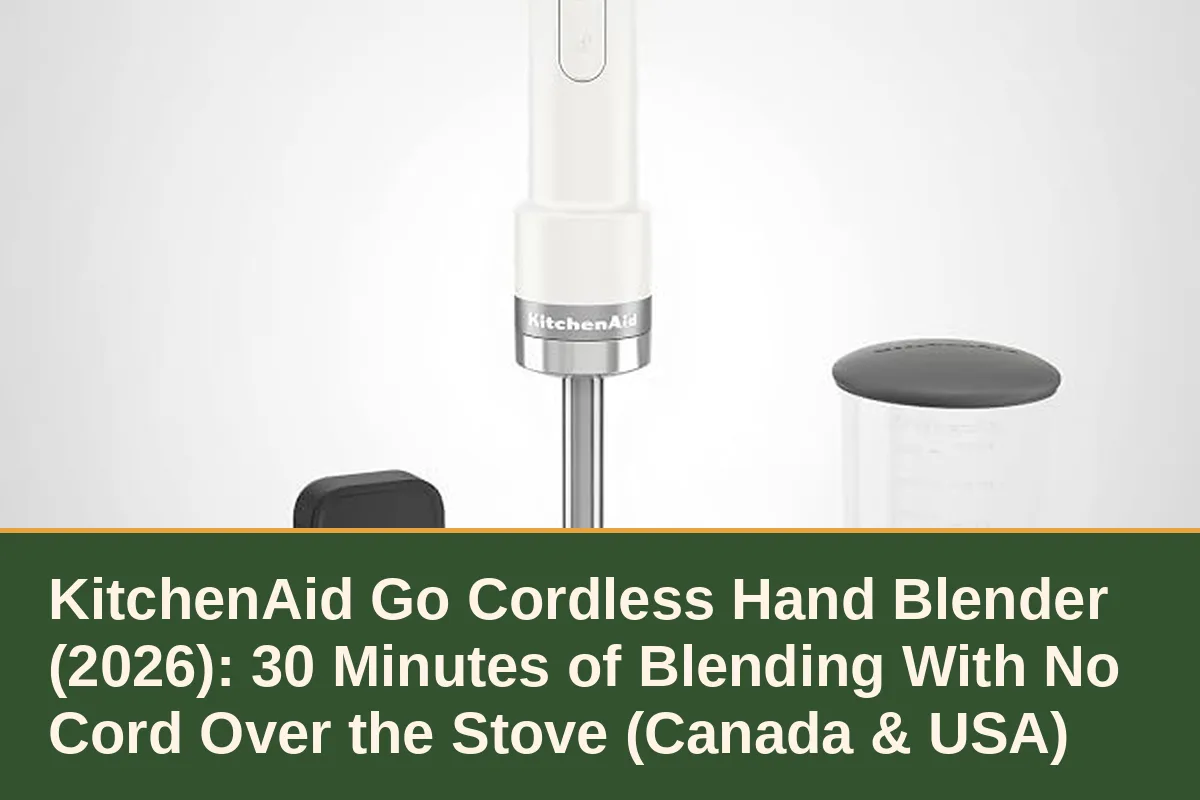
The KitchenAid Go Cordless Hand Blender fixes the hand blender oldest annoyance: the cord. It blends for up to 30 rated minutes on KitchenAid removable 12V MAX battery, so the blender travels pot to pot - soup on the stove, sauce at the counter, dressing at the table - with nothing trailing through the food or over a hot burner.
Key takeaways: the 7-inch removable arm carries a 4-point stainless blade for smoothies, shakes and soups, the trigger varies speed with squeeze pressure for real control, and the U.S.-patented removable pan guard clips on so the blade never kisses your pan coating.
What is new and why it matters
Retail listings dated 2025 (Best Buy, Amazon) confirm the current KHBRV71 configuration: battery-included and battery-sold-separately boxes, USB-C charging with wall adapter, the 3-cup BPA-free jar with lid, and the one-year warranty - the details buyers actually trip over, verified for this guide.
A quotable way to put it: The Go hand blender is the only mainstream stick blender whose battery also powers a chopper, a hand mixer and a citrus juicer. Related reading: our KitchenAid Go guide our immersion blender guide our mini food chopper guide.
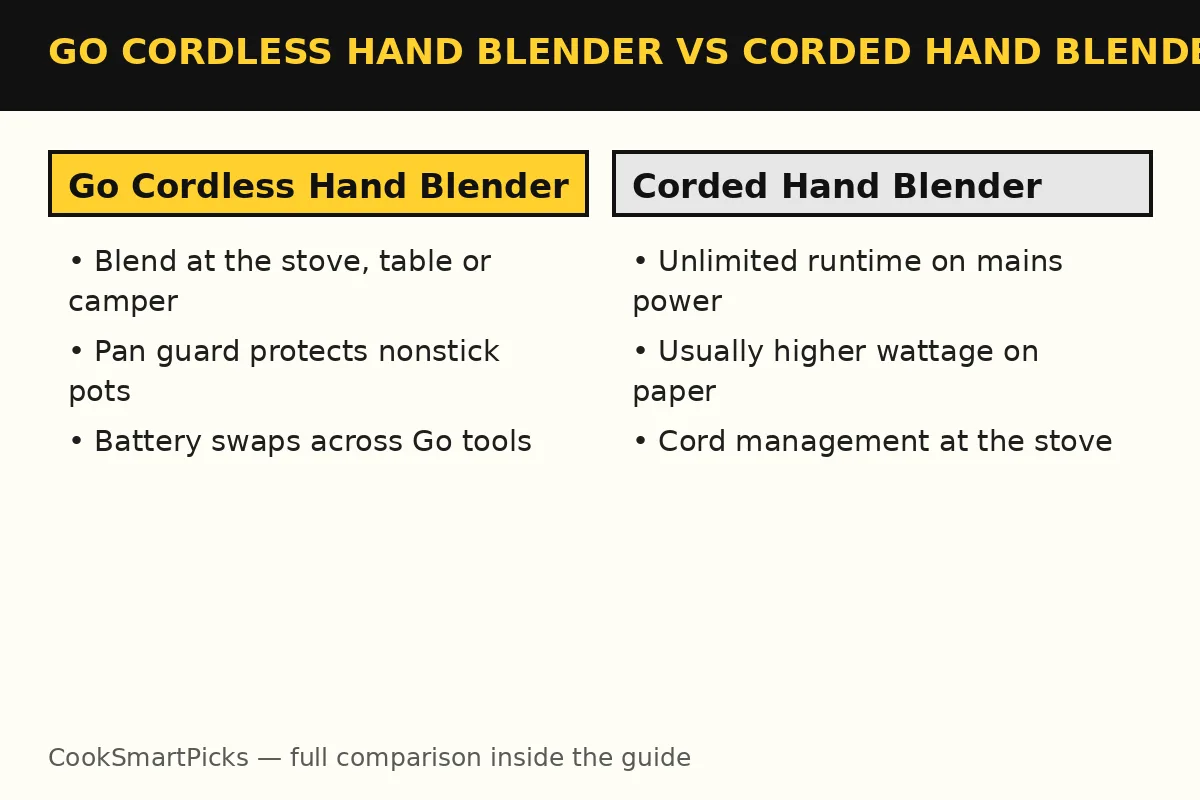
KitchenAid Go Cordless Hand Blender vs KitchenAid Variable Speed Hand Blender (corded)
| Feature | Go Cordless Hand Blender | Corded Hand Blender |
|---|---|---|
| Power | 12V MAX battery, 180W class | Mains, model dependent |
| Runtime | Up to 30 min continuous | Unlimited while plugged in |
| Arm | 7 in removable, 4-point blade | Fixed or removable by model |
| Speed | Variable-speed trigger | Dial or trigger by model |
| In the box | 3-cup jar with lid, pan guard, USB-C charging | Jar on select models |
| Weight | About 1.8 lb | Varies |
Pros and cons
Go Cordless Hand Blender - Pros
- No cord draped over burners or knocked into the soup - the safety upgrade is the product
- Removable pan guard lets it blend directly in nonstick and enamel pots
- One battery strategy: the same 12V MAX pack runs the Go chopper, mixer, blender and juicer
Cons and watch-outs
- 30 minutes is a ceiling - marathon stock-pot sessions belong to corded models
- Battery sold separately on some configurations; the with-battery box is the simple buy
- Less raw wattage than big corded blenders for frozen-fruit smoothies - use the jar and pulse
Best for: soup-and-sauce cooks in small kitchens and Go-system homes. Skip for daily frozen smoothies - a countertop or personal blender is the right tool.
The alternative: KitchenAid Variable Speed Hand Blender (corded)
A corded KitchenAid hand blender counters with unlimited runtime and a lower entry price - the pick for long blending sessions and single-tool buyers who do not want a battery platform.
FAQs
How long does the Go hand blender run?
Up to 30 minutes of continuous blending per charge, per KitchenAid - and since real blending jobs take one to three minutes, that is many meals per charge.
Will it scratch my nonstick pot?
It ships with a patented removable pan guard that covers the blade bell, designed specifically to protect cookware coatings while blending in the pot.
Is the battery included?
Both ways exist: KHBRV71 boxes are sold with the 12V MAX battery or without it for Go owners. The listing title states which - check before ordering.
Cordless or corded hand blender: which should I buy?
Cordless for freedom, safety around the stove and platform value. Corded for unlimited runtime and the lowest price.
Sources
Specs in this guide are the manufacturers' published figures as reported by the sources below; where testers disagree with a maker's claim, the guide says so. We do not print prices — use the buttons above for the live price in your marketplace.
- Best Buy - KitchenAid Go Cordless Hand Blender — Retail specs: KHBRV71, 180W, 30-minute runtime, 4-point blade, pan guard, jar and charging contents.
- KitchenAid - Go Cordless lineup — Manufacturer lineup: hand blender 30-minute rating, 4-point blade, and the shared-battery Go family with per-tool runtimes.
- Food Processor Hub - KitchenAid Go platform review — Platform detail: KRB12 12V MAX battery sold separately on tool-only boxes, nominal 10.8V, runtime behaviour across Go tools.
Last updated: November 20, 2026. We refresh this guide whenever the makers revise these products.