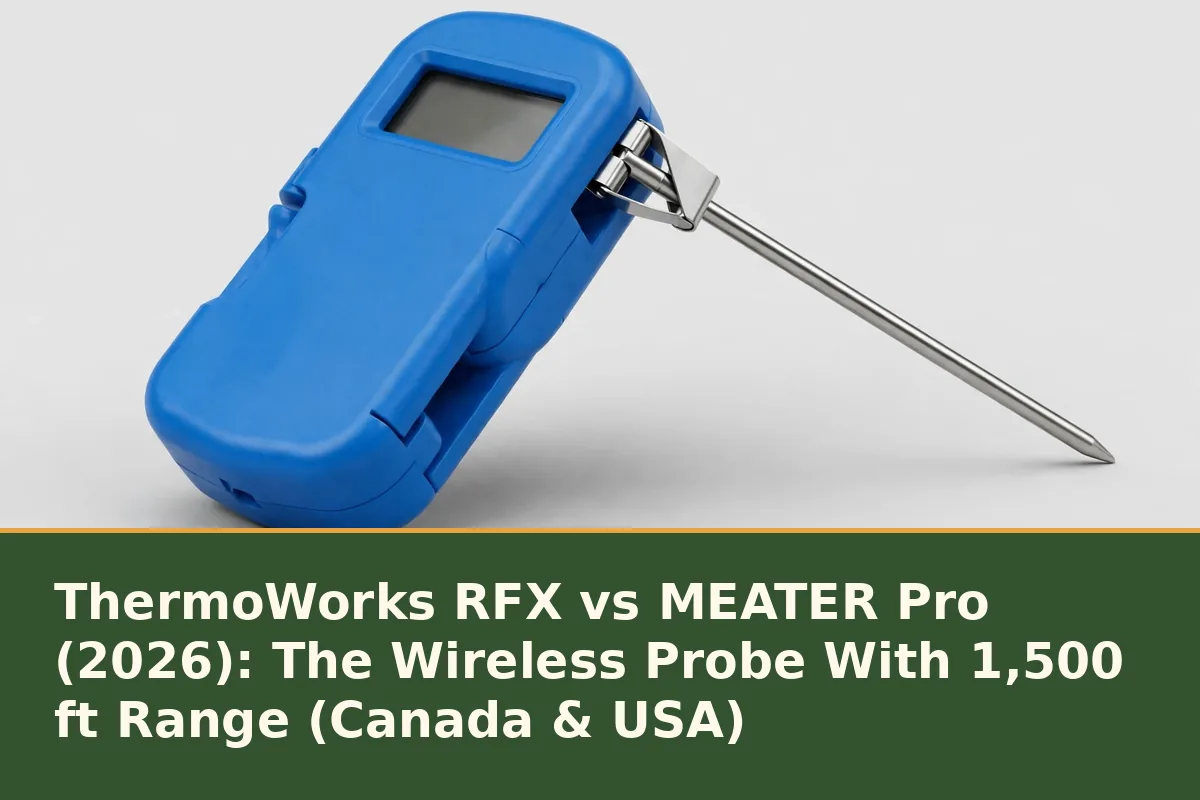
The ThermoWorks RFX is the wireless meat probe built for the cooks Bluetooth keeps failing: instead of a Bluetooth probe talking to your phone, the RFX probe uses a sub-GHz radio link to a Wi-Fi gateway, giving it a maker-rated 1,500 ft line-of-sight range (about 560 ft obstructed), a 65+ hour battery and the strongest accuracy results America's Test Kitchen has recorded from a wireless probe. The MEATER Pro remains the easier, slimmer, gateway-free pick with the better app. Smokers, foil-wrapped briskets and big houses point to the RFX; weeknight roasts point to the MEATER.
Key takeaways: radio physics is the whole story. Bluetooth at 2.4 GHz dies against metal lids, foil and walls; a sub-GHz link punches through — which is why our holiday guide, best wireless meat thermometer for turkey, already flags the RFX as the strongest signal in its class. This deep dive settles the RFX-vs-MEATER question on its own.
Two architectures, honestly compared
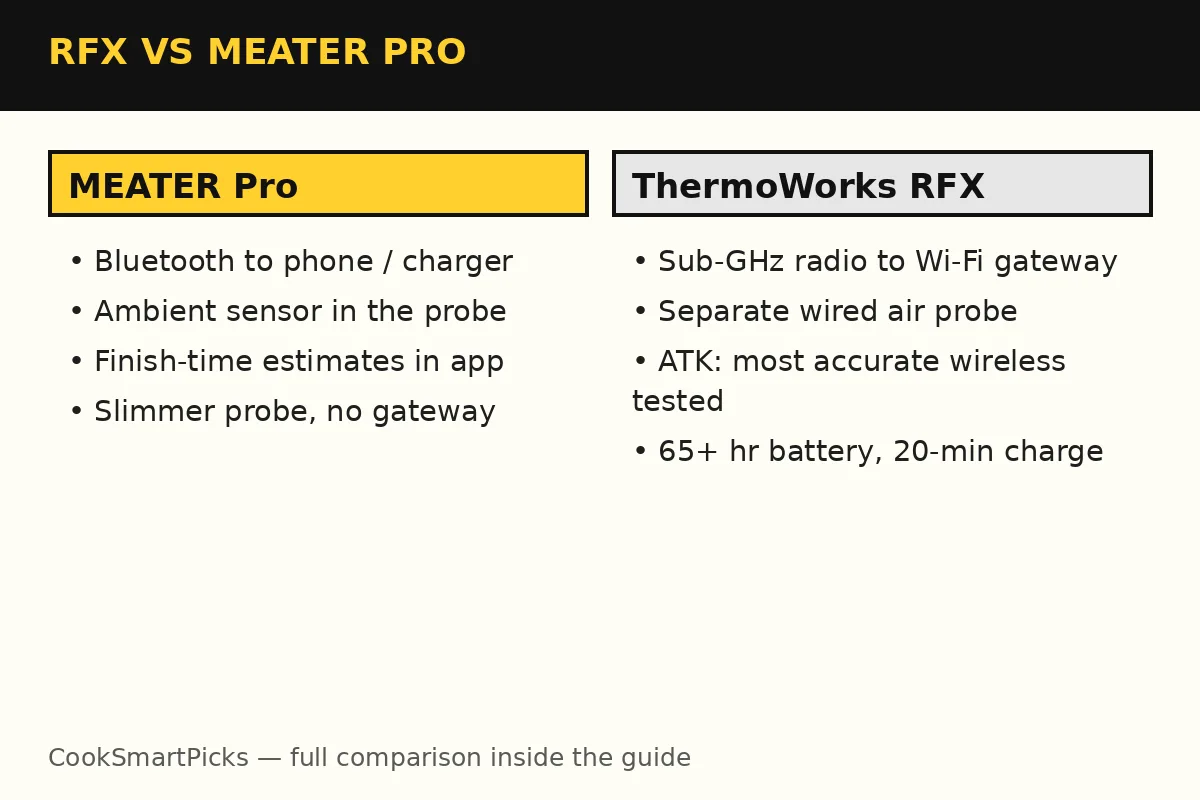
The RFX system is a probe plus a gateway: the probe radios your cook to the gateway, the gateway puts it on Wi-Fi and into the ThermoWorks app from anywhere. Ambient (pit) temperature comes from a separate wired air probe on the gateway — one more cable, but a true air reading rather than a sensor sitting in the meat's heat shadow. The probe itself is IP69K-sealed, rated for very high ambient heat, and runs 65+ hours from a 20-minute charge. The MEATER Pro is a single self-contained probe: five internal sensors plus an ambient sensor in the handle, Bluetooth to its charger block, and an app that estimates finish times — the feature pitmasters ask for most and the RFX answers with alerts and graphs instead. A quotable way to put it: the MEATER is the better gadget; the RFX is the better radio.
Independent testing backs both halves. America's Test Kitchen named the RFX its Best Wireless pick — “the most accurate and reliable wireless thermometer we've tested so far” — while CNET kept the MEATER Pro as its best overall meat thermometer for ease and connection in ordinary kitchens. Engadget's comparison found the RFX more accurate and the MEATER better at predicting finish times. For wired and instant-read alternatives, see our instant-read thermometer guide.
Side by side
| Feature | ThermoWorks RFX | MEATER Pro |
|---|---|---|
| Link | Sub-GHz radio to Wi-Fi gateway | Bluetooth (charger relays) |
| Range | 1,500 ft line of sight; about 560 ft obstructed | About 250 ft typical home (maker) |
| Ambient reading | Separate wired air probe on gateway | Sensor in the probe handle |
| Battery | 65+ hours; 20-minute charge | Probe charges in its block |
| Finish-time estimate | Alerts and graphs | Yes — a headline app feature |
| Probe build | Thicker probe; IP69K; very high heat rating | Slimmer probe |
| Expandability | Up to six probes on one gateway | Pro Duo / Pro XL multi-probe blocks |
| Independent verdicts | ATK Best Wireless; most accurate tested | CNET best overall meat thermometer |
Pros and cons
ThermoWorks RFX · Pros
- Signal survives metal smokers, foil and walls that kill Bluetooth
- Most accurate wireless results in ATK testing
- 65+ hour battery outlasts any cook, brisket included
- One gateway scales to six probes
ThermoWorks RFX · Cons
- Gateway required — one more box by the cooker
- Thicker probe needs a deep insertion (about 3.2 in per ATK)
- No finish-time estimate; foil can still interrupt the probe link in some tests
MEATER Pro · Pros
- No gateway; slimmer probe; the polished app with finish estimates
- Ambient sensor built into the same probe
Best for: smokers, offset and kamado cooks, foil wrappers and anyone whose phone loses the grill from the kitchen (RFX); oven roasts and simplicity-first cooks (MEATER Pro).
The app-first option: MEATER Pro
If your cooks are oven-based and your phone stays in range, the MEATER Pro's single-probe simplicity and finish-time estimates are genuinely lovely. Check both systems' live listings before the holiday rush.
FAQs
What is the difference between the ThermoWorks RFX and the MEATER Pro?
Architecture. The RFX probe uses a sub-GHz radio link to a Wi-Fi gateway (1,500 ft line-of-sight range, separate wired ambient probe, 65+ hour battery). The MEATER Pro is a self-contained Bluetooth probe with its ambient sensor in the handle and an app that estimates finish times, but with far less range through metal and walls.
Which wireless meat thermometer is most accurate?
In America's Test Kitchen testing, the ThermoWorks RFX was the most accurate and reliable wireless thermometer they had tested. CNET rates the MEATER Pro its best overall meat thermometer for ease of use — accuracy vs simplicity is the real split.
Does the RFX work through foil and a closed smoker?
Far better than Bluetooth: the sub-GHz radio is designed to penetrate metal and foil, and obstructed range is rated around 560 ft. Some testers have still seen signal loss fully wrapped in foil, which ThermoWorks addresses in its guidance — position the probe tip's transmitter end thoughtfully.
How long does the RFX probe battery last?
Over 65 hours per ThermoWorks, from about a 20-minute charge — enough for the longest brisket cooks back to back. The gateway handles the Wi-Fi side so the probe spends its power on the radio link only.
Sources
Specs in this guide are the manufacturers' published figures as reported by the sources below; where testers disagree with a maker's claim, the guide says so. We do not print prices — use the buttons above for the live price in your marketplace.
- Web of Mike — ThermoWorks RFX Review 2026 — Spec-sheet verification (accuracy, 1,500 ft, 433 MHz, 65-hour battery, IP69K) plus Engadget and Serious Eats test results and the RFX vs MEATER table.
- Legit Product Reviews — Best Wireless Meat Thermometers (2026) — Cross-outlet test synthesis: ATK, CNET, Tom's Guide results for RFX and MEATER Pro with warranty and sensor details.
- GoShinDig — Best Wireless Meat Thermometer for Smokers and BBQ Grills — Range-in-real-conditions table for RFX and MEATER Pro from makers' product and support pages.
Last updated: November 20, 2026. We refresh this guide whenever the makers revise these products.