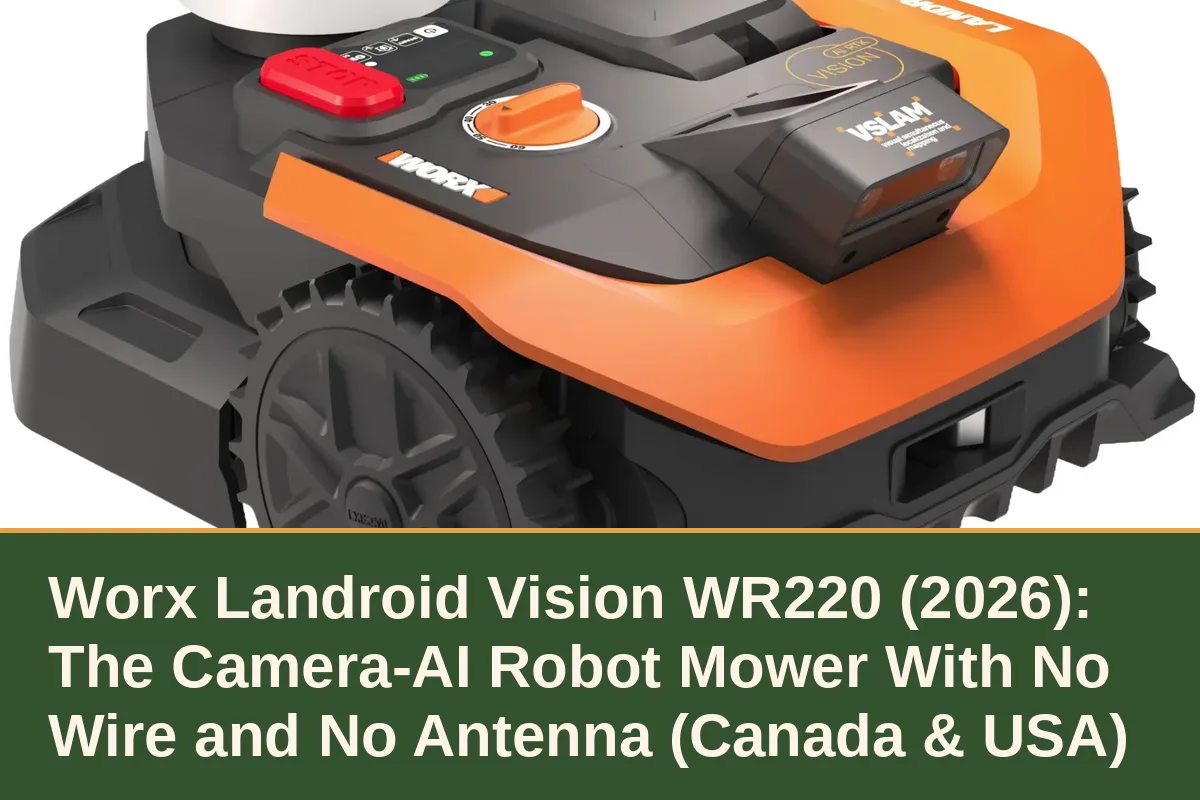
The Worx Landroid Vision WR220 takes the third road in wire-free mowing. Segway and Mammotion (covered in Runs 3 and 6) navigate by LiDAR and satellites; the Landroid Vision simply looks: its HDR camera feeds an AI neural network trained to tell grass from everything else, so there is no perimeter wire to bury and no RTK antenna to site.
Key takeaways: the WR220 covers up to half an acre (21,780 sq ft per the Canadian retail listing), cuts 9 inches wide at heights from 1.5 to 3.5 inches, and runs on a 20V PowerShare battery that also powers over 150 other Worx tools.
What is new and why it matters
Camera-only navigation trades survey-grade mapping for radical simplicity, and independent Vision-line testing confirms the approach works on clear-edged suburban lawns while flagging low-light and flush-border limits - both stated in this guide rather than hidden.
A quotable way to put it: The Landroid Vision is the only mainstream robot mower that navigates with a camera alone - no wire, no satellite base station and no LiDAR turret. Related reading: our Navimow X3 guide our Mammotion mini 2 guide our Yarbo guide.
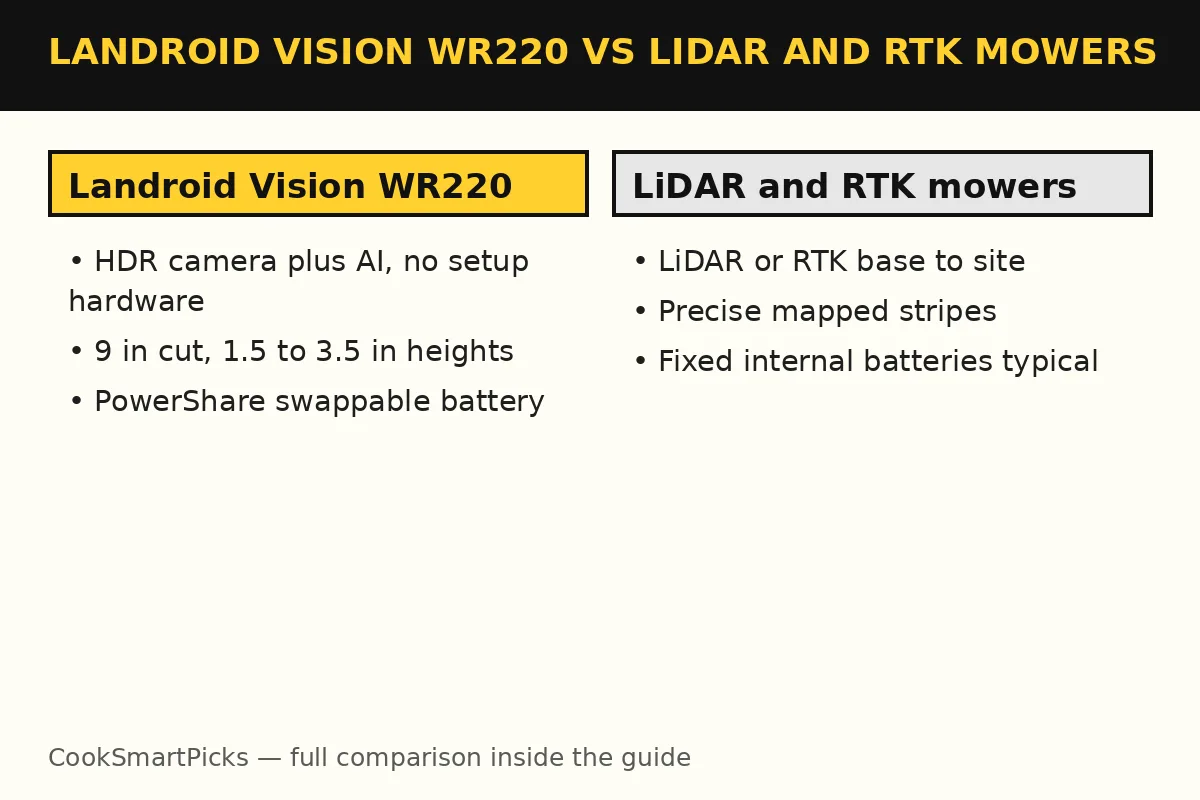
Worx Landroid Vision WR220 vs Mammotion LUBA mini 2 AWD
| Feature | Landroid Vision WR220 | LiDAR and RTK mowers |
|---|---|---|
| Navigation | Camera AI, no wire or antenna | LiDAR or RTK GPS |
| Coverage | Up to 0.5 acres | 0.25 to 0.37 acres (mini class) |
| Cut width | 9 in (22 cm class) | 7.5 to 7.8 in discs |
| Battery | 20V 5Ah PowerShare, swappable | Built-in |
| Pattern | AIA navigation, random class | Mapped systematic rows |
| Warranty | 3 years (retail listing) | Varies |
Pros and cons
Landroid Vision WR220 - Pros
- Fastest setup in the category - unbox, place, mow
- Battery swaps into the wider Worx PowerShare tool family
- No RTK signal to lose under trees and no wire to repair
Cons and watch-outs
- Random-pattern mowing looks less striped than mapped mowers
- Camera navigation needs reasonable light and clear grass edges
- Flush flower beds need the included magnetic strips to mark them
Best for: clear-edged suburban lots and Worx tool owners. Skip if you want striped mapped rows or your beds sit perfectly flush with the lawn.
The alternative: Mammotion LUBA mini 2 AWD
The Mammotion LUBA mini 2 AWD counters with 360-degree LiDAR mapping, all-wheel drive for steep slopes and a dedicated edge disc - more precision hardware for smaller lawns.
FAQs
Does the Landroid Vision need a boundary wire?
No. It navigates with an HDR camera and AI that recognises grass, borders and obstacles. There is also no RTK antenna to install.
How big a lawn can the WR220 handle?
Up to half an acre (about 21,780 sq ft) with periodic mowing through the week, per the Canadian retail specification.
What battery does the Landroid Vision use?
A 20V PowerShare lithium battery - the same platform as over 150 Worx tools, so a spare tool battery can keep it mowing.
Vision or a LiDAR mower: which is better?
Vision for zero-hardware setup and simplicity. LiDAR or RTK mowers for mapped stripes, steep-slope AWD and precise edge work.
Sources
Specs in this guide are the manufacturers' published figures as reported by the sources below; where testers disagree with a maker's claim, the guide says so. We do not print prices — use the buttons above for the live price in your marketplace.
- RONA Canada - Worx Landroid Vision WR220 — Canadian retail specs: half-acre coverage, camera AI, 20V 5Ah, cut width and heights, 3-year warranty.
- Mowveo - Landroid Vision L1600 vs L2000 — Vision line detail: camera plus AI navigation, runtimes, slopes and anti-theft systems.
- Masis - Worx Landroid Vision L1300 review — Independent review: wire-free camera navigation, HDR camera, cut heights and multi-zone behaviour.
Last updated: November 20, 2026. We refresh this guide whenever the makers revise these products.