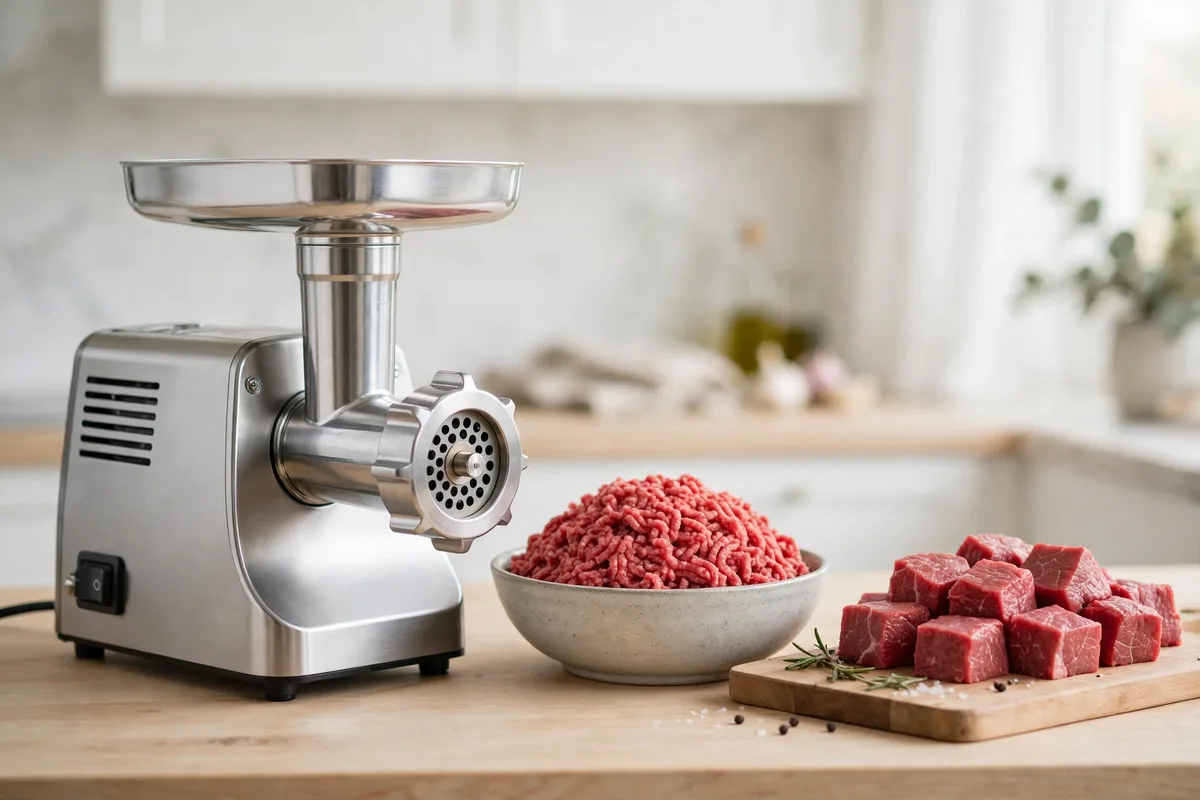
The best electric meat grinder is the one whose numbers survive a second look. No small-appliance category prints bigger wattage figures — or means less by them — than this one, so this guide starts by separating the watts a motor actually draws while grinding from the locked-motor peak it hits for a split second at a stall. Ranked on head size, honest throughput, plate selection and how each machine behaves when sinew wraps the auger halfway through a batch, these are the five grinders worth your counter space in Canada and the USA. If your prep starts with slicing rather than grinding, our guide to the best electric meat slicers in Canada and the USA covers the neighbouring machine.
Why grind at home at all? Control. You choose the cut, the fat ratio and the grind size, and the meat goes from whole muscle to burger blend minutes before it cooks — no mystery trim, no weeks-old case meat. Hunters get a second reason: a deer or two each fall turns into burger, sausage and jerky meat on your own schedule instead of a processor’s wait list. The trade is real work — cubing, chilling, grinding, parts to wash — which is why the machine must be sized for your batches.
The five picks below split cleanly by workload. Two are size #12 machines that swallow family and game batches, one is an all-stainless heavy-duty #8 built like light commercial equipment, one is a compact brand-name grinder for a few pounds at a time, and one is a budget #12 that trades motor muscle for head size. Every throughput figure is the manufacturer’s published rating, labelled as such, and every wattage claim is read rated first, peak second.
One warning before the picks: no home grinder on this list grinds bones, tendons or frozen-solid meat, whatever the listing photos imply. These are boneless-meat machines. Treat them that way, keep the meat cold and the parts colder, and each will out-grind a stand-mixer attachment easily.
Disclosure: CookSmartPicks is reader-supported. When you buy through links on this page, we may earn an Amazon commission at no extra cost to you. Prices and availability change often — check the current price on Amazon before you decide.
The short answer
For most homes, the STX International Turboforce 3000 pairs a big #12 head with the deepest accessory kit in the category. Hunters and heavy users should step up to the all-stainless LEM Big Bite #8, and small kitchens are best served by the compact Cuisinart MG-100.
How we chose these meat grinders
CookSmartPicks is a research-based guide; we do not claim hands-on testing we have not done. For this list we compared manufacturer specifications and manuals — head size, rated and locked-motor wattage, published pounds-per-minute or pounds-per-hour throughput, plate sizes in the box, gear and head materials, and warranty length — against independent roundups and long-term owner reports from verified buyers in Canada and the USA. Where a headline number and the fine print disagree, the fine print wins.
Three filters cut the field to five. The first is power honesty: a grinder had to publish, or let us establish, a real working wattage or horsepower figure — not just a four-digit peak. The second is parts support: plates, knives and stuffing tubes are wear items, so every pick comes from a brand that sells replacements in both countries. The third is the cleaning reality — every grinder here breaks down into a head, auger, knife and plates that must be washed and dried after every session, so we favoured builds whose materials tolerate that routine for years: stainless where it matters, and honest hand-wash guidance where aluminum is used instead.
The lineup at a glance
| Product | Best for | Why it stands out |
|---|---|---|
| STX International Turboforce 3000 Series Electric Meat Grinder | Best overall | A #12 head, five plates and three blades in the box, and the deepest accessory kit in the category |
| LEM Big Bite #8 Electric Meat Grinder | Best heavy-duty | All-stainless head, auger and pan, a 0.5 HP induction motor and a 5-year warranty |
| Cuisinart MG-100 Electric Meat Grinder | Best compact | A 300 W brand-name grinder that stores in a cabinet and still stuffs sausage |
| Weston Butcher Series #12 Meat Grinder & Sausage Stuffer | Best pro-style | A 750 W, 1 HP #12 with two speeds — one for grinding, one for stuffing — and a cam-action headlock |
| Sunmile SM-G50 Electric Meat Grinder | Best budget | A full #12 head on a 350 W rated motor — the big-grinder shape at a small-grinder price |
1. STX International Turboforce 3000 Series Electric Meat Grinder — Best overall
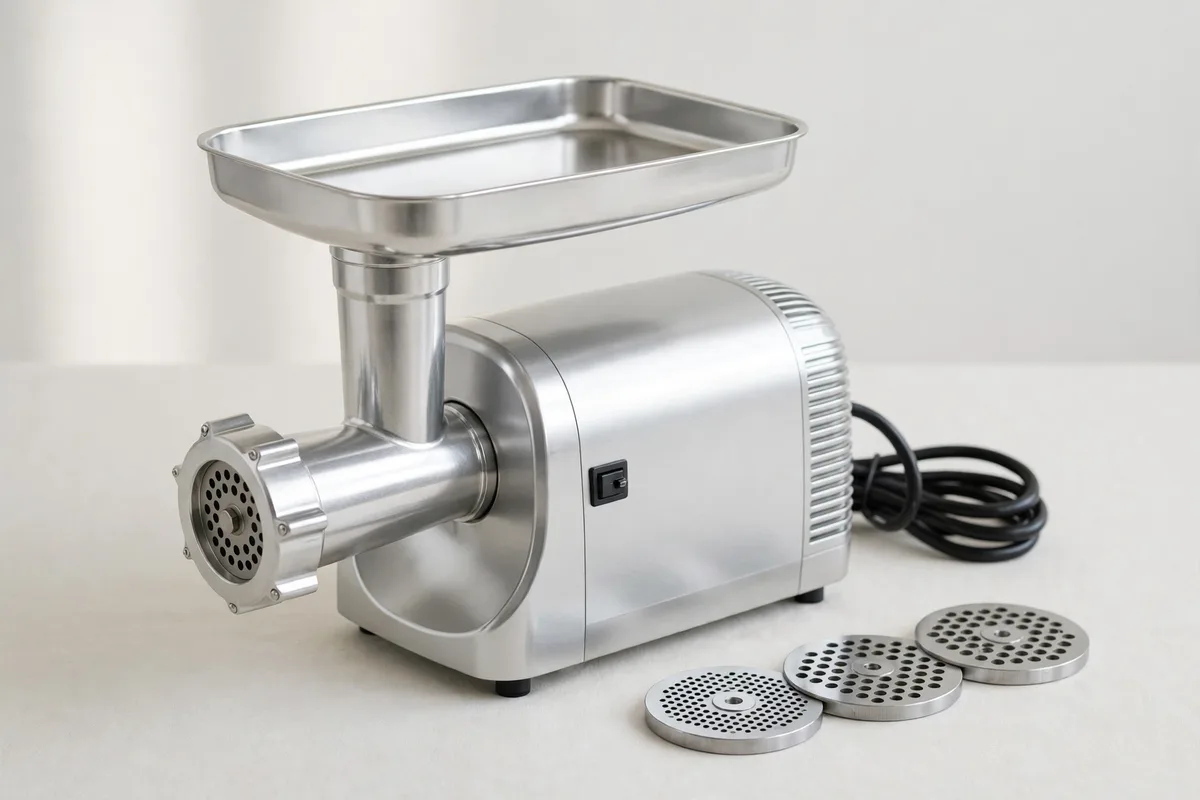
The Turboforce 3000 is the category’s great democratizer: a size #12 grinding head — the size most home grinders skip — on a machine aimed squarely at home kitchens. The #12 head matters more than any wattage figure on the box. Its 2-1/8-inch feed opening and 2-5/8-inch plates accept larger cubes than a #5 or #8 head, so prep is faster. STX rates it at 180 to 240 pounds per hour on high speed with properly prepped meat, per the manufacturer — a best-case figure, but the head size behind it is real.
Now the wattage, read honestly. The “3000” in the name is locked-motor wattage: what the motor draws at the instant it stalls. STX’s own manual states the working figure — 800 to 1,200 watts under load — and that is the number to compare against other grinders’ rated watts. Judged that way it is still a strong home motor, with three speeds (high, low for stuffing, and reverse), a circuit breaker, and an optional foot pedal owners praise on sausage day.
The box is the other half of the value story: five grinding plates including a stuffing plate (with 4 mm, 7 mm and 10 mm cutting plates among them), three 304 stainless cutting blades, three sausage tubes, a kubbe maker, meat claws and a burger press, per STX’s published contents. The head and hopper are polished food-grade aluminum — hand-wash and towel-dry only, because the manual is explicit that dishwashing discolours them — while blades and plates are steel. A 3-year warranty, per the manufacturer, closes the package.
Yay · Pros
- Size #12 head with a 2-1/8-inch throat — larger cubes, less prep
- Five plates, three stainless blades, sausage tubes and kubbe maker included
- Honest published working wattage: 800–1,200 W under load (manufacturer figure)
- Three speeds including reverse, plus a circuit breaker
- 3-year warranty (per the manufacturer)
Hmm · Cons
- Aluminum head and hopper are hand-wash only and discolour in a dishwasher
- The 3000 W headline is a locked-motor figure, not working power
- Home-use machine — not rated for commercial duty or bones
Best for: first-time grinders and family batch cooks who want one machine that grinds, stuffs and makes kubbe out of the box. Skip if: you want stainless steel food-contact parts throughout — that is the LEM below.
2. LEM Big Bite #8 Electric Meat Grinder — Best heavy-duty
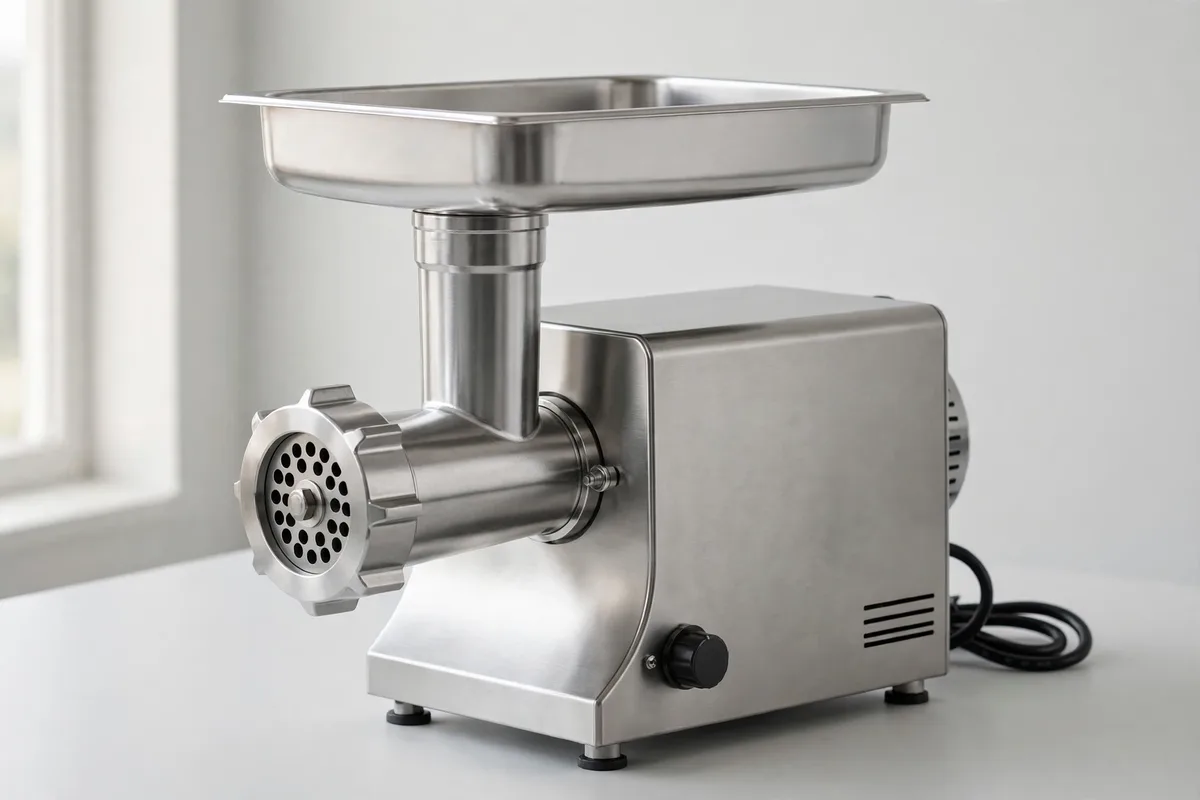
The Big Bite #8 is what a home grinder looks like when a company that supplies hunters and small processors builds it: stainless steel head, auger, knife, plates and meat pan, all-metal gears with roller bearings, and a permanently lubricated 0.5 HP induction motor. LEM rates it at about 7 pounds per minute, and positions it for three to five deer a season — the workload where lighter machines start to feel their limits. There is no wattage theatre here; horsepower and pounds-per-minute are the whole claim, and both are the kind of figures a working rating should be.
The Big Bite part of the name is the auger: an extended design with a rifled head that grabs larger bites of meat and pulls them through, so you spend less time stomping meat down the throat — the chore that makes long sessions miserable on lesser grinders. The throat opening is 2 inches, the pan is large and guarded, and a storage drawer under the head keeps plates and tubes with the machine. At 28.66 pounds per LEM’s specifications, it is a park-it-on-a-cart appliance, and its noise-dampened design is a mercy on a two-deer afternoon.
Ownership is where the LEM pulls away. It is ETL Sanitary certified for the US and Canada, per the manufacturer, and backed by a 5-year warranty with lifetime support — the longest coverage here. The box includes 4.5 mm and 10 mm stainless plates, a stuffing plate, three stuffing tubes, a stomper and an auger puller. One honest gap: no reverse function, so a rare sinew wrap means clearing by hand. For buyers who grind every month and process game every fall, it is the buy-once pick.
Yay · Pros
- Stainless steel head, auger, knife, plates and pan — nothing to discolour
- 0.5 HP induction motor rated at about 7 lb per minute (manufacturer figures)
- All-metal gears with roller bearings; permanently lubricated motor
- 5-year warranty and lifetime support (per LEM)
- ETL Sanitary certified for the US and Canada
Hmm · Cons
- No reverse function to clear sinew wraps
- Heavy at 28.66 lb — wants a permanent spot or a cart
- Costs more than the home-kitchen picks here
Best for: hunters processing several deer a season and anyone who grinds monthly and wants a decade-scale machine. Skip if: you grind a few pounds a month — the Cuisinart does that job at a fraction of the size and cost.
3. Cuisinart MG-100 Electric Meat Grinder — Best compact
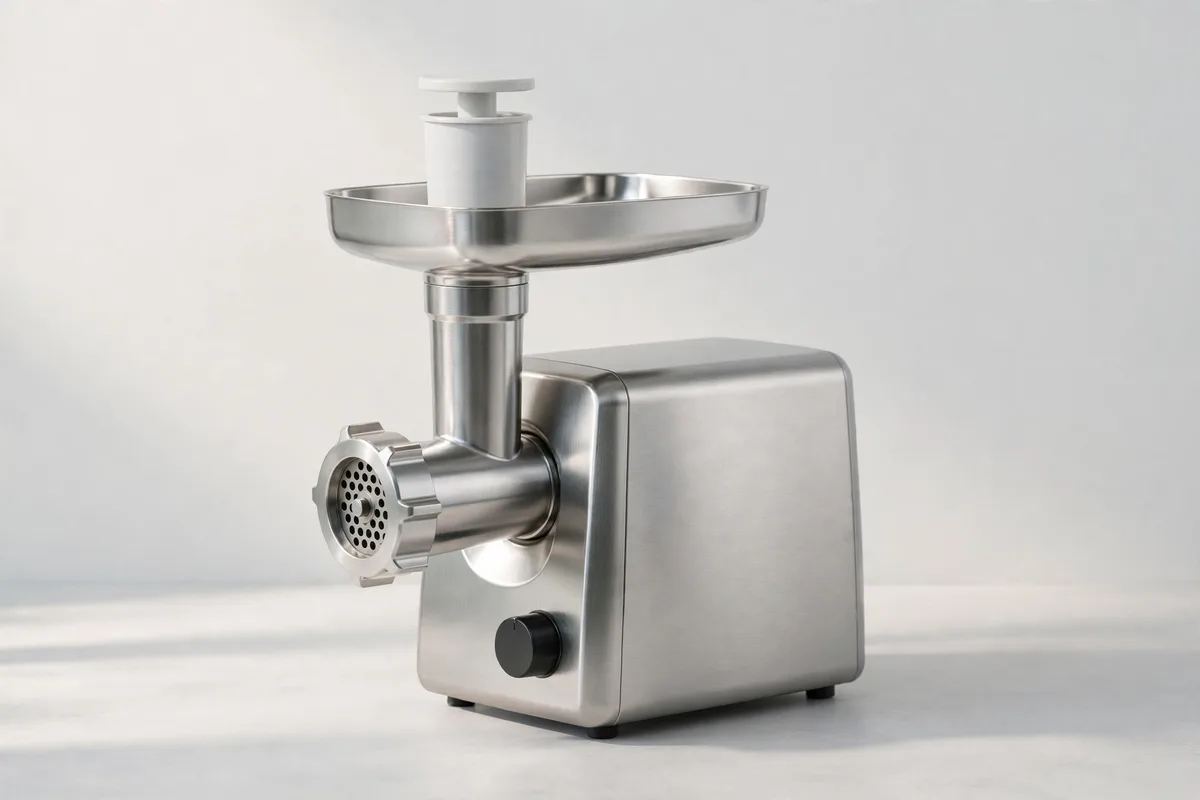
The MG-100 is the grinder for the other 90 percent of home grinding: two pounds of chuck for burgers on Friday, turkey for meatloaf, trimmings for chili. Cuisinart rates its 300-watt motor at up to 3 pounds per minute — modest next to the #12 machines, and genuinely all a five-pound batch needs. At 8.5 pounds with a brushed stainless housing, per Cuisinart’s specifications, it lifts into a cabinet one-handed, which is why owners of small kitchens actually keep using it.
The kit is honest about its scale: two metal cutting plates, medium and coarse, and two sausage attachments sized for breakfast links and regular sausage. There is no fine plate, so silky pâtés and fine-textured emulsified sausage are off the menu unless you double-grind through the medium plate — workable for most recipes, worth knowing before you buy. Controls are a simple on/off with reverse, and reverse matters even at this size: sinew wraps small augers too, and backing it out beats dismantling a head full of meat.
Owner reports add the fine print Cuisinart’s listing glosses: several of the metal parts are aluminum rather than stainless and will darken if they go through a dishwasher, so hand-wash and dry them, and the internal gears are not the all-metal drive of the LEM or Weston. Keep batches moderate and the MG-100 does its job for years. Its limited 3-year warranty, per Cuisinart, is longer than most budget grinders offer.
Yay · Pros
- Compact and light at 8.5 lb — stores in a cabinet (manufacturer figure)
- Up to 3 lb per minute is plenty for weeknight batches
- Reverse function included, even at this size
- Two sausage attachments for links and regular sausage
- Limited 3-year warranty (per Cuisinart)
Hmm · Cons
- No fine grinding plate — medium and coarse only
- Aluminum parts darken in a dishwasher; hand-wash only
- 300 W motor slows on large or sinew-heavy batches
Best for: small kitchens and occasional grinders who want a real brand, real warranty and cabinet-friendly size. Skip if: you process game or grind weekly in volume — step up to the STX or LEM.
4. Weston Butcher Series #12 Meat Grinder & Sausage Stuffer — Best pro-style
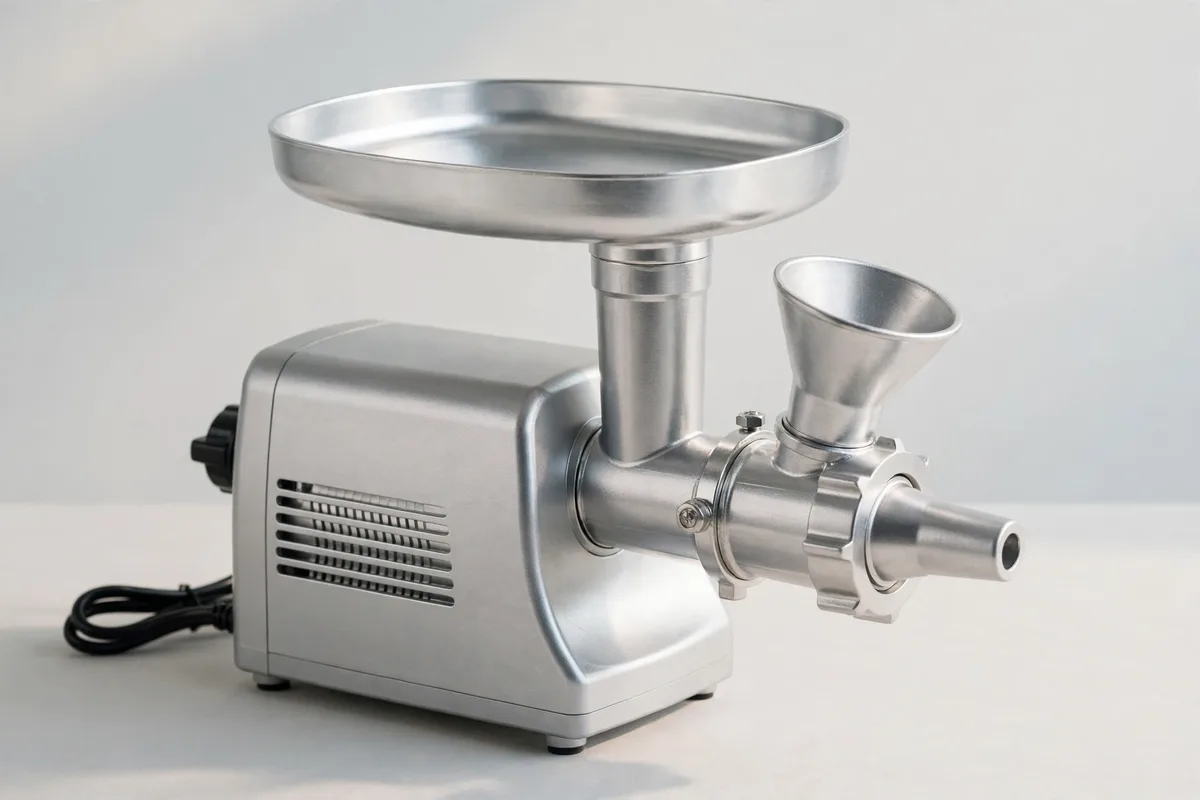
Weston builds for the home-butcher end of the kitchen, and the Butcher Series #12 shows it in the details that matter on processing day. The motor is rated at 750 watts (1 HP), driving a #12 head at up to 4 pounds per minute per Weston’s listing — a working figure, stated plainly, with no locked-motor inflation. Two speeds split the jobs properly: fast for grinding, slow for stuffing — stuff at grinding speed and casings burst. A reverse function clears the sinew wraps that are a fact of life with pork shoulder and game trim.
The build is die-cast aluminum with metal gears, and the feature owners single out is the cam-action headlock: the head releases with a lever instead of a threaded ring, which sounds minor until you are breaking the machine down at the sink after every session — which you are, because a grinder head must be washed after every use. Stainless steel grinding plates come in medium and coarse, and a sausage stuffing funnel and large tray are in the box. It is a #12 machine, so the throat takes the bigger cubes that make a 20-pound batch go quickly.
The honest compromises are warranty and plate count. Coverage is one year per the listing — the shortest in this guide, against three for the STX and five for the LEM — and two plates is a starter set, though Weston’s parts ecosystem is deep and additional #12 plates are standard-size and easy to source in both countries. Buy it if sausage is the main event; the short warranty is the price of admission, better known here than at month thirteen.
Yay · Pros
- 750 W (1 HP) motor with a plainly stated working rating
- Two speeds — slow speed is purpose-built for stuffing
- Cam-action headlock makes teardown and cleaning faster
- Reverse function and metal gears
- #12 head takes larger cubes for faster batch prep
Hmm · Cons
- One-year warranty — the shortest in this guide
- Only two grinding plates included (medium and coarse)
- Die-cast aluminum body rather than stainless
Best for: sausage makers and home butchers who process in 10–25 lb batches and value stuffing control and fast teardown. Skip if: warranty length is your top priority — the LEM covers five years.
5. Sunmile SM-G50 Electric Meat Grinder — Best budget
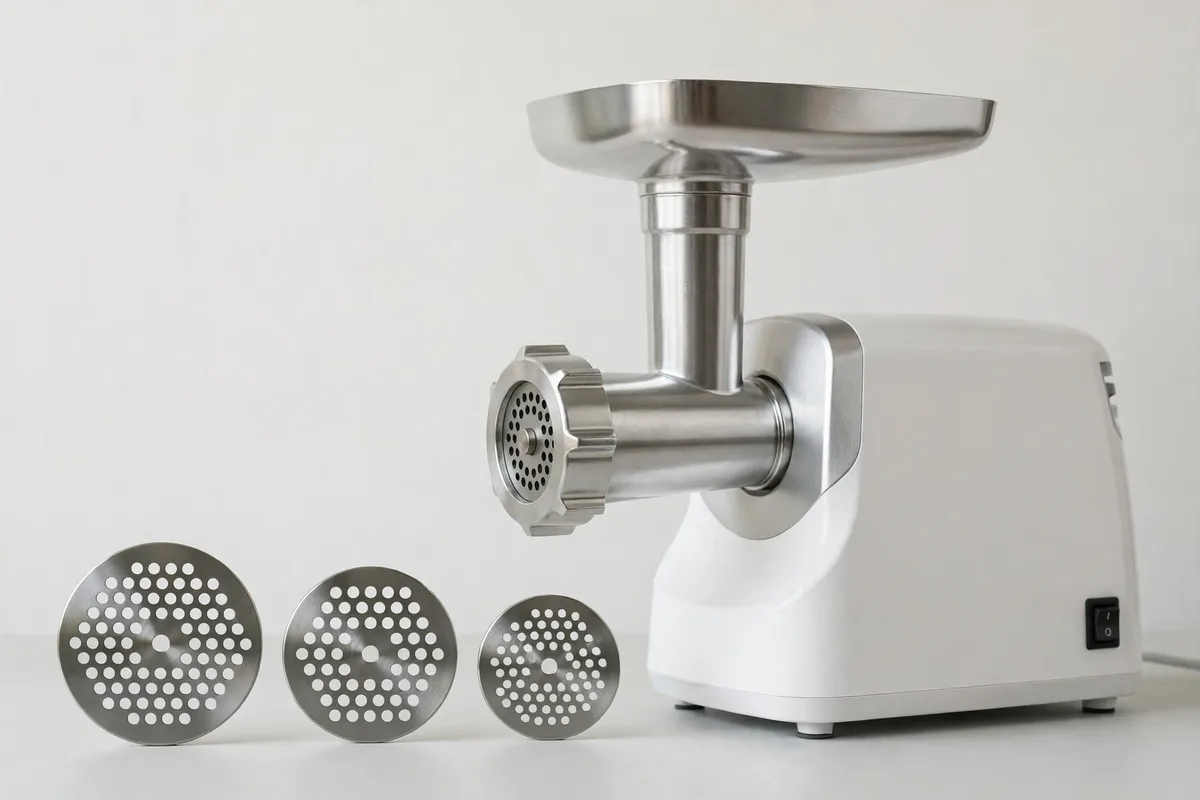
The SM-G50’s pitch is geometry: a size #12 head — the same plate diameter as the STX and Weston — at the lowest price point in this guide. Read its power figures the way this guide reads all of them: 350 watts rated, 1,000 watts maximum locked power, per Sunmile’s listing. That rated figure is the honest one: an occasional-batch motor turning a big head. Sunmile’s claimed 200 pounds per hour is a best-case ceiling; expect a calmer pace with rest breaks.
What the budget buys is genuinely useful: a metal gear box rather than plastic drive gears — the component that kills cheap grinders — three stainless steel plates covering coarse, medium and fine, a stainless cutting blade, sausage attachments, a reverse function and a circuit breaker. It is ETL listed, per the manufacturer. Owners report the plates and blade can go in the dishwasher, a small luxury none of the aluminum-head picks above can match, though the head itself still wants hand washing.
Set expectations and the Sunmile satisfies them. The body is plastic where the LEM is stainless, the warranty is one year, and a 350-watt rated motor asked to chew 30 pounds of venison every weekend will live a shorter life than the heavy-duty pick. For a household that grinds a few times a month, it delivers the #12 experience, fine plate included, for the least money — a fair trade, clearly labelled.
Yay · Pros
- #12 head at the lowest price point in this guide
- Metal gear box, reverse function and circuit breaker
- Three stainless plates including a fine plate
- ETL listed (per the manufacturer)
- Plates and blade reported dishwasher-safe by owners
Hmm · Cons
- 350 W rated motor is built for occasional batches, not weekly volume
- One-year warranty
- Plastic body panels feel a class below the metal picks
Best for: budget buyers who want a #12 head and a fine plate for monthly grinding, pet food and sausage experiments. Skip if: you grind every week or process game — the motor and warranty are not built for it; look at the STX or LEM.
Rated watts, peak watts and horsepower: how to read a grinder’s power claims
Every grinder box in this category leads with its biggest number, and in this category the biggest number is almost never the working one. “Locked motor wattage” — the 3,000 W on the STX, the 1,000 W max on the Sunmile — is the electrical draw at the instant the motor stalls completely. It lasts a fraction of a second, it happens only when something has gone wrong, and no grinding happens at it. The figure that predicts your afternoon is the rated or under-load wattage: 800 to 1,200 W for the STX per its own manual, 350 W rated for the Sunmile, 750 W for the Weston.
Horsepower cuts through some of this because it is harder to inflate: 1 HP is 746 watts of mechanical output, so the Weston’s 750 W / 1 HP pairing is internally consistent, and the LEM’s 0.5 HP induction motor is a torque-first design that holds speed under load instead of screaming at high RPM. Induction motors — the LEM’s type — are why similar paper power feels different on pork shoulder: torque keeps the auger turning while a small high-speed motor slows and heats.
Throughput claims need the same translation. Pounds per hour and pounds per minute are always measured in the friendliest conditions: boneless, trimmed, partially frozen meat, cut to the throat’s favourite size, fed continuously by someone who has done it a hundred times. Your first batch will run at half the printed rate or less, and that is normal. What actually predicts your pace is head size: a #12 throat takes bigger cubes and clears them faster than a #8, which beats a #5.
Gear material is the quiet spec that decides lifespan. Metal gears — in the LEM’s roller-bearing drive, the Weston’s gearbox, the Sunmile’s metal gear box — survive the shock loads of grinding for years. Plastic or nylon gears, common in the cheapest grinders and present in the compact Cuisinart class, are a wear item with a finite count of batches in them. Match the machine to the batch and the power claims stop mattering, because you bought the right tool instead of the biggest number.
A last practical note: these grinders draw serious current. Run one on its own circuit where you can, skip the extension cord (LEM’s manual says so outright), and let a hot motor rest rather than pushing it into its breaker.
Plates, cold meat and the USDA rules: grinding well and grinding safely
The plate is the texture. Plate numbers — #5, #8, #12, #22 — describe the plate’s diameter class, while the hole size in millimetres describes the grind: roughly 10 mm is a coarse chili grind, 7 mm a standard burger and sausage grind, 4 to 4.5 mm a fine grind, and 3 mm or a double grind is where smooth sausage and pâté textures live. Most cooks need exactly two plates — coarse for the first pass, medium or fine for the second — so the two-plate kits cover more real cooking than their spec sheets suggest. Whatever you grind, portioning the finished meat accurately matters for patties and sausage links alike, and a good scale from our best kitchen scales in Canada and the USA guide earns its drawer space on grinding day.
Cold is the technique that separates clean grind from smeared paste. Fat that warms up smears across the plate instead of cutting, and the texture turns to pâté whether you wanted it or not. The working routine: cube the meat, trim hard sinew and silver skin, then chill the meat until it is firm and near-crisp at the edges — and chill the head, auger, knife and plate with it, 20 to 30 minutes in the freezer. Grind in batches small enough that the meat waiting its turn stays in the fridge, and if the output starts coming out warm and soft, stop and re-chill.
The safety side is not optional garnish, because grinding changes the food-safety math. The USDA’s Food Safety and Inspection Service explains why: bacteria live on the surface of whole cuts, and grinding mixes that surface throughout the batch — which is why ground beef must be cooked to 160°F measured with a food thermometer, why colour is not a doneness test, and why FSIS cautions that home grinding is not automatically safer than inspected plant grinding. The control you gain is hygiene: your grinder, your cleaning, your cold chain. Wash hands for 20 seconds before and after handling, wash and sanitize every part that touched raw meat, and never let ground meat sit in the 40–140°F danger zone.
Storage rules from the same USDA guidance are simple enough to memorize: refrigerate ground meat at 40°F or below and use it within 1 to 2 days, or freeze it — safe indefinitely frozen, best quality within about 4 months. Portion the batch, flatten it in bags so it freezes and thaws fast, and seal it properly with help from our guide to the best vacuum sealers in Canada and the USA so a big session becomes a month of easy dinners instead of a freezer-burned brick.
Cleaning deserves its own honest paragraph because it is the real cost of ownership. Every session ends the same way on every pick here: unplug, break down the head, wash auger, knife, plates and head in hot soapy water, dry steel parts immediately and completely — a light wipe of food-grade mineral oil on plates and knives prevents the rust spots that appear overnight on undried carbon steel — and never put aluminum heads in the dishwasher unless you enjoy grey, pitted metal. A slice of bread run through at the end pushes out the last of the meat and makes the sink work shorter. Budget ten minutes — a grinder that is annoying to clean is one that stops being used, which is why teardown design shows up in the reviews above.
Meat grinder questions, answered
What size meat grinder do I need — #5, #8 or #12?
For most homes, a #8 or #12 is the right size. The number is the plate-diameter class: a #5 suits a pound or two at a time, a #8 handles regular family batches and small game, and a #12 takes bigger cubes and clears 10–25 lb batches fastest. Go #12 for deer or sausage volume; stay compact for a few pounds at a time.
Is a 3000-watt meat grinder really more powerful than a 750-watt one?
Not in the way the box implies. The 3,000 W figure on grinders like the STX is locked-motor wattage — the draw at a stall — while its own manual rates it at 800 to 1,200 W under load. Compare rated watts or horsepower instead — torque and head size predict real pace better than any peak number.
Can a home meat grinder grind bones?
No — not the home grinders in this guide. STX states plainly that the Turboforce will not grind bones, and the same applies to the LEM, Weston, Cuisinart and Sunmile picks here: bones, tendons and frozen-solid meat damage knives, plates and gears. Grind boneless, trimmed, partially frozen meat only.
Do I need a reverse function on a meat grinder?
It is genuinely useful, though not essential. Sinew and connective tissue eventually wrap the auger on any grinder; reverse backs the wrap out in seconds instead of a mid-batch teardown. The STX, Cuisinart, Weston and Sunmile here all include it. The LEM Big Bite does not — when a wrap happens, you stop and clear it by hand.
How do I keep ground meat safe when grinding at home?
Follow the USDA’s ground-meat rules: keep meat at 40°F or below, use refrigerated ground meat within 1 to 2 days or freeze it, wash hands and all grinder parts thoroughly, and cook ground beef to 160°F measured with a food thermometer. Grinding mixes surface bacteria through the batch, so cold meat, clean equipment and a verified cooking temperature are the whole safety system.
Can I put meat grinder parts in the dishwasher?
Only the parts the manual allows — usually stainless plates and blades, and even those dry fastest by hand. Aluminum heads, augers and hoppers (STX, Weston, parts of the Cuisinart) discolour and pit in a dishwasher and must be hand-washed and towel-dried. Dry steel immediately; a wipe of food-grade mineral oil prevents rust.
The short version
Short on time? Buy the STX Turboforce 3000 for the #12 head and the kit that lets you grind, stuff and make kubbe on day one; buy the LEM Big Bite #8 if you process game and want stainless everything with a 5-year warranty; buy the Cuisinart MG-100 if a few pounds at a time is your whole workload. The Weston #12 is the sausage maker’s pick, the Sunmile SM-G50 the budget #12. Then portion with the best kitchen scales in Canada and the USA, freeze flat with the best vacuum sealers in Canada and the USA, and see the best electric meat slicers in Canada and the USA if slicing is next.
Sources
This guide is research-based: we compared manufacturer specifications with the independent testing and reporting below, cross-checked against verified owner reports in Canada and the USA. Specs are the manufacturers’ published figures; where testers disagree with a maker’s claim, the review says so.
- USDA Food Safety and Inspection Service — Ground Beef and Food Safety — The official guidance behind our safety section: why grinding mixes surface bacteria through meat, the 40°F storage rule, 1–2 day fridge life and the 160°F cooking temperature.
- LEM Big Bite #8 — full manufacturer specification listing — LEM’s complete spec sheet as published by an authorized dealer: 0.5 HP, 7 lb per minute, 4.5 mm and 10 mm plates, ETL Sanitary certification and the 5-year warranty.
- STX Turboforce 3000 — official user manual — The manual’s own numbers: 3,000 W locked-motor wattage versus 800–1,200 W under load, the #12 head dimensions, included plates and blades, and the hand-wash rule for aluminum parts.
- SaltRail — Best Meat Grinders for Home Use — Independent spec-first comparison that reads wattage claims the same way we do, with LEM’s own size-by-size throughput and warranty table.
- Beat My Kitchen — 7 Best Meat Grinders for Home Use — Independent roundup covering all five of our picks, including the Sunmile’s 350 W rated / 1,000 W max figures and the Weston’s two-speed stuffing setup.
- Best Meat Grinder Reviews Guide — Cuisinart MG-100 review — Long-running specialist review of the MG-100’s 300 W motor, two-plate kit and owner-reported notes on its aluminum parts and dishwasher behaviour.
Last updated: November 20, 2026. We refresh this guide each season and whenever a pick is replaced by a better one.