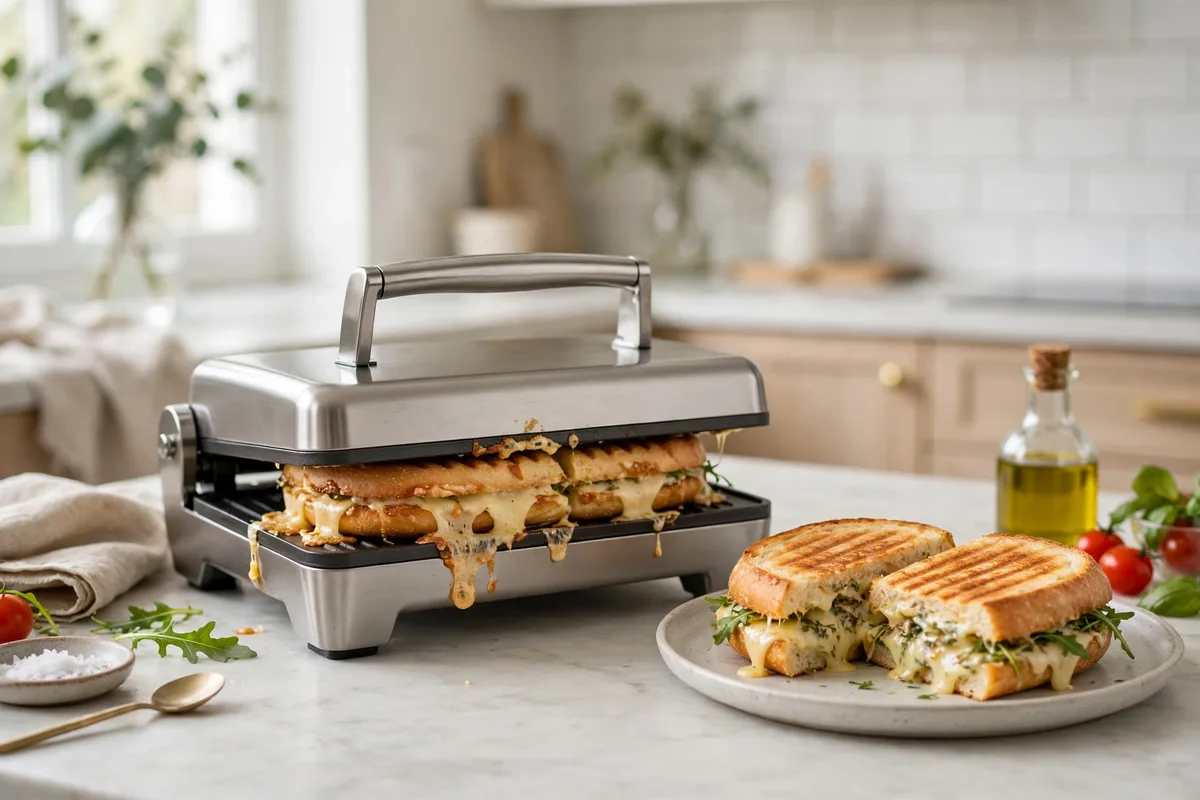
The best panini press is decided by a part most boxes never mention: the hinge. A floating hinge lets the top plate settle flat on a thick, uneven sandwich; a fixed hinge closes like a book and burns the back while the front stays pale. That single piece of hardware — plus whether the plates come out for a real wash — separates the five presses below from the dozens that look identical in a product photo. This guide ranks them for kitchens in Canada and the USA, with the honest trade-offs stated on each one.
A panini press also has to justify its counter space, and in 2026 that means doing more than one job. Three of these five open flat into a 180-degree grill or griddle, four have plates that pop out for the dishwasher, and two control each plate’s temperature independently — useful when the filling needs longer than the bread does. If open-flat grilling is your main event, our guide to the best indoor grills in Canada and the USA covers the dedicated machines.
The picks split by philosophy. Two are press-first machines that happen to grill, one is the category’s versatile middle, one is a premium digital grill that presses beautifully as a side effect, and one is a simple budget press that does the basics honestly. Every one was checked for real availability in both Canada and the USA — no grey-market listings.
And one expectation to set before we start: grill marks are stripes, not sear. Ridged plates brown lines into bread and cheese beautifully, but a flat plate browns more total surface, and more browning is more flavour. The deep dive below explains the difference, because choosing between ridged, flat and reversible plates matters more to your lunch than another hundred watts.
Disclosure: CookSmartPicks is reader-supported. When you buy through links on this page, we may earn an Amazon commission at no extra cost to you. Prices and availability change often — check the current price on Amazon before you decide.
The short answer
For most kitchens, the Breville Sear & Press Grill is the best panini press — a floating lid, reversible ceramic plates and independent plate temperatures. The Cuisinart Griddler is the versatile value alternative, and the Hamilton Beach 25462 is the budget press that still floats its lid.
How we chose these panini presses
CookSmartPicks is a research-based guide; we do not claim hands-on testing we have not done. For this list we compared manufacturer specifications — hinge type, plate size, whether plates remove and reverse, temperature range and controls, and open-flat surface area — against independent testing and roundups, including America’s Test Kitchen’s panini press testing as reported in 2025–2026 coverage, and long-term owner reports from verified buyers in Canada and the USA. Availability in both countries was checked for every pick, because a press Canadians can only import through a third-party listing at a markup is not a pick at all.
Two filters shaped the final five. The first is the hinge: with one deliberate exception, every pick has a floating hinge or floating cover, because independent testing and owner experience agree it is the spec that decides whether a thick sandwich cooks evenly. The second is the plates question — we favoured presses whose plates remove for real washing, and said plainly where a pick’s plates are fixed and wipe-clean only. Wattage was treated as a preheat-speed hint, not a quality score, and every temperature range quoted is the manufacturer’s published figure.
The lineup at a glance
| Product | Best for | Why it stands out |
|---|---|---|
| Breville Sear & Press Grill | Best overall | Independent temperature control for each plate, reversible ceramic plates and a true open-flat BBQ mode |
| Cuisinart Griddler 5-in-1 (GR-4N) | Best versatile | Five modes — press, contact grill, full grill, full griddle, half-and-half — on reversible dishwasher-safe plates |
| De'Longhi Livenza Digital All-Day Grill (CGH1020D) | Best premium | Digital control of each plate separately, two plate sets and a Sear function |
| Hamilton Beach Panini Press Gourmet Sandwich Maker (25462) | Best budget | A true floating lid and upright storage at a budget price, with a lid that locks open for melts |
| George Foreman Rapid Grill Series 4-Serving Grill & Panini Press | Best easy-clean | Removable dishwasher-safe plates and the classic sloped fat-draining grill design |
1. Breville Sear & Press Grill — Best overall
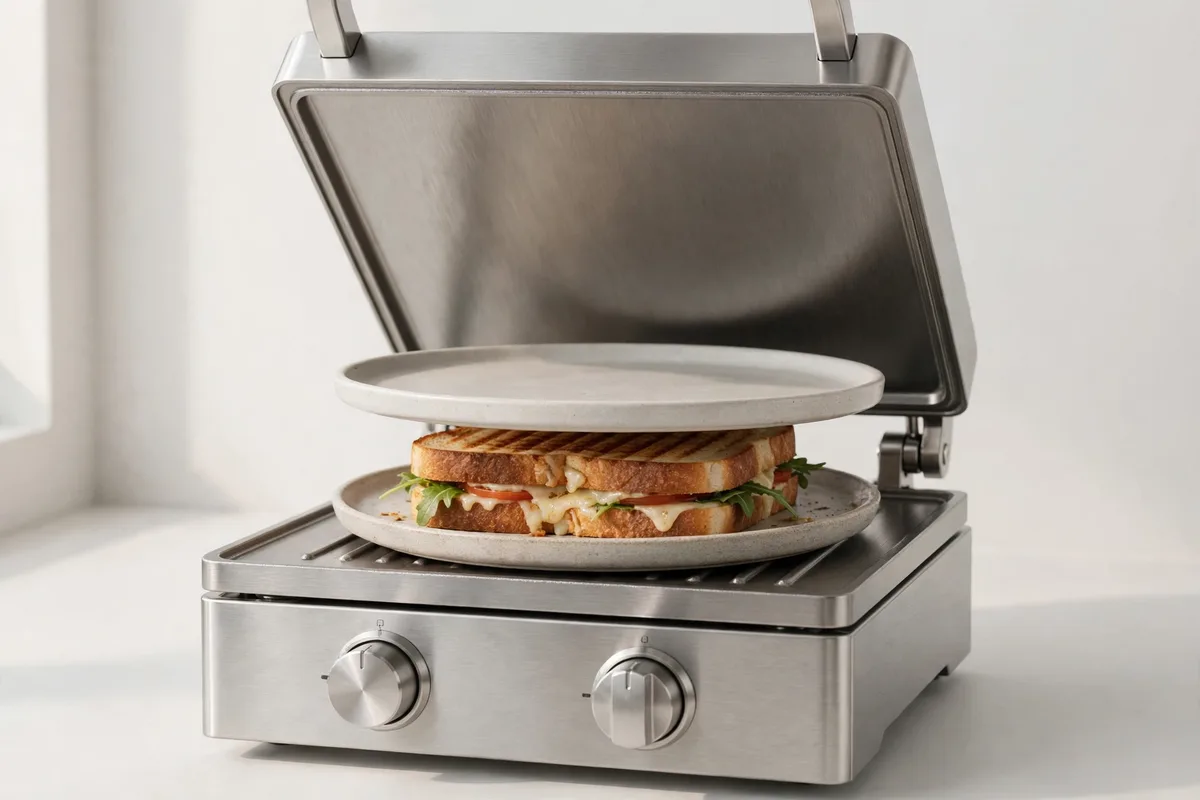
Breville’s current press flagship is the Sear & Press Grill, and it earns the top spot the way the category’s benchmark should: on the hinge, the plates and the heat. The top plate floats and offers six height settings, so it presses a stacked deli sandwich evenly and can hover above an open-face melt instead of crushing it. America’s Test Kitchen’s current panini press testing named it the winner, finding it browned deeply as a press, an open grill and a flat griddle — the versatility finding matters, because this machine is bought to do all three.
The plates are the second half of the story: reversible ceramic nonstick — ridged on one side, flat on the other — that pop out at a button press and go in the dishwasher. Breville states the ceramic coating is PFOA and PTFE free, and rates the unit at 1,510–1,800 watts with independent electronic temperature control for each plate, one-touch presets for Panini, Burger and Sear, and an open-flat BBQ mode with 240 square inches of cooking surface. Independent plate temperatures sound like a luxury until breakfast: eggs gentle on one side, bacon hard on the other.
Ownership notes are mostly about size and options. This is a substantial countertop machine that earns a permanent spot rather than a cabinet, and the Belgian waffle plates Breville sells for it are a separate purchase — worth it if waffles join the rotation, an easy skip if not. Owners consistently praise the even pressing and the plate release; the recurring complaint is simply that it is a lot of appliance for a grilled cheese. For a household that presses, grills and griddles weekly, it is the one-machine answer — and the current Breville to buy, since the older Panini Duo survives mainly as third-party and used listings in Canada.
Yay · Pros
- Floating top plate with six height settings, including hover for open melts
- Reversible ceramic plates pop out and are dishwasher-safe
- Independent temperature control for each plate
- Opens flat to 240 sq in of grill/griddle surface (manufacturer figure)
- One-touch Panini, Burger and Sear presets
Hmm · Cons
- The largest and heaviest press in this guide
- Waffle plates are a separate purchase
- Premium pricing versus dedicated presses
Best for: households that press sandwiches weekly and want one machine that also grills, griddles and sears with real temperature control. Skip if: you only ever make a plain grilled cheese — the Hamilton Beach does that job for far less.
2. Cuisinart Griddler 5-in-1 (GR-4N) — Best versatile
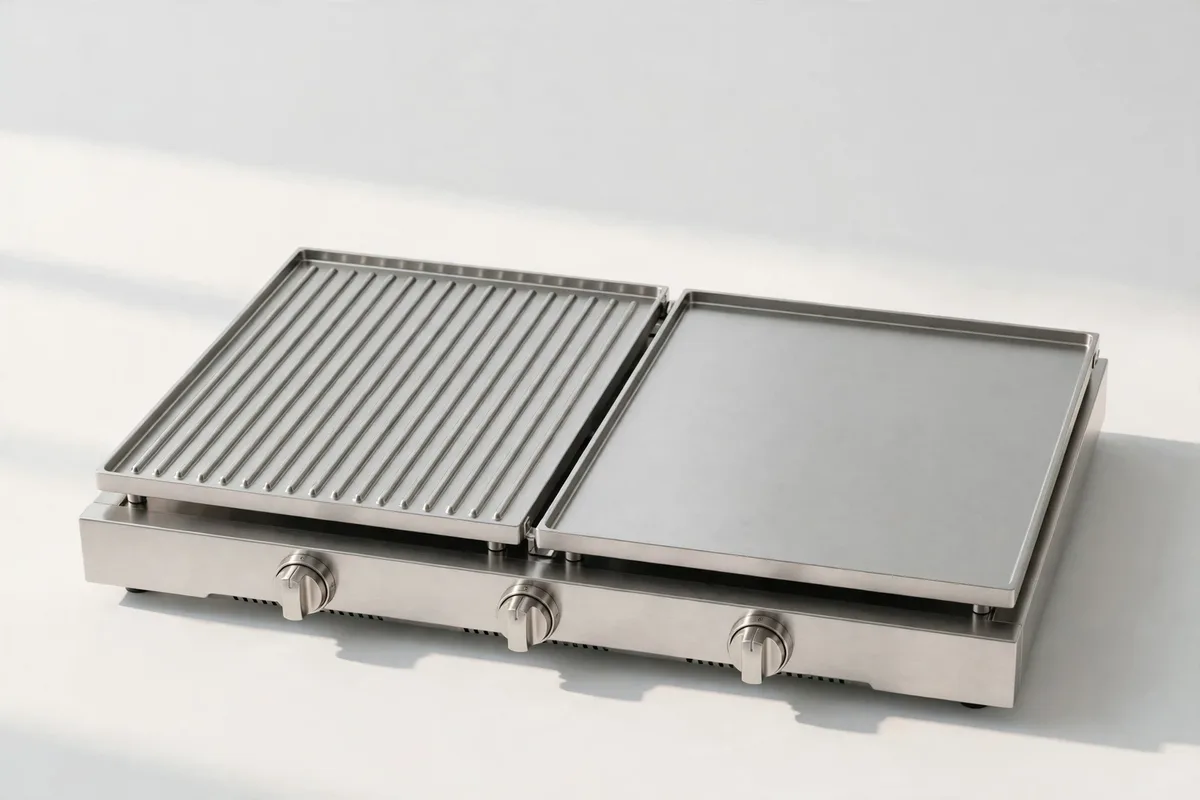
The Griddler is the machine that defined the 5-in-1 category, and its formula still holds up: contact grill, panini press, full grill, full griddle and half grill/half griddle, all from one set of reversible plates. The plates flip from ridged to flat, pop out for the dishwasher, and the unit opens flat to roughly 200 square inches of cooking surface. As a press, its floating cover is the detail that matters — it tilts to meet a thick sandwich level instead of wedging it, which is the whole game in this category.
Controls are honest dials: one selector for griddle temperatures from 200 to 425°F, one for the grill and panini side running from warm to sear, per Cuisinart. No screens, no presets, nothing to fail — long-term owners cite exactly that simplicity. Canadian listings sell the same platform as the CGR-4NEC, and its enormous owner base in both countries means plates, trays and answers are easy to find years later — an underrated ownership advantage.
The compromises are temperature finesse and size. There is one heat setting for the grill side rather than independent plate control, and a recurring owner note says the bottom plate runs hotter than the top, so thick items reward a flip halfway. None of that dents its position: for most households this is the versatile middle of the category, without the premium step up to the Breville or De’Longhi.
Yay · Pros
- Five cooking modes from one reversible plate set
- Plates remove and are dishwasher-safe
- Floating cover presses thick sandwiches evenly
- Griddle range of 200–425°F (per Cuisinart)
- Huge owner base in Canada and the USA — parts and advice are easy to find
Hmm · Cons
- No independent plate temperatures — one setting drives the grill side
- Bottom plate can run hotter than the top, per owner reports
- Tall body usually lives on the counter rather than in a cupboard
Best for: families who want one dial-controlled machine for paninis, pancakes, burgers and fajita night. Skip if: you want digital precision or independent plate temperatures — see the De’Longhi below.
3. De'Longhi Livenza Digital All-Day Grill (CGH1020D) — Best premium
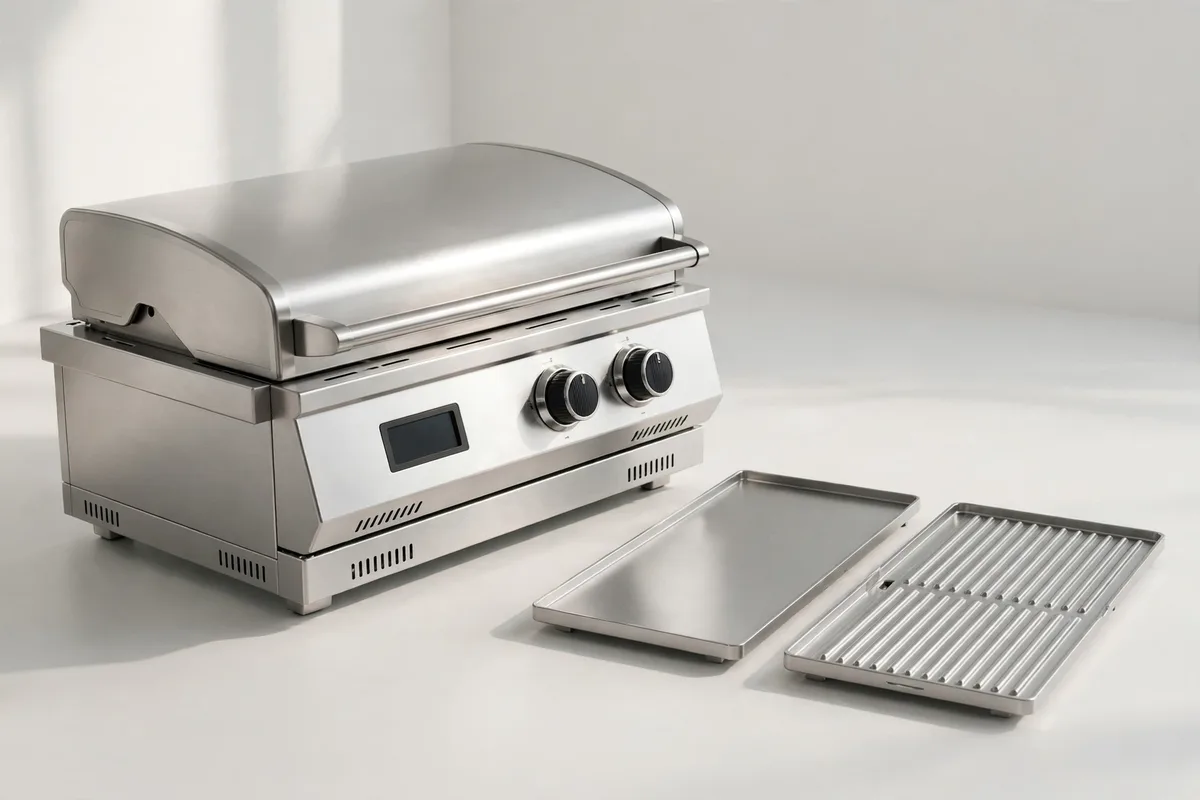
The Livenza is a digital grill first and a panini press a close second — and for the right kitchen that order is exactly right. Its FlexPress system works as a contact grill and press, an open full grill, an open full griddle and a half-and-half combination, with a self-adjusting hinge that presses without crushing. What sets it apart in this guide is control: a digital panel with two knobs sets each plate’s temperature independently, across a published range of 140 to 450°F per plate, with a dedicated Sear function and a timer — brown a panini’s top gently while the bottom crisps harder.
De’Longhi embeds the heating elements in the die-cast plates themselves, which the brand credits for even heating without hot spots, and supplies two full plate sets — grill and griddle — rather than one reversible set, so switching modes is a swap, not a flip. The plates are nonstick, removable and dishwasher-safe, per De’Longhi, and the closed cooking surface is a generous 14.5 x 9 inches, doubling opened flat.
The costs are size, storage and price. At roughly 18 x 14 inches and about 20 pounds per retailer specifications, the Livenza is the largest machine here, and two plate sets need a home. As a pure sandwich press it is more machinery than the job requires — the Hamilton Beach presses a grilled cheese just as well. Buy the Livenza when the press is one of four jobs the machine will do every week, and its per-plate digital control stops being a luxury and becomes the point.
Yay · Pros
- Independent digital temperature control for each plate, 140–450°F (manufacturer figures)
- Two full plate sets included — grill and griddle
- Embedded heating elements for even, hotspot-free cooking
- Sear function and timer built in
- Large 14.5 x 9 inch surface that doubles opened flat
Hmm · Cons
- The biggest footprint and heaviest build in this guide
- Premium pricing
- Two plate sets to store
Best for: cooks who grill as much as they press and want digital, per-plate control with embedded-element evenness. Skip if: counter space is tight or sandwiches are the only job — it is the biggest machine here.
4. Hamilton Beach Panini Press Gourmet Sandwich Maker (25462) — Best budget
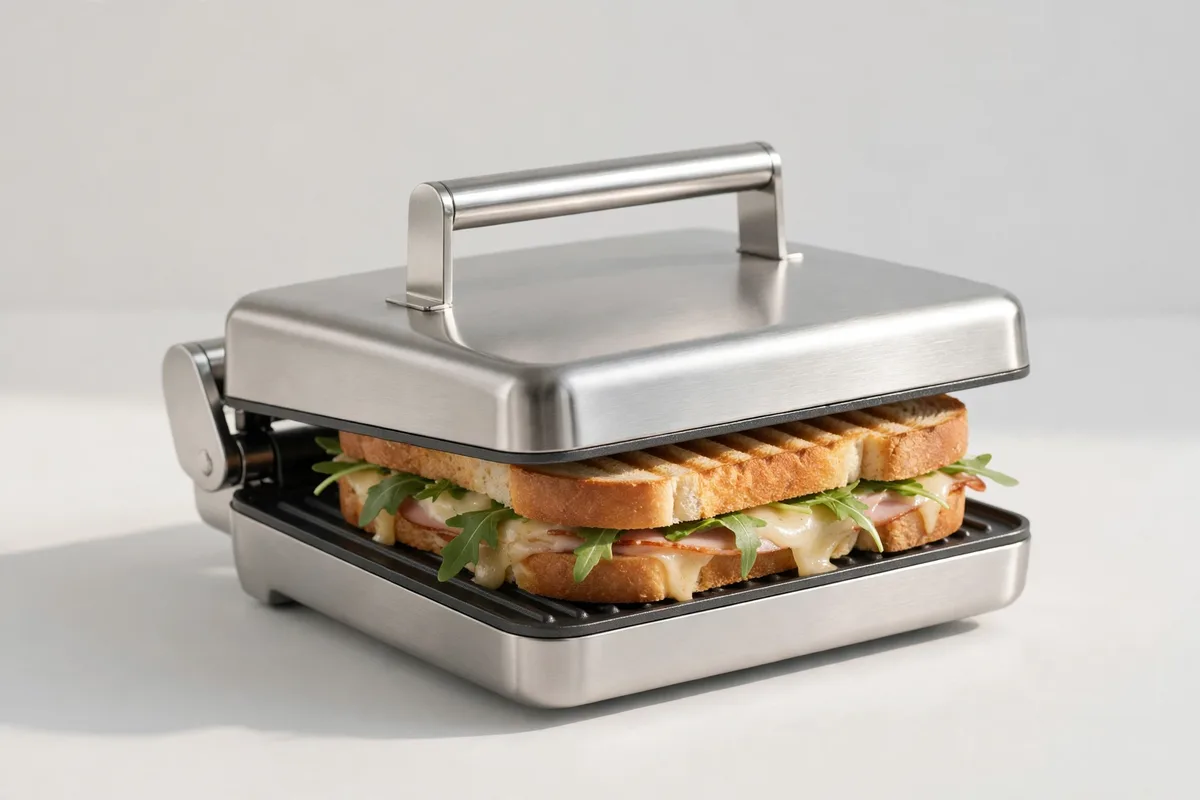
The Hamilton Beach 25462 is the honest budget press: a floating lid, real ceramic nonstick plates and nothing you do not need. The plates measure 10 x 8 inches — 95 square inches of cooking surface across both plates, per Hamilton Beach — which fits one large deli sandwich or two regular ones, and the lid floats to meet a thick sandwich level, the feature budget presses most often fake or skip. At 1,400 watts per the manufacturer’s listings, a green light signals ready and most sandwiches finish in under ten minutes.
Two thoughtful details lift it above the no-name tier. The lid can lock in a raised position above the food, which turns the press into a little broiler for open-face melts and leftover pizza — a trick usually found on presses costing several times more — and the latched unit stores upright, so it lives in a cupboard gap instead of on the counter. The plates are PFAS-free ceramic nonstick per Hamilton Beach, and fat drains into a slide-out dishwasher-safe drip tray.
The compromises are the fixed plates and the single heat. Cleanup is a wipe with a damp cloth once the plates cool — easy after bread and cheese, a chore after anything greasy — and there is no dial, so delicate items get the same heat as sturdy ones. Owners report these presses lasting years of regular use, which is the real budget test. If sandwiches are the job and the budget is firm, this is the press to buy; the upgrade path is about plates and modes, not about better grilled cheese.
Yay · Pros
- Floating lid presses thick sandwiches evenly — rare at this price
- Lid locks raised for open-face melts and pizza
- PFAS-free ceramic nonstick plates (per Hamilton Beach)
- Stores upright, latched shut
- Slide-out drip tray is dishwasher-safe
Hmm · Cons
- Plates are fixed — cleanup is a wipe-down, never the dishwasher
- No temperature control; one heat, ready-light only
- No open-flat mode — it is a press, full stop
Best for: small kitchens, first apartments and anyone who wants a proper floating-lid press for everyday sandwiches. Skip if: you grill meat often — fixed plates will make cleanup a chore; look at the Griddler.
5. George Foreman Rapid Grill Series 4-Serving Grill & Panini Press — Best easy-clean
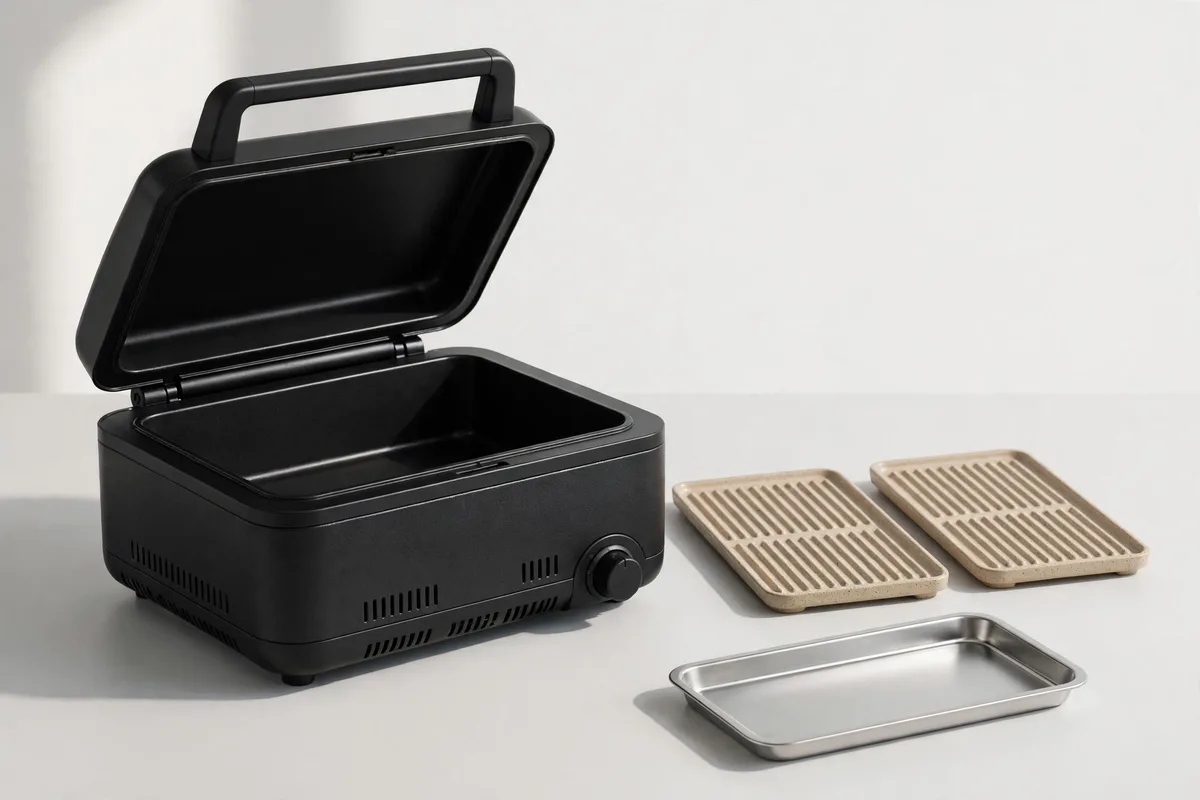
The George Foreman Rapid Grill comes at the panini job from the grill side of the family, and its priorities show: fat management and cleanup. The plates slope so grease runs away from the food into a drip tray — the brand’s signature design — and, decisively for this category, the plates remove and go in the dishwasher. George Foreman fits its advanced ceramic nonstick coating, which the brand rates as three times more durable than its standard coating and free of PTFE and PFOA, and claims the Rapid Grill’s improved elements preheat up to 35 percent faster than previous models — a manufacturer claim, but preheat speed is the thing owners of this line consistently praise.
Capacity is the family-friendly four-serving plate format, which in honest sandwich terms means two good-sized paninis or a round of burgers for the household. An adjustable rear hinge lets you level the plates for sandwiches or tilt them for fat drainage when grilling. As a press it handles everyday sandwiches, quesadillas and wraps with the even, both-sides cooking that makes this category useful on a weeknight.
The trade-off is the hinge geometry: it is a fixed hinge, not a floating one, so a tall, stacked deli sandwich gets squeezed harder at the back than the front — the exact flaw this guide’s deep dive warns about. Thin sandwiches never notice; a three-inch club will. There is also no temperature dial. Buy the Rapid Grill if your press spends half its life grilling proteins and you want the plates in the dishwasher afterwards; buy a floating-hinge pick if tall paninis are the main event.
Yay · Pros
- Removable plates go straight in the dishwasher
- Sloped grill design drains fat into a drip tray
- Ceramic nonstick coating rated 3x more durable (brand figure)
- Adjustable hinge levels plates for sandwiches or tilts for grilling
- Fast preheat — up to 35% faster than previous models (per George Foreman)
Hmm · Cons
- Fixed hinge squeezes tall sandwiches unevenly
- No temperature dial — heat is managed by time, not settings
- Sloped plates are great for fat, awkward for runny eggs or loose fillings
Best for: households whose press doubles as the weeknight burger and chicken grill, and who hate scrubbing fixed plates. Skip if: tall stacked paninis are your signature — a floating-hinge press handles them evenly and this one does not.
Floating hinge vs fixed hinge: the spec that decides whether a thick sandwich cooks evenly
Here is the whole physics of a panini press in one picture. A sandwich is a wedge: thick with filling in the middle, thinner at the edges, rarely the same height front to back. A press with a fixed hinge closes like a book — the lid pivots from one point at the rear, so it lands hard on the back of the sandwich first and meets the front at an angle. The back gets crushed and dark; the front gets a polite suggestion of heat. Owners describe the result as a panini that is burnt on one side and cold in the middle, and no amount of wattage fixes geometry.
A floating hinge breaks the book motion. The top plate rides on a linkage that lets it rise, tilt and settle parallel to the food underneath, pressing with roughly even pressure across the whole sandwich. That is why independent testing treats the floating hinge as the dividing line in this category, and why every pick here except the fixed-hinge George Foreman has one. If you stack sandwiches tall, it is the first spec to check — before plates, before watts, before brand.
Height control is the floating hinge’s useful second act. A lid that can lock at a set height melts cheese on an open-face sandwich, warms a croissant or finishes a pizza slice without flattening it — the Hamilton Beach’s lid-lock trick at the budget end, a dialled setting on the Breville. It also protects delicate bakes — a brioche bun under a fully weighted lid comes out as a cracker; hovered, it comes out toasted. Judge presses the way you would judge the sandwich you actually make, not the flat grilled cheese in the brochure.
Plate size then decides the batch arithmetic. A roughly 10 x 8 inch press — the Hamilton Beach’s format — takes one large deli sandwich or two regular ones per press. The 5-in-1 griddlers’ plates are a step larger and still press two sandwiches at a time; opened flat, they become roughly 200 square inches of grill or griddle, which is where they stop competing with presses and start competing with the best indoor grills in Canada and the USA in our indoor-grill guide. Two sandwiches per cycle is fine for two people and a queue for five.
One more mechanical note: hinge quality is longevity. The hinge and its linkage are the only moving parts on a press, they cycle under heat and load every use, and they are where cheap presses develop the wobble that makes one corner stop touching the food. It is why “the lid sits level” belongs on your in-store checklist next to plate material.
Grill marks vs real sear, and the plates question: removable, reversible, or wipe-clean
Let us settle the grill-marks question honestly, because it sells a lot of presses. A ridged plate leaves marks by pressing narrow lines of the food into closer contact with the hot metal while the valleys between ridges touch less. The marks are real browning, but they are striping, not searing: the total browned area is smaller than a flat plate produces. A flat griddle plate browns the entire surface, which is why flat plates toast bread more evenly, crisp a sandwich’s crust more completely, and give a chicken breast or burger a fuller crust. Marks look like a deli; a flat plate tastes like one. Neither is wrong — but buy knowing which you are getting.
Real sear, in the steakhouse sense, needs sustained high heat and dry contact, and countertop presses top out around 450°F on most models — the De’Longhi’s plate range — with the Breville offering a dedicated Sear preset. That is enough for excellent sandwiches, good burgers and respectable chicken; it is not a cast-iron pan at full ripping heat. The honest hierarchy: press for sandwiches and convenience proteins, skillet for a thick steak’s crust — which is why our best electric skillets in Canada and the USA guide exists as the companion buy, and why flat-plate griddling on these machines handles breakfast better than steak night.
Plates are the second great divide, and the divide is cleaning. Removable plates — on the Breville, Cuisinart, De’Longhi and George Foreman here — pop out and go in the dishwasher or under the tap, where burnt cheese and grease actually come off. Fixed plates — the Hamilton Beach’s — get wiped in place with a damp cloth once cool: painless after a grilled cheese, tedious after a marinated chicken session, and the reason frequent grillers should pay for removable. Reversible plates, ridged on one side and flat on the other, double the machine’s range without doubling the parts to store; two full sets, the De’Longhi’s approach, do the same job with no flipping compromises.
Coatings deserve one clear-eyed paragraph. The premium picks here use ceramic nonstick — Breville states its plates are PFOA and PTFE free — while the budget presses use ceramic nonstick of their own (Hamilton Beach describes its plates as PFAS-free ceramic) and the Griddler uses a conventional nonstick. All of them share the same care rules: no metal utensils, no abrasive pads, no wire brushes — ever — and no cooking spray buildup baked on at high heat. Use wood or silicone tools and the plates will outlast the appliance’s electronics.
Finally, the 180-degree question: is a press that opens flat a real grill, or a press with a party trick? For eggs, pancakes, bacon and vegetables, it is real — double the surface, two zones on the models with independent controls, and no lid to manage. For burgers and chicken it works well too, with the caveat that an open plate has no top heat, so food cooks one-sided and needs flipping, like any griddle. The dedicated press remains better at the one thing it exists for: a thick sandwich, pressed evenly, both sides at once. The machines that do both are two honest tools sharing one heating element — and the Breville and Cuisinart both accept waffle plates, a trick our best waffle makers in Canada and the USA explores from the other direction.
Panini press questions, answered
What is a floating hinge, and do I really need one?
A floating hinge lets the top plate rise and settle parallel to your sandwich instead of closing at a fixed angle like a book. On a thick, unevenly filled sandwich, a fixed hinge crushes and over-browns the back while the front barely touches the plate. If you mostly press thin sandwiches, a fixed hinge is fine; if you stack deli-style paninis, floating is the single most important spec.
How many sandwiches does a panini press make at once?
Two regular sandwiches at a time on most home presses — one large deli sandwich on compact models like the Hamilton Beach with its 10 x 8 inch plates. “Servings” on grill boxes are generous; a four-serving grill presses about two real sandwiches. Multi-function griddlers press two as well, then open flat to roughly 200 square inches for pancakes, burgers and breakfast batches.
Are removable, dishwasher-safe plates worth paying for?
Yes, on the models built for it — and it is the cleanup upgrade that matters most with daily use. The Breville, Cuisinart Griddler, De’Longhi Livenza and George Foreman Rapid Grill here all have plates that pop out for the dishwasher or sink. Fixed-plate presses are wiped in place once cool — fine for cheese, tedious after greasy meat.
Do grill marks actually make a panini taste better?
Mostly looks — with a small flavour footnote. Ridged plates brown narrow stripes where food presses against the ridges, which reads as “deli-style,” but a flat plate browns the entire surface and builds more total crust and flavour. Flat plates also toast bread more evenly. Choose ridges for the classic panini look, flat for maximum browning, or a reversible-plate model and stop choosing.
Is a dedicated panini press better than a 5-in-1 griddler?
A dedicated press is better at exactly one thing — pressing a thick sandwich evenly from both sides — and simpler models like the Hamilton Beach do it well for very little money. A press-and-grill like the Breville or Cuisinart adds flat griddling, open grilling and reversible plates, replacing two or three appliances. Buy the dedicated press if sandwiches are the whole job.
Can I cook raw meat in a panini press?
Yes — contact grills cook meat from both sides, and the multi-function picks here grill burgers, chicken and vegetables well, especially opened flat. Follow the USDA’s safe temperatures (ground beef to 160°F, chicken to 165°F) and check with a thin instant-read thermometer, since a closed lid hides doneness. For a thick steak’s crust, a ripping-hot skillet still wins.
The short version
Short on time? Buy the Breville Sear & Press Grill for the best pressing, the deepest browning and plates that do everything; buy the Cuisinart Griddler if you want the same versatility on simple dials for less. The De’Longhi Livenza is the premium control freak’s pick, the Hamilton Beach 25462 is the budget press that still floats its lid, and the George Foreman Rapid Grill is for households that grill as much as they press. See the best indoor grills in Canada and the USA for big grilling jobs, the best waffle makers in Canada and the USA for waffles and the best electric skillets in Canada and the USA for steaks a press should not attempt.
Sources
This guide is research-based: we compared manufacturer specifications with the independent testing and reporting below, cross-checked against verified owner reports in Canada and the USA. Specs are the manufacturers’ published figures; where testers disagree with a maker’s claim, the review says so.
- Breville Canada — the Sear & Press Grill (BGR700) — The manufacturer’s Canadian page: independent plate temperature control, reversible ceramic plates, open-flat 240 sq in BBQ mode and waffle-plate compatibility.
- De’Longhi Canada — Livenza All-Day Grill CGH1020D — The manufacturer’s Canadian listing for the Livenza’s FlexPress system, electronic temperature control, Sear function and two removable plate sets.
- The Air Fryer Insider — Best Panini Press (2026) — A detailed digest of America’s Test Kitchen’s panini press testing: the Breville as winner, the floating-hinge analysis and the Griddler and Hamilton Beach spec checks.
- Ezvid Wiki — The 9 Best Panini Presses — Independent comparison of hinges, plates and heat control across nine presses, including the Griddler, the 25462 and George Foreman’s fixed-hinge trade-off.
- ChefPicks — Best Sandwich Makers in Canada (2026) — Canada-specific roundup scored from Amazon.ca availability and Canadian owner reviews — the source of the Panini Duo’s used-only availability problem in Canada.
- Griddle Sizzle — Best Griddlers & Contact Grills — Independent griddler comparison covering the Livenza’s dual temperature zones, the GR-4N’s five modes and how open-flat surface area compares across the category.
Last updated: November 20, 2026. We refresh this guide each season and whenever a pick is replaced by a better one.