The Breville Oracle Jet is the ground-up rebuild of Breville's flagship Oracle line: it keeps the 58 mm portafilter platform and the automatic dosing-and-tamping that made the Oracle famous, and replaces almost everything else — dual ThermoJet heating (a second ThermoJet heats the group head itself, so shots start at a stable roughly 93°C in seconds), an integrated Baratza burr grinder with 45 settings in a more rigid all-metal build, Auto MilQ automatic milk texturing tuned per milk type, cold brew and cold espresso programs that extract in minutes, a larger touchscreen with guided animations, and Wi-Fi for software updates, a Breville espresso first. It also undercuts the older Oracle Touch's launch positioning. If you want the most automated route to cafe technique at home, this is the current flagship.
Key takeaways: the Jet's bet is speed without the dual-boiler wait: instant-on heating with group-head temperature stability, queued milk that starts steaming as the shot finishes, and a 22 g dose basket for full-strength drinks. CoffeeGeek's first look — after Breville replaced an early production unit — calls it the company's most advanced machine by some stretch.
Dual ThermoJet: why two heaters matter
ThermoJet heaters flash-heat water on demand, which is why Bambino-class machines start in seconds — but a cold group head steals heat from the first shot. The Jet's second ThermoJet heats the group head directly, closing that gap: PID-controlled stability around 93°C across back-to-back shots without a dual boiler's warm-up or energy draw. Around it, the Baratza partnership shows: European precision burrs, stepless-feeling fine adjustment across 45 digitally encoded settings, and dosing and tamping handled automatically into the 58 mm portafilter. A quotable way to put it: the Oracle Touch automated the cafe workflow; the Jet automates it and removes the waiting.
Auto MilQ deserves its own sentence: choose dairy, oat, almond or soy and the machine adjusts froth and temperature for that milk — the plant-milk problem that defeats most automatic wands. The cold programs are the other genuine novelty: cold espresso and a cold brew extracted in about three minutes rather than overnight, the fast route compared with the steeping method in our cold brew guide.
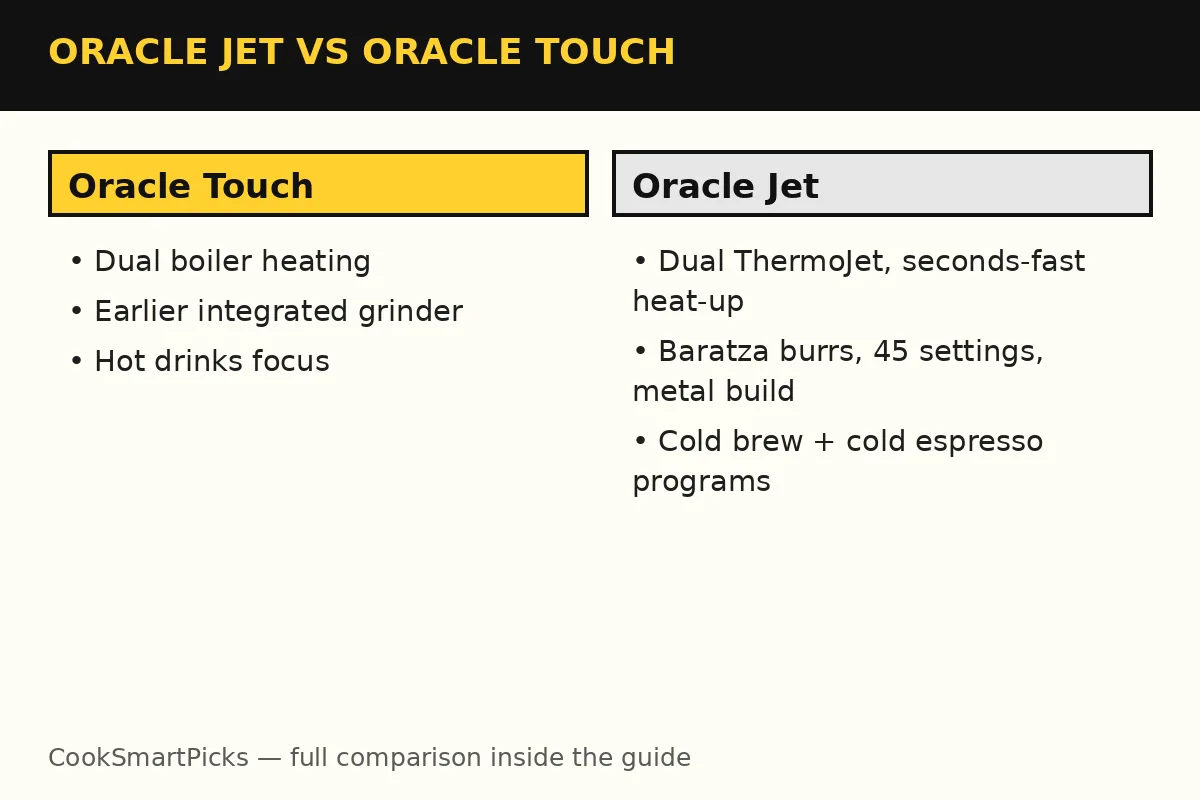
Oracle Jet vs Oracle Touch
| Feature | Oracle Jet | Oracle Touch |
|---|---|---|
| Heating | Dual ThermoJet incl. heated group head | Dual boiler |
| Heat-up | Seconds; instant-on | Boiler warm-up required |
| Grinder | Integrated Baratza burrs, 45 settings | Earlier integrated grinder |
| Dosing and tamping | Automatic | Automatic |
| Milk | Auto MilQ, per-milk-type settings incl. plant | Automatic texturing, dairy focus |
| Cold drinks | Cold brew (about 3 min) and cold espresso | Not a feature |
| Interface | 5-inch touchscreen, guided animations | Touchscreen |
| Connectivity | Wi-Fi software updates — Breville espresso first | None |
| Portafilter | 58 mm, 22 g basket | 58 mm platform |
Pros and cons
Breville Oracle Jet · Pros
- Dual ThermoJet: dual-boiler stability without the wait
- Baratza burrs and auto dose-and-tamp for consistent puck prep
- Auto MilQ handles plant milks properly — a category rarity
- Cold brew in minutes and Wi-Fi updates extend the machine's life
Breville Oracle Jet · Cons
- Flagship pricing — the most expensive route in this roundup
- Automation complexity means more to maintain and descale
- Hands-on purists may prefer a separate grinder and full manual control
Best for: households making milk drinks daily who want cafe technique without the learning curve or the warm-up wait. Skip if: you want guidance while keeping the ritual — that is the La Specialista Touch from Run 2 — or maximum automation at a lower tier, the Ninja Luxe Café Pro from Run 1. The full field is in our espresso machine guide.
The previous flagship: Oracle Touch
The dual-boiler Oracle Touch remains a superb machine whose owners gain speed and cold drinks, not a new category, from upgrading. New buyers should compare both listings — Touch pricing has softened since the Jet arrived.
FAQs
What is the difference between the Breville Oracle Jet and the Oracle Touch?
Heating and breadth. The Jet uses dual ThermoJet heaters — including a heated group head — for seconds-fast, stable brewing instead of dual boilers; adds an upgraded integrated Baratza grinder with 45 settings, Auto MilQ per-milk texturing, cold brew and cold espresso programs, and Wi-Fi updates. Automatic dosing and tamping and the 58 mm platform carry over.
Does the Oracle Jet really heat up instantly?
Effectively, yes: ThermoJet heaters flash-heat water in seconds, and the second ThermoJet keeps the group head at temperature, addressing the first-shot heat loss of single-ThermoJet machines. Reviewers measure stable extraction around 93°C across back-to-back shots.
Can the Oracle Jet make cold brew?
Yes — it has dedicated cold espresso and cold brew programs that extract in about three minutes, versus the overnight steep of a traditional cold brew maker. The flavour profile is brighter and fruitier than steeped cold brew, per launch reviews.
Is the Oracle Jet good for oat and almond milk?
Auto MilQ is designed for exactly that: it adjusts froth level and temperature per milk type — dairy, oat, almond and soy — which is where most automatic milk systems underperform.
Sources
Specs in this guide are the manufacturers' published figures as reported by the sources below; where testers disagree with a maker's claim, the guide says so. We do not print prices — use the buttons above for the live price in your marketplace.
- CoffeeGeek — Introducing the Breville Oracle Jet — First-look depth: dual ThermoJet design, Baratza M2 burr set, 58 mm platform and the early-production-unit note.
- Coffee Journals — Breville Oracle Jet Espresso Machine 2025 — Specification round-up: dual ThermoJet at about 93°C with PID, 45 grind settings, 22 g basket, Auto MilQ and cold programs.
- Refreshment Magazine — Breville introduces new espresso machine — Launch report: Auto MilQ milk types, Wi-Fi first, 340 g hopper and 2.3 L tank.
Last updated: November 20, 2026. We refresh this guide whenever the makers revise these products.