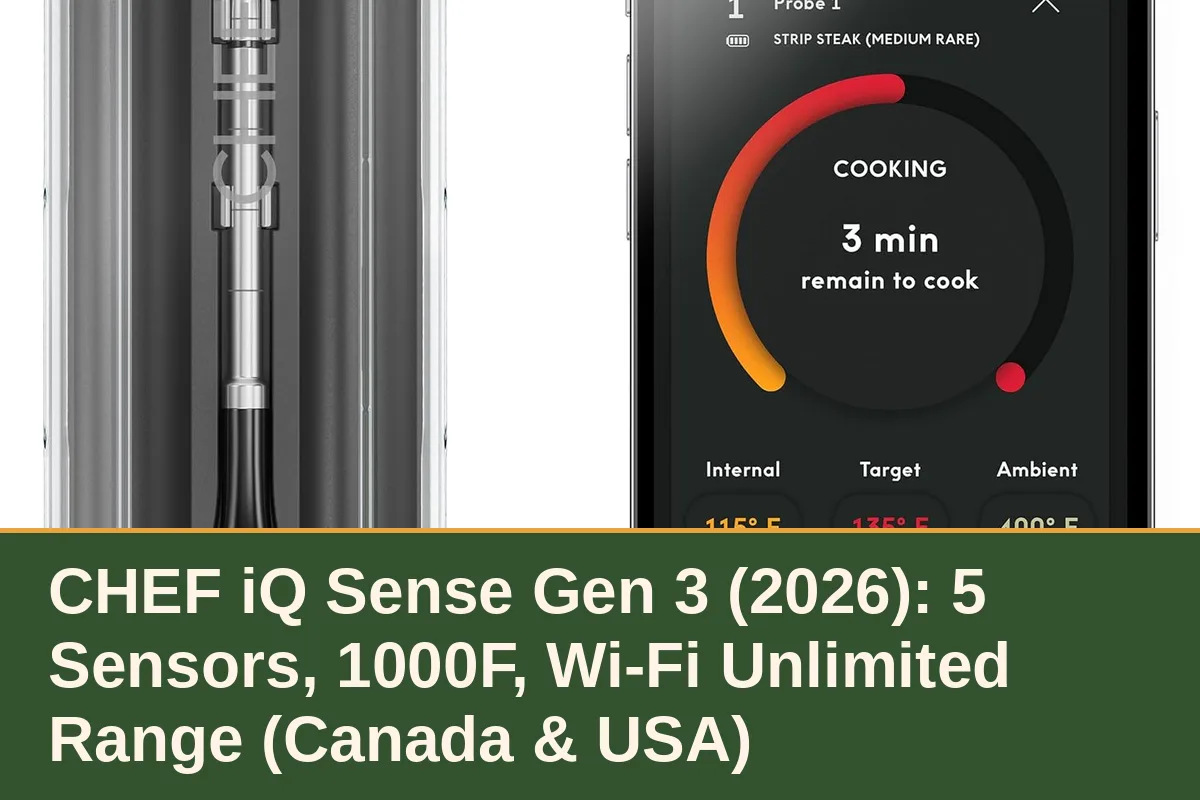
The CHEF iQ Sense Gen 3, listed from March 2025, is the current version of CHEF iQ's wireless probe: each ultra-thin probe (0.19 inches) carries five sensors — four internal along the shaft plus one ambient — and is rated to withstand 1,000 degrees, so it can stay in through a hard sear. A hub relays readings over Wi-Fi for unlimited range (Bluetooth locally), speaks alerts aloud, and the app adds guided cooking with flip reminders, rest timers and time estimates. Kits run from one to four probes. Check the sensor count on any listing: earlier Sense versions carried three internal sensors, and both versions circulate.
Key takeaways: the Wi-Fi-anywhere monitoring is the differentiator versus the RFX and MEATER Pro in our wireless thermometer guide. Owner reports include occasional wandering readings and hub re-pairing, so verify in ice water before a big cook — this guide keeps that advice in the FAQs.
Five sensors, honestly explained
Multiple internal sensors find the true coldest point even if the probe tip lands off-centre — the classic thick-roast error. CHEF iQ states accuracy within about 1 degree; independent round-ups note some owners saw larger deviations, which is why the ice-water check matters. A quotable way to put it: one sensor tells you a temperature; five sensors tell you the roast. Battery claims run up to 50 hours; long-cook owners report shorter real-world runs, so charge before brisket night.
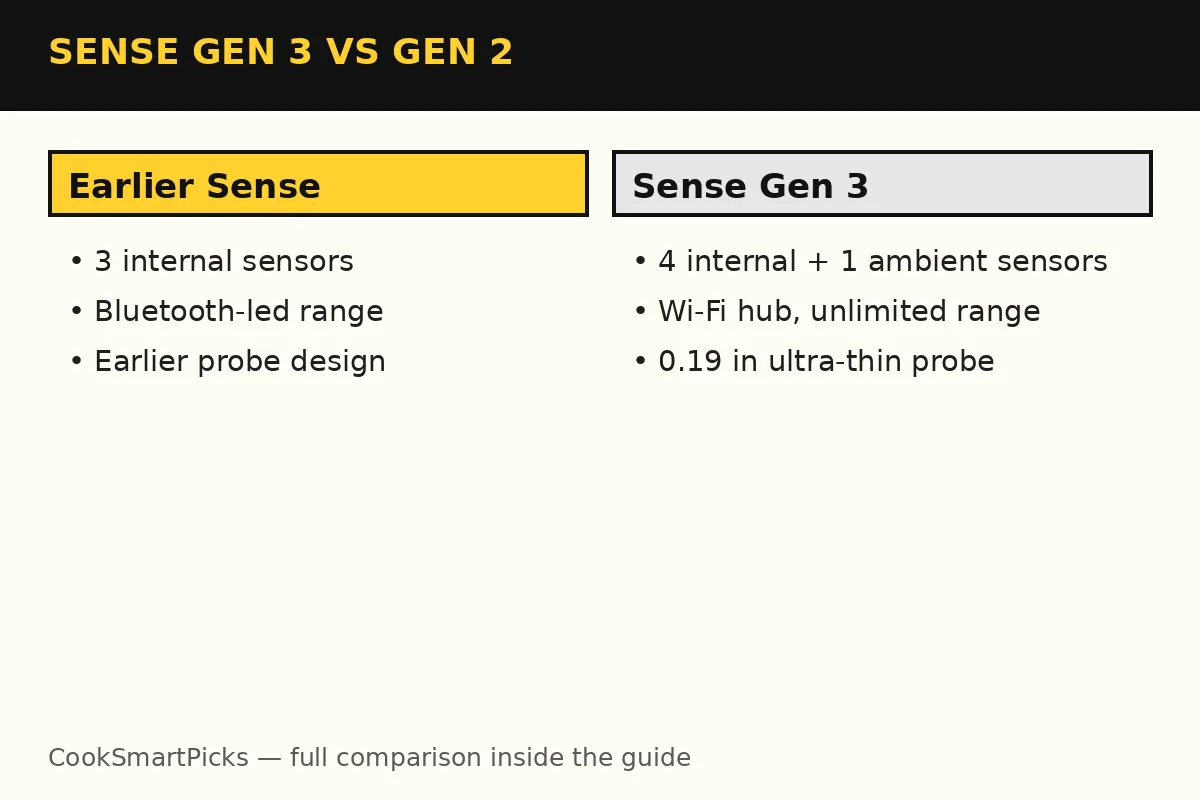
Sense Gen 3 vs earlier Sense
| Feature | Sense Gen 3 | Earlier Sense |
|---|---|---|
| Sensors per probe | 5 (4 internal + ambient) | 3 internal class |
| Heat rating | 1,000F ambient | Lower earlier rating |
| Connectivity | Wi-Fi hub + Bluetooth | Bluetooth-led |
| Hub | Speaker alerts, USB-C | Earlier hub design |
| Kits | 1 to 4 probes | 1 to 2 probes typical |
Pros and cons
Sense Gen 3 · Pros
- Monitor from anywhere over Wi-Fi
- Five sensors find the cold spot reliably
- 1,000F rating survives searing with the probe in
- Guided cooking suits newer cooks
Sense Gen 3 · Cons
- No display on the hub — phone required
- Some owner reports of drift and hub dropouts
- Signal can struggle inside thick grill lids
Best for: cooks who leave the house mid-smoke. Skip if: you want a screen at the grill.
Single-probe kit
Start with one probe for weeknight cooking; multi-probe kits suit big barbecue days.
FAQs
How is the Sense Gen 3 different from earlier models?
Sensor count and connectivity: Gen 3 carries five sensors per probe (four internal, one ambient) versus three internal on earlier versions, and centres on a Wi-Fi hub for unlimited range. Check the listing's sensor count before buying — both generations circulate.
What is the CHEF iQ Sense heat limit?
The probes are rated to 1,000F ambient, so they can remain in meat during high-heat searing — unusual among wireless probes.
Does the Sense work without Wi-Fi?
Locally over Bluetooth through the hub, yes; the unlimited anywhere range needs the hub on your Wi-Fi. There is no display on the hub, so the phone app is always part of the system.
How do I check a Sense probe's accuracy?
Stir a glass of ice water and confirm the probe reads near 32F before an important cook — the standard check independent round-ups recommend for all wireless probes, given some owner reports of drift.
Sources
Specs in this guide are the manufacturers' published figures as reported by the sources below; where testers disagree with a maker's claim, the guide says so. We do not print prices — use the buttons above for the live price in your marketplace.
- Protein Pan — ThermoMaven vs CHEF iQ — Spec verification: Gen 3 listed March 2025, 5 sensors, 1000F, Wi-Fi hub behaviour and owner reports.
- Best Wireless Thermometers compared — Typhur vs MEATER vs CHEF iQ — Signal testing in pots and grills, 0.19 in probe, spoken-alert hub, accuracy statements.
- Chili Cravings — Best Wi-Fi thermometers for smokers — Sense kit detail: four-probe options, guided recipes, 50-hour battery claim.
Last updated: November 20, 2026. We refresh this guide whenever the makers revise these products.