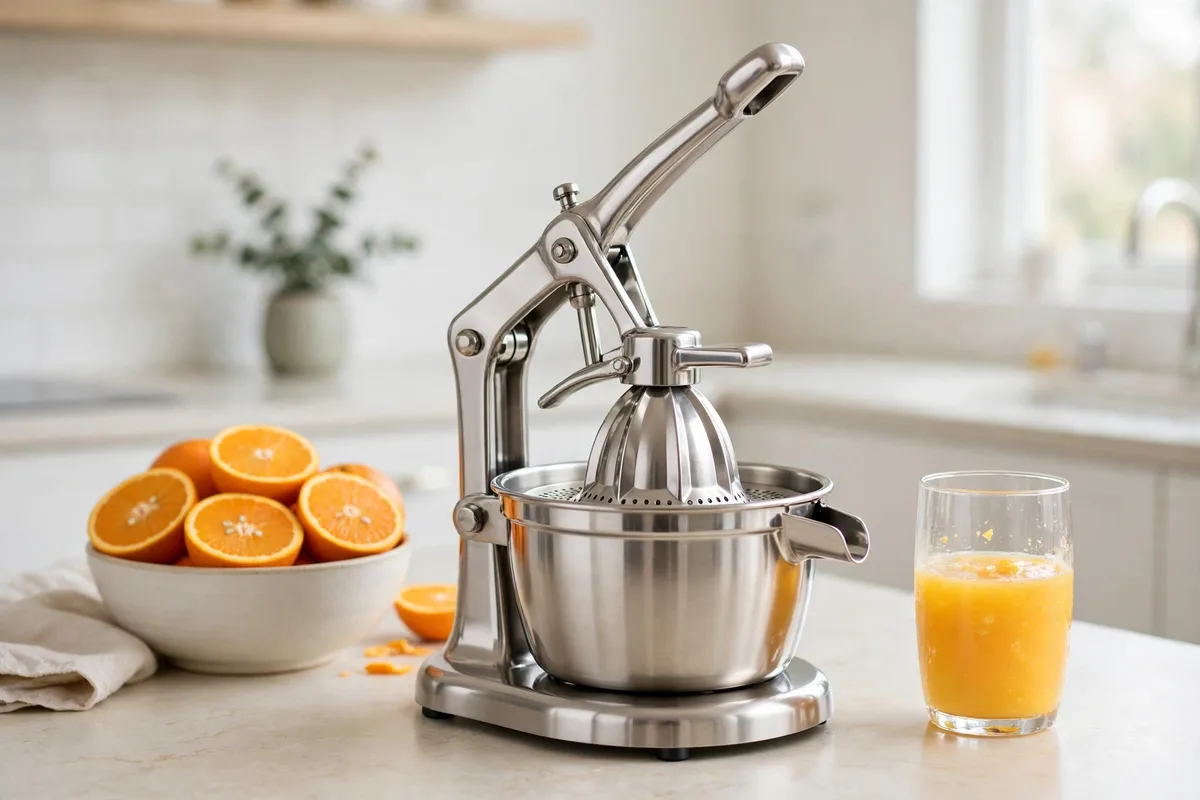
The best citrus juicer is the one that gets a halved orange out of your hands and into a glass in under a minute, without leaving the counter sticky or your wrist aching. That sounds simple, but the category splits into two genuinely different machines: lever presses that squeeze the fruit for you, and spinning reamers you push the fruit onto yourself. They differ in effort, in how much pulp reaches the glass, in how well a grapefruit fits compared with a lime, and in how many parts land in the sink afterwards — and those four differences, not wattage, are what this guide compares.
One boundary first, because listings blur it constantly: a citrus juicer presses halved citrus, and nothing else. It will not juice kale, ginger or a carrot, and it is not a slow masticating machine. If your juice habit runs beyond citrus, the best cold-press juicers in Canada and the USA guide covers that different appliance class. This guide is for households whose juice is oranges at breakfast, lemons for cooking, limes for drinks and the occasional grapefruit — and who want that one job done with the least effort and the least washing up.
The five picks below run from a die-cast lever press that does the pushing for you, through a stainless mid-priced motorized press, a pitcher-style budget machine with a real pulp dial, a retro counter piece, and a small, quiet direct-to-glass reamer for one or two people. Every specification is the manufacturer’s published figure, pulp claims are read literally — a strainer is not a pulp dial — and where two listings for the same model disagree, the disagreement is printed rather than smoothed over.
Disclosure: CookSmartPicks is reader-supported. When you buy through links on this page, we may earn an Amazon commission at no extra cost to you. Prices and availability change often — check the current price on Amazon before you decide.
The short answer
For daily juicing, the Breville Citrus Press Pro’s lever arm does the pressing for you and earns the top spot. The Eurolux ELCJ-1700 brings a similar press-handle idea in stainless at a mid price, and the BLACK+DECKER CJ650W is the budget pick with a 32-ounce pitcher and a genuine adjustable pulp lever.
How we chose these citrus juicers
CookSmartPicks is a research-based guide; we do not claim hands-on testing we have not done. For this list we compared manufacturer specifications and manuals — pressing mechanism, cone and ream sizing, pulp-control method, spout design and the count of removable parts — against independent roundups and verified owner reports from Canada and the USA. Mechanism came first: a lever press and a push-down reamer are different purchases wearing the same name, so each pick below is labelled by how it actually extracts, and no pick earns a pulp-control credit for a fixed strainer.
Three honesty filters shaped the final five. The first is pulp language: only a model that changes the hole size, swaps filters or moves a lever gets described as adjustable; the rest are described as strainers, because that is what they are. The second is cone fit: we checked how each model handles the two ends of the fruit bowl — a key lime and a full grapefruit — since a universal cone that suits oranges can under-extract both. The third is the cleanup count: every removable part is named, because the juicer that takes four pieces to the sink gets used on a Tuesday and the one that takes eight quietly stops being used at all. Models sold only in one country, and manual squeezers (a different class), were cut.
The lineup at a glance
| Product | Best for | Why it stands out |
|---|---|---|
| Breville Citrus Press Pro 800CPXL | Best overall | A power-assisted lever press with a Quadra-Fin cone — the machine does the pushing |
| Eurolux Electric Citrus Juicer ELCJ-1700 | Best value motorized | A stainless press-handle machine with a 160-watt motor (manual figure) at a mid price |
| BLACK+DECKER 32oz Citrus Juicer CJ650W | Best budget | Juices into its own 32-ounce pitcher with a real adjustable pulp lever |
| Smeg CJF11 Citrus Juicer | Best style | Die-cast aluminium 1950s retro design with a stainless reamer — the counter piece that also juices |
| Tribest CitriStar CS-1000 Citrus Juicer | Best quiet compact | A small, quiet 50-watt reamer with two ream sizes and a locking stainless spout |
1. Breville Citrus Press Pro 800CPXL — Best overall
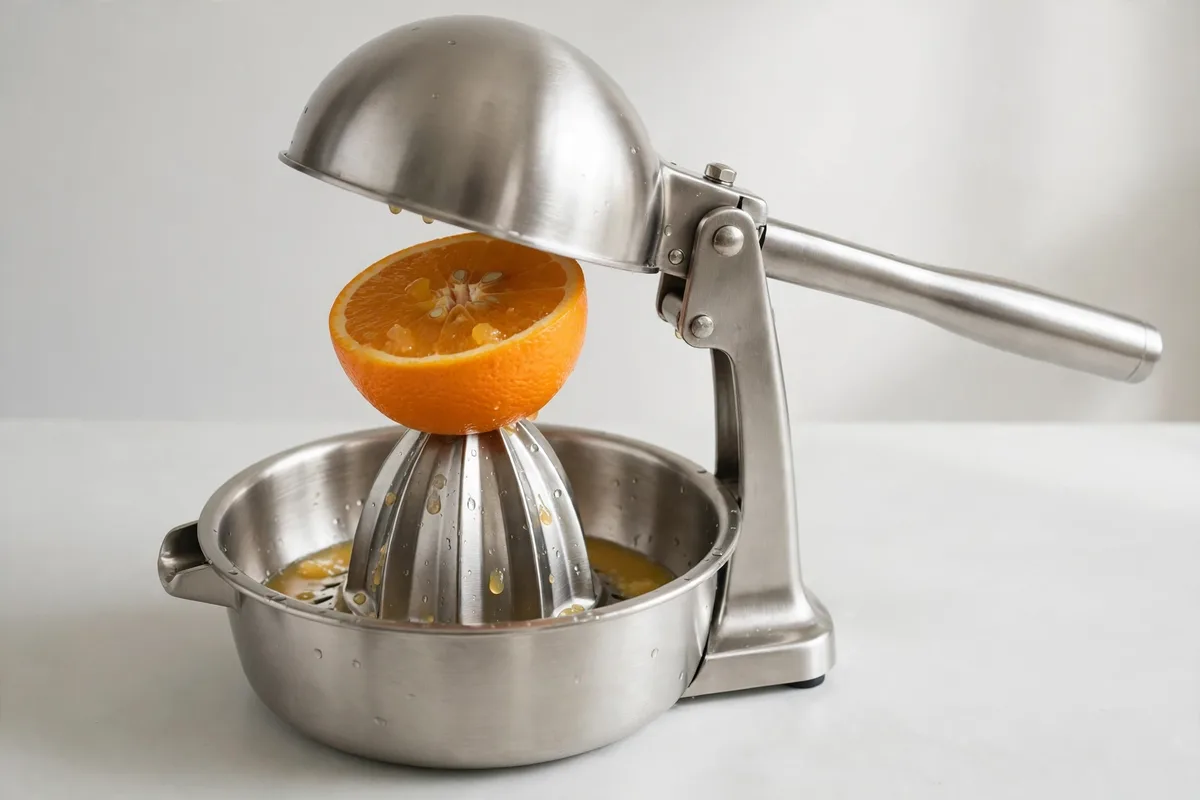
The Citrus Press Pro is the only true lever press in this guide, and the mechanism is the whole argument for it. You halve the fruit, set it on the stainless Quadra-Fin cone, and pull the soft-grip arm down; a triple-hinged, power-assisted lever keeps pressure even through the stroke while a fruit dome centres the half on the cone. Your hand guides rather than pushes, which is why this is the pick for daily juicing, for batch juicing for a family, and for anyone whose grip strength makes push-down reamers a short-lived experiment. Breville rates the motor at 110 watts in its published specifications — one retailer listing says 100 watts, a difference that changes nothing in use, because on a press the lever does the work.
Pulp control here is real but coarse, and it works by hardware rather than a dial: two interchangeable stainless steel filters, fine and coarse, swap by hand depending on how smooth you want the juice. The cone itself is die-cast and acid-resistant per Breville, sized — per the maker — for everything from the smallest lime to the largest grapefruit, so there are no cone swaps between fruits. A drip-stop spout flips up to hold juice back between glasses, which matters more than it sounds when the machine lives on the counter over a glass rather than over its own pitcher.
The ownership costs are size and parts. At roughly 16 inches tall with the arm raised (about 408 mm in the published dimensions), it wants to be pulled out from under low cabinets before use, and the removable stack — cone, collector, filter, dome and spout — is the longest wash list in this guide, though everything except the motor base is dishwasher-safe per Breville. Owners consistently praise the yield and the quiet, unhurried feel of the press, and just as consistently mention the footprint.
Yay · Pros
- Lever does the pressing — the lowest-effort extraction here, and the kindest to wrists
- One Quadra-Fin cone covers limes to grapefruit per Breville — no cone swaps
- Two interchangeable stainless filters give genuine, if coarse, pulp choice
- Drip-stop spout and die-cast, acid-resistant build for daily counter life
Hmm · Cons
- Tall with the arm raised — measure the space under your cabinets first
- The longest parts list to wash of any pick here
- Pulp choice is a filter swap, not a dial you can nudge mid-batch
Best for: daily juicers, families juicing by the pitcher, and anyone who wants the machine — not their arm — to do the pressing. Skip if: you juice a single glass twice a week; the smaller reamers below do that job with half the footprint.
2. Eurolux Electric Citrus Juicer ELCJ-1700 — Best value motorized
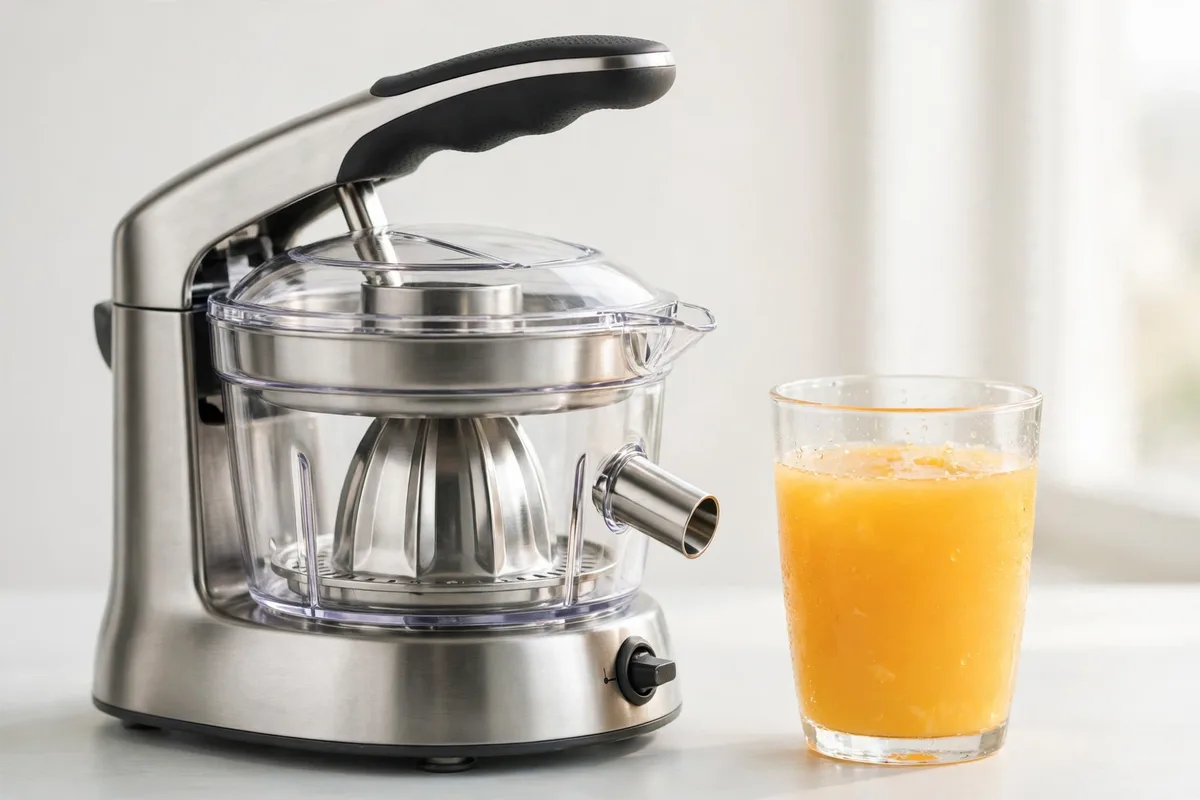
The Eurolux takes the press idea down a price tier: a brushed stainless steel body, a universal juicing cone, and a soft-grip press handle you push down over the fruit while the motor turns the cone. The manual for the ELCJ-1700S specifies a 160-watt motor at 110 volts; some current listings for newer versions of this juicer quote 120 watts, so treat the exact figure as version-dependent — either way, it is among the stronger motors in this class, and Eurolux describes the operation as automatic start and stop, with the cone turning as you press and stopping when you release. Suction-cup feet hold the base in place while you work.
On pulp, read the listing the way this guide does: the Eurolux has an integrated stainless filter that traps seeds and pulp for a smooth glass. That is a strainer doing its job well — it is not an adjustable pulp dial, and households split between smooth and extra-pulpy juice should know the texture here is fixed on the smoother side. The anti-drip spout flips up to stop the flow, and juice can collect in the removable container or run straight into a glass under the spout.
Cleanup is the mid-pack story: the cone, pulp filter and juice collector come off and are dishwasher-safe per the manual, and the press handle lifts away for washing — fewer pieces than the Breville, more than the two-part budget machines. Owner reports centre on value: stainless construction and press-handle ease at a mid price, with the recurring notes being the fixed pulp texture and the need to press firmly on large grapefruit halves, where a universal cone meets its size limit.
Yay · Pros
- Press handle plus motor: much less hand effort than a push-down reamer
- Stainless steel housing, cone area and filter — no plastic juice path worries
- Anti-drip flip spout and suction-cup feet for a tidy, steady counter session
- Removable parts are dishwasher-safe per the manual
Hmm · Cons
- Pulp control is a fixed strainer, not an adjustment — texture runs smooth
- Wattage differs between versions and listings (120 W vs the manual’s 160 W)
- Universal cone works hardest on the largest grapefruit halves
Best for: households that juice most days and want press-handle ease and stainless build without flagship size or cost. Skip if: your household argues about pulp levels; the adjustable lever on the budget pick below settles that argument better.
3. BLACK+DECKER 32oz Citrus Juicer CJ650W — Best budget
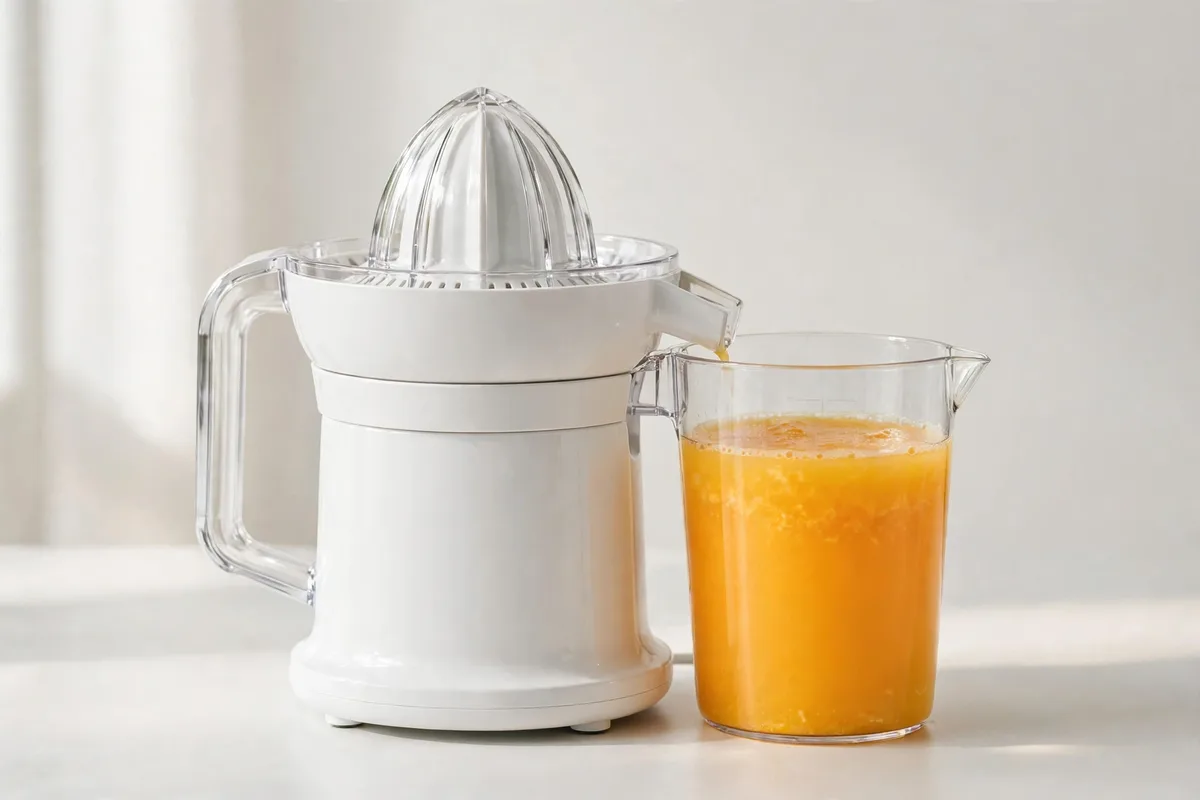
The CJ650W is the budget pick that refuses to behave like a compromise on the two things budget juicers usually drop: batch size and pulp choice. It juices into a clear 32-ounce pitcher — a quarter-gallon, with measurement markings from 4 to 32 ounces — that lifts off and pours at the table through a drip-free spout, so a family batch is juiced once rather than glass by glass. The 30-watt motor is pressure-activated: press the fruit down and it runs, lift and it stops. Nobody should buy a citrus juicer on wattage; the cone design and the reversing action matter, and both are present here.
The pulp control is the headline feature at this price: a simple lever on the strainer adjusts how much pulp passes into the pitcher, which makes this — not the pricier strainer-only models — the pick for households where one person wants smooth juice and another wants it chewy. The dual-purpose cone is self-reversing, changing direction with each press to work the fruit from both sides, and it is shaped to handle large fruit like grapefruit as well as lemons and limes on the same cone. Pulp collects in the strainer, where the maker notes it can be kept for baking rather than binned.
The trade-offs are materials and feel. The body and pitcher are plastic, the machine is light enough to shift on the counter if you press off-centre, and a 30-watt reamer asks for a few more seconds per half than the stronger motors here. Against that, the cleanup count is the shortest here alongside the Tribest: cone, strainer and pitcher, all dishwasher-safe, plus a storage cover and in-base cord storage. For a first citrus juicer or a cook who juices by the measured pitcher, it is the easiest recommendation in the list to defend.
Yay · Pros
- Adjustable pulp lever — genuine pulp choice at a budget price
- 32-ounce pitcher with measurements: juice once, pour at the table
- Self-reversing dual-purpose cone handles small and large citrus
- Shortest cleanup list here, all dishwasher-safe, with cord storage
Hmm · Cons
- Plastic build and light weight — steady it with one hand on big fruit
- 30-watt motor is slower per half than the stronger picks
- Pitcher is one more part to wash when you only wanted a single glass
Best for: budget buyers, families juicing by the pitcher, and mixed-pulp households that need the adjustment more than the metal. Skip if: you want a machine that lives beautifully on the counter for a decade; the stainless picks above are built for that.
4. Smeg CJF11 Citrus Juicer — Best style
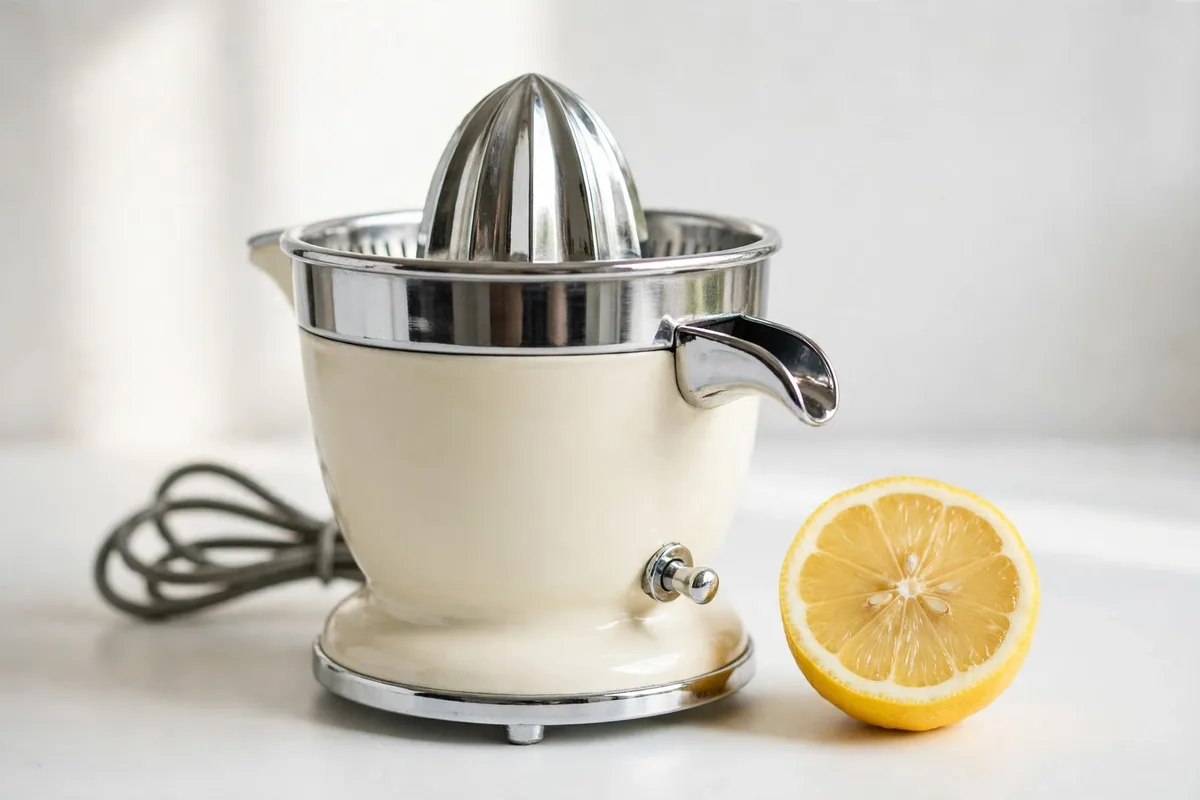
The Smeg is bought with the eyes first, so let us be precise about what the eyes are getting: a die-cast aluminium body in Smeg’s 1950s retro styling, offered in a range of colours, with a universal reamer and strainer in anti-corrosive stainless steel and a pop-up anti-drip spout, also stainless. The lid and juicing bowl are Tritan Renew — a material Smeg specifies as containing 50 percent certified recycled content — and the lid doubles as a bowl for fruit and peel while you work. It is the only pick here designed to be looked at between uses, and it is honestly built underneath the styling: the metal body gives it a planted, quality feel that plastic machines do not imitate.
The juicing itself is a straightforward push-down reamer: a 70-watt motor with a built-in sensor starts when you press fruit onto the reamer and stops when you lift off, turning one way (anti-clockwise). Juice dispenses directly into a glass under the spout — there is no pitcher — and the spout pops up to stop drips. Two honest limits follow from that simplicity. There is no pulp adjustment: the stainless strainer sets the texture. And a single-direction 70-watt reamer is a gentler extractor than the lever press or the reversing cones, so expect to leave a touch more juice in the rind on the largest fruit.
Where the Smeg wins its place is the daily countertop reality for a lot of kitchens: the juicer that stays out gets used, and this is the one designed to stay out. Cleanup is short — reamer, strainer, bowl and lid — and the North American version runs on 120 volts, so check the model suffix when ordering, since European CJF11 listings are 220–240 volt machines. Buy it as a design object that juices properly, not as the extraction champion.
Yay · Pros
- Die-cast aluminium retro body in multiple colours — made to live on the counter
- Stainless steel reamer, strainer and anti-drip spout
- Automatic start/stop pressure sensor — no switches to manage
- Short parts list; reamer and strainer are dishwasher-safe per Smeg
Hmm · Cons
- No pulp adjustment — the strainer sets one texture
- Single-direction 70 W reamer is the gentlest extractor here
- You are paying for design; extraction per dollar trails the picks above
Best for: style-led kitchens where the juicer lives on display, and one-or-two-glass juicing is the normal job. Skip if: you juice by the pitcher or want pulp control; the BLACK+DECKER and Breville serve those needs directly.
5. Tribest CitriStar CS-1000 Citrus Juicer — Best quiet compact
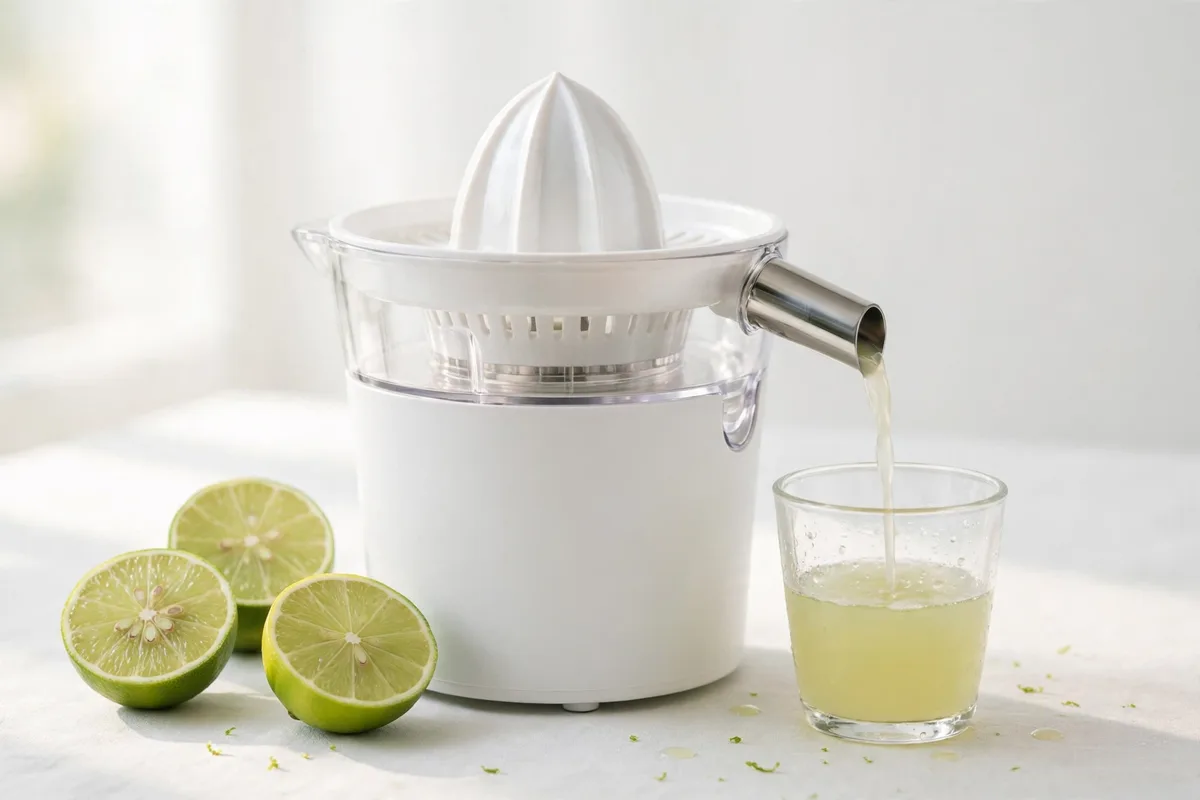
The CitriStar is the small-kitchen answer: an 8 by 8 by 9.5-inch footprint (Tribest’s published dimensions), a 50-watt motor the maker describes as quiet yet powerful, and a design that juices straight into your glass with nothing in between. Tribest’s own emphasis is on not stalling — the maker notes it does not stop when you push firmly on the ream, a real annoyance on small reamers that cut out under pressure — and on a sloped collector that keeps juice moving toward the spout. For one or two people juicing a glass at a time, this directness is the whole appeal: fruit, glass, drink, rinse.
Cone fit is where this small machine out-thinks bigger ones. It ships with a small ream and a ream cap that converts it for large fruit, so limes and lemons get a ream their size — which genuinely extracts more from small fruit than a big universal cone skating inside the rind — and grapefruit gets the full-size cap. The strainer and the high-clearance spout are stainless steel; the spout locks up to stop drips and sits high enough to fit a tall glass and to resist the clogging that plagues low spouts on pulpy fruit. The reams and body are BPA-free per Tribest.
The limits are scale and texture. There is no pitcher and no pulp adjustment — the stainless strainer sets a fairly smooth texture — and a household juicing for four will feel the one-glass-at-a-time rhythm. Cleanup, though, is the shortest in this guide: ream, strainer and collector, with a cord wrap underneath for drawer storage, and Tribest backs it with a 1-year household warranty per the maker page.
Yay · Pros
- Smallest footprint here, with cord wrap for drawer storage
- Two ream sizes — small fruit gets a properly sized ream, not a compromise
- Stainless locking spout sits high, resists clogs and stops drips
- Quiet-running 50 W motor per Tribest; does not stall under firm pressure
Hmm · Cons
- One glass at a time — no pitcher for family batches
- No pulp adjustment; the strainer sets the texture
- Plastic reams and body, where the Breville and Smeg use metal
Best for: small kitchens, one-or-two-person households, and anyone who juices a single glass straight, quietly, every morning. Skip if: you juice for a family at once; the pitcher and lever picks above match that rhythm better.
Lever press vs spinning reamer: what actually gets the juice out
Every electric citrus juicer in this guide does the same chemistry — rupturing the juice vesicles inside a halved fruit — by one of two mechanics, and the mechanic decides effort, yield and even flavour. A spinning reamer (the Eurolux, BLACK+DECKER, Smeg and Tribest) grinds the cone’s fins through the flesh while you supply the downward pressure. A lever press (the Breville) keeps the same cone but replaces your arm with a hinged lever and dome, so pressure is higher, more even, and sustained through the whole stroke without your wrist in the equation. That is why the press feels effortless on the twelfth half and the reamer does not.
Yield differences are real but smaller than marketing suggests, and they concentrate at the edges of the fruit bowl. On a standard orange, a decent reamer and a press finish within a spoonful of each other. The press pulls ahead on grapefruit, where its dome holds a wide half centred and squeezes the outer vesicles a hand-pressed reamer tends to leave, and reversing reamers — the BLACK+DECKER’s cone changes direction with each press — close much of the gap on ordinary fruit by working the flesh from both directions. Extraction still follows cone fit, which is why the Tribest’s two ream sizes matter out of proportion to its size.
Flavour is the honest counterweight to maximum pressure. The white pith and the membranes carry the bitter compounds, and pressing harder — by lever or by leaning on a reamer — extracts more of them along with the last of the juice. The technique is the same on every machine here: press until the juice runs clear and slows, then stop. The glass gained by grinding a rind to paste is a bitter glass — which is why this guide does not rank on raw squeezing force.
Choose the press if juicing is daily, batched, or hard on your hands; choose a reamer if it is a glass at a time and counter space is the scarce resource. And keep the class boundary clear in both directions: none of these machines touches what the best cold-press juicers in Canada and the USA do with leafy greens and hard produce, and no cold-press machine matches a citrus reamer’s thirty-second, two-part-cleanup orange juice. They are neighbours on the counter — the best blenders and mixers in Canada and the USA often sit beside them — not substitutes for each other.
Pulp control, cone fit and the cleanup count: the specs that decide daily use
Pulp is where citrus listings stretch language furthest, so here is the honest taxonomy. A true adjustment changes how much pulp passes while you juice: the BLACK+DECKER does it with a lever that changes the strainer’s effective hole size, and the Breville does it with two interchangeable stainless filters, fine and coarse — real control, delivered as hardware. A fixed strainer, however good, is not control: the Eurolux, Smeg and Tribest strainers trap seeds and most pulp and deliver a consistently smooth glass. Neither answer is wrong. What is wrong is a listing that calls a strainer “pulp control,” and it is why each pick above is labelled with the mechanism, not the marketing phrase.
Cone fit is the second silent spec. A lime on a grapefruit-sized cone gets its flesh skimmed; a grapefruit on a small cone leaves a ring of unjuiced vesicles around the edge. The category’s answers, in order of fit: two dedicated ream sizes (Tribest), a finned cone shaped to centralise any half under a dome (Breville), a dual-purpose reversing cone (BLACK+DECKER), and one-size universal cones (Eurolux and Smeg) that handle the middle of the range best. If your juicing is mostly lemons and limes for cooking, fit at the small end matters more to your yield than motor size does.
Then count the cleanup, because that is the spec that decides whether the machine is used in month six. From shortest to longest: the Tribest’s ream, strainer and collector; the BLACK+DECKER’s cone, strainer and pitcher; the Smeg’s reamer, strainer, bowl and lid; the Eurolux’s cone, filter, collector and press handle; and the Breville’s cone, collector, filter, dome and spout assembly. Every one of those parts is dishwasher-safe on its model per its maker, except the motor bases, which never wash. A thirty-second rinse straight after juicing beats any dishwasher cycle, because dried citrus pulp sets like glue — the habit matters more than the parts count, but the count sets how heavy the habit feels.
Two smaller features repay attention while you compare. A drip-stop or locking spout — present on the Breville, Eurolux, Smeg and Tribest — is the difference between a machine that can live over a glass on the counter and one that leaves a ring under itself daily. And check where the juice lands: a pitcher machine suits recipes and families, a direct-to-glass machine suits a single morning glass. Match pulp mechanism, cone fit and delivery to your actual fruit and your actual mornings, and any of the five will serve — the best electric kettles in Canada and the USA can handle the tea while you juice.
Citrus juicer questions, answered
Is a citrus juicer the same as a cold-press juicer?
No — they are different appliance classes. A citrus juicer presses halved citrus fruit on a cone and does nothing else; a cold-press (masticating) juicer slowly crushes whole produce — greens, ginger, carrots, apples — through an auger. If your juice is only citrus, the citrus machine is faster, cheaper to run and far quicker to clean. If you juice beyond citrus, you need the other class; our cold-press guide covers it.
Can these juicers handle grapefruit as well as limes?
Yes, with fit caveats. The Breville’s single finned cone and dome are sized per the maker from limes to the largest grapefruit, and the Tribest swaps between a small ream and a large ream cap for the two extremes. Universal cones on the Eurolux and Smeg handle both, working hardest on the very largest grapefruit halves. The honest rule: the closer the cone matches the fruit, the more complete the extraction.
Can I get completely pulp-free juice?
Very close, on the strainer-style models. The Eurolux, Smeg and Tribest strainers trap seeds and most pulp for a smooth glass, and the Breville’s fine filter is its smoothest setting. Truly laboratory-smooth juice still takes a final pour through a kitchen strainer — a ten-second step no machine in this class fully replaces, whatever the listing implies.
Why does my juice sometimes taste bitter?
Bitterness comes from the pith, not the juice. Pressing harder or longer — especially grinding the half down to the rind — extracts bitter compounds from the white pith and membranes. Press until the juice runs clear and slows, then stop, on any machine. Room-temperature fruit also yields more juice with less pressure than fridge-cold fruit, which reduces the temptation to over-press.
Are the parts dishwasher-safe?
On all five picks, the removable juicing parts are dishwasher-safe per their manufacturers — cones, reams, strainers, filters, collectors and pitchers. Motor bases are never immersed; they wipe clean. The practical advice from owner reports is consistent: a quick rinse immediately after juicing stops pulp drying onto strainers, which is where most cleaning complaints in this category actually come from.
Electric citrus juicer or a manual squeezer — which is worth it?
It depends on volume and frequency. A manual squeezer is unbeatable for a lemon here and there: no parts, no counter space, nothing to wash beyond one piece. Electric earns its place when juicing is daily, batched for several people, or hard on your hands — that is the lever press’s whole case. Juicing a glass most mornings makes electric pay for itself in effort quickly.
The short version
Short on time? Buy the Breville Citrus Press Pro if citrus is a daily habit — its lever does the pressing and its two filters give real pulp choice. Buy the Eurolux ELCJ-1700 for the same press-handle idea in stainless at a mid price, the BLACK+DECKER CJ650W for a pitcher and a genuine pulp lever on a budget, the Smeg CJF11 if the machine is part of the kitchen’s look, and the Tribest CitriStar for a small, quiet glass-at-a-time routine. If your juicing runs beyond citrus, start with the best cold-press juicers in Canada and the USA instead.
Sources
This guide is research-based: we compared manufacturer specifications with the independent testing and reporting below, cross-checked against verified owner reports in Canada and the USA. Specs are the manufacturers’ published figures; where testers disagree with a maker’s claim, the review says so.
- Breville — Citrus Press Pro 800CPXL specification sheet — Maker’s published figures for the Quadra-Fin cone, active-arm press, drip-stop spout and stainless filter.
- Eurolux — ELCJ-1700 Premium Electric Orange Juicer manual (Manuals+) — Manual specifications: 160 W motor at 110 V, stainless construction, pulp filter, dishwasher-safe removable parts.
- The Home Depot — BLACK+DECKER CJ650W product record — Retailer specification record: 32-ounce pitcher, adjustable pulp control, self-reversing dual-purpose cone, 30 W.
- Rackhams — Smeg CJF11 Retro Citrus Juicer specifications — Specification listing: 70 W motor, stainless universal reamer and strainer, Tritan Renew lid and bowl, anti-drip spout.
- Tribest — CitriStar CS-1000-A official product page — Maker’s page: 50 W quiet motor, small and large reams, stainless strainer and locking spout, 1-year household warranty.
- Best Cast Irons — Best Citrus Juicer Reviews (2026) — Independent research-based roundup cross-checking maker manuals and listing records across seven electric citrus juicers, printing conflicting figures where records disagree.
Last updated: November 20, 2026. We refresh this guide each season and whenever a pick is replaced by a better one.