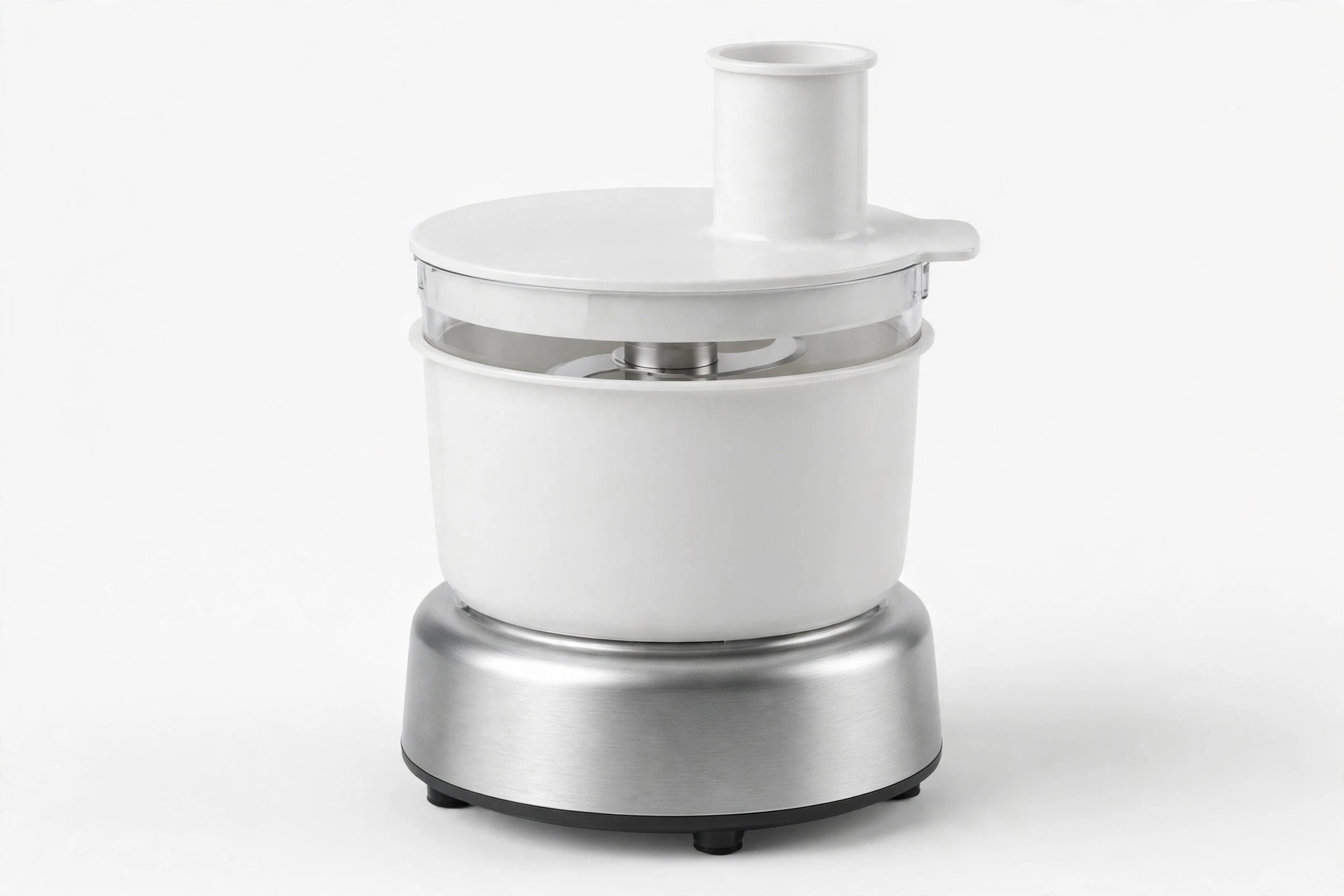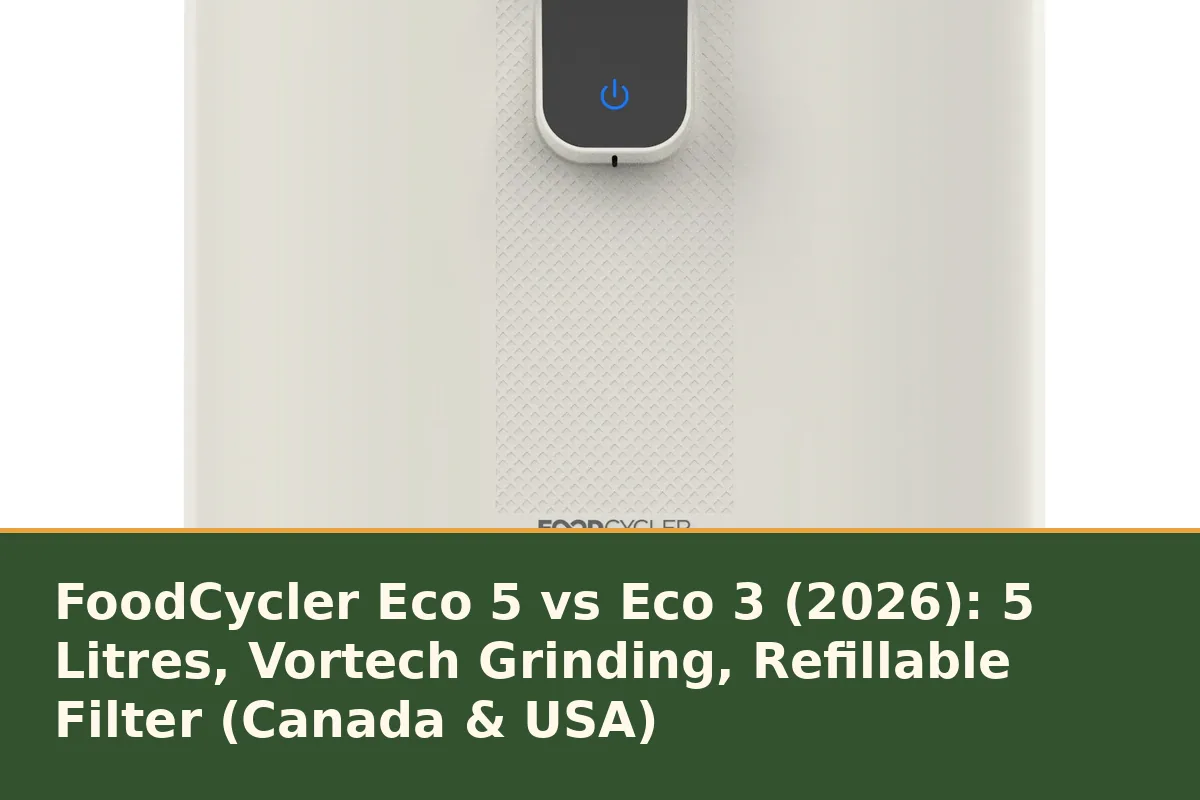
The FoodCycler Eco 5 is the large model in Food Cycle Science's countertop recycler line, sold with Vitamix in North America: a removable 5-litre bucket of scraps is dried and ground by the Vortech system into a fine, dry by-product in 4 to 9 hours, reducing volume by up to 90 percent, with a refillable carbon filter controlling odour and about 1.5 kWh used per cycle. One button runs the whole cycle. Like every machine in this class — the Mill in our Mill guide and the Lomi in our Lomi 3 guide — the output is honestly a soil amendment or pre-compost, not finished compost, and this guide keeps that framing.
Key takeaways: the Eco 5 doubles the old FC-50's 2.5-litre bucket, grinds finer with stacked arms, and replaces disposable filter cartridges with one refillable canister you top up every 3 to 4 months. It is a one-touch appliance with no app — simplicity is the point.
Eco 5 vs Eco 3: size is the decision
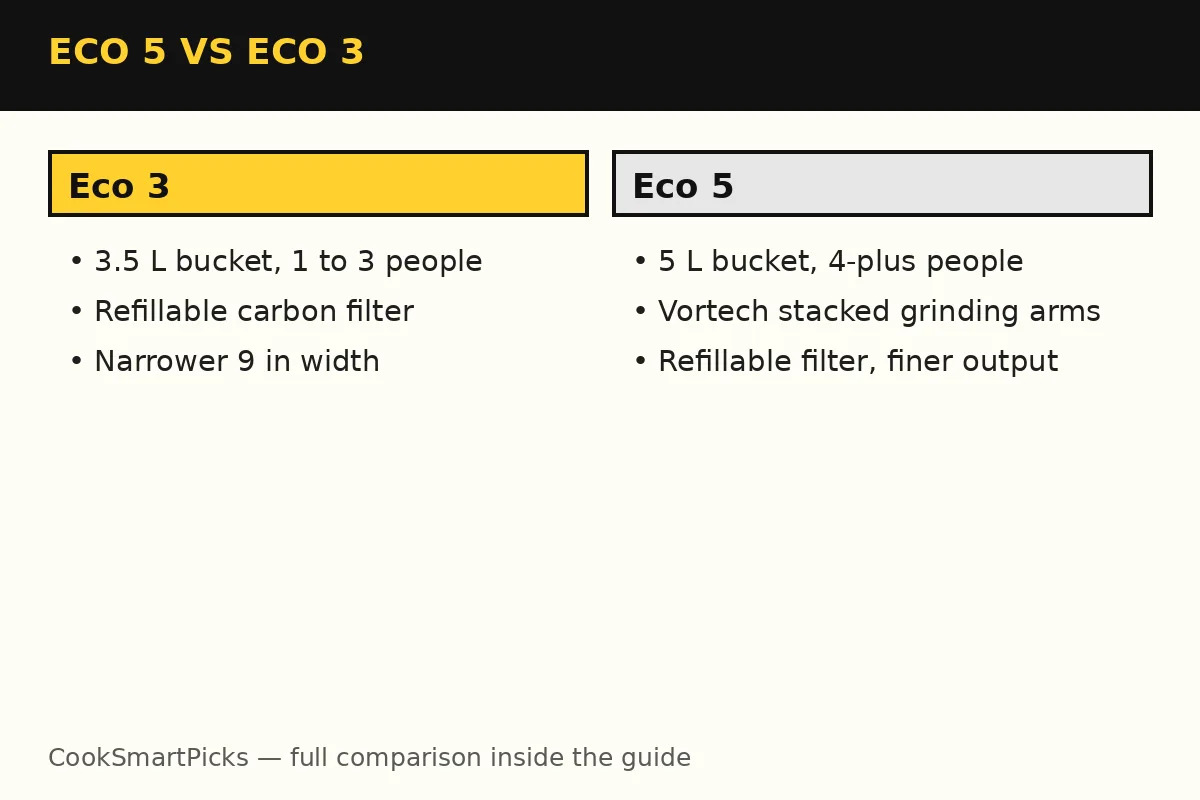
The Eco 3 serves 1 to 3 people with a 3.5-litre bucket in a narrower body; the Eco 5 serves 4-plus with 5 litres. Both accept meat, fish, poultry and fish bones; beef bones, oils and most compostable plastics stay out, with dairy and hard pits in small amounts only. A quotable way to put it: the Eco 5 is a garbage can that does homework — scraps go in nightly and a cup of dry amendment comes out. The wider field is in our electric composter guide.
Eco 5 vs Eco 3
| Feature | Eco 5 | Eco 3 |
|---|---|---|
| Bucket | 5 L | 3.5 L |
| Household | 4-plus people | 1 to 3 people |
| Cycle | 4 to 9 hours, one touch | Similar one-touch cycle |
| Filter | Refillable carbon canister | Refillable carbon canister |
| Energy | About 1.5 kWh per cycle | Lower per smaller loads |
Pros and cons
Eco 5 · Pros
- Largest bucket in the line: fewer cycles for families
- Refillable filter cuts consumable waste and cost
- One-touch simple; bucket lifts out to the cutting board
Eco 5 · Cons
- About 30 lb and bulky on the counter
- Output is a soil amendment, not finished compost
- No app or cycle choices — one program only
Best for: families without municipal food-waste pickup. Skip if: your city collects scraps weekly.
The smaller Eco 3
Singles and couples get the same system in a narrower body with the Eco 3.
FAQs
Is FoodCycler output real compost?
No. The Eco 5 produces a dry, ground soil amendment (pre-compost). Mix it into soil, add it to an outdoor compost bin to finish, or dispose of it per local rules.
How long does an Eco 5 cycle take and cost to run?
Four to nine hours depending on load wetness, using about 1.5 kWh per cycle per FoodCycler — roughly a desktop computer running for the same period.
What cannot go in the Eco 5?
Beef bones, oils and fats, candy and gum, cardboard and most compostable plastics. Dairy, sauces, pork bones and hard pits are small-amounts only.
How often does the Eco 5 filter need refilling?
Every 3 to 4 months, or about 500 cycle hours, sooner if odours return. The canister is refillable with carbon pellets rather than replaced whole.
Sources
Specs in this guide are the manufacturers' published figures as reported by the sources below; where testers disagree with a maker's claim, the guide says so. We do not print prices — use the buttons above for the live price in your marketplace.
- Reviewed via Emerald — Vitamix Eco 5 FoodCycler review — Hands-on: 5 L capacity, 4 to 9 hour cycles, refillable carbon canister, honest not-compost framing.
- Best Utah Real Estate — Reencle vs FoodCycler vs GEME — Eco 5 detail: stacked grinding arms, finer output, filter refill cadence and energy use.
- Countertop Guide — FoodCycler Eco 5 vs Eco 3 specs — Side-by-side published specs: capacity, dimensions, weight and one-touch controls.
Last updated: November 20, 2026. We refresh this guide whenever the makers revise these products.