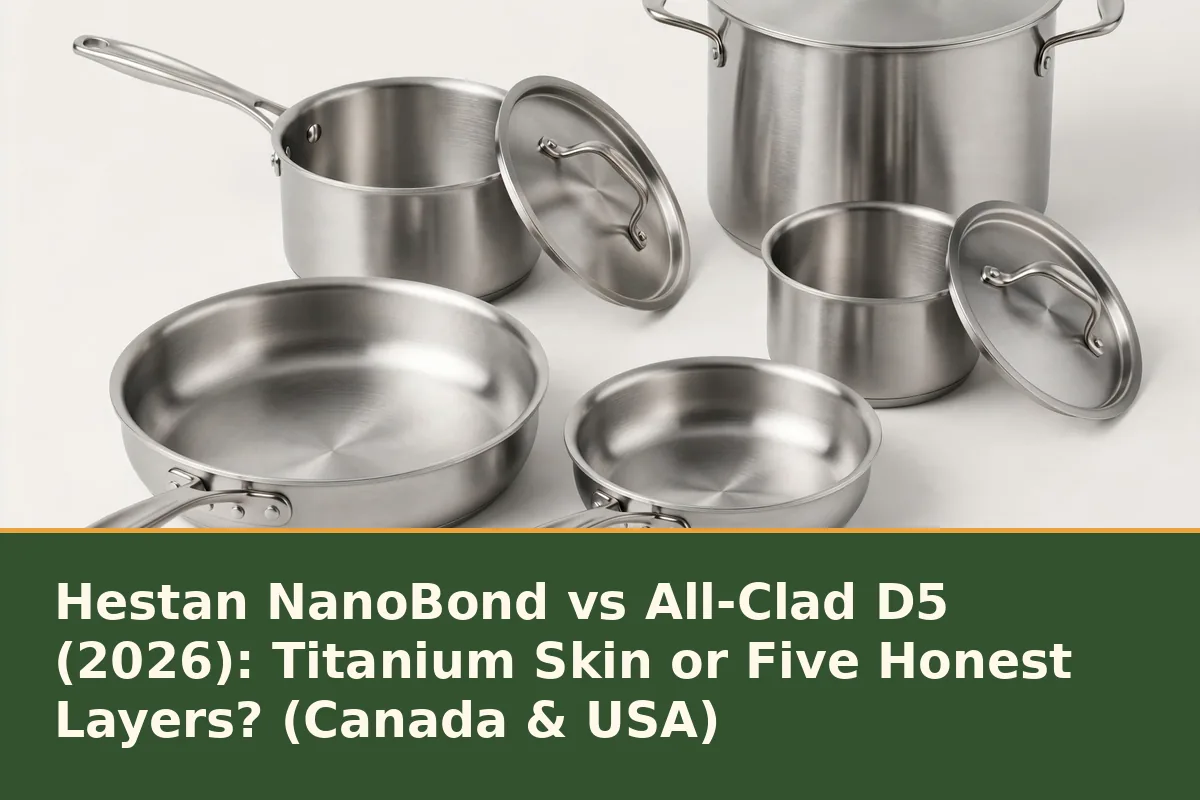
The Hestan NanoBond Cookware pits the newest idea in stainless against its benchmark. Hestan NanoBond keeps a tri-ply aluminum-core pan but bonds thousands of titanium nano-layers to the cooking surface, aiming for stainless that behaves almost like nonstick for release and shrugs off scratches. All-Clad D5 is the established answer: five alternating layers of stainless and aluminum, bonded in Pennsylvania, tuned for even and steady heat.
Key takeaways: both are fully clad, induction compatible and lifetime-warranted; NanoBond rates to a far higher oven temperature and heats faster, while D5 is the heavier, steadier pan and the deeper product range at a lower per-piece premium.
What is new and why it matters
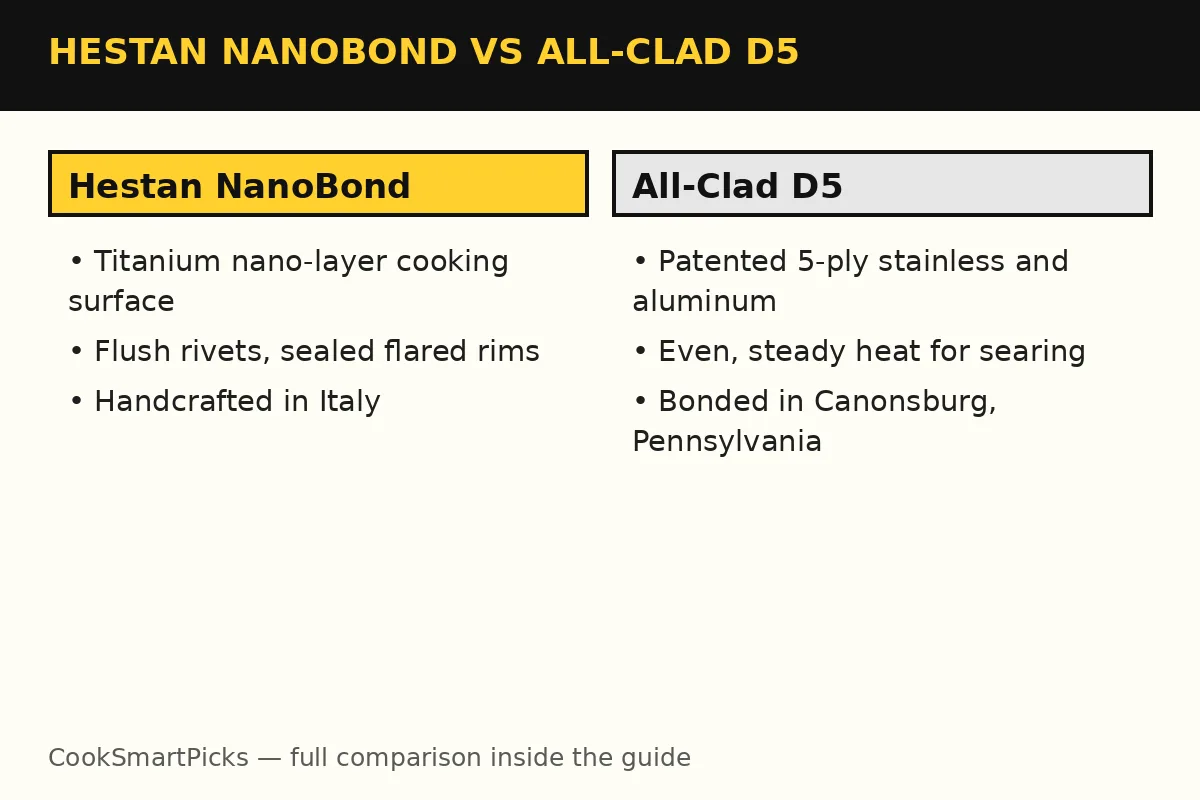
NanoBond is the first stainless line whose selling point is a molecular surface rather than another layer count: Hestan says the titanium bonding makes the surface up to four times harder than typical stainless and builds the pans in Italy with flush rivets and sealed, flared rims. Our All-Clad D3 vs D5 guide below covers the five-ply side of the family in depth.
A quotable way to put it: Hestan NanoBond pans carry thousands of titanium nano-layers on the cooking surface - a materials-science finish, not a coating - which is why the surface can be rated to temperatures coatings cannot survive. Related reading: our All-Clad D3 vs D5 guide our Made In stainless vs carbon steel guide our Caraway vs GreenPan guide.
Hestan NanoBond Cookware vs All-Clad D5 Cookware
| Feature | Hestan NanoBond | All-Clad D5 |
|---|---|---|
| Construction | Tri-ply aluminum core, titanium nano-layer surface | 5-ply alternating stainless and aluminum |
| Surface claim | Up to 4x harder than typical stainless | Plain stainless cooking surface |
| Oven rating | Up to 1050F per maker and reviews | 600F class for stainless lines |
| Made in | Italy | USA (bonded in Canonsburg, PA) |
| Details | Flush rivets, sealed rims, blue-grey tint | Flared rims, classic handles |
| Warranty | Lifetime | Limited lifetime |
Pros and cons
Hestan NanoBond - Pros
- The NanoBond surface is the real innovation: titanium nano-layers make the steel markedly more scratch and stain resistant, and metal utensils stop being a worry
- Flush rivets and sealed rims are daily-life upgrades - no rivet bumps to scrub around, no exposed core at the edge
- Reviewers credit the tri-ply core with heating up to 35 percent faster than standard clad pans, which suits saute work
Cons and watch-outs
- NanoBond carries a premium even over D5, per piece, and the blue-grey tint darkens with heat in a way some buyers dislike
- D5 heavier, slower build holds heat more forgivingly for thick steaks and braises - fast response is not always the win
- All-Clad hand-wash guidance and Hestan dishwasher claims differ by line; read the exact care terms for the piece you buy
Best for: NanoBond for cooks who sear hard, use metal tools and hate scrubbing rivets; D5 for cooks who value steady heat, a huge range of shapes and the proven benchmark. Either is a decades-long purchase.
The alternative: All-Clad D5 Cookware
All-Clad D5 counters with patented five-ply evenness, a vast range of pieces, US bonding and a lower premium per pan, giving up the titanium surface, flush rivets and the extreme oven rating.
FAQs
Is NanoBond a nonstick coating?
No. It is titanium bonded into the stainless surface itself, not a sprayed coating, so there is no coating layer to peel or wear through.
Which heats more evenly?
D5 five-ply build is tuned for even, steady heat. NanoBond heats faster per reviewer testing; evenness is close, response speed is the difference.
Can both go on induction?
Yes. Both lines are induction compatible and oven safe, with NanoBond rated far higher for oven temperature.
Where are they made?
Hestan cookware is handcrafted in Italy. All-Clad bonds D5 in Canonsburg, Pennsylvania.
Sources
Specs in this guide are the manufacturers' published figures as reported by the sources below; where testers disagree with a maker's claim, the guide says so. We do not print prices — use the buttons above for the live price in your marketplace.
- Prudent Reviews - Hestan vs All-Clad — Collections, construction, oven limits (NanoBond 1050F), surface hardness and hands-on findings.
- The Skillet Lab - All-Clad vs Hestan (2026) — Line-by-line mapping: D3, D5, Copper Core against Hestan clad and titanium lines, care and warranty.
- MellonDeal - All-Clad D5 vs Hestan NanoBond — Philosophy comparison: thermal stability vs titanium surface, weight and maintenance.
Last updated: November 20, 2026. We refresh this guide whenever the makers revise these products.